Bird Treats: A Reference Guide to Safe, Useful Rewards
Bird treats occupy an odd position in avian care. They are simultaneously one of the most useful tools an owner has and one of the most common sources of dietary harm. A single millet seed delivered at the right moment can teach a budgie to step onto a hand, while an unlimited honey-coated seed stick left clipped to the cage can contribute to obesity and fatty liver disease over months. The difference is not the treat itself but the quantity, frequency, and nutritional context.
Published guidance from avian veterinarians consistently frames treats as a small supplement to a complete diet, not a replacement for pellets, fresh vegetables, or formulated food. The Association of Avian Veterinarians owner resources and the Merck Veterinary Manual section on exotic and laboratory animals both emphasize that psittacine birds evolved to forage across varied terrain for most of their waking hours, and that captive diets high in fat and sugar are a leading cause of preventable disease. Treats can either support natural foraging behavior or undermine it, depending on how they are chosen and offered.
This guide covers what makes a treat appropriate for a given species, how to read a label, which formats support foraging and training, which foods are dangerous, and how to build a rotation that keeps a bird interested without unbalancing its nutrition. It is written for owners of parrots, parakeets, cockatiels, finches, canaries, and other companion birds.
Why Treats Matter Beyond Simple Rewards
In the wild, a parrot may spend four to seven hours a day locating, cracking, stripping, and consuming food. In a cage, that same bird may eat a bowl of pellets in fifteen minutes. The gap between those two realities is where behavioral problems live: screaming, feather plucking, bar chewing, and cage aggression are frequently linked to under-stimulation. A treat that requires work, such as a seed head that must be stripped or a dehydrated vegetable that must be shredded, restores a small piece of that foraging effort.
Treats also function as communication. In positive reinforcement training, a high-value food reward marks the exact moment a bird performs the desired behavior. The reward must be small enough to consume in one or two seconds so the bird can immediately repeat the behavior and earn another. A treat that takes thirty seconds to chew breaks the training loop and slows learning. This is why the same food can be excellent as enrichment and poor as a training reward, and vice versa.
Finally, treats are a social currency. Hand-feeding a favorite item is one of the most reliable ways to build trust with a nervous bird, and it is often the first step in taming a parent-raised or rehomed parrot. The treat is not nutritionally significant in that moment; its value is relational.
What to Look For in a Bird Treat
Ingredient lists on bird treats are often shorter than those on dog or cat products, but they still reward careful reading. The first three ingredients typically account for the majority of the product by weight. If sugar, honey, corn syrup, or a syrup-coated seed appears early, the product is primarily an energy source rather than a nutritional one. Artificial colors are unnecessary in avian products and are best avoided, particularly for species prone to obesity or metabolic issues.
Size matters as much as composition. A treat that is too large for a bird's beak will be dropped, crushed, or ignored, and a treat that is too small for a large parrot will be swallowed without any foraging value. Budgies, finches, and canaries need pieces roughly the size of a grain of rice for training and larger seed heads for foraging. Cockatiels and lovebirds handle small seeds and crumbled cakes. African greys, amazons, cockatoos, and macaws need larger nuts, chunks of dried vegetable, or whole seed heads to stay engaged.
Texture and format determine enrichment value. A soft, sugary stick that dissolves in seconds offers calories and little else. A hard, fibrous item that must be held, rotated, and stripped offers minutes of activity. Neither is inherently wrong, but they serve different purposes and should be selected accordingly.
Freshness is a practical concern that is easy to overlook. Seed mixes and dehydrated products absorb moisture from humid air and can develop mold, which is dangerous for birds with sensitive respiratory systems. Resealable packaging, small bag sizes for single-bird households, and storage in a cool, dry place all reduce that risk. Any treat that smells musty, looks clumped, or shows visible fuzz should be discarded rather than picked through.
Formats and Their Trade-Offs
Seed-based treats are the most familiar category. They are palatable, widely available, and effective as training rewards. Their limitation is nutritional: seeds are high in fat and low in vitamins and minerals, and a bird that fills up on seeds may reduce its intake of pellets or vegetables. Seed treats work best when they are a small fraction of the daily diet and are rotated rather than offered continuously.
Pellet-based treats occupy the opposite end of the spectrum. They are nutritionally complete, low in sugar, and often formulated with veterinary input. Their trade-off is palatability. Birds raised on seed may not recognize a pellet as food at all, and even birds already eating pellets may not find a plain pellet rewarding enough to serve as a training treat. Crumbling a pellet-based cake into pea-sized pieces can bridge that gap by adding texture and novelty.
Dehydrated fruits and vegetables sit in the middle. They retain fiber and some nutrients, offer varied textures and colors, and are generally lower in sugar than honey-coated products. Dehydration does reduce heat-sensitive vitamins, so these items are better understood as enrichment and variety than as a primary nutrient source. They are particularly useful for medium and large parrots that need something to hold and destroy.
Foraging and interactive formats, such as a dehydrated vegetable slice suspended on a natural fiber string, turn a snack into an activity. The bird must manipulate, strip, and disassemble the item, which can occupy twenty to forty minutes. The trade-off is supervision: string and fiber can fray, and small birds are at risk of entanglement. These products are generally best suited to medium and large birds under direct observation.
Species-Specific Considerations
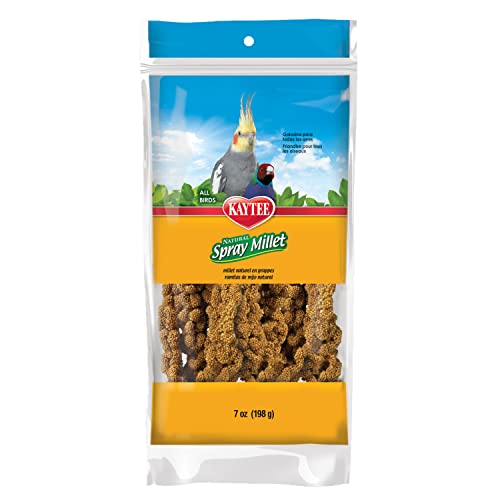
Small birds such as budgies, finches, and canaries have high metabolic rates and small beaks. They benefit from tiny, frequent rewards and are prone to obesity when given unlimited seed. Millet spray is the classic high-value reward for this group because individual seeds can be picked off one at a time, but it should be offered sparingly rather than left in the cage continuously.
Cockatiels and lovebirds sit between the small and medium categories. They handle small seeds, crumbled cakes, and soft vegetable pieces well, and they are particularly prone to fatty liver disease when fed high-fat seed diets over long periods. For these species, a treat rotation that leans toward vegetable-based and pellet-based items is safer than one built around honey sticks.
Medium and large parrots, including African greys, amazons, cockatoos, and macaws, need larger items to stay engaged. Whole nuts, large seed heads, and thick vegetable slices are appropriate. These birds are also strong enough to destroy soft toys and treats quickly, so durability and supervision matter. A treat that a macaw can dismantle in two minutes may still be useful as a reward but offers little enrichment value.
Across all species, the same principle applies: the treat should be sized to the bird, offered in amounts that leave room for a complete diet, and rotated so that no single nutrient profile dominates.
How Much and How Often
The most common guideline in avian care is that treats should make up no more than about ten percent of a bird's daily caloric intake. In practical terms, that is roughly the volume of the bird's own head per day, spread across training sessions and enrichment. For a budgie, that might be a few millet seeds; for a macaw, a small piece of nut or dried vegetable.
Training sessions are the exception to the daily limit in the sense that the pieces are tiny. A single millet seed or a crumb of pellet-sized cake consumed in one or two seconds does not meaningfully change the day's nutrition, even if the bird earns twenty of them in a session. The danger is the recreational treat that is left in the cage for hours, because the bird grazes on it continuously and reduces its appetite for balanced food.
A workable rotation might include a seed-based or millet treat two or three times a week, a pellet-based or vegetable-based treat on other days, and a foraging item once or twice a week for enrichment. The exact schedule matters less than the pattern: variety, moderation, and no single item becoming the default.
bird treats
A Closer Look at One Widely Available Option
Among the treat formats sold for companion birds, one product frequently appears in owner discussions and retailer listings. It is a seed-and-fruit style mix intended for foraging and daily variety rather than as a training reward. The formulation avoids artificial colors and does not use a honey or sugar coating, which distinguishes it from many competing sticks and mixes. It is available in species-specific sizes, and the resealable packaging helps with freshness in humid climates.
The trade-off is familiar to anyone who has kept a parrot on a seed-heavy diet. The mix contains sunflower and other oil seeds, so it is calorie-dense and should be offered in measured amounts rather than free-fed. Some birds selectively pick out the sunflower seeds and leave the fruit and vegetable pieces behind, which defeats the nutritional intent of the blend. It is also not ideal as a rapid-fire training reward because the pieces are larger than a single seed and take longer to consume.
For owners who want a concrete example of a no-dye, no-honey-coating mix to compare against other products, this is a reasonable reference point. Current pricing and availability can be checked directly on the retailer listing: check the current price on Amazon. The same listing can be viewed again below in the buying section for convenience.
How to Evaluate Any Bird Treat Before Buying
Start with the ingredient panel. A short list of recognizable foods is a better sign than a long list of stabilizers, colors, and syrups. If the first ingredient is a sugar source, the product is a candy, not a supplement. If the first ingredient is a seed or grain, the product is an energy source and should be portioned accordingly. If the first ingredient is a vegetable or a formulated pellet, the product is more likely to contribute something nutritionally useful.
Next, consider the format relative to the bird. A treat that requires manipulation, such as a seed head on a stalk or a dehydrated vegetable on a string, offers enrichment value that a loose mix does not. A treat that is soft and quickly consumed is better suited to training. The same product can be right for one purpose and wrong for another, so it helps to decide in advance whether the goal is reward, enrichment, or supplementation.
Finally, check the packaging and storage instructions. Resealable bags, small sizes for single-bird homes, and clear guidance on refrigeration or cool storage all reduce the risk of spoilage. Products that sit open in a warm kitchen lose freshness quickly and can develop mold that is not always visible.
Treats and Training: Matching the Reward to the Task
Positive reinforcement training depends on timing, and timing depends on the size of the reward. A treat that takes more than a second or two to eat delays the next repetition and blurs the association between behavior and consequence. For small birds, a single millet seed or a crumb of pellet cake is close to ideal. For large parrots, a small piece of nut or a broken fragment of dried fruit works better than a whole item.
High-value rewards are reserved for difficult or new behaviors, such as harness training, recall, or stepping onto an unfamiliar hand. Lower-value rewards, such as a piece of a favorite vegetable, can maintain behaviors the bird already knows. Rotating reward values keeps the bird interested and prevents the highest-value treat from becoming routine.
Owners sometimes report that a bird will work for one specific treat and ignore everything else. In those cases, the practical solution is to reserve that item exclusively for training and to offer other treats at other times. Scarcity preserves value, and value preserves motivation.
Foods and Ingredients to Avoid
Some foods that are safe for humans are dangerous for birds, and the list is not intuitive. The ASPCA Animal Poison Control maintains guidance on toxic substances, and the ASPCA pet care library covers general safety principles that apply across species. The following items should never be offered, regardless of how small the amount.
- Chocolate: contains theobromine, which is toxic to birds and can cause seizures and cardiac arrest even in tiny quantities.
- Avocado: contains persin, which is rapidly fatal to birds. The fruit, pit, skin, and leaves are all unsafe.
- Onion and garlic, raw or powdered: damage red blood cells and can cause hemolytic anemia. Garlic powder appears in many human snack foods, so labels matter.
- Caffeine: found in coffee, tea, and soda, causes cardiac arrhythmia, hyperthermia, and seizures.
- Salty snacks: chips, pretzels, and salted nuts can cause kidney failure because birds do not excrete sodium efficiently.
- Fruit pits and seeds: apple, cherry, peach, and plum pits and seeds contain cyanide compounds. The flesh is fine; the pit is not.
- Xylitol: an artificial sweetener that causes rapid hypoglycemia and liver failure.
- Alcohol: even a small amount can fatally depress the central nervous system in a bird.
Beyond outright toxins, owners should be cautious with heavily processed human foods, especially anything containing added salt, sugar, or preservatives. A plain piece of cooked sweet potato or a slice of apple is a reasonable occasional treat. A piece of sweet potato casserole is not.
Common Mistakes in Treat Feeding
The most frequent mistake is treating before meals. A bird that fills up on seed or honey sticks in the morning may refuse its pellets and vegetables later, and over time the diet drifts toward fat and sugar. Offering fresh food first, when the bird is hungriest after a night's fast, and treats afterward, helps preserve the balance.
Another common error is leaving a treat in the cage all day. A seed stick or honey-coated bar that hangs on the bars for hours becomes a continuous food source rather than an occasional reward. The bird grazes, its appetite for balanced food drops, and the treat loses its value as a training reward because it is always available.
Owners also tend to underestimate how much a bird is actually eating. A budgie that seems to eat only a few seeds may be consuming a meaningful share of its daily calories in treats, especially if the treats are calorie-dense. Measuring treats by volume, or counting individual seeds during training, gives a clearer picture than estimating by eye.
Finally, some owners interpret a bird's enthusiasm for a treat as evidence that the treat is good for it. Palatability and nutrition are separate qualities. Birds will readily overeat foods that are harmful to them, just as children will overeat candy. The owner's job is to set the limit, not the bird's preference.
Building a Rotation That Works
A practical rotation starts with the bird's base diet. If the bird eats a formulated pellet as its staple, treats can lean toward seed, fruit, and vegetable items without unbalancing the overall nutrition. If the bird is on a seed-based diet, treats should lean toward pellets, vegetables, and low-sugar items to compensate.
Within that frame, variety can be organized by format: a seed-based treat for foraging, a pellet-based treat for training, and a vegetable-based treat for enrichment. Rotating by format rather than by brand keeps the bird interested and avoids the trap of relying on a single product.
It also helps to rotate by species-appropriate size. Small birds do best with tiny pieces and seed heads; medium birds with crumbled cakes and small vegetable pieces; large birds with nuts, large seed heads, and thick vegetable slices. Matching the format to the bird reduces waste and increases the treat's usefulness.
Frequently Asked Questions
How often should a bird receive treats?
Published guidance generally places treats at no more than about ten percent of daily calories. In practice, that means small training rewards several times a week, recreational treats two or three times a week, and foraging items once or twice a week. Daily overfeeding of treats is a leading contributor to obesity and fatty liver disease in captive birds.
What if a bird refuses pellets and vegetables and only wants treats?
Birds are opportunistic eaters and will choose high-value food over balanced food if both are available. Offer pellets and chopped vegetables first thing in the morning, when the bird is hungriest, and offer treats only after the balanced food has been available for a while. Reduce treat frequency gradually rather than abruptly, and maintain consistent exposure to the foods the bird needs to learn to eat.
Can treats be used for training and bonding?
Yes, and this is where treats are most valuable. High-value rewards such as millet for small birds or small nut pieces for large parrots are the foundation of positive reinforcement training. The key is size: a reward should be consumed in one or two seconds so the bird can immediately repeat the behavior. A treat that takes thirty seconds to eat disrupts the training loop.
Are honey-coated or sugar-coated treats ever acceptable?
They can be offered occasionally as a special reward, but they should not be a routine part of the diet. The sugar content is high, the nutritional value is low, and birds with weight issues, diabetes, or restricted diets should avoid them entirely. A honey stick once a week is a very different thing from a honey stick left in the cage every day.
How should treats be stored?
Seed mixes and dehydrated products should be kept in resealable containers in a cool, dry place, and small bags are preferable for single-bird households. In humid climates, some pellet-based products benefit from refrigeration after opening. Any treat that smells musty, looks clumped, or shows visible mold should be discarded.
Where to Buy
As an Amazon Associate, PawCritic earns from qualifying purchases. This does not affect our reviews or recommendations.
For readers who want to compare a concrete example of a no-dye, no-honey-coating seed and fruit mix against other products, the listing below is the same one referenced earlier in the guide. It is offered as a reference point rather than as a ranked pick, since treat suitability depends on species, diet, and purpose. Current pricing and availability can be checked directly on the listing: view this option on Amazon. The same listing appears again below for convenience.
Key Takeaways
- Treats should make up no more than about ten percent of a bird's daily calories, with training rewards kept to one- or two-second pieces.
- Ingredient order matters: sugar or syrup first means candy, seed first means energy source, vegetable or pellet first means nutritional supplement.
- Format determines value: hard, fibrous items support foraging, soft items support training, and large items suit large beaks.
- Species size and metabolism should guide treat selection, from millet seeds for budgies to whole nuts for macaws.
- Toxic foods include chocolate, avocado, onion, garlic, caffeine, salty snacks, fruit pits, xylitol, and alcohol.
- Storage and freshness matter, especially in humid climates where seed and dehydrated products can develop mold.
- A rotation by format, rather than reliance on a single product, keeps birds interested and diets balanced.
Affiliate Disclosure: PawCritic.com participates in the Amazon Services LLC Associates Program. We may earn commissions from qualifying purchases at no extra cost to you.