Cat Grooming Tools: A Practical Buying Guide
Regular grooming is one of the most overlooked parts of cat care, yet it touches nearly every aspect of feline health. Coat condition is frequently the first visible signal of a nutritional deficiency, an endocrine problem, or a parasitic infestation, which is why veterinary references such as the Cornell Feline Health Center treat routine coat checks as a useful early-warning habit. Brushing also spreads natural skin oils along the hair shaft, lifts dead undercoat before it becomes felted, and cuts down on the volume of fur a cat swallows during self-grooming. For many households, the difference between a comfortable cat and a matted one comes down to having two or three appropriate tools on hand and using them consistently.
This guide is written for cat owners who want to understand what actually matters in a brush, clipper, or grinder before spending money. It is not a ranked list of laboratory-tested winners. Instead, it explains the categories of grooming tools, the specifications that separate a workable tool from a frustrating one, the coat types and temperaments each design suits, and the maintenance and safety habits that keep grooming sessions calm. Where a specific product is mentioned, it is offered as a concrete example of its category rather than a universal recommendation.
cat grooming tools brushes clippers nail trimmers
Why Cats Still Need Help With Their Coat
Cats spend a large portion of their waking hours grooming, but self-grooming has limits. A cat's tongue is a rasp, not a comb: it removes loose surface hair and some dander, but it cannot reach the dense undercoat that builds up along the flanks, belly, and hindquarters of medium and long-haired breeds. That undercoat is where mats begin. Once a mat forms close to the skin, it traps moisture, restricts airflow, and can hide wounds, fleas, or hot spots. Published owner reports and veterinary guidance both describe mats as painful rather than merely cosmetic, because tightening fur pulls continuously on the skin underneath.
Swallowed fur is the second problem. Every cat ingests some hair while grooming, and most of it passes through the digestive tract. When the volume rises, hair accumulates in the stomach and is either vomited back up as a hairball or, less commonly, forms a blockage that requires veterinary attention. The Merck Veterinary Manual cat owner reference notes that frequent hairballs are not normal and should prompt a review of grooming routine, diet, and underlying skin or gastrointestinal health. Brushing removes loose fur before the cat can swallow it, which is the simplest intervention available at home.
Grooming sessions also function as a weekly health check. Running hands and a comb over the body makes it easy to notice new lumps, scabs, areas of hair loss, flea dirt, or tenderness that a cat would otherwise hide. Cats are skilled at masking discomfort, so a structured grooming routine creates regular opportunities to catch small problems before they become expensive ones.
Matching Tools to Coat Type
The single most common mistake in cat grooming is buying one brush and expecting it to work on every coat. Coat length, density, and texture vary enormously between breeds and individuals, and a tool that glides through a short British Shorthair coat can snag painfully in a Persian's fine undercoat.
Short and Medium Coats
Short-haired cats generally need the least equipment. A rubber curry or a soft bristle brush removes loose hair and stimulates the skin, while a fine-toothed metal comb checks for flea dirt and small mats near the tail base and behind the ears. Slicker brushes with bent-wire pins work well on medium coats, but the pins should have rounded tips and a flexible cushion. Stiff, straight pins on a rigid pad can scratch the skin and are a frequent cause of cats suddenly refusing to be brushed.
Long Coats
Long-haired cats need a layered approach: a wide-toothed comb to open the coat and locate tangles, a slicker or pin brush to separate the hair, and a fine comb to finish. The order matters. Going straight in with a slicker on a coat that already contains mats pushes the tangles tighter against the skin. A steel greyhound comb with teeth spaced roughly 3 to 6 mm apart is the workhorse for long coats and costs very little.
Double Coats
Breeds such as the Maine Coon, Siberian, and Norwegian Forest Cat carry a dense insulating undercoat beneath a longer topcoat. These cats shed heavily in spring and autumn, and a deshedding tool with a stainless steel edge reaching below the topcoat removes far more loose undercoat than a brush alone. The trade-off is that deshedding edges cut or pull undercoat hair, so they must be used lightly, in the direction of growth, and never on cats with sensitive skin or bare patches.
Brushes, Combs, and Deshedding Tools
Bristle brushes are the gentlest option and suit cats that dislike metal against the skin. They remove surface hair and distribute oils but do little for undercoat. Slicker brushes are the general-purpose choice for most coats; the wire pins should be fine, bent, and set in a soft rubber pad so they flex rather than scrape. Pin brushes with rounded plastic or metal tips are gentler than slickers and work well on cats with sensitive skin or thin coats.
Deshedding tools sit at the aggressive end of the spectrum. They are effective on double-coated cats during seasonal shedding but should be limited to short sessions, perhaps once or twice a week, and never used on the tail, belly, or legs where skin is thin. A common owner error is over-deshedding, which thins the coat unevenly and can leave bald patches that take months to regrow.
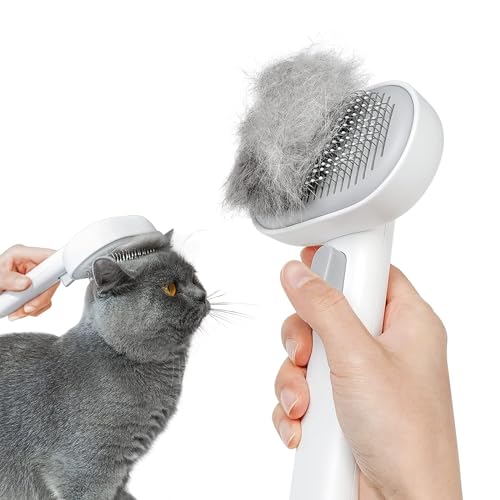
Self-cleaning mechanisms, usually a retracting pin pad activated by a button, are a genuine convenience on slicker brushes because they remove collected fur in one motion. The trade-off is mechanical complexity: the retraction mechanism can stiffen with hair and dander over time and needs occasional cleaning around the pin bed to keep working smoothly.
For owners who want a single concrete example of a general-purpose slicker brush to compare against, this self-cleaning model is widely reviewed and representative of the category: check the current price on Amazon. It suits short, medium, and most long coats for routine maintenance, and the retracting pin pad makes cleanup quick. The trade-off is that the button can feel stiff when new and the tool works best on dry fur; damp or heavily matted coats should be combed out first with a wide-toothed comb.
Nail Trimming: Clippers, Scissors, and Grinders
Nail care is the part of grooming most owners postpone, largely because of the quick, the blood vessel and nerve running inside each nail. On clear or light-coloured nails the quick is visible as a pink core, making it straightforward to trim a small amount beyond it. On dark nails the quick is invisible, and the safe approach is to remove thin slivers from the tip and stop while the cut surface still looks solid rather than spongy or grey.
Scissor and Guillotine Clippers
Scissor-style clippers have two curved blades that close around the nail, while guillotine styles use a single blade sliding past a ring. Both work, and preference is largely about hand position. Features worth checking include hardened stainless steel blades, a safety stop that limits how far the blades close, and non-slip handles. A blunt or nicked blade crushes the nail instead of cutting it, which is uncomfortable and leaves a ragged edge that snags on fabric. Blades cannot usually be sharpened at home, so a clipper is a consumable item rather than a lifetime purchase.
Electric Grinders
Grinders rotate a sanding drum against the nail tip and gradually shorten it, producing a rounded edge that does not snag. Because material is removed slowly, the risk of hitting the quick in a single pass is lower than with clippers, though heat buildup from friction is a real concern if the drum is held against one nail for more than a few seconds. Most cordless models offer two speeds, typically in the region of 6,000 to 9,000 RPM, and USB charging. Noise and vibration are the main reasons cats reject grinders, so a quiet motor and a gradual introduction matter more than torque.
For owners who prefer a grinding approach or who have cats with thick, curved senior nails, this cordless grinder is a representative example of the category: view this option on Amazon. It offers two speed settings, USB recharging, and replacement sanding bands. The trade-off is that cats sensitive to vibration may need weeks of desensitisation with the device switched off before it is used on a nail.
How Often to Groom
Frequency depends on coat length and shedding cycle. Short-haired cats generally do well with one or two brushing sessions a week plus a comb check. Medium coats benefit from two or three sessions. Long-haired cats need three to five sessions a week, and daily during spring and autumn shedding peaks. Nails should be checked every two to three weeks; indoor cats often need trimming more often than outdoor cats because carpet and soft furnishings do not wear nails down. Senior cats may need more frequent trims because reduced activity lets nails grow longer and curl inward toward the pad.
Ears and eyes need less routine intervention. A vet-approved ear cleaner used sparingly on a cotton pad is appropriate when wax is visible, but cotton buds should not be inserted into the ear canal. Any persistent discharge, odour, or head shaking is a veterinary matter rather than a grooming one.
Making Sessions Low-Stress
Grooming resistance is usually a history problem rather than a temperament problem. A cat that was once nicked by clippers or snagged by a stiff brush remembers it. Rebuilding tolerance starts with very short sessions, often just a few strokes, paired with a high-value treat and ending before the cat shows irritation. Kittens introduced gently to handling between eight and twelve weeks tend to accept grooming far more readily as adults, but older cats can still learn through gradual desensitisation.
Timing matters. Most cats are most receptive after a meal or a nap and least receptive when already overstimulated from play. Working on a stable, non-slip surface at a height where the cat feels secure is easier than chasing a cat across the floor. If a cat shows signs of genuine panic rather than mild annoyance, a pheromone diffuser in the room or a towel-wrap technique taught by a veterinary professional can help. Severe cases are best handled with a groomer experienced in anxious cats or with veterinary guidance, because forcing the issue tends to make the next session harder.
Detangling and Mat Removal
Small tangles can be worked out with fingers first, then a wide-toothed comb, then a slicker. Detangling sprays or a light mist of water can reduce friction, but soaking a mat is counterproductive because wet fur tightens as it dries. Never cut a mat with scissors: cat skin is thin and loose, and it is easy to catch a fold of skin between the blades. Mats that are tight against the skin, or that cover a large area, are safest removed by a professional groomer or a veterinary clinic, sometimes with clippers and occasionally with sedation if the cat is in pain.
Hairball frequency is a useful gauge of whether the routine is working. Occasional hairballs are common, but two or more a week suggests the cat is swallowing more fur than it should. The answer is usually more frequent brushing and a review of diet rather than a new tool. Persistent vomiting, appetite loss, or lethargy alongside hairballs warrants veterinary assessment rather than home management.
Safety and Common Mistakes
Several recurring errors cause most grooming injuries. Trimming too close to the quick is the most obvious, and the standard response is styptic powder or a styptic pencil applied with light pressure for 30 to 60 seconds; cornflour or baking soda can substitute briefly. If bleeding continues beyond a few minutes, a vet visit is appropriate. Using human nail clippers is another common mistake: they are designed for flat nails and tend to split or crush a curved feline nail.
Other mistakes include brushing against the direction of growth on sensitive cats, over-deshedding until the coat thins visibly, using a grinder on one nail long enough to generate heat, and ignoring signs of skin disease. Grooming tools should never be shared between cats without cleaning, particularly where ringworm or fleas are a concern. Any product applied to the coat, including detanglers and flea treatments, should be checked against the ASPCA Animal Poison Control guidance, because some essential oils and human hair products are toxic to cats.
Cleaning and Storage
Brushes accumulate dander, oils, and hair, and a dirty brush redistributes all three. A weekly routine of removing trapped fur and washing pin pads or bristles in warm soapy water, followed by thorough drying, keeps tools hygienic and extends their life. Metal combs can be wiped with a cloth and occasionally rinsed. Clipper blades benefit from a drop of light oil and a wipe to remove hair and debris. Grinders should have the sanding drum cleared of dust, and the drum replaced when it stops cutting efficiently rather than being pressed harder against the nail.
Storage matters less than cleanliness, but keeping tools in a dry drawer or container prevents rust on steel edges and keeps them away from curious paws. Blades that have developed nicks or rust should be replaced rather than resharpened at home.
What to Avoid
Heavily marketed grooming gadgets sometimes promise more than they deliver. Self-grooming arch stations, where a cat rubs against a brush mounted on a base, can be useful as a supplement in multi-cat homes, but they do not replace hands-on brushing and are of limited value on long coats. Coat-conditioning sprays that contain unknown essential oils are a risk rather than a benefit. So-called de-matting combs with blade-like teeth can slice hair rather than separate it and should be used only with an understanding of how much coat they remove.
Cheap clippers with soft blades are another false economy. A clipper that crushes rather than cuts makes the experience unpleasant for the cat and increases the chance of the next session being resisted. The same applies to slicker brushes with rigid, sharp pins: they cost little but can put a cat off brushing for months.
Frequently Asked Questions
How often should a cat be brushed?
Short-haired cats generally need one or two sessions a week, medium coats two to three, and long coats three to five, with daily brushing during shedding peaks. The test is simple: if a fine comb passes through the coat without catching, the routine is keeping up.
How often should nails be trimmed?
Every two to three weeks suits most cats. Indoor and senior cats often need more frequent trims because their nails are not worn down naturally, and overgrown nails can curl into the pad.
Can human nail clippers be used on cats?
They can be used on very young kittens in a pinch, but they are not designed for the curved, hard nail of an adult cat and increase the risk of splitting or crushing. Dedicated cat clippers or a grinder are safer.
What should be done if the quick is cut?
Apply styptic powder or a styptic pencil with gentle pressure for 30 to 60 seconds. Cornflour or baking soda can substitute temporarily. If bleeding does not stop within a few minutes, contact a veterinarian.
Are electric grooming tools safe for cats?
Yes, when used according to the manufacturer's instructions, on the lowest speed during introduction, and without prolonged contact that could generate heat. The device should be kept away from the eyes, ears, and mouth.
What if a cat hates being groomed?
Shorten sessions drastically, pair them with treats, and build duration gradually over days or weeks. Pheromone products can help in the environment. If the cat remains genuinely distressed, a groomer experienced with anxious cats or veterinary advice is the kinder route.
Where to Buy
As an Amazon Associate, PawCritic earns from qualifying purchases. This does not affect our reviews or recommendations.
Final Thoughts
A workable cat grooming kit does not need to be large. A soft slicker or pin brush, a steel comb, a pair of sharp clippers with a safety stop, and optionally a deshedding tool for double-coated breeds cover the overwhelming majority of needs. The tools matter less than the routine: short, frequent, low-stress sessions that leave the cat willing to be handled again next time. Owners who brush consistently tend to see fewer hairballs, fewer mats, and more opportunities to notice skin problems early, which is ultimately what grooming is for.