Cat Harness and Leash Buying Guide: What Actually Keeps a Cat Secured
A cat harness is not a smaller version of a dog harness. Feline anatomy and feline panic behavior make escape prevention the central engineering problem, and most harnesses sold for cats fail at it in predictable ways. Cats have collarbones that are not rigidly attached to the skeleton, which allows them to compress their shoulders and slide backward out of anything that only encircles the neck. They also have a loose skin envelope that disguises a very slim frame, so a harness that looks snug on a fluffy cat can be several inches too large. When a cat panics, it does not pull forward like a dog. It reverses, twists, and thrashes, and any harness that concentrates load on a single strap will rotate and open a gap.
The practical consequence is that the design of the harness matters far more than the brand name or the price. Published feline behavior guidance from shelters and veterinary behaviorists consistently describes escape-proof fit in terms of load distribution: the harness must have a strap behind the shoulder blades that catches when the cat backs up, and a strap behind the ribcage that catches when the cat surges forward. A single-loop or vest-style harness that relies on overall snugness rather than mechanical stops is the type most commonly reported by owners as having been slipped. The sections below explain which specifications matter, how to size and fit a harness correctly, how to train a cat to accept one, and what the honest limitations of harness walking are.
The Four Design Requirements That Determine Whether a Harness Stays On
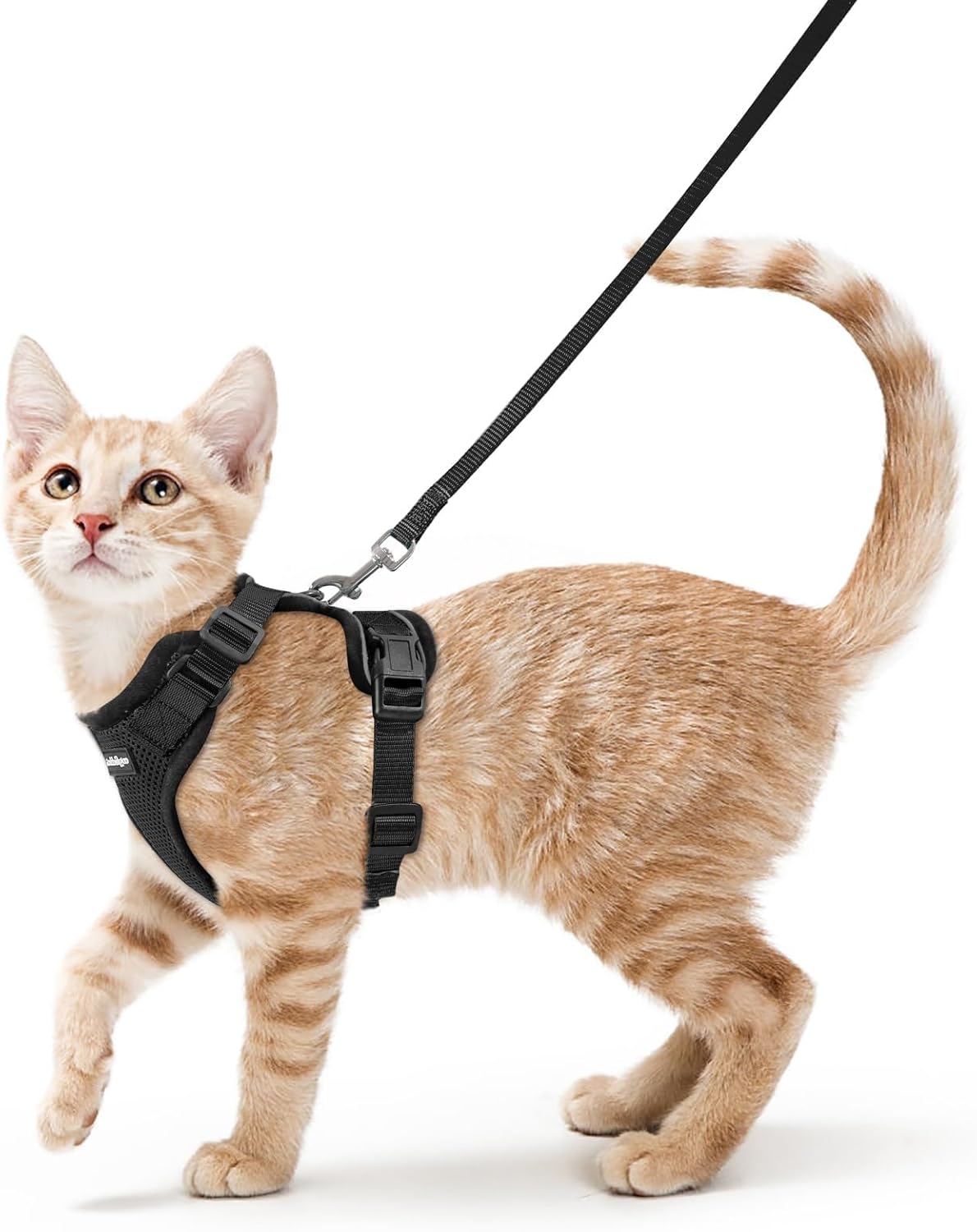
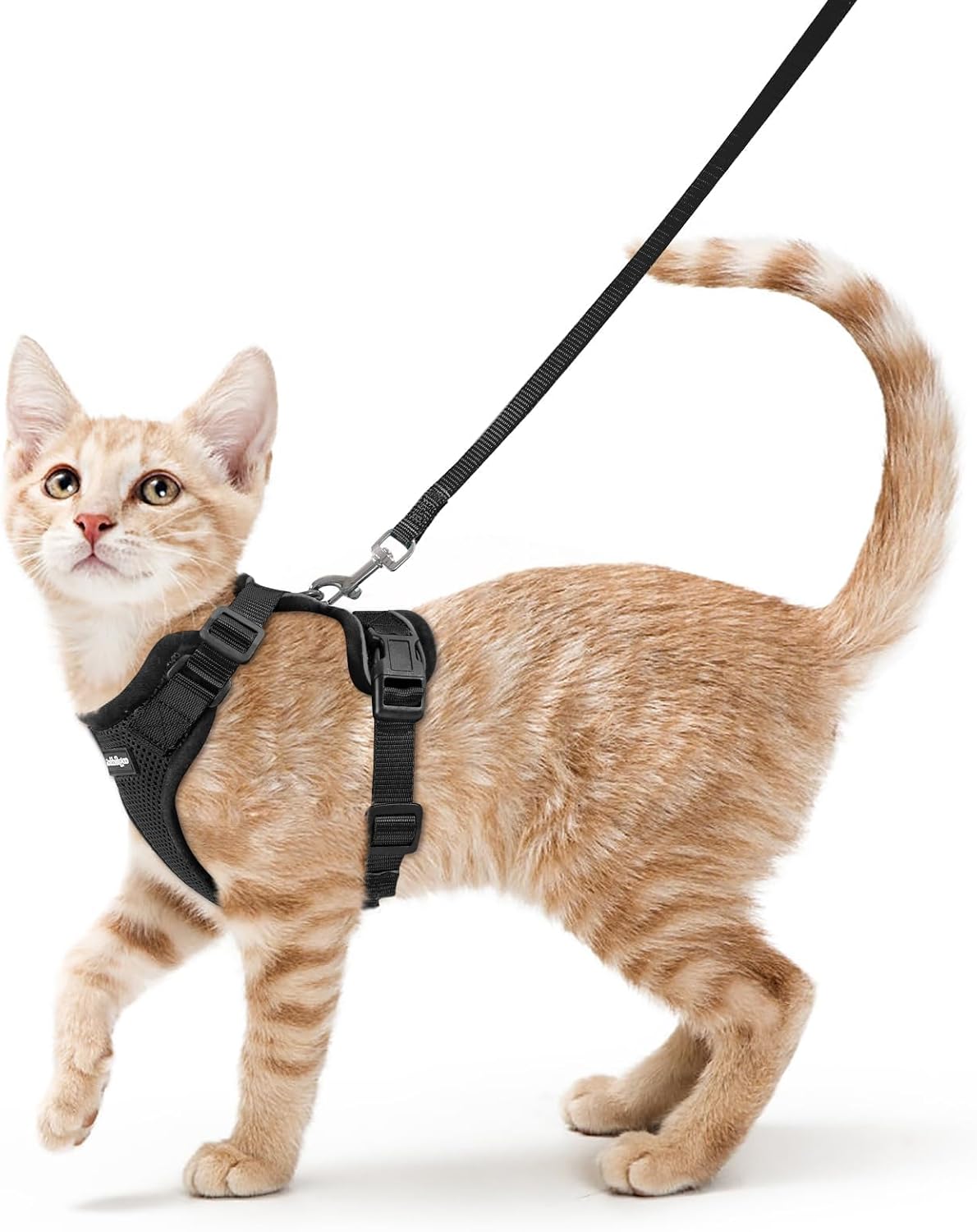
The first requirement is a double-loop or H-style layout. Two separate straps, one seated behind the skull at the base of the neck and one seated behind the elbows around the ribcage, joined by a short spine strap, create two independent mechanical stops. If the cat backs up, the ribcage strap tightens against the widest part of the chest and cannot pass over the shoulders. If the cat surges forward, the neck strap catches behind the skull. This is the configuration that cat rescue organizations and foster networks most often recommend for cats with any escape history, and it is the layout to look for first.
The second requirement is at least three independent adjustment points: neck, chest, and the connecting spine strap. Cats vary enormously in chest-to-neck ratio. A long, narrow Oriental Shorthair and a barrel-chested British Shorthair of the same weight need completely different strap geometry. A harness with only two adjustment points cannot be tuned to both, and the result is either a gap at the neck or a strap digging into the armpit. Three-point adjustment is the minimum; four is better for very large or very small cats.
The third requirement is a back-clip leash attachment positioned between the shoulder blades. A neck attachment creates a choking risk and encourages a cat to flip and twist when tension is applied. A belly attachment creates a tripping and tangling hazard. A dorsal clip keeps leash tension aligned with the spine, which is the direction a cat's body is strongest and least likely to rotate out of the harness.
The fourth requirement is closure hardware that can be operated on a moving, possibly resisting animal. Quick-release side buckles are the standard for a reason: they allow the harness to be placed over a standing or lying cat and closed in two or three motions, rather than requiring the cat to step into a loop. Step-in designs are common in vest-style harnesses and are a frequent source of owner frustration and of cats learning to resist the harness before it is even fastened.
How to Fit a Cat Harness Correctly
Fitting is where most escape incidents actually begin. The widely repeated two-finger rule is a useful starting point: after adjustment, two fingers should slide under any strap with light resistance, and no more. Three fingers of slack means the harness can be backed out of. One finger or none means the strap is compressing the chest or cutting behind the elbow, which causes chafing and can restrict breathing during exertion. The rule is a starting point, not a finish line, because fur length changes the reading. On a long-haired cat, part the fur and check the strap against the skin rather than against the coat.
Three measurements drive sizing decisions. Neck circumference is taken at the base of the skull, snugly, with two fingers inserted under the tape. Chest circumference is taken around the widest part of the ribcage, immediately behind the front legs, which is where the belly strap of an H-style harness should sit. Body weight is the third figure, because most manufacturers publish weight ranges alongside girth ranges, and the two sometimes disagree. For long-bodied cats such as Orientals and Maine Coons, back length from the base of the neck to the base of the tail is also worth recording, since some brands size on length.
When a cat falls between two published sizes, the smaller size is generally the safer choice, provided the chest strap can still be adjusted to sit behind the elbows without pinching. A harness that is slightly snug can be loosened at one adjustment point. A harness that is slightly large has no mechanism to become smaller once the cat is moving, and the gap at the neck or chest is exactly what a determined cat exploits. After any adjustment, the harness should be checked by gently tugging the spine strap upward while watching for the neck loop to move toward the throat, which indicates the neck strap is too loose.
Materials, Padding, and Heat
Nylon webbing is the most common structural material because it is strong, cheap, and does not stretch. Its weakness is edge abrasion: thin webbing can chafe behind the elbows on long walks, particularly on short-haired cats. Padded mesh panels solve the chafing problem by spreading load over a wider area, but they also trap heat. A padded vest-style harness worn on a humid day above roughly 85 degrees Fahrenheit is a genuine overheating risk, especially for long-haired cats and flat-faced breeds. The practical compromise many owners land on is a padded harness for cool-weather walks and a minimal all-strap harness for summer, or walking at dawn and dusk when the pavement and air are cooler.
Elastic components deserve scrutiny. An elasticized chest panel or a bungee leash segment absorbs the shock of a sudden bolt, which reduces the chance that a spook escalates into a full panic and reduces the jerk transmitted to the cat's spine. The trade-off is that elastic degrades. Owner reports and manufacturer guidance both indicate that elastic panels and bungee cords lose their stretch over roughly six to twelve months of regular use, after which they behave like a slightly loose static strap. Elastic should be treated as a wear item to inspect, not a permanent feature.
Velcro closures appear on shirt-style and jacket-style harnesses. They are quiet, which matters for sound-sensitive cats who startle at the snap of a side-release buckle, and they distribute load across a broad fabric panel. Their limitation is holding power over time: lint, fur, and repeated opening reduce grip, and a Velcro-only harness that has lost its bite is a harness that can be peeled open by a thrashing cat. Velcro harnesses are best treated as comfort-first options for calm cats rather than as escape-proof solutions for determined ones.
Escape-Proof Versus Comfort: The Real Trade-Off
Every cat harness sits somewhere on a spectrum between maximum security and maximum comfort, and no single design maximizes both. Full-coverage jacket harnesses that wrap the entire torso from neck to hip are the most difficult to escape because there is no exposed fur for the cat to brace against and no single strap to rotate. The cost is heat retention, bulk, and a fitting process that often requires custom measurements. Minimal H-style webbing harnesses are the coolest and lightest option and are easy to adjust across a wide size range, but they offer less padding and depend entirely on correct adjustment for security.
The honest guidance for most owners is to match the harness to the cat rather than to a ranking. A calm cat who walks politely on a loose leash does not need a custom jacket harness; a padded H-style harness with a mesh chest panel will be more comfortable and entirely adequate. A cat with a history of slipping collars and harnesses, or a cat who panics violently at sudden noises, is a candidate for the most redundant closure system available, even at the cost of comfort and price. Buying for the cat in front of you, not for the average cat, is the decision that prevents both escapes and wasted money.
A Concrete Example: What a Padded H-Style Harness Looks Like in Practice
One widely purchased example in this category is a padded H-style harness with a mesh chest panel, reflective stitching, quick-release side buckles, and a dorsal leash ring, sold in a range of sizes from small kitten through large adult. Specifications published for this type of harness describe a breathable mesh panel over the chest, two adjustable loops, and a machine-washable construction. Owner reviews commonly describe it as easy to put on a standing cat and comfortable for walks of moderate length, with the recurring caveats that the mesh panel is warm in hot weather and that a determined cat can still escape if the straps are not adjusted snugly.
That pattern of feedback is representative of the category rather than unique to one product. Padded H-style harnesses are the most common recommendation for first-time harness users because they balance security, comfort, and price, and because their adjustment range covers most domestic cat body types. They are not the right answer for a cat who has already escaped multiple harnesses, and they are not the coolest option for a cat walking in summer heat. Readers who want to see current specifications, size charts, and verified owner feedback for this style can check the current price on Amazon and compare the published measurements against their own cat's neck and chest girths before buying.
Leashes: Fixed-Length, Bungee, and Retractable
A fixed-length leash of four to six feet in lightweight nylon or cotton is the standard recommendation for cat walking, and it is the right starting point for nearly every cat. Light weight matters because a heavy leash drags on the harness and reminds the cat constantly that it is restrained. Fixed length matters because it gives the handler immediate, predictable control when a dog appears, a car backfires, or another cat crosses the path. The main drawback is limited exploration range, which is why many owners eventually add a longer line for use in enclosed spaces.
A leash with a short bungee or elastic segment is genuinely useful during the training phase. The stretch absorbs the first hard pull of a bolt, which softens the jerk transmitted to the cat and reduces the chance that a startle becomes a full-blown panic. The limitation is the same as with elastic harness panels: the stretch degrades with use, and a bungee leash should be inspected for cracks, thinning, or permanent elongation. A bungee leash is not a substitute for a properly fitted harness; it reduces shock, it does not prevent escape.
Retractable leashes are the most misunderstood option in this category. They give a cat a long radius of exploration, which is appealing for confident cats in quiet areas, but the constant light tension of a retractable mechanism teaches a cat to pull, which is the opposite of what a loose-leash walk requires. The thin tape of a retractable leash can also cause friction burns if it is grabbed or wrapped around a limb during a sudden bolt, and the extended length allows a cat to wrap around trees, posts, and bushes faster than a handler can react. Retractables are best reserved for cats who are already reliable on a fixed leash, used in low-distraction environments, and never used during the training phase.
Harness Training: A Realistic Timeline
Training a cat to accept a harness is a desensitization project, and the published guidance from feline behavior resources is consistent about the sequence. The harness should first be placed near the cat's food bowl or sleeping spot for several days so it becomes a familiar object rather than a novel threat. It is then worn indoors for very short periods, two to three minutes at first, always paired with food, play, or grooming, and always supervised. Cats should never be left alone in a harness, because an unsupervised cat can snag a strap on furniture and panic.
The leash is introduced indoors after the harness is tolerated, initially by letting the cat drag it while supervised, then by having the handler follow rather than lead. The first outdoor sessions should be short, five to ten minutes, held at the quietest time of day, and conducted at the doorstep rather than down the street. The goal of early outdoor sessions is a positive ending, not distance covered. Sessions are extended gradually over weeks, not days, and the walk is ended the moment the cat shows stress signals: flattened ears, a twitching tail tip, dilated pupils, a lowered body posture, or growling.
The most common training failure is rushing the outdoor phase. A cat who is startled badly on an early walk may refuse the harness for months afterward, and the recovery process is slower than the original introduction would have been. The second most common failure is inconsistency: putting the harness on only occasionally, so the cat never builds a reliable positive association. Short, frequent, food-paired sessions outperform long, infrequent ones by a wide margin.
Common Mistakes and What to Avoid
Leaving a harness on a cat unsupervised indoors is the most frequent mistake and the one most likely to cause injury. A strap caught on a cabinet handle or a chair leg can turn a calm cat into a panicked one in seconds, and the resulting thrashing can cause soft-tissue injury or a fall. A harness is walking equipment, not clothing, and it should come off when the walk ends.
Attaching the leash to a collar instead of the harness is another common error. A cat's neck is not built to absorb leash tension, and a collar attachment creates a strangulation risk if the cat bolts or becomes entangled. The leash belongs on the harness, and the harness belongs on the body, not the neck. Similarly, using a dog harness because it fits is a mistake: dog harnesses are cut for a deeper chest and a different center of gravity, and the resulting gaps at the neck and chest are exactly where cats escape.
Ignoring heat and pavement is a seasonal mistake with real consequences. Asphalt that is comfortable to a human hand can be hot enough to burn paw pads, and a padded harness adds a layer of insulation that a cat cannot remove. Summer walks are best scheduled for early morning or after dusk, kept short, and paired with a minimal harness rather than a padded vest. Finally, owners frequently overestimate how much walking a cat wants. Many cats prefer a fifteen-minute sniffing session in a quiet yard to a long march down a sidewalk, and forcing distance on a reluctant cat undermines the entire point of the exercise.
Safety Notes Specific to Cats
Harness walking does not eliminate outdoor risk; it manages it. A cat on a leash can still be approached by an off-leash dog, exposed to parasites, or startled by traffic. Published veterinary guidance recommends that cats with outdoor access remain on year-round parasite prevention, and that any plant a cat can reach be checked against a poison-control database before the cat is allowed near it. The ASPCA Animal Poison Control maintains a searchable list of toxic plants and household substances that is worth reviewing before establishing a regular walking route through a garden or park.
Owners should also be aware that harness walking is not appropriate for every cat. Cats with certain cardiac or respiratory conditions, cats recovering from surgery, and cats with severe anxiety may be made worse rather than better by outdoor exposure. The Merck Veterinary Manual cat owner reference covers the conditions that affect exercise tolerance and is a reasonable starting point for a conversation with a veterinarian. For cats with no diagnosed condition, the general principle still applies: gradual introduction, close observation, and a willingness to stop are what make harness walking safe.
Frequently Asked Questions
Can a cat wear a dog harness? A small-breed dog harness may physically fit a large cat, but the cut is wrong for feline anatomy. Dog harnesses are built for a deeper chest and a different shoulder structure, so the neck and chest straps sit where a cat can slip them. A cat-specific harness with a double-loop layout and three adjustment points is the appropriate choice.
How tight should a cat harness be? Two fingers should slide under each strap with light resistance. Less than that compresses the chest or chafes behind the elbows. More than that leaves a gap a cat can exploit. On long-haired cats, part the fur and check the strap against the skin rather than the coat.
What if my cat flops over and refuses to move? This is a fear response, not stubbornness. Leave the harness on for two to three minutes in a comfortable spot, reward with food, then remove it. Repeat several times daily. If the behavior persists beyond about two weeks, try a different harness style, and try fitting sessions immediately before meals when food motivation is highest.
How long can a cat wear a harness? For walks, the duration the cat tolerates comfortably, typically fifteen to thirty minutes for an established walker. Indoors, harness time should be supervised and brief. A harness should never be left on an unsupervised cat, and it should never be used to tether a cat to a fixed object.
Is harness walking safe for kittens? Kittens can be introduced to a harness, but the harness must fit and the sessions must be very short. Growth means a kitten will outgrow a harness within weeks, so an adjustable harness with a wide size range is more economical than a fixed-size one. Outdoor sessions should wait until the kitten is fully vaccinated and cleared by a veterinarian.
Where to Look Before Buying
The most useful preparation is measurement. Record the cat's neck circumference, chest circumference, weight, and for long-bodied cats, back length, and compare those figures against the manufacturer's published size chart rather than against a general size label. Read the verified owner reviews specifically for comments about sizing accuracy, escape attempts, and heat, because those three themes predict satisfaction more reliably than star averages. For a padded H-style harness in the middle of the price and size range, readers can view this option on Amazon as a reference point for specifications and current owner feedback.
Buying decisions should also account for the leash, which is often sold separately. A lightweight fixed-length leash is the default, with a bungee leash added for the training phase if the cat startles easily. A harness that fits well with a cheap leash is a better setup than a premium harness with a heavy leash that drags. Readers comparing this category can check the current price on Amazon for the harness example discussed above, and should confirm the published size range covers their cat before ordering.
Finally, it is worth stating plainly what a harness can and cannot do. It can give an indoor cat supervised access to smells, sounds, and surfaces that no indoor environment reproduces. It can provide low-impact exercise and mental engagement that reduce stress-related behaviors. It cannot make an unsupervised outdoor cat safe, it cannot substitute for a secure enclosure, and it cannot compensate for a harness that is the wrong size or the wrong design for the individual cat. Matching the equipment to the cat, fitting it correctly, and training patiently are what turn a harness from a piece of nylon into a genuinely useful piece of feline enrichment equipment.
Affiliate Disclosure: PawCritic.com participates in the Amazon Services LLC Associates Program. We may earn commissions from qualifying purchases at no extra cost to you.
Where to Buy
As an Amazon Associate, PawCritic earns from qualifying purchases. This does not affect our reviews or recommendations.