Cat Litter for Multiple Cats 2026: Heavy-Duty Solutions
Running a multi-cat household changes the litter equation in almost every way that matters. One cat using one box is a manageable chore; three or four cats sharing a single tray converts that chore into a daily negotiation over territory, hygiene, and smell. The goal of this guide is to explain what actually separates heavy-duty litter setups that survive a multi-cat home from products that quietly fail within a few weeks. Rather than a hands-on product roundup, this article is a research-based buying guide: every recommendation here traces back to published veterinary guidance, manufacturer specifications, or patterns that repeat across large numbers of verified owner reviews. Where one specific product is worth examining as a concrete example, we point to it directly, but the substance of this guide is the category knowledge you need before you spend anything.
Disclosure: This article contains affiliate links. If you make a purchase through these links, we may earn a commission at no extra cost to you. Thank you for supporting PawCritic!
Why Multi-Cat Households Are a Different Problem
Cats are territorial animals, and the litter box is one of the most contested resources in a shared home. The Cornell Feline Health Center publishes guidance emphasizing that inadequate or poorly maintained litter facilities are among the most common contributors to house-soiling problems, and its widely cited rule of thumb is one box per cat plus one extra. That number is not arbitrary: it reduces competition, gives subordinate cats an alternative when a dominant cat guards a favored box, and distributes waste load so no single box saturates with odor between cleanings. If you currently have three cats and two boxes, the single most effective upgrade you can make costs far less than any premium litter: add a third and fourth box in separate, quiet locations.
The second reason multi-cat homes are harder is volume. More cats means more urine clumps, more feces, and faster ammonia buildup. Ammonia is not just unpleasant; sustained exposure irritates the feline respiratory tract, and cats have a sense of smell far keener than ours, which means a box that smells acceptable to you may already be repellent to your cat. The Merck Veterinary Manual's owner reference material notes that cats rejecting a dirty or odorous box are a leading presentation in behavior consultations. Heavy-duty solutions, then, are defined by three measurable properties: clumping strength under high traffic, odor control under heavy daily load, and physical durability of the box itself. Everything else is marketing.
cat litter for multiple cats heavy-duty solutions
Litter Type: The Foundation of Any Heavy-Duty Setup
Clumping Clay
Sodium bentonite clay remains the default for multi-cat homes for a straightforward reason: it forms tight, hard clumps that survive repeated scooping without crumbling into the surrounding litter. Crumbled clumps are the hidden failure mode of cheap litter in high-traffic boxes, because fragments of dissolved urine continue to generate ammonia after the visible clump is removed. When comparing products, look for phrases like hard clumping or multi-cat formula on the manufacturer's specifications, and pay attention to the granule size. Fine granules clump more tightly and feel softer under paws, while larger crystals and pellets track less but often clump less firmly. The trade-off to clay is weight, dust during pouring, and tracking; none of these are dealbreakers, but they shape what box and mat you should pair with it.
Silica Gel Crystals
Crystalline silica litter absorbs urine into the granules themselves rather than forming scoopable clumps, which means moisture and much of its odor are trapped until the litter is replaced rather than scooped. Manufacturer specifications typically claim odor control for up to a month for a single cat, but honest scaling matters here: in a four-cat home you should treat that as roughly one week per box, and feces still needs daily scooping. Verified owner reviews consistently report that crystal litters excel in low-dust performance and are gentler on human allergies, but that some cats reject the texture on first transition. If you switch, do it gradually over one to two weeks by mixing increasing proportions into the existing litter, because a sudden change is one of the classic triggers for box avoidance.
Natural and Plant-Based Options
Wood pellets, recycled paper, walnut, corn, and wheat litters appeal to owners concerned about dust, sustainability, or the risk of a kitten ingesting clay. Many clump reasonably well, and plant-based litters are generally lighter to carry, which matters when you are filling four boxes. The honest limitations: natural litters tend to be more expensive per pound of absorbency, some mold in humid climates if the box is not scooped diligently, and corn and wheat litters should be stored securely because they can attract pantry pests. Paper pellets, meanwhile, barely clump at all and are better treated as a short-term or post-surgical option than a heavy-duty daily driver. Whatever you choose, note that the AAFCO exists to standardize pet food labeling rather than litter, so there is no equivalent regulatory floor for litter claims; treat marketing terms as unverified until the ingredient list or the manufacturer's own specification sheet backs them up.
Scented Versus Unscented
This choice causes more arguments than it should. Heavily perfumed litters mask odor for humans but many cats find added fragrance aversive, and veterinary behavior guidance generally recommends unscented litter, scooped frequently, over scented litter scooped rarely. If your multi-cat home still smells, the fix is almost never stronger perfume; it is more boxes, better clumping, a deeper litter layer, and more frequent scooping. Activated carbon additives and baking-soda products address odor chemically without imposing a scent on the cat, and are the safer first intervention.
The Box Itself: Where Heavy-Duty Actually Lives
Litter gets the attention, but the box determines whether your setup survives a multi-cat household mechanically. Thin-walled boxes flex, absorb urine odors into scratched plastic over months, and crack along stress lines. Heavier-gauge plastic with smooth, low-porosity surfaces resists the micro-scratching that harbors bacteria and retained smell, and box manufacturers that specify BPA-free or antimicrobial materials are giving you a checkable claim. Replace any box that retains odor after a full wash, because your cat's nose will reject it long before your eyes see a problem; a common guideline from behavior specialists is to replace standard plastic boxes roughly once a year in heavy-use homes.
Size is the specification owners most often get wrong. A litter box should, per published behavioral guidance, be at least as long as your cat from nose to base of tail, allowing the cat to turn around and dig without stepping in old waste. Big cats, including Maine Coons and overweight cats, need oversized boxes in the neighborhood of twenty to twenty-four inches of interior length or more; kittens and arthritic seniors need a low entry side they can step over without jumping. Covered boxes concentrate odor inside, which some cats dislike, and while they reduce visible mess they can also trap dust. Top-entry boxes dramatically reduce tracking and work well for agile cats, but they are inappropriate for seniors, very young kittens, or any cat with mobility issues.
A Concrete Example Worth Examining
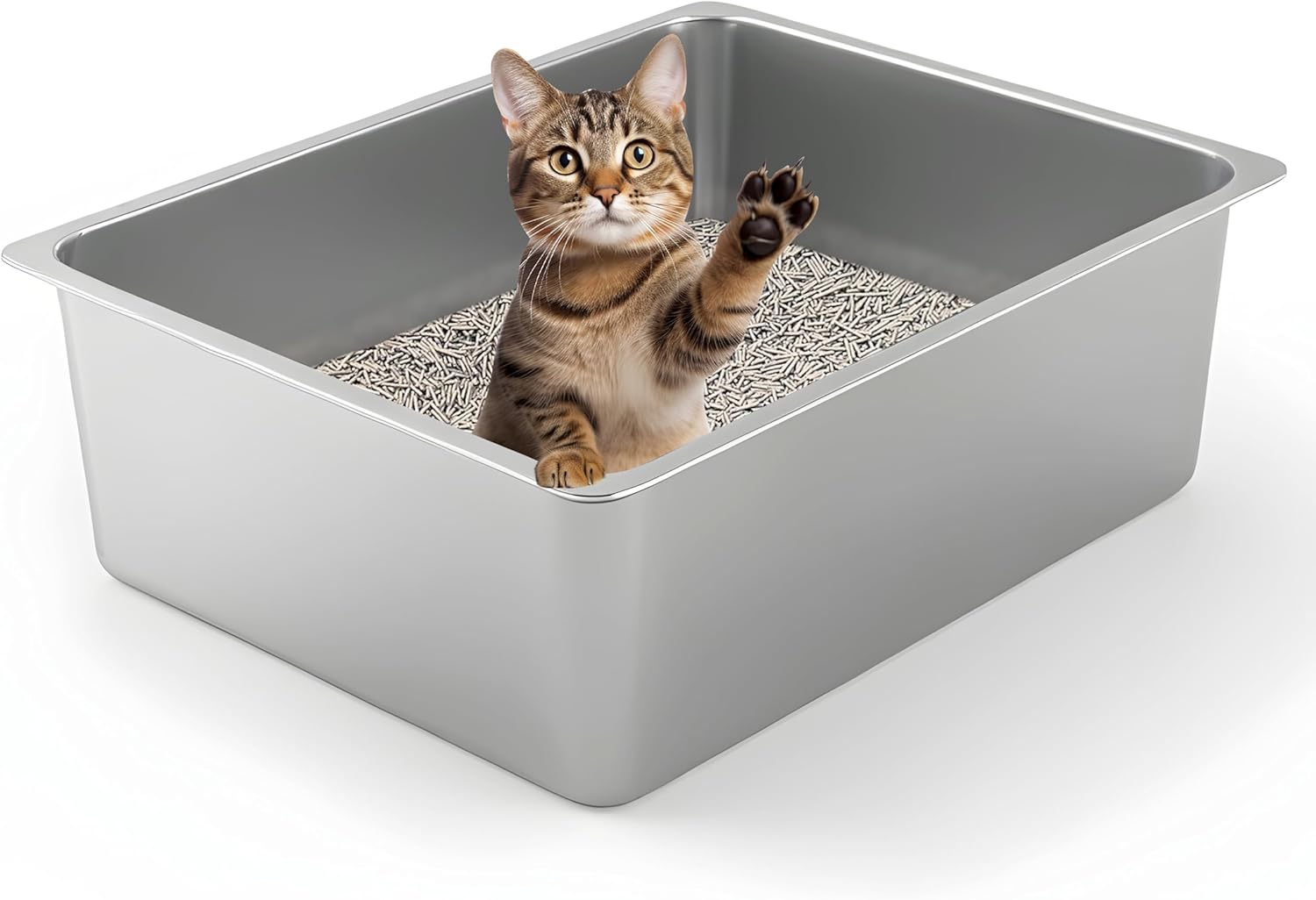
One widely available product that illustrates several heavy-duty principles at once is a high-sided, open-style litter box such as the Kirecoo Stainless Steel Cat Litter Box, which you can check the current price on Amazon. Its high-sided design addresses the single most common complaint in multi-cat homes, which is litter being flung over low walls by enthusiastic diggers, and its non-stick surface claim targets the odor-absorption problem described above. Verified owner feedback repeatedly highlights easy cleaning and effective scatter containment, while the recurring criticisms are that the metal can scratch with aggressive scooping and the footprint is large, so measure your space first. It suits households with diggers and high-volume usage; it is not the right pick if you specifically want a covered or top-entry design. Treat it as one data point in the category, compare its listed dimensions against your largest cat, and read recent owner reviews for anything the manufacturer's page omits. If the open style fits your situation, you can view this option on Amazon alongside alternatives before deciding.
Litter Depth, Placement, and the Numbers That Matter
Manufacturer specifications generally recommend two to four inches of litter depth. Multi-cat boxes trend toward the deeper end because heavy usage thins the layer quickly, and shallow litter over a saturated bed produces the strongest ammonia and the least diggable substrate. Do not overfill past about four inches, however; an overly deep box invites digging catastrophes and wastes litter. On placement, boxes should be distributed rather than clustered: two boxes side by side function socially as one box if a dominant cat can guard both entrances. Avoid noisy appliances, avoid the spot next to the food and water bowls, and ensure each cat has at least two escape routes from every box, since a cat cornered in a tray once may avoid that location for months. In apartments, a spare bathroom or a quiet hallway corner typically beats a laundry room with a banging washer.
Odor Control Beyond the Litter
Ammonia management in a multi-cat home is a systems problem. Scoop at least once daily, ideally twice, because clumps that sit begin to break down and release odor into the whole box. Wash boxes monthly with mild unscented soap and warm water; avoid ammonia-based cleaners, bleach-heavy protocols applied to soiled residue, and pine or citrus-scented products near the box, since several common household substances are irritants or worse for cats, and the ASPCA Animal Poison Control maintains reference material on hazardous household products worth reviewing. A large, high-walled litter mat placed at every exit point captures a large share of tracked granules before they reach your floors, and washing the mat weekly prevents it from becoming a secondary odor source. An air purifier with an activated carbon filter in the same room is a legitimate complement, though never a substitute, for scooping frequency.
cat litter for multiple cats heavy-duty solutions
Common Mistakes Multi-Cat Owners Make
- Too few boxes in too few locations. The one-per-cat-plus-one guideline exists because resource guarding is real; a row of boxes in one basement corner defeats its purpose.
- Buying the cheapest litter and scooping less. Weak clumps crumble, dissolve, and load the box with residual ammonia; economy litter usually costs more per week of acceptable odor than a hard-clumping formula.
- Sudden litter changes. Switching formulas overnight is a classic trigger for elimination outside the box. Transition over one to two weeks by mixing.
- Using hooded boxes for cats who dislike them. Covers trap odor at nose height and block escape sightlines; some cats accept them, some merely tolerate them, and some refuse.
- Replacing boxes never. Scratched, porous, odor-saturated plastic is invisible to you and obvious to your cat. Rotate in fresh boxes roughly annually in heavy-use homes.
- Punishing house-soiling. Veterinary behavior guidance is unambiguous that punishment worsens the problem; inappropriate elimination is a signal to investigate health, box count, cleanliness, or inter-cat conflict.
Safety Considerations Specific to Litter
Dust exposure matters for both cats and the humans who pour the litter; if anyone in the home has asthma, low-dust formulas and pouring slowly close to the box reduce airborne particles. Sodium bentonite clay expands dramatically when wet, which is why clumping clay is generally not recommended for kittens under about three or four months, who may ingest litter while grooming and risk gastrointestinal blockage; a paper or wood pellet non-clumping option is the standard alternative for young kittens. Pregnant owners should be aware of the toxoplasmosis risk associated with cat feces and should have a non-pregnant household member handle scooping, or wear gloves and wash thoroughly afterward. None of these are reasons to avoid cat ownership; they are simply checkable precautions published in standard veterinary owner guidance.
Budgeting Honestly
A workable multi-cat setup has three cost layers: the boxes, the recurring litter, and the accessories. Open, high-sided boxes typically run in the fifteen-to-forty-dollar range each, premium top-entry or oversized designs run higher, and a four-cat household following the plus-one rule needs five boxes, so budget the total rather than a single unit price. Litter is the dominant recurring cost; compare products on cost per week at your actual box count, not cost per pound, because densities differ enormously between clay, silica, and plant litters. Mats, a quality metal scoop with a wide slotted head, and spare liners are modest expenses that pay for themselves in cleaning time. The premium end of the market, including self-cleaning boxes, can work but adds mechanical failure modes and, critically, does not reduce the box-count requirement, since several cats often refuse to share a single motorized unit.
Frequently Asked Questions
How many litter boxes do I really need for multiple cats?
The standard veterinary guideline is one box per cat plus one additional box, distributed across separate locations. Three cats means four boxes. If space truly prevents this, maximize distribution and scooping frequency, and consult your veterinarian if any cat begins avoiding the boxes.
What litter type controls odor best in a multi-cat home?
Hard-clumping clay with strong multi-cat formulas is the most consistently effective for scoopable odor removal, while silica crystals perform well for those willing to replace rather than scoop urine. Either way, daily scooping matters more than brand choice.
Is a covered or top-entry box better for multiple cats?
It depends on the cats. Top-entry designs reduce tracking substantially and suit agile adults; covered boxes contain some odor externally but concentrate it internally. Both are poor fits for seniors or cats with mobility limits, and either can be guarded by a dominant cat, so keep at least one open, low-entry box available.
How deep should the litter be, and how often should I replace it fully?
Aim for two to four inches, topped up as scooping removes volume. Even with perfect scooping, empty and wash the box monthly with mild soap and replace the litter entirely, because dissolved organic residue accumulates beyond what scooping removes.
My cat started missing the box after we added a new cat. What changed?
This is usually resource competition, territorial stress, or a medical issue such as urinary tract disease, all of which are covered in standard veterinary owner references. Increase box count, separate locations, and schedule a veterinary check before assuming a behavior problem.
Can kittens use the same heavy-duty litter as adults?
Not clumping clay, in most guidance, due to ingestion risk during grooming. Use a non-clumping paper or pellet litter until the kitten is several months old, then transition gradually to the household formula.
Conclusion
A heavy-duty multi-cat litter setup is not one miracle product; it is a system built on count, placement, litter chemistry, and maintenance discipline. Start with the veterinary-backed arithmetic of one box per cat plus one, choose a hard-clumping or high-absorbency litter matched to your cats' textures and ages, invest in durable high-sided or appropriately styled boxes sized to your largest cat, and commit to daily scooping with monthly washes. Within that system, individual products like the high-sided example linked above are simply well-chosen components. If you want to compare that option against others in the category, you can check the current price on Amazon and read recent verified reviews before committing. Build the system first, choose the components second, and your multi-cat home will smell, and function, like a single-cat one.