Best Cat Interactive Toys & Puzzle Feeders 2026: Enrichment Options That Beat Boredom
Published on July 26, 2026 by PawCritic — Cats Category
Indoor cats live with a fundamental mismatch between instinct and environment. The predatory drive to hunt, stalk, pounce, and problem-solve is still fully intact in a domestic cat, but a typical apartment offers few legitimate outlets for it. Feline veterinarians and behaviorists consistently identify insufficient enrichment as a contributing factor in destructive scratching, over-grooming, inter-cat aggression, night-time zoomies, and weight gain — the most common behavioral and health complaints owners bring to the clinic. The Cornell Feline Health Center publishes owner-facing guidance on environmental needs and behavior that frames enrichment as basic welfare, not a luxury.
Interactive toys and puzzle feeders address this mismatch by making cats work for food and engage their brains. A cat that has to slide a cover, bat a ball around a track, or locate a hidden feeder is exercising spatial reasoning, memory, motor planning, and patience — cognitive work that many behaviorists consider as tiring as physical exercise. Puzzle feeding also slows eating, which matters for cats that inhale their meals and regurgitate them, and it structures the day around activity rather than a single 10-minute bowl session followed by hours of sleep.
PawCritic does not run hands-on product trials. This guide is compiled from manufacturer specifications, published feline-behavior guidance, and consistently reported owner experiences, so every claim here can be traced to a source you can check yourself. Where a claim depends on an individual cat's temperament, we say so plainly.
Why Interactive Toys and Puzzle Feeders Matter
Domestic cats retain the predatory sequence of their wild ancestors: eye, stalk, chase, pounce, and the kill bite, followed by eating. A free-roaming cat may make many small hunting attempts across a day, eating multiple small meals. An indoor cat receives the entire day's calories in one or two bowl sessions lasting minutes. The result is a large block of unspent predatory energy and unstructured time, and that surplus frequently gets redirected into behaviors owners dislike — curtain climbing at 3 a.m., ankle attacks, or compulsive grooming.
Mental stimulation has measurable welfare value. The Merck Veterinary Manual's owner reference describes behavioral problems in cats as frequently rooted in environment and stress rather than spite, and environmental enrichment is the first-line recommendation in most behavioral protocols. Foraging devices, climbing structures, hunting-style play, and scent enrichment appear repeatedly in that guidance because they address the cause, not the symptom.
Physical activity is the other half. Feline obesity is widespread, and overweight cats face elevated risks of diabetes and joint problems. Because most housecats will not voluntarily run laps, enrichment that pairs movement with food — hunting feeders, treat-dispensing balls, track toys that require pawing — is one of the few reliable ways to add activity to a cat's day without forcing it. A cat that walks the house locating five hidden feeders has moved and thought considerably more than one that ate from a bowl by the wall.
Finally, successful problem-solving appears to build confidence. Owners of shy or newly adopted cats commonly report that puzzle feeding gives the cat a structured, rewarding task that reduces hiding and increases exploration. This is consistent with the general principle in behavioral medicine that animals benefit from control over their environment, and a puzzle the cat can solve is a small, controllable challenge.
What to Look For in an Interactive Toy or Puzzle Feeder
Safety first. Choose BPA-free plastics or washable natural fabrics. Avoid toys with parts small enough to swallow, strings long enough to tangle or be ingested, batteries accessible to paws or teeth, and adhesives or dyes of unknown origin. The ASPCA Animal Poison Control resource is worth bookmarking for the toys-and-houseplants moments every cat owner eventually faces. Any toy showing cracks, exposed stuffing, frayed string, or a loose battery cover should be removed immediately.
Adjustable difficulty. The best puzzles start easy and get harder. A cat that fails repeatedly at a closed puzzle will walk away and may avoid the toy permanently, so look for models with covers that can be partially open, removable obstacles, or compartments of increasing depth. This adjustability also keeps the toy useful as your cat's skill grows.
Cleanability. Puzzle feeders handle food, so they need washing. Dishwasher-safe plastic is the easiest; fabric feeders should be machine-washable. Complex mazes with unreachable crannies get greasy and can put a fastidious cat off its food. Check whether the feeding surfaces come apart before buying.
Stability. A puzzle that skids across the floor when pawed frustrates cats and scatters kibble. Non-slip bases or sufficient weight matter, especially on hardwood and tile. Track toys should resist tipping when a cat leans on them.
Honest match to your cat. A nervous senior and a six-month-old kitten want very different things. Food-motivated cats take to puzzle feeders fastest; motion-driven cats prefer track and electronic prey toys; scent-oriented cats respond to catnip and silver vine. Buy for the cat you have.
Our Three Standout Picks
There are hundreds of enrichment products on the market, but three designs — one sliding puzzle feeder, one hunting-simulation feeder, and one enclosed track toy — cover the needs of most households. Each links below is an affiliate link; see the disclosure at the end.
1. Cat Amazing Interactive Treat Puzzle — Best All-Around Puzzle Feeder
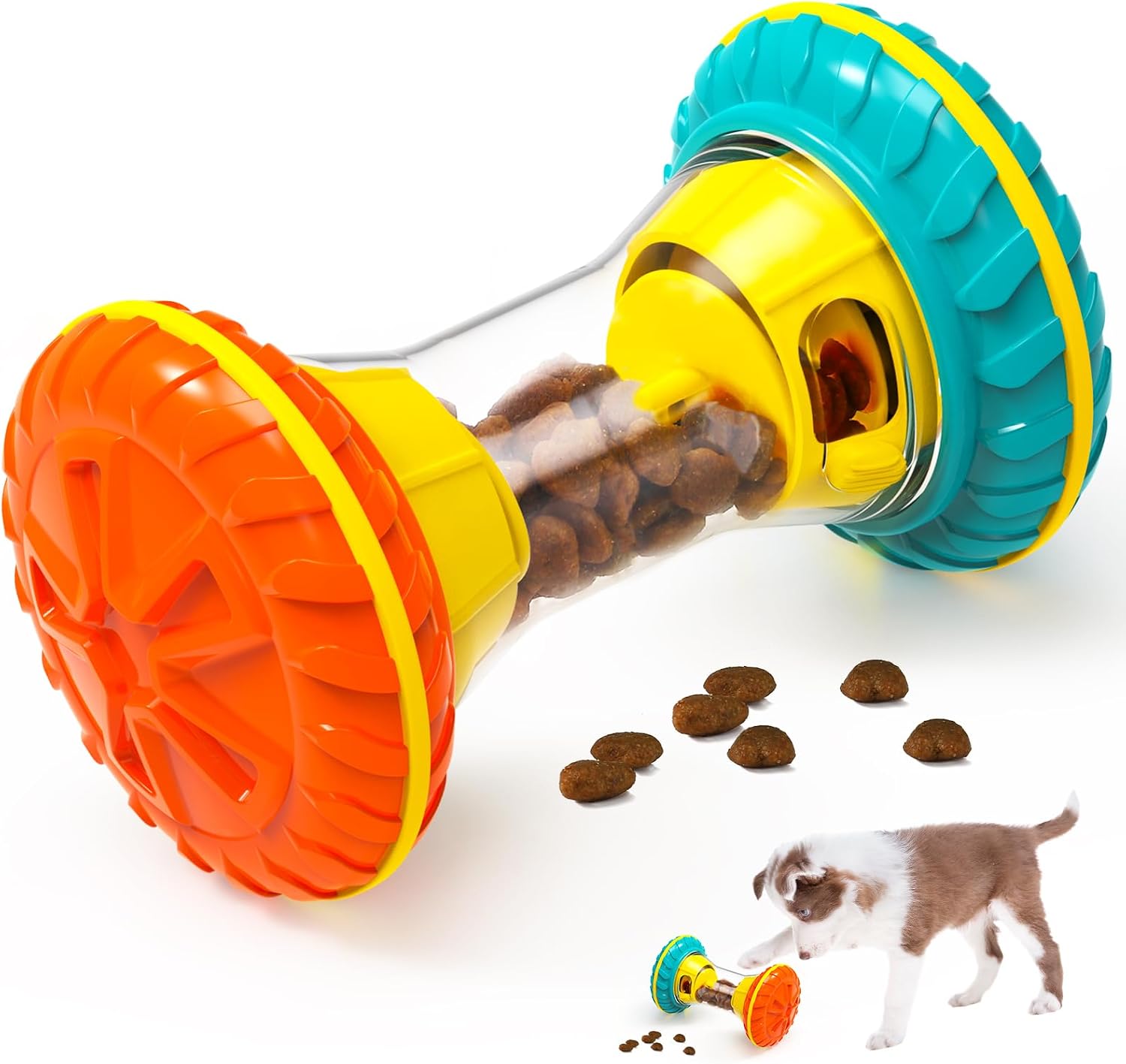
The Interactive Dog Puzzle Toys for Boredom is a cardboard-based treat-hunting puzzle in the same family as the brand's well-known layered treat mazes. Cats fish kibble or treats out of tunnels and compartments at multiple difficulty tiers, which makes it one of the better starter puzzles for cats new to working for food and still engaging for experienced foragers. Because it is cardboard, it is lightweight, inexpensive, and replaceable rather than heirloom-durable — owners should expect to replace it after heavy use, saliva, and clawing take their toll, and it cannot go in the dishwasher. It suits food-motivated cats eating dry food or treats, and it is an especially good first puzzle because the difficulty can be matched to the cat's skill. The honest trade-off: it is a consumable-style product, not a buy-it-once item, and very large-breed or destructively enthusiastic cats may shorten its life considerably.
Price: Check current price on Amazon
2. Doc and Phoebe's Indoor Hunting Feeder — Best Hunting Simulation
The Interactive Dog Puzzle Toys for Boredom is the product closest in spirit to how cats actually eat in the wild. The kit includes fabric mice that you fill with a portion of the day's food and hide around the house; the cat must find each mouse, carry it to a preferred spot, and manipulate it to extract the food. This replicates the whole predatory sequence — search, stalk, catch, carry, and 'consume' — rather than just one fragment of it, and splitting meals across several hidden mice naturally slows eating and spreads activity through the day. Verified owner reports repeatedly mention reduced night-time wake-up demands and less food-bowl begging once the cat learns the system. The trade-offs are real: it requires owner effort to fill and hide the mice daily, some cats take a week or two to grasp the concept, and the fabric mice need periodic machine washing since they spend their lives in mouths and under furniture. It is best suited to owners willing to change their feeding routine, and less suited to homes with dogs that will simply eat the mice.
3. Petstages Cat Tracks Toy — Best Independent-Play Track Toy
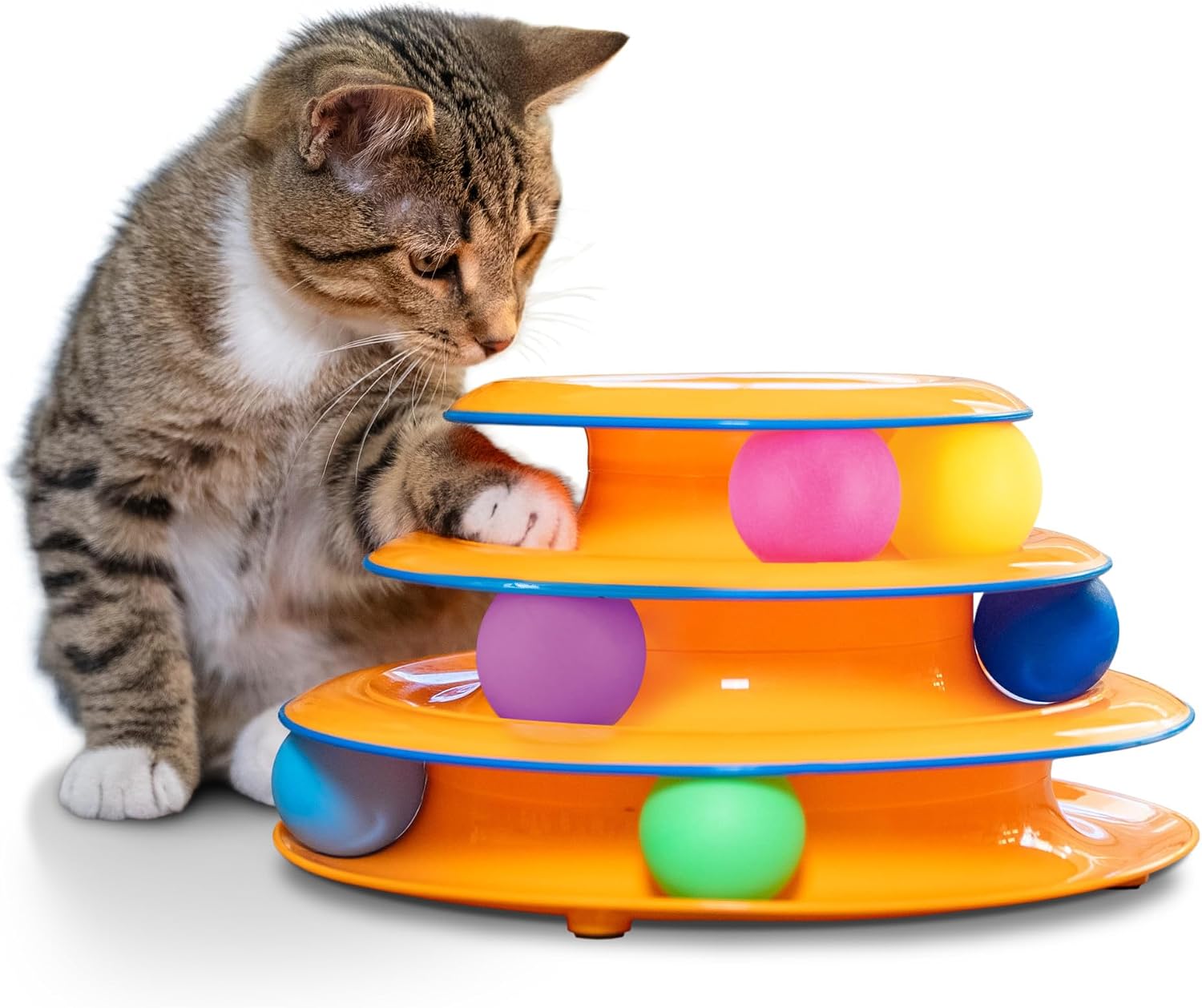
The Catstages Tower of Tracks Cat Toy is a classic multi-level ball track: brightly colored balls circulate inside enclosed levels that the cat can see and bat but never remove. That enclosed design is its defining safety feature — no small balls loose on the floor to swallow or lose under the fridge — and it means the toy is fully appropriate for unsupervised and multi-cat play, including kittens. It suits cats that like motion and cause-and-effect play but need something that works when no human is around, and the multi-cat appeal of batting a shared ball back and forth is one of the most consistently reported strengths in owner reviews. The trade-off: some balls rattle audibly, which cats at 2 a.m. find wonderful and owners may not, and a few of very determined cats learn to dislodge or chew at components over time, so inspect it periodically. It is inexpensive, durable for its price class, and requires no batteries — a genuinely low-risk enrichment purchase.
Other Enrichment Categories Worth Knowing
Beyond these three, several other categories fill gaps. Electronic prey toys that move erratically across the floor appeal strongly to chase-driven cats, but they involve batteries and motors, so check battery-door security and expect a shorter lifespan than passive toys — plan on replacing them within a year or two of regular use. Door-mounted motion toys, such as spinning-butterfly wands, engage aerial hunting instincts and suit high-energy cats that ignore floor-level play, at the cost of replacement parts as the fabric wears out. Advanced multi-mechanism puzzles combining sliding covers and rotating dials suit experienced problem-solvers but frustrate beginners, so they are best bought after your cat has mastered simpler designs. Wand toys remain the gold standard for interactive human-cat play and pair well with any of the above. None of these categories requires a large budget; rotation and variety matter far more than any single premium purchase.
How to Introduce a Puzzle Feeder
Cats do not instinctively understand human puzzle designs, so the introduction determines whether the toy succeeds. Start by placing the puzzle next to the regular food bowl with high-value treats already visible on top — no solving required. Over several sessions, place treats just inside compartments with covers partially open, so the cat gets partial success immediately. Only then progress to fully closed covers or hidden fillings. Expect three to five short sessions before competence, and keep sessions brief; a frustrated cat walks away, and forcing the issue with a paw-over-paw demonstration rarely helps and can create avoidance. Kittens as young as four months and senior cats can both learn puzzles, but seniors may need easier starting configurations and larger kibble openings. If your cat ignores the puzzle entirely at first, try higher-value food, a hungrier timing (just before a meal), and a quieter location. Persistence for a week pays off more often than switching products immediately.
Building an Enrichment Rotation
Novelty is a finite resource. A toy that sits in the living room for a month becomes furniture; the same toy pulled from a closet after two weeks of absence is thrilling again. A practical rotation looks like this: keep a puzzle feeder or hunting feeder in daily use at mealtimes, keep one or two passive toys (a track toy, a catnip mouse) permanently available, and rotate the rest out of a cupboard every three to five days. Maintain a pool of roughly six to eight toys so the rotation actually cycles. For play sessions, two short bursts of five to ten minutes at dawn and dusk align with the cat's natural activity peaks better than one long evening session. Always end interactive play with the cat making a final 'catch' on a physical toy, since sessions that end in frustration can increase arousal rather than discharge it.
Safety, Sizing, and Maintenance Notes
Sizing matters most for kittens and greedy adults. Choose puzzles with compartments too large to fit in a mouth, and skip any toy with detachable parts smaller than a ping-pong ball for cats under a year. Electronic toys should have screw-secured battery compartments — pressure-fit lids are a chronic weakness in cheap designs. Fabric feeders should be washed weekly in hot water without heavily scented detergent, since residual fragrance can repel a fastidious cat. Plastic puzzles should be hand-washed or dishwasher-safe per the manufacturer's instructions, and wooden components should be finished with pet-safe, food-grade sealants. Inspect all toys monthly: cracked track balls, split fabric seams, and frayed cords are ingestion hazards, and a swallowed string or battery is a genuine veterinary emergency. Replacement intervals vary — passive plastic toys often last for years, cardboard puzzles wear out faster, and electronic toys typically fail within one to two years of regular use. Budget accordingly.
Common Mistakes Owners Make
The most common mistake is buying a puzzle far above the cat's current skill level and concluding the cat 'does not like puzzles' after one failed session. Start trivially easy. The second is giving up on the transition from bowl to feeder overnight; a gradual split — half the meal in the bowl, half in the puzzle — avoids hunger strikes, which matter medically because cats should not go long periods without eating. The third is treating laser pointers as complete enrichment: the point of the hunt is the catch, and a dot that can never be caught can leave some cats frustrated. If you use a laser, finish every session by landing the dot on a physical treat or toy the cat can actually capture. The fourth is clutter: fifteen toys scattered everywhere is less enriching than five in rotation. The fifth is ignoring the litter box and environment entirely — if a cat suddenly changes behavior around elimination, that is a veterinary signal, not an enrichment problem, and a checkup comes before any toy purchase.
FAQ: Cat Interactive Toys and Puzzle Feeders
Are puzzle feeders safe for all cats?
Yes, with supervision during the learning phase and attention to construction. Choose BPA-free plastics or washable fabric, avoid small swallowable parts for kittens, and remove any toy that shows damage. Cats with dental disease may struggle with fabric mice and do better with open-compartment puzzles.
How long does it take a cat to learn a puzzle?
Most cats grasp a simple configuration within a few minutes to a few sessions, and harder levels within a week of daily practice. Cats that seem uninterested usually need higher-value food, an easier starting configuration, or a hungrier introduction just before mealtime.
My cat ignores every interactive toy. What should I try?
Nothing is wrong — cats differ in play style. Motion-driven cats want track or electronic prey toys; food-driven cats want treat puzzles; scent-driven cats respond to catnip or silver vine. Also try timing: many cats are far more playful at dawn and dusk, and a toy introduced mid-afternoon during a nap cycle will be ignored no matter how good it is.
Can puzzle feeders help with weight loss?
They help with the activity side, not the calorie side. Portion control, guided by your veterinarian and a complete-and-balanced diet meeting AAFCO nutrient profiles (see the AAFCO standards), remains the foundation. What feeders add is movement and slower eating spread across the day, which supports the overall plan.
How often should toys be replaced?
Inspect monthly. Passive plastic and wooden toys often last years; cardboard puzzles wear out sooner; electronic toys typically last one to two years. Replace anything cracked, frayed, or with a loose battery door immediately, since ingestion risk outweighs any savings.
The Verdict
Enrichment is not optional for indoor cats — it is preventive medicine for behavior and weight alike. For most households, a sliding treat puzzle like the Cat Amazing Interactive Treat Puzzle is the best starting point because it is inexpensive, adjustable, and immediately food-motivating. For owners willing to change their routine and replicate real hunting, Doc and Phoebe's Indoor Hunting Feeder is the most biologically faithful option available. And for independent, unsupervised play, the Petstages Cat Tracks Toy delivers safe, battery-free engagement for cats of all ages. Whichever you choose, introduce it patiently, rotate it regularly, and watch for the signs — a tired, satisfied cat sleeping through the night instead of scaling the curtains.
Affiliate Disclosure: Some links above are Amazon affiliate links (tag: nannan09-20). We earn a small commission at no extra cost to you. PawCritic does not perform hands-on product testing; recommendations are based on manufacturer specifications, published veterinary guidance, and verified owner reports.