Interactive play is not a luxury for indoor cats. Feline behavior guidance from the Cornell Feline Health Center consistently describes daily predatory play as a core welfare need, not an optional extra. A cat that never gets to stalk, pounce, and bat at something is a cat with an unspent hunting drive, and that drive tends to come out sideways: furniture scratching, night yowling, overgrooming, and sometimes redirected aggression toward people or other pets. The practical takeaway is simple. A short, structured play session twice a day does more for most indoor cats than a shelf full of toys that sit untouched.
That last point matters, because the cat toy market is enormous and most of it is interchangeable. The category has three genuinely distinct jobs: interactive toys you operate with your hand, puzzle feeders that turn meals into work, and automatic or electronic toys that run when nobody is home. Buying one good option in each category beats buying twelve variations of the same crinkle ball. This guide covers what published guidance and manufacturer specifications actually say about each type, where the real trade-offs are, and what to check before you spend money.
Disclosure: As an Amazon Associate, we earn from qualifying purchases. This means we may earn a commission when you buy products through links on our site at no additional cost to you.
cat toys interactive toys puzzle feeders feather wands enrichment toys
Why Interactive Play Is a Welfare Need, Not a Bonus
Indoor cats live longer, safer lives than outdoor cats, but they trade away almost all of their natural hunting opportunities. A feral cat makes dozens of stalk-and-pounce attempts a day, most of which fail. An indoor cat makes zero unless a human arranges them. Cornell Feline Health Center guidance on environmental enrichment treats this as a solvable problem: the goal is to simulate the hunt sequence in a way the cat can actually complete, ending with a capture and ideally a small reward.
The behavioral payoff is well documented in veterinary behavior literature. Play sessions reduce anxiety, burn calories, and give cats a legitimate outlet for scratching, biting, and chasing. Cats that get regular interactive play are generally easier to live with: fewer 3 a.m. ambushes, less compulsive grooming, and less food-bowl nagging. Play is also one of the few interventions that helps with both obesity and boredom, which are two of the most common problems veterinarians see in indoor cats.
There is a catch that most buying guides skip. Play has to be terminated correctly. If a cat stalks a laser dot for ten minutes and never catches anything, the session ends in frustration, and some cats respond to that frustration by redirecting onto nearby hands or ankles. The fix is to end wand and laser sessions with a physical capture: a stuffed toy the cat can grab and kick, or a treat tossed across the floor. This is standard advice in veterinary behavior practice, and it is the single biggest difference between play that calms a cat and play that winds one up.
How to Read Cat Toy Marketing Without Getting Fooled
Toy packaging is not regulated the way pet food is. There is no equivalent of the AAFCO standards for a feather wand, which means claims like vet approved, premium, and mental enrichment are essentially advertising copy. What actually matters is narrower and more checkable: what the toy is made of, how it is powered, what happens when it breaks, and whether a cat can swallow a piece of it.
Three specifications are worth reading carefully before purchase. First, power source. Battery-operated toys list a battery type and an estimated runtime; rechargeable toys list a battery capacity and a charge time. Those numbers are manufacturer claims, not independent measurements, and real-world runtime is usually shorter, especially with motors that reverse direction or sensors that trigger constantly. Second, replacement parts. Feather wands and electronic teasers almost always outlive their attachments, so a toy with a replaceable head has a much longer useful life than one molded as a single piece. Third, materials. Fabric toys should list whether they are machine washable, and plastic puzzle feeders should be described as food-safe and free of BPA, because kibble and treats sit directly on the surface.
Safety is the other filter. The ASPCA Animal Poison Control publishes guidance on household hazards that applies directly to toys: string, ribbon, yarn, and elastic can cause linear foreign body obstruction if swallowed, which is a surgical emergency. Feathers, bells, and glued-on eyes are common culprits. Any toy with a part that can be pulled off by a determined cat should be used only under supervision, and any toy that has started shedding fibers, cracking, or losing stitching should be retired rather than repaired with household glue.
Interactive Wand Toys: The Best Value in the Category
Wand toys are the highest-return purchase in cat enrichment because they depend on a human, and a human is the variable a cat finds most interesting. A wand with a lightweight carbon or fiberglass rod and a replaceable lure can replicate the full hunt sequence: stalking, chasing, pouncing, and catching. The wand itself rarely fails; the lure does. Feathers fray, strings snap, and fabric strips shred. That is why the practical buying decision is not which wand looks best in the photo but whether replacement lures are sold separately and are easy to attach.
Rod length matters more than most buyers expect. A wand around 24 to 36 inches lets you move the lure in unpredictable, prey-like arcs without looming over the cat, which matters for shy or nervous cats that will not engage if a human is leaning into their space. Longer wands are better for fast cats and for playing across a room; shorter wands are easier to control in tight spaces. Handle grip is a minor detail until you are waving a wand for fifteen minutes, at which point foam grips earn their place.
The honest limitation of wand toys is that they require you. If you travel, work long hours, or have a cat that demands play at 4 a.m., a wand alone will not solve the problem. It also does nothing for cats whose owners cannot physically play due to mobility limitations. That is the gap automatic toys are designed to fill, and it is worth being clear-eyed about the trade-off: automatic toys provide motion, but they do not provide the social feedback of a human who reacts to the cat.
Puzzle Feeders: Turning Meals Into Work
Puzzle feeders are the most underrated category, because they solve two problems at once. Cats evolved to eat many small prey meals a day, not two large bowls of kibble, and free-feeding from a bowl is associated with both obesity and boredom. A puzzle feeder slows eating, which reduces vomiting after meals in cats that bolt their food, and it converts a five-minute meal into fifteen minutes of problem-solving. For a cat that is home alone all day, that is meaningful enrichment.
Difficulty is the variable that makes or breaks a puzzle feeder. A feeder that is too hard gets abandoned; a cat that walks away from a puzzle after two minutes of pawing has learned that the effort is not worth the reward, and that lesson is hard to unlearn. The standard advice is to start with a feeder that releases food almost immediately and increase difficulty only after the cat is reliably finishing meals. Manufacturers often describe their feeders as beginner, intermediate, or advanced, and those labels are a reasonable starting point even though they are not standardized.
Cleaning is the specification buyers overlook. Puzzle feeders have crevices, tracks, and removable cups, and wet food or oily treats leave residue that grows bacteria. A feeder described as top-rack dishwasher safe is dramatically easier to live with than one that requires hand-scrubbing with a bottle brush. Plastic feeders can also retain odors over time, which is why some owners prefer ceramic or stainless components where available. None of this is glamorous, but it determines whether the feeder is still in use six months later.
Automatic and Electronic Toys: What They Can and Cannot Do
Automatic toys fall into two broad groups: motorized teasers that move a lure or wand on their own, and rolling or scurrying toys that mimic prey on the floor. Both are designed for solo play, and both have the same fundamental limitation: cats habituate to predictable motion. A toy that moves in the same pattern every time becomes furniture within a week. That is why randomized movement patterns, adjustable speeds, and auto shut-off timers are the features that actually matter, not the number of attachments in the box.
Auto shut-off deserves special attention. A toy that runs continuously for an hour teaches a cat to ignore it, because the motion is always there. A toy that runs for ten minutes and then goes quiet preserves novelty and gives the cat a reason to re-engage when it starts again. Most reputable manufacturers now list a shut-off interval in the specifications, and ten to fifteen minutes is the common range. If a listing does not mention one, assume the toy runs until the battery dies or someone turns it off.
Battery life is the other honest trade-off. Motorized teasers draw more power than rolling toys because they fight gravity and friction, and manufacturer runtime estimates are typically given under ideal conditions. Rechargeable toys avoid the cost of disposable batteries but tie the toy to a charging cable, and a toy that is charging is a toy that is not playing. For a cat that gets two supervised wand sessions a day, an automatic toy is a supplement, not a replacement. For a cat home alone for ten hours, it is closer to a necessity.
Laser Toys and the Frustration Problem
Laser toys are the most polarizing product in cat enrichment. They are enormously effective at triggering chase behavior, they never need replacing, and they work on cats that ignore everything else. They are also the classic example of an incomplete hunt: the cat chases, pounces, and catches nothing, because the dot is not a physical object. Veterinary behavior guidance generally treats laser play as acceptable only when it is paired with a tangible reward at the end, such as a treat or a stuffed toy the cat can grab.
There is also an eye-safety consideration that manufacturers rarely mention. A laser pointed directly at a cat's eyes, or reflected off a mirror into the eyes, can cause retinal damage. Automatic laser toys that rotate across a room are generally safer than handheld lasers because the beam is moving and diffused, but they should still be positioned so the beam never lands on a cat's face at close range. Cats with a history of compulsive behavior, particularly light-chasing or shadow-chasing, should not be given laser toys at all, because the behavior can escalate.
Catnip, Silvervine, and Other Attractants
Roughly half to two-thirds of cats respond to catnip, and the response is genetic. Cats that do not respond to catnip often respond to silvervine, valerian root, or Tatarian honeysuckle, which contain different compounds that trigger a similar effect. This is why a catnip toy that one cat ignores can be another cat's favorite object. It is also why buying a single catnip toy and concluding that your cat does not like catnip is a mistake; try at least two different attractants before giving up.
Potency fades. Catnip is a volatile oil, and it evaporates from fabric over weeks to months. Airing a toy in a sealed bag with fresh catnip, or storing it in a zip-top bag between uses, extends its useful life. Washing a catnip toy removes much of the oil, so a machine-washable catnip toy is a compromise: it stays hygienic but loses potency faster. The practical approach is to keep two or three catnip toys in rotation and refresh them rather than expecting one toy to stay potent indefinitely.
Kittens under about six months and senior cats often show reduced or no response to catnip, which is normal and not a sign of a problem. Pregnant cats should generally avoid catnip, and cats with certain medical conditions should be cleared by a veterinarian before regular use. None of these are reasons to avoid catnip toys entirely; they are reasons to pay attention to how an individual cat responds.
Matching Toys to Your Cat's Personality and Age
Cat toy recommendations fail most often because they ignore the individual cat. An active adolescent cat that scales bookshelves needs wand play with fast, erratic movement and a puzzle feeder that actually slows eating. A sedentary senior cat may need a toy that moves slowly and predictably, positioned on the floor rather than in the air, because jumping becomes uncomfortable with age. A shy cat needs distance and a wand long enough that the human is not looming, while a confident cat may prefer a rolling toy it can chase across a room.
Age changes the calculus in specific ways. Kittens explore with their mouths, so toys should have no small detachable parts and should be supervised. Adult cats between one and seven years are usually the easiest to engage and can handle the widest range of difficulty. Senior cats benefit from shorter sessions, softer surfaces, and toys that do not require jumping. Cats with arthritis, dental disease, or vision loss need toys adapted to their limitations, and a veterinarian is the right person to ask about what is appropriate.
Multi-cat households add another layer. Puzzle feeders should be one per cat, placed far enough apart that a faster cat cannot monopolize both. Wand play with multiple cats usually works better one at a time, because a cat that is watching another cat catch the lure is not getting the same enrichment. Automatic toys can be genuinely useful in multi-cat homes because they provide motion without requiring a human to referee who gets the wand.
Rotation, Storage, and Maintenance
Novelty is the currency of cat enrichment, and rotation is how you manufacture novelty without buying more. A practical system is to keep four or five toys available and store the rest out of sight, swapping the active set every week or so. A toy that has been in a closet for a week is functionally new when it reappears. This works far better than leaving everything on the floor, where it becomes background noise.
Inspection should be routine. Before each play session, check wand lures for loose feathers, frayed string, or exposed wire. Check electronic toys for cracked housings and battery corrosion. Check plush toys for split seams and loose stuffing, which is a swallowing hazard. Check puzzle feeders for cracks that trap food and for parts that have come loose. Anything that fails inspection should be discarded, not repaired with tape or glue, because cats will chew both.
Cleaning schedules depend on the toy. Plush toys used with treats should be washed weekly in a mild detergent and dried thoroughly, because damp fabric grows mold. Puzzle feeders used with wet food should be rinsed after every meal and washed daily. Wand lures and electronic toys generally need only a wipe-down, but they should be stored where a cat cannot chew on them unsupervised. Batteries should be removed from toys that will sit unused for long periods, because leaking batteries damage both the toy and the surface it sits on.
Common Mistakes and What to Avoid
The most common mistake is buying toys for the owner's taste rather than the cat's. A toy that looks clever on a shelf may be ignored if it does not move like prey, and a cheap crinkle ball may be the only thing a particular cat ever wants. The second most common mistake is buying too many toys at once, which makes it impossible to tell what the cat actually likes and floods the environment with objects that lose novelty immediately.
Other mistakes are more serious. Leaving string, ribbon, or yarn toys out unsupervised risks linear foreign body obstruction, which is one of the more common surgical emergencies in cats. Using laser toys without a tangible reward creates frustration that can turn into redirected aggression. Leaving a puzzle feeder out with wet food for hours invites bacterial growth and food refusal. Using a toy that is too small for the cat risks ingestion. None of these are exotic hazards; they are the routine ways cat toys cause problems.
Finally, avoid the assumption that a bored cat needs more toys. Often a bored cat needs more structure: predictable play times, a feeding routine that includes some work for food, and vertical space to climb. Toys are one tool in that system. A cat with a consistent routine and two real play sessions a day will usually be more content than a cat drowning in unused plastic.
A Concrete Example and How to Evaluate It
When evaluating any specific interactive toy, the questions are the same regardless of brand. Does it move unpredictably, or does it repeat the same pattern? Does it have an auto shut-off timer? Are replacement lures or parts available? Is it rechargeable or does it burn through disposable batteries? Is it safe to leave out unsupervised, or does it require a human present? The answers matter more than the marketing copy.
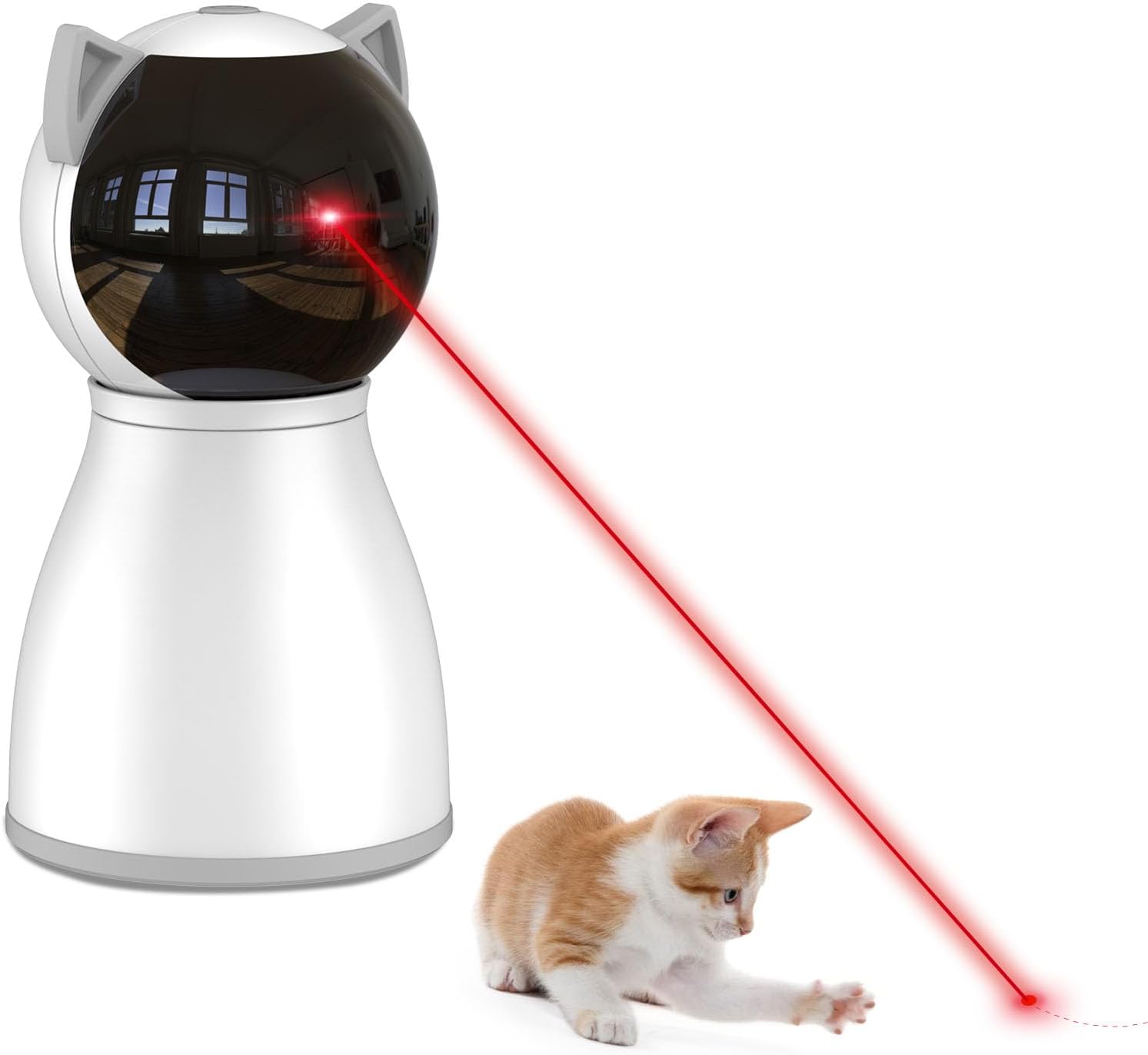
As one concrete example in the motorized teaser category, a rechargeable unit with randomized movement, adjustable speed, and a replaceable feather attachment addresses the three failure modes that kill most automatic toys: predictability, battery cost, and a lure that wears out before the motor does. It is not a substitute for wand play, and it will not engage every cat, particularly shy ones that startle easily. But for a household where the cat is alone for long stretches, it is the kind of purchase that earns its place. You can check the current price on Amazon to see whether the specifications match what your cat needs.
If the answer is that your cat needs a human-operated wand instead, that is a perfectly good conclusion. The best toy is the one that actually gets used, and for most cats that means a wand, a puzzle feeder, and one automatic backup. Everything else is optional.
cat toys interactive toys puzzle feeders feather wands enrichment toys
Frequently Asked Questions
How often should I play with my cat?
Veterinary behavior guidance generally recommends two structured sessions a day, roughly ten to fifteen minutes each, timed before meals so the play mimics a hunt followed by a meal. Frequency matters more than duration. A cat that gets two short sessions every day is better off than one that gets an hour once a week.
Why does my cat ignore toys after a few days?
Habituation. Cats stop responding to stimuli that become predictable, which is why rotation works and why randomized movement matters in automatic toys. Put the ignored toy away for a week and reintroduce it; it will often be interesting again.
Are laser pointers bad for cats?
They are not inherently harmful, but they are incomplete. A laser session that ends without a physical capture can leave a cat frustrated, and in some cats it triggers compulsive light-chasing. End every laser session with a treat or a grab-able toy.
Is catnip safe?
Catnip is considered safe for most adult cats when used as intended. Kittens under six months, pregnant cats, and cats with certain medical conditions should avoid it or be cleared by a veterinarian first. If a cat becomes aggressive rather than playful on catnip, reduce or stop use.
Can I leave automatic toys out while I am at work?
Only if the toy is designed for unsupervised use and has no parts a cat can swallow. Motorized teasers with string or feathers should generally be supervised. Rolling toys with sealed housings are safer for solo play, but even those should be inspected regularly for cracks and battery corrosion.
How do I know if a puzzle feeder is too hard?
If the cat walks away within a minute or two without eating, it is too hard. Start with a feeder that releases food almost immediately and increase difficulty only after the cat reliably finishes meals. A frustrated cat learns to avoid the feeder, and that lesson is difficult to reverse.
For broader guidance on feline health and behavior, the Merck Veterinary Manual cat owner reference is a useful starting point, and any sudden change in play behavior, appetite, or activity level is worth a veterinary conversation rather than a new toy.