Chinchilla Cages and Accessories: A Research-Based Habitat Guide
Published July 2, 2026 by PawCritic — Small Pets Category
A chinchilla cage is not a container. It is a life-support system for an animal built to leap, climb, and chew. Wild chinchillas live in the rocky, vertical terrain of the Andes, where they bound between boulders and wedge themselves into narrow crevices. That evolutionary history does not disappear in a living room. Published guidance from exotic-animal veterinarians and welfare organizations consistently describes height, solid footing, and safe materials as the three non-negotiables of chinchilla housing.
This guide explains what the published evidence and manufacturer specifications actually say about cage sizing, bar spacing, flooring, materials, and accessories. It is written for owners who want to understand the reasoning behind each recommendation rather than a ranked list of products. Where a specific product is referenced, it is offered as one concrete example of a category, not as a tested winner.
One point deserves emphasis at the outset: chinchillas are not oversized hamsters. They are long-lived rodents, often reaching 10 to 15 years in captivity, and their housing needs differ sharply from those of guinea pigs, rats, or ferrets. A cage that meets a chinchilla's needs on day one is a decade-long investment; a cage that does not is a welfare problem waiting to surface.
Why Vertical Space Is the First Specification to Check
Chinchillas are among the most vertical small mammals kept as pets. Owner reports and breeder guidance repeatedly describe animals that prefer to move upward rather than across a floor. A single bound from a lower platform to a higher one is normal locomotion, not an athletic stunt. When a cage cannot accommodate that behavior, the animal tends to compensate with repetitive pacing, bar biting, or fur chewing.
As a practical rule, published care guidance treats roughly 30 inches of interior height as the absolute floor for a single chinchilla, with 36 inches or more strongly preferred. For a bonded pair, 48 inches is a more realistic minimum. These numbers are not arbitrary. They reflect the vertical clearance a chinchilla needs to complete a full jump arc between two solid surfaces without striking the cage ceiling or a platform above.
Height also changes how a chinchilla uses a cage. In a tall, multi-level enclosure, each level becomes a distinct territory: a sleeping ledge, a feeding station, a dust-bathing corner, a lookout perch. In a short cage, all of those functions collapse into one crowded floor, and the animal has nowhere to retreat when it feels exposed. The behavioral difference between the two setups is visible to any attentive owner within a week.
Floor footprint still matters, but it is secondary. A cage that is 48 inches tall and 24 inches wide offers more usable chinchilla habitat than a cage that is 24 inches tall and 48 inches wide, even though the two have identical volume. The vertical cage gives the animal somewhere to go.
Bar Spacing, Flooring, and Materials: The Safety Specifications
Bar spacing is the specification most often gotten wrong by first-time buyers. A chinchilla can squeeze through a gap that looks far too small, and a juvenile can pass through openings that an adult cannot. Published manufacturer specifications for chinchilla cages generally fall between 0.5 and 1 inch in the narrower dimension. Spacing wider than 1 inch creates both an escape risk and a head-entrapment risk.
Flooring is the second critical safety specification. Wire floors are widely condemned in chinchilla care literature because the species lacks the padded foot structure of dogs and cats. Their feet are covered in fine fur over relatively thin skin, and prolonged standing on wire produces pressure sores and pododermatitis, sometimes called bumblefoot. Solid floors, whether plastic pans or wooden platforms, are the standard recommendation. This is one of the clearest points of consensus in the exotic-pet literature, and it is reflected in the Merck Veterinary Manual section on exotic and laboratory animals.
Materials deserve the same scrutiny. Powder-coated and epoxy-coated steel are the finishes most often specified by reputable manufacturers, because they resist rust and resist chewing. Galvanized steel resists rust effectively but carries a theoretical concern: chinchillas chew constantly, and ingested zinc coating is a toxicity risk. Owners considering a galvanized cage should raise the question with an exotic-animal veterinarian first. A directory of clinicians with this specialty is maintained by the Association of Exotic Mammal Veterinarians.
Plastic components occupy a middle ground. A thick, deep plastic base pan is useful for containing bedding and debris, and most chinchillas ignore it. A thin plastic shelf edge or ramp tread, by contrast, invites chewing. Where plastic is unavoidable, thickness and placement matter more than the material itself.
Sizing by Household: Single, Pair, and Multi-Chinchilla Setups
Sizing advice should be tied to the number of animals, not to a single universal number. A solitary chinchilla does well in a cage of roughly 36 inches tall by 24 inches wide by 18 to 20 inches deep, provided it has at least two solid levels and clear jumping space between them. A bonded pair needs closer to 48 inches of height and a wider footprint, because two animals occupying the same levels need room to separate without conflict.
Multi-chinchilla households, including breeders and rescues, often use modular or stacking systems. These allow territory to expand as the group grows. The trade-off is that stacked units can be narrow in depth, which limits running space even when total volume looks generous on paper. Depth of 18 inches is common in stacking systems; 24 inches is noticeably better for active animals.
Juvenile chinchillas present a special sizing problem. They are small enough to pass through bar spacing that would safely contain an adult, and they are energetic enough to test every gap in the enclosure. A cage with 0.75-inch by 0.5-inch spacing is the safer choice for a young animal, even if it will eventually be replaced by a larger enclosure.
What the Published Guidance Says About Accessories
Accessories are where chinchilla housing most often goes wrong, because the market is full of products designed for other species and relabeled for chinchillas. The following categories are the ones that matter, with the reasoning behind each.
Solid Ledges and Platforms
Ledges provide the landing surfaces that make a tall cage usable. Kiln-dried pine and poplar are the woods most often recommended because they are safe to chew and provide grip. Painted or varnished shelves are a poor choice because the finish can flake and be ingested. A cage with three or four well-placed ledges gives a chinchilla a genuine vertical circuit rather than a single ladder between two floors.
Hideouts With Multiple Exits
Chinchillas are prey animals and retreat when startled. A hideout with a single entrance can trap an animal that feels cornered, which is why multi-entrance wooden houses are the standard recommendation. Wooden construction is preferred over plastic for the same chewing-safety reasons that apply elsewhere in the cage.
Dust Baths
Chinchillas do not bathe in water. Their dense fur holds moisture and promotes skin problems, so the species relies on volcanic ash or pumice dust baths to absorb oils and debris. A covered dust bath house keeps the dust contained and gives the animal a private space to roll. This is not an optional accessory; it is part of basic husbandry.
Hay Feeders and Water Bottles
Grass hay should be available continuously, and a wall-mounted feeder keeps it off the floor and out of soiled bedding. For water, a bottle with a ball-bearing valve is the usual recommendation because it keeps water clean and reduces spills. Bottle capacity of at least 16 ounces is reasonable for a single chinchilla.
Food Bowls and Chew Toys
Heavy ceramic bowls resist tipping, which matters for an animal that likes to stand on the rim of its dish. Chew toys are not optional either. A chinchilla's teeth grow continuously, and untreated wood blocks, pumice stones, and safe chew sticks are the standard way to manage wear. Any product that cannot be safely ingested should be avoided, because some of it eventually will be.
A Note on Toxicity and Household Hazards
Chinchillas are sensitive to a range of household exposures that owners often overlook. Aromatic bedding such as cedar and pine shavings releases oils that are harmful to small mammals. Nonstick cookware fumes, scented candles, air fresheners, and aerosol sprays are all documented respiratory irritants for birds and small pets. Plants brought into the home may be toxic if chewed. The ASPCA Animal Poison Control maintains a searchable database of toxic and non-toxic plants and household substances that is worth consulting before introducing anything new near the cage. General small-pet care guidance is also available through the ASPCA pet care library.
Temperature is another environmental hazard that is frequently underestimated. Chinchillas evolved in a cool, dry climate and tolerate heat poorly. Temperatures above roughly 80 degrees Fahrenheit are considered dangerous, and sustained exposure can be fatal. Ideal room temperature is generally cited as 60 to 72 degrees Fahrenheit with good ventilation and no direct drafts. A thermometer placed near the cage is a basic piece of equipment, not an optional one.
One Concrete Example: A Tall Multi-Level Cage
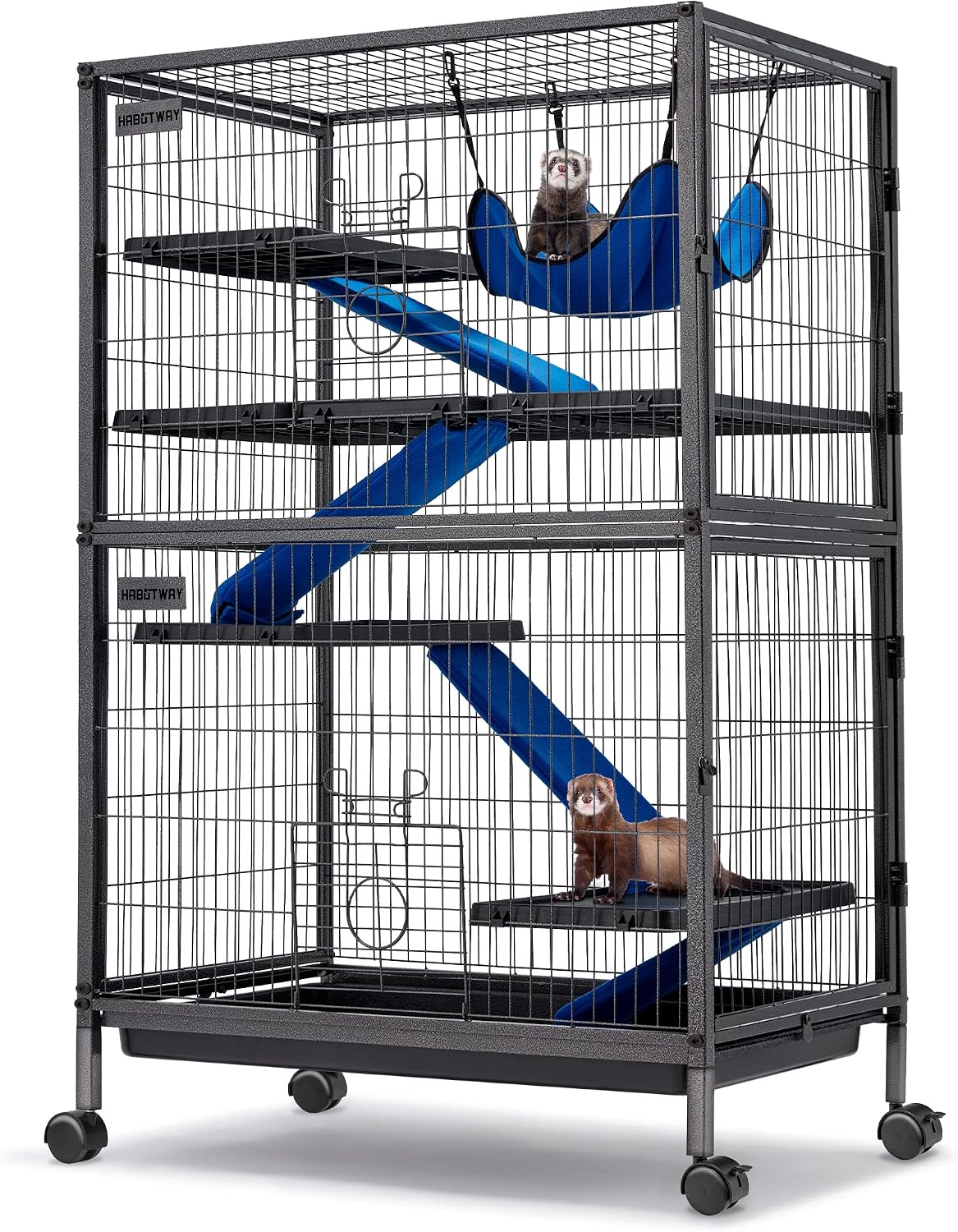
For readers who want a concrete starting point, the category of tall powder-coated steel cages with solid plastic pans and multiple levels represents the configuration most consistent with published chinchilla housing guidance. One widely available example in this category is a 48-inch tall, three-level design with solid floors and 1-inch by 0.5-inch bar spacing. Manufacturer specifications for this style of cage typically list removable level pans, a full-width front door, and included ramps and ledges.
This configuration suits a single chinchilla or a bonded pair. Its main advantage is height: three levels with clear jumping space between them allow the animal to move vertically the way the species naturally does, and solid plastic pans eliminate the wire-floor risk that produces foot injuries. Its trade-offs are also worth stating plainly. Cages in this class are heavy, often over 40 pounds assembled, which makes them awkward to move once set up. The plastic pans usually require hand wiping rather than sliding out like a drawer, so deep cleaning takes longer than it does in cages with pull-out trays. Assembly is typically required and can take the better part of an hour.
Owners who want to look at this specific option can check the current price on Amazon. It is offered here as an illustration of the tall, solid-floored, multi-level category, not as a tested winner over other cages with the same specifications.
Alternative Configurations and Who They Suit
Not every household needs a 48-inch tower. Several other configurations appear repeatedly in manufacturer catalogs and owner discussions, and each has a distinct trade-off.
Mid-size two-level cages (36 inches tall). These suit owners with limited floor space who still want meaningful vertical room. The trade-off is that a highly active chinchilla may exhaust the available height quickly and benefit from an upgrade within the first year. A deep base pan, often around six inches, is a genuine advantage in this class because it contains bedding scatter.
Extra-tall budget cages (48 inches, lighter gauge wire). These offer height at a lower price, but the savings usually show up in thinner wire, thinner plastic pans, and less precise assembly. Pan inserts that rest on wire rather than locking into a frame can shift during vigorous digging, which reintroduces a foot-injury risk if the animal contacts the wire beneath. Some owners secure pans with zip ties as a precaution.
Modular stacking systems. These suit multi-chinchilla households and anyone who expects their collection to grow. Individual units are often around 24 inches tall and connect via tunnels or stacked frames. The trade-off is narrow depth and the cost of expansion, which adds up quickly. Buyers should also confirm the coating on any galvanized system, as noted earlier.
Starter kits that bundle a cage with food and supplies. These are convenient for first-time owners because they eliminate the guesswork of assembling a shopping list. The trade-off is that the included cage is often the minimum acceptable size, meaning it will likely be replaced within a year by an owner who wants to do right by an active animal. The food and hay included in a reputable kit are usually the most valuable part of the bundle.
Cage Placement and Daily Environment
Where a cage goes matters almost as much as what the cage is. A quiet room away from direct sunlight, heating vents, and foot traffic is the standard recommendation. Kitchens are a poor choice because of cooking fumes and temperature swings. Laundry rooms are a poor choice because of humidity. Bedrooms are workable but require attention to noise, since chinchillas are most active at dawn and dusk and a squeaky wheel or dripping bottle can disrupt human sleep.
Bedding choice follows from the same logic. Kiln-dried aspen shavings and paper-based beddings are the usual recommendations. Cedar and pine shavings are avoided because of aromatic oils. Bedding depth of one to two inches across solid floor pans is typical, with wet spots removed daily and full replacement weekly.
Ventilation is a specification that rarely appears on a product page but matters in practice. A cage with solid walls on three sides traps ammonia from urine, which irritates respiratory tissue. Wire-sided cages with solid floors strike the better balance: airflow on all sides, solid footing underfoot.
Cleaning and Maintenance Realities
Chinchilla urine is concentrated and produces ammonia quickly, so cleaning frequency is not a matter of preference. Daily spot cleaning, weekly bedding replacement, and a deeper scrub every two to four weeks is the schedule most care guides describe. The cage design determines how burdensome that schedule feels.
A full-width front door, roughly 24 inches across, makes a meaningful difference because it allows access to every corner without disassembling the cage. French-style doors that split open serve the same purpose. Cages with only a small single-panel door force the owner to reach through a narrow opening, which is awkward for scrubbing and for retrieving a reluctant animal.
Removable pans simplify cleaning, but only if they actually detach. Some cages advertise removable pans that in practice require partial disassembly to free. Buyers should look for owner reports that specifically describe the cleaning process rather than relying on product copy.
Wooden accessories, including ledges and hideouts, should be inspected during each cleaning. Chewed edges splinter over time, and soiled wood cannot be fully disinfected. Replacing a worn ledge is inexpensive and prevents injury.
Common Mistakes in Chinchilla Housing
The same errors appear repeatedly in owner discussions and in guidance from exotic-animal clinicians.
- Buying a cage labeled for chinchillas without checking dimensions. Many cages sold under that label are sized for guinea pigs or hamsters. Height and bar spacing should be verified against the numbers, not the label.
- Using a ferret or guinea pig cage. Ferret cages typically have bar spacing of two inches or more, which a chinchilla can escape through or become trapped in. Guinea pig cages are too short.
- Adding a wheel that is too small. Wheels under roughly 15 inches in diameter force the spine into an unnatural curve. Wire or mesh running surfaces can catch toes. A solid-surface wheel of adequate diameter is the only safe design, and many chinchillas ignore wheels entirely in favor of jumping.
- Overfilling the cage with accessories. Every ledge, house, and toy consumes jumping space. Vertical clearance between levels is more valuable than accessory count.
- Neglecting temperature. A cage placed near a window or in a warm room can become dangerous during a heat wave. Cooling options include air conditioning and granite cooling tiles; ice packs with gel filling should never be placed directly in the cage because the covering can be chewed.
- Skipping the dust bath. Without regular dust baths, chinchilla fur becomes oily and matted, and skin problems follow.
Frequently Asked Questions
What is the minimum cage size for one chinchilla?
Published guidance generally treats 30 inches of height by 18 inches wide by 18 inches deep with two solid levels as the absolute minimum for a single animal. A more comfortable long-term size is 36 inches tall by 24 inches wide by 18 to 20 inches deep. For a bonded pair, 48 inches of height is a more realistic target, with a wider footprint to allow the animals to separate when they choose.
Can a chinchilla live in a cage designed for another species?
Generally no. Ferret cages have bar spacing that is too wide. Guinea pig cages are too short and lack the vertical structure chinchillas use. Rat cages are usually too small in every dimension. A cage designed specifically for chinchillas, with 0.5 to 1 inch bar spacing, solid floors, and adequate height, is the appropriate choice.
How often does a chinchilla cage need cleaning?
Spot cleaning daily, bedding replacement weekly, and a full scrub every two to four weeks is the standard schedule. Ammonia buildup is the reason for the frequency; chinchilla urine is concentrated and the smell becomes noticeable quickly in a poorly ventilated cage.
Are wire floors ever acceptable?
No. Wire floors are associated with pododermatitis, a painful foot condition, and are widely discouraged in chinchilla care literature. Solid plastic or wooden floors are the standard. Cages that place a plastic pan over a wire frame are acceptable only if the pan cannot shift and expose the wire beneath.
Can two chinchillas share one cage?
Yes, if they are bonded. Same-sex pairs raised together, or carefully introduced adults, can coexist well. A bonded pair needs a larger cage than a single animal, with multiple levels so each chinchilla can establish its own space. Introductions should be gradual and conducted in neutral territory.
Does a chinchilla need an exercise wheel?
Not necessarily. Many chinchillas prefer jumping between levels to running in a wheel. If a wheel is provided, it should be at least 15 inches in diameter with a solid running surface. Wheels that are too small or made of wire mesh can cause spinal and foot injuries.
Is it safe to keep a chinchilla cage in a bedroom?
It is workable with adjustments. Chinchillas are most active at dawn and dusk, so noise from wheels, bottles, and chewing can disturb sleep. Silent water bottles, removing noisy accessories at night, and positioning the cage away from the bed reduce the disruption. The animal also benefits from a dark, quiet period overnight.
Final Considerations Before Buying
The single most useful thing a prospective owner can do is measure the space available, then compare that measurement against the height and depth specifications of any cage under consideration. Height should be prioritized over width. Solid floors should be treated as non-negotiable. Bar spacing should be checked against the size of the smallest animal that will live in the cage, including a juvenile.
Materials deserve a second look as well. Powder-coated and epoxy-coated steel are the finishes most consistent with long-term durability and chewing safety. Galvanized steel warrants a conversation with a veterinarian before purchase. Thin plastic components should be evaluated for whether they will be chewed, and if so, whether they can be replaced.
Accessories should be selected for function rather than quantity: solid ledges for landing, a multi-entrance hideout for security, a covered dust bath for coat health, a wall-mounted hay feeder, a heavy ceramic bowl, and a bottle with a ball-bearing valve. Wooden chew items are part of basic dental care, not extras.
Owners who want to examine one concrete example of the tall, solid-floored, multi-level category described throughout this guide can view this option on Amazon. The same category includes several similar cages from different manufacturers, and specifications should be compared directly rather than assumed to be equivalent.
A chinchilla cage is a decade-long purchase. The animal inside it will spend most of its life there, and the specifications that matter most, height, flooring, bar spacing, and material safety, are also the ones that are easiest to verify before buying. Getting those right at the outset prevents the most common welfare problems and the most expensive mistakes.
Affiliate Disclosure: PawCritic is a participant in the Amazon Services LLC Associates Program, an affiliate advertising program designed to provide a means for sites to earn advertising fees by linking to Amazon.com and affiliated sites. Purchases made through links on this page help support independent research at no extra cost to the reader.
Last updated: July 2, 2026. Prices and availability are subject to change. Always verify current pricing before purchasing.