Dog Dental Care Products: A Research-Based Buying Guide
Dental disease is one of the most under-recognized health problems in companion dogs. Most estimates from veterinary authorities place the prevalence of periodontal disease well above half of all dogs by the time they reach middle age, and many dogs show no obvious symptoms until the condition is advanced. The purpose of this guide is to help a dog owner make informed decisions about the dental care category: which product types exist, what published guidance says about each one, what specifications matter, and how to avoid common marketing traps. PawCritic does not perform hands-on product testing; every claim below is attributed to published veterinary guidance, manufacturer specifications, or verified owner reporting.
Two concrete product examples are referenced as Amazon affiliate links so you can inspect current pricing, sizing charts, and owner feedback directly. They are examples within the category, not rankings, and there are many acceptable alternatives on the market.
Why Dental Care Matters
The mechanism of dental disease is well documented in veterinary literature. After a dog eats, food particles combine with saliva and oral bacteria to form plaque, a soft film that coats the tooth surface. If plaque is not disrupted within roughly two to three days, it mineralizes into tartar, a hard brown deposit that ordinary chewing and wiping cannot remove. Tartar below the gumline triggers inflammation of the gums, called gingivitis, which can progress to periodontal disease: infection and destruction of the ligaments and bone that hold teeth in place. The Merck Veterinary Manual's owner resources cover this progression and its warning signs, and are worth reading before you shop for any product; see the Merck Veterinary Manual dog owner reference.
The systemic angle matters too. Bacteria associated with advanced periodontal disease have been linked in veterinary studies to changes in the heart, liver, and kidneys, and chronic oral pain is widely believed to be under-reported in dogs because most dogs continue eating even with significant dental discomfort. Signs that justify a veterinary visit rather than a shopping trip include persistent foul breath, bleeding or receding gums, reluctance to chew on one side, dropped food, pawing at the mouth, loose teeth, or facial swelling. No home product substitutes for a professional examination, and professional cleaning under anesthesia remains the only way to remove tartar below the gumline. For general preventive care resources, the American Veterinary Medical Association maintains owner-facing material at the AVMA pet owner resources page.
The VOHC Seal: Your Fastest Filter
The Veterinary Oral Health Council is an independent body that reviews trial data submitted by manufacturers and awards a seal to products that demonstrate statistically meaningful plaque or tartar reduction under controlled protocols. This is the single most useful filter in the entire category, because dental product marketing is otherwise lightly regulated and claims like 'cleans teeth' or 'fights plaque' can appear on products with no supporting evidence. Before buying any chew, treat, water additive, or dental diet, check the VOHC's published list of accepted products and confirm the exact formulation and size you are buying appears on it. Manufacturers sometimes reformulate, and a reformulated product may no longer carry the seal even if the packaging looks identical to a previously accepted version.
Note what the seal does and does not tell you. It tells you a product met an evidence standard for plaque or tartar reduction in trials; it does not tell you the product is appropriate for your individual dog's size, chewing style, calorie budget, or allergy profile. Those judgments remain yours and your veterinarian's.
The Four Product Categories, Compared
Dog dental products fall into four broad families: toothbrushes and pet toothpaste, dental chews and treats, water additives, and topical gels or sprays. Each works by a different mechanism, with different evidence levels and different trade-offs, and the strongest home routines typically combine two of them rather than relying on one.
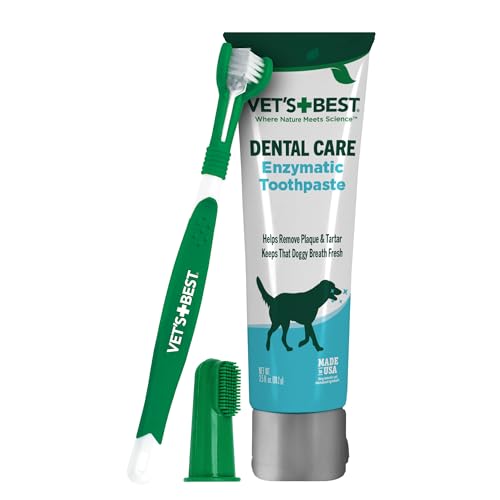
Brushing with pet toothpaste is the approach most consistently recommended in veterinary guidance, because mechanical disruption of plaque at and just below the gumline is the mechanism with the deepest evidence base. The critical specifications: the toothpaste must be formulated for dogs, because human toothpaste can contain fluoride and xylitol, both of which are toxic to dogs; enzymatic formulations are designed to continue breaking down plaque after application, which matters for dogs who only tolerate brief brushing; and the brush head should suit your dog's mouth, with finger brushes or small heads for dogs under about twenty pounds and dual-ended or long-handled brushes for larger dogs. One widely available example of the category that consistently earns strong owner feedback is a dual-ended toothbrush paired with enzymatic poultry-flavored toothpaste; you can view this option on Amazon to compare its brush geometry and paste formulation against alternatives.
The honest limitation of brushing is behavioral, not technical. Many dogs initially resist mouth handling, and owner compliance drops off quickly. Verified owner reports consistently describe success when brushing is introduced gradually over one to two weeks: letting the dog lick the paste off the brush first, then brushing a few front teeth, then extending session length. A dog who will never accept brushing is not a lost cause; it simply shifts your best available strategy toward chews and additives.
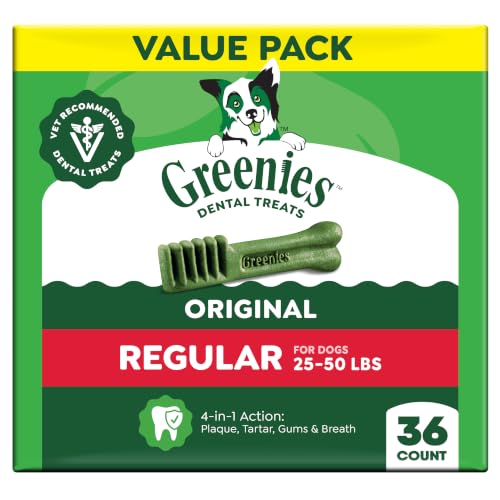
Dental chews work through mechanical abrasion during extended chewing, and several carry VOHC acceptance for tartar control. Chews suit busy households and dogs who enjoy chewing, and the chewing action itself has enrichment value. The trade-offs are real: chews only clean the surfaces the chew contacts, so they reach the pointed cheek teeth far better than the inner surfaces; calories must be subtracted from the daily ration, which matters for weight management; and gulpers who swallow chews whole get almost no dental benefit along with a choking or gastrointestinal risk. Size selection is a genuine safety issue: a chew sized for a smaller dog can splinter or lodge in a larger dog's throat, while an oversized chew exceeds a small dog's calorie needs. One frequently purchased example in this category is a long-standing VOHC-listed dental chew available in sizes from under ten pounds to over fifty pounds; you can check the current price on Amazon and cross-reference the exact size and formulation against the VOHC accepted-products list before ordering. If your dog is a power chewer or a gulper, look instead for larger, longer-lasting formats, and always supervise chewing.
Water additives are dosed into the drinking bowl daily and typically rely on ingredients such as zinc compounds, chlorhexidine, or chlorophyll to reduce bacterial load and odor. Their strongest evidence base is breath freshness rather than measurable tartar reduction, so treat them as a supplement layered onto mechanical care, not a standalone solution. Practical considerations: some dogs refuse changed-tasting water, so introduce the additive at a fraction of the labeled dose and increase gradually, and provide a second plain-water bowl during transition. Check the label for xylitol, an artificial sweetener that is highly toxic to dogs and has appeared in some orally administered products sold online; the ASPCA's Animal Poison Control center maintains searchable toxicity information at ASPCA Animal Poison Control and is the right resource if you ever suspect your dog has ingested a questionable ingredient.
Topical gels and sprays round out the category. Antiseptic gels containing chlorhexidine are used in veterinary dentistry to suppress the bacteria driving plaque and gingivitis, and no-rinse formats suit dogs recovering from dental procedures or those who cannot tolerate brushing. Manufacturer guidance on many chlorhexidine products limits continuous use to short courses, often around two weeks, unless a veterinarian directs otherwise, because prolonged antiseptic exposure can disrupt normal oral flora. Increased drooling after application is a commonly reported and usually harmless side effect. These products are best positioned as a bridge between home routines and professional cleanings, used under veterinary advice rather than as a permanent substitute for mechanical care.
Sizing, Safety, and Chewing Style
Sizing errors are the most common safety problem reported with dental chews. Always follow the manufacturer's weight ranges printed on the package, and when your dog sits near a boundary between sizes, choose the larger size for chews and the smaller size for brush heads. Evaluate your dog's chewing style honestly: power chewers fragment hard chews quickly and may benefit from tougher formats, while gentle chewers may give up on products too hard for them and get no cleaning effect at all. A practical field test described by veterinary dentists is that any chew hard enough that you cannot indent it with a thumbnail is hard enough to fracture a tooth, and fractured carnassial teeth are a common and expensive consequence of overly hard chews, bones, and antlers.
Inspect mouths after chewing sessions during the first weeks of any new product. Cuts to the palate, wedged fragments, and gum irritation are reported by owners most often during the introduction phase, and catching them early lets you switch formats before an injury develops. Any product that splinters into sharp shards should be discarded regardless of brand reputation.
Building a Routine That Actually Sticks
Published veterinary guidance consistently emphasizes consistency over intensity. A realistic progression looks like this. First, lift your dog's lips and look at the teeth and gums; if you see heavy tartar, red gums, or loose teeth, book a veterinary exam before starting anything new. Second, add one daily mechanical product, usually a chew, at the correct size, with calories subtracted from meals. Third, if you intend to brush, introduce the paste as a treat over several days, then graduate to a few teeth at a time, aiming eventually for daily or near-daily brushing of the outer surfaces; inner surfaces matter less because dogs accumulate far less plaque there. Fourth, layer a water additive only if it helps with breath or if brushing is impossible. Finally, keep annual veterinary exams, because home care slows tartar but never eliminates the eventual need for professional scaling.
Common Mistakes to Avoid
- Using human toothpaste. Fluoride and xylitol are toxic to dogs; only use paste labeled for pets.
- Buying on flavor marketing alone. Palatability matters only if the product also has evidence behind it; check the VOHC list.
- Ignoring calories. A daily chew can add a meaningful share of a small dog's energy requirement; adjust meals accordingly.
- Assuming bad breath is normal. Persistent odor is a medical sign, not a personality trait, and warrants an exam.
- Treating a water additive as complete care. Breath freshness is not the same as tartar control.
- Giving hard chews to power chewers. Slab fractures to the large cheek teeth are painful and often require extraction.
Where to Start Shopping
As a starting point for comparison shopping, the two category examples discussed above are available here: for the enzymatic toothpaste and brush pairing, check the current price on Amazon, and for the VOHC-listed daily chew in multiple sizes, check the current price on Amazon. Review the size chart, ingredient list, and recent owner reviews on each listing before purchasing, and verify VOHC status independently.
Frequently Asked Questions
How often should I brush my dog's teeth?
Daily brushing is the standard recommendation, and three to four sessions per week still provides meaningful benefit. Frequency matters more than duration; a short consistent session outperforms an occasional thorough one.
Are dental chews as effective as brushing?
No, and veterinary guidance is clear on this. Chews clean the surfaces chewing reaches, while brushing disrupts plaque at the gumline and on smooth surfaces the chew never contacts. Chews are a valuable supplement, and a strong option when brushing is impossible, but the two mechanisms are not interchangeable.
When should dental care start for a puppy?
Mouth handling can begin as soon as a puppy comes home, using finger rubbing and pet toothpaste once adult teeth arrive, typically by six to eight months. Early acclimation is repeatedly credited in owner reports with making adult brushing routine rather than a struggle.
How much does a professional cleaning cost?
Costs vary widely by region, dog size, and disease severity, and commonly range from a few hundred dollars to well over a thousand once anesthesia, scaling, polishing, dental radiographs, and any extractions are included. Consistent home care extends the interval between cleanings, which reduces both cost and anesthetic events over a dog's lifetime.
What is VOHC approval?
It is a seal awarded by the Veterinary Oral Health Council to products that met evidence standards for plaque or tartar reduction in controlled trials. It is the closest thing the category has to independent verification, and it is the first thing to check before believing any dental claim on a package.
The Bottom Line
Dental care is one of the highest-value, lowest-glamour investments in a dog's long-term health. Prioritize mechanical care, verify claims through the VOHC list, size every product correctly, count chew calories, and pair home routines with regular veterinary exams. Your dog cannot book a dental appointment; choosing evidence over marketing on their behalf is one of the clearest ways to advocate for their comfort and longevity.
Affiliate Disclosure: PawCritic may earn a commission from qualifying purchases made through product links on this page. This comes at no additional cost to you. PawCritic does not perform hands-on product testing; recommendations are based on published guidance, manufacturer specifications, and verified owner reports.
Last updated: April 2026 | Category: Dog Health and Dental Care | Author: PawCritic editorial team.