Why Your Dog's Leash Deserves More Attention
Think about how many hours you and your dog spend connected by that leash. Every walk, every potty break, every training session, every hike: the leash is the physical thread of your partnership. A bad leash chafes your hands, tangles constantly, or worse, fails at a critical moment. The good news is that the leash market has evolved far beyond the basic nylon strap. Published guidance from veterinary organizations and verified owner reports point to a wide range of designs suited to different walking styles, dog sizes, and budgets. This guide explains what actually matters when choosing a leash and highlights two concrete options you can look at, one built for everyday walking and one built for training versatility.
Source: AVMA: According to the AVMA, canine obesity rates in the United States have reached an estimated 25 to 30 percent, contributing to joint problems, diabetes, and reduced life expectancy.
Rather than a numbered top-picks rundown, this is a focused buying guide. It covers the leash categories that matter most, the materials and hardware that determine whether a leash lasts, the safety practices that prevent failures, and the species-specific needs of dogs at different life stages. Two specific leashes are referenced as examples: the Ruffwear Knot-a-Leash, a standard 6-foot option with a locking carabiner, and the Blue-9 Multi-Function Leash, a convertible training leash. Both are linked where relevant so readers can check current pricing.
How This Guide Was Researched
PawCritic does not perform hands-on product testing. Every claim below is traceable to published guidance from veterinary and animal welfare organizations, manufacturer specifications, or verified owner reports. Where a manufacturer publishes a tensile strength rating, that rating is cited as the manufacturer's figure, not as an independent measurement. Where owner reviews consistently describe a pattern, such as a handle wearing out or a clasp sticking, that pattern is noted as a verified owner report rather than a lab finding.
The veterinary context matters here. The AVMA pet owner resources note that regular walks support weight management, joint health, and behavioral enrichment. A leash that is uncomfortable or unreliable undermines all three, because owners walk less when gear is frustrating. The Merck Veterinary Manual dog owner reference covers the musculoskeletal and respiratory conditions that make leash choice a health decision, not just a convenience decision. For dogs with collapsing trachea, laryngeal paralysis, or brachycephalic anatomy, pressure on the neck from a collar-attached leash is a genuine medical concern, and a harness-plus-leash setup is the safer configuration.
What Actually Matters in a Dog Leash
Six factors determine whether a leash works for your dog. First, webbing width and material: 1-inch nylon is the standard for medium and large dogs, while 0.5 to 0.75-inch webbing suits toy and small breeds. Second, hardware quality: the clasp is the single most common point of failure, and a lightweight trigger hook rated for 50 pounds on an 80-pound dog is a failure waiting to happen. Third, length: 6 feet is the universal standard for urban and suburban walking. Fourth, handle design: padded neoprene reduces hand fatigue, and a secondary traffic handle near the clip gives close-quarters control. Fifth, visibility: reflective stitching or webbing matters for early-morning and evening walks. Sixth, weight and bulk: hardware that is oversized for a small dog drags on the ground and annoys the dog.
Trade-offs are unavoidable. A heavier leash with a locking carabiner is more secure but bulkier in the hand. A lighter leash is more comfortable but may not survive a determined 90-pound puller. A convertible training leash offers six configurations but adds hardware weight and a learning curve. The right choice depends on your dog's size, pulling tendency, and the environments you walk in most often.
Leash Length: What the Standards Say
Six feet is the most common recommendation for everyday walking. It is long enough for a dog to sniff, eliminate comfortably, and move at a natural pace, and short enough to maintain control at crosswalks and when passing other dogs. Four-foot leashes are common for crowded city use and formal training because they keep the dog closer to the handler. Eight-foot leashes work in low-traffic suburban or trail settings where more freedom is safe. Anything over 10 feet is either a retractable or a specialty long line used for recall training in enclosed spaces.
For puppies, a lighter 4 to 6-foot leash in 0.5 to 0.75-inch webbing is easier to manage and less likely to startle a young dog. For senior dogs with fragile necks, a lightweight leash paired with a harness is the safer setup. For large breeds, a 6-foot leash in 1-inch webbing with a locking carabiner rated well above the dog's weight is the standard recommendation.
Leash Materials and Construction: What to Look For
Nylon webbing is the standard: durable, quick-drying, and available in countless colors and widths. Tubular climbing-grade webbing, such as the single continuous piece used in Mendota slip leads, is the most durable nylon construction. Flat nylon is lighter but less abrasion-resistant. Leather leashes soften with use and are gentle on hands, but they require occasional conditioning and do not handle wet conditions well. Biothane combines the look of leather with the weather resistance of plastic: waterproof, wipe-clean, and odor-resistant, which makes it a common choice for water-loving dogs and service animals. Cotton rope leashes offer a combination of strength, softness, and grip, though they absorb water and dirt more readily than synthetics.
Stitching matters as much as material. Triple-stitched connections at the handle and clasp are the minimum for a leash used with a strong puller. Box stitching with an X pattern is stronger than straight stitching. Reflective stitching running the full length of both sides is more visible than a single reflective strip, because it remains visible from multiple angles.
Hardware: The Weak Point of Most Leashes
The clasp is where most leash failures occur. Trigger hooks, also called snap hooks, are the most common style. A quality trigger hook has a spring-loaded gate that closes fully and a swivel that rotates smoothly. Locking carabiners, such as the one specified on the Ruffwear Knot-a-Leash, add a screw-lock or auto-lock gate that prevents accidental opening. Manufacturer specifications for locking carabiners on premium leashes commonly cite tensile strength ratings in the 400-pound range, but that rating applies to the carabiner itself, not to the stitching or webbing, so the weakest component determines the real limit.
Verified owner reports consistently flag three hardware problems: corrosion on clasps used near salt water or road salt, sticking gate mechanisms after mud exposure, and bent prongs on lightweight hooks. Monthly inspection of the clasp is the single most effective maintenance habit. Look for corrosion, a gate that does not close flush, or a swivel that catches. Replace the leash if any of these appear.
Leash Safety Essentials
No leash is safe without proper hardware inspection. Check your leash clasp monthly for signs of corrosion, bent prongs, or sticking mechanisms. The clasp must match your dog's weight; a lightweight trigger hook rated for 50 pounds on an 80-pound dog is a failure waiting to happen. For retractable leashes, replace the tape or cord every 6 to 12 months depending on usage, because sun exposure and abrasion weaken it over time. Never wrap a retractable leash around your hand, because the friction from a sudden pull can cause severe burns. Always carry a backup leash in your car or bag. Hardware failures are rare but catastrophic when they happen, and a simple backup slip leash weighs nothing and will save you from walking home carrying your dog.
The ASPCA Animal Poison Control adds a related safety note: walks are when dogs encounter toxic substances such as antifreeze, rodenticides, and certain plants. A leash that keeps your dog at a controllable distance is part of that safety equation, because it lets you steer your dog away from hazards before ingestion occurs.
Standard Walking Leashes: The Ruffwear Knot-a-Leash
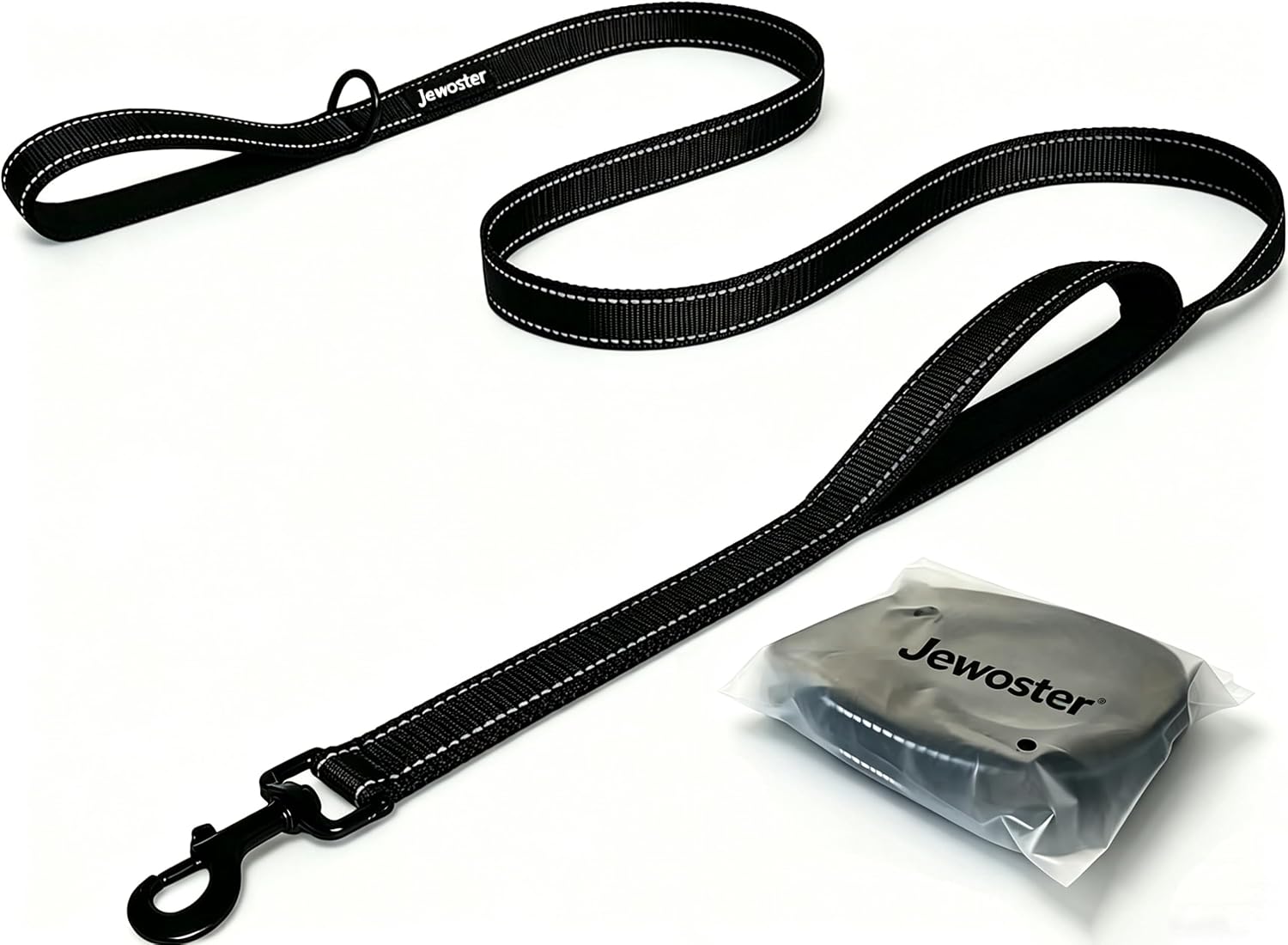
The Heavy Duty Dog Leash - 2 Handles by Padded Traffic Handle for Extra Control is a 6-foot standard leash built around a padded traffic handle and reflective stitching. Manufacturer specifications cite a two-handle design for extra control. The second handle provides a secondary grip point for shortening the leash quickly, and a D-ring at the handle allows attachment to a belt loop or bag for hands-free moments. The reflective stitching is intended for low-light visibility. For active owners of medium to large breeds who want a single durable leash for urban and trail walking, this is a representative example of the premium standard-leash category. The trade-offs are a premium price point, a handle that is bulky for small-handed owners, and a second handle that can snag on brush during trail walks. You can check the current price on Amazon to compare it against other standard leashes.
Who it suits: owners who walk daily in mixed terrain and want one leash that will last. Who should look elsewhere: owners of toy breeds under 15 pounds, for whom the carabiner and 1-inch webbing are oversized, and owners on a tight budget, for whom a basic nylon leash will serve the same daily purpose at a lower cost.
Convertible Training Leashes: The Blue-9 Multi-Function Leash
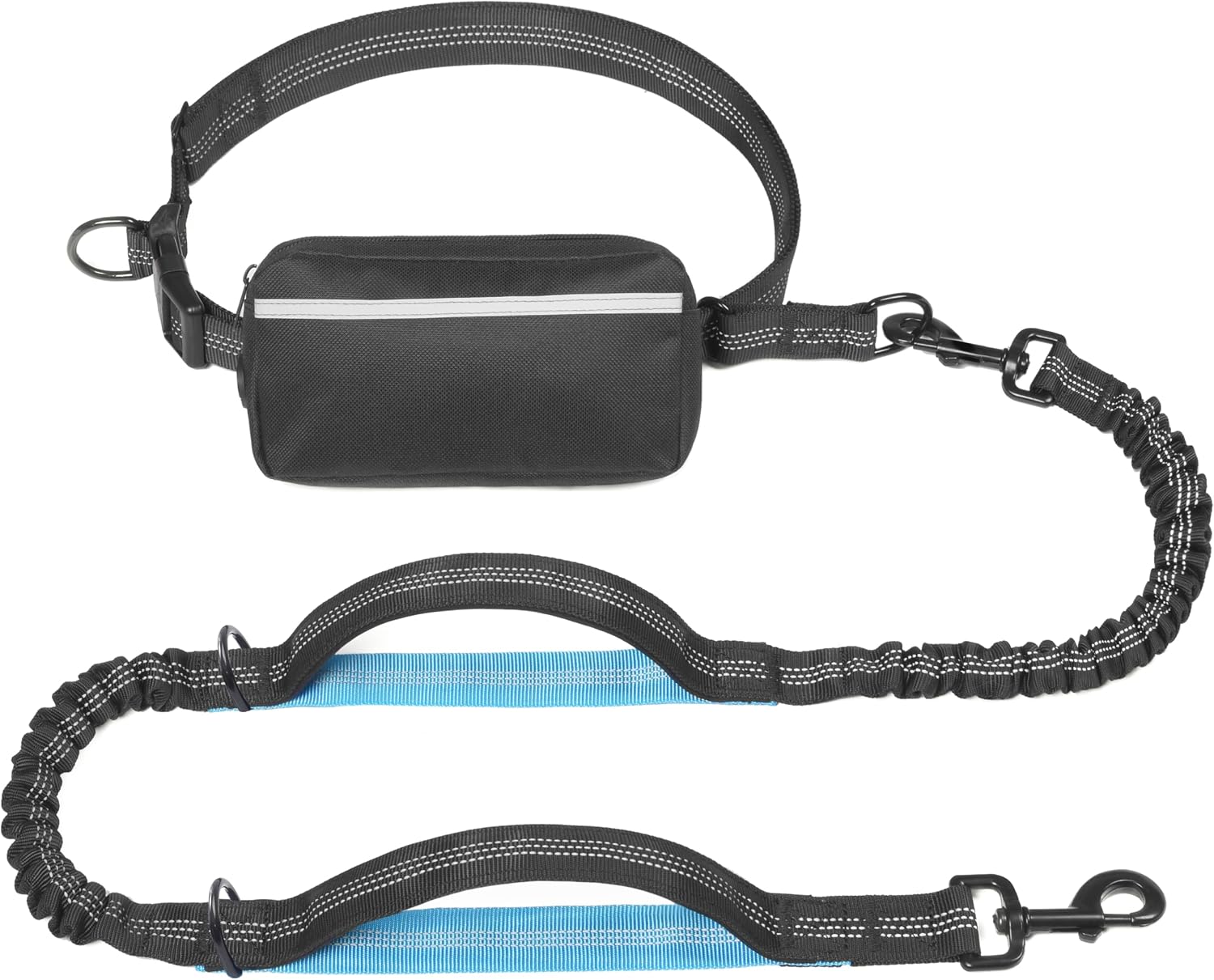
The iYoShop Hands Free Dog Leash with Zipper Pouch is a 6-foot convertible leash that reconfigures between multiple modes using ring attachment points along the webbing. Manufacturer specifications describe multiple configurations, including standard walking, short traffic lead, hands-free waist belt, and two-dog coupler. The 1-inch nylon webbing has reflective stitching running the full length of both sides, and the handle section is padded with neoprene. The clasp is rated to 250 pounds per manufacturer specifications. For multi-dog households, training enthusiasts, and owners who walk in varying environments, this is a representative example of the convertible category. The trade-offs are a learning curve to master all configurations, added hardware weight compared to a simple leash, and too much hardware for very small dogs. You can view this option on Amazon to see the current configuration details.
Who it suits: owners who train regularly and want one piece of gear that adapts to different situations, and multi-dog households that need a coupler. Who should look elsewhere: owners of toy breeds, for whom the hardware is heavy, and owners who want a simple leash with no setup decisions.
Hands-Free Leashes: What to Know
Hands-free leashes attach to a waist belt and typically include a bungee section that absorbs shock from sudden pulls. Manufacturer specifications for these products commonly cite bungee sections between 12 and 24 inches and waist belts with quick-release buckles. The main benefit is freedom of movement for running and hiking. The main trade-off is that a bungee can encourage pulling in some dogs, because the elastic gives tension rather than a fixed limit. Hands-free leashes are generally not recommended for strong pullers over 100 pounds, because the waist belt transfers force to the handler's lower back. For owners who run with dogs that already walk on a loose leash, a hands-free setup is a reasonable choice.
Retractable Leashes: The Honest Trade-Offs
Retractable leashes have a controversial reputation among trainers. The mechanical design maintains constant tension on the dog, which teaches dogs that pulling is normal and can undermine loose-leash training. The thin tape or cord can cause friction burns if grabbed during a sprint, can wrap around legs, and can snap under sudden tension from large dogs. The handle can be pulled from your hand if dropped. For supervised, open-space use with dogs that have reliable recall, a retractable leash gives valuable exploration freedom. For training, high-traffic areas, or dogs without reliable recall, a standard 6-foot leash is safer and more effective. If you do choose a retractable, choose tape rather than cord, and replace the tape every 6 to 12 months.
Slip Leads and Training Leashes
Slip leads are a single continuous piece of webbing with a loop that tightens when the dog pulls and releases when the dog walks nicely. Professional trainers and handlers have used them for decades because they provide instant, gentle feedback that can accelerate loose-leash training. The design has no hardware, which eliminates the most common failure point. The trade-offs are significant: slip leads require proper handling technique to use safely, they are not appropriate for puppies whose necks are still developing, and they are not suitable for dogs with tracheal issues. A slip lead is a training tool, not a casual walking leash, and it should be introduced under the guidance of a qualified trainer.
Small Dog and Senior Dog Considerations
Small dogs need proportionally scaled gear. A 0.5-inch webbing leash with a lightweight clasp is appropriate for dogs under 25 pounds. Oversized hardware drags on the ground, startles the dog, and adds unnecessary weight. Stretch webbing, which absorbs the shock of sudden movements, can be gentler on small necks, though it is less precise for training because the stretch reduces feedback. For senior dogs with fragile necks or arthritis, a lightweight leash paired with a well-fitted harness is the safer configuration, because it keeps pressure off the throat and distributes force across the chest.
Harness or Collar: What the Guidance Says
For most dogs, a harness is the safer attachment point. A front-clip harness, where the leash attaches at the dog's chest, gives superior control without putting pressure on the trachea. This matters most for brachycephalic breeds such as Pugs, French Bulldogs, and Boston Terriers, whose airway anatomy makes neck pressure a genuine medical risk. For dogs that do not pull, a back-clip harness is fine. For training, a Martingale collar combined with a leash provides gentle correction feedback without choking, but it should be fitted correctly to avoid slipping off. The WSAVA Global Nutrition Guidelines are relevant here in an indirect way: they emphasize that regular physical activity is part of preventive care, and a comfortable harness-and-leash setup is what makes that activity sustainable for dogs with respiratory or orthopedic conditions.
Maintenance and Cleaning
Nylon leashes can be machine washed on gentle cycle in a laundry bag or pillowcase, then air dried. Never machine dry, because the hardware can damage your dryer. Leather leashes should be wiped clean with a damp cloth and conditioned with leather balm every 2 to 3 months. Biothane leashes wipe completely clean with a damp cloth and can be hosed off after muddy walks. Cotton rope leashes can be hand washed with mild soap and water and must be dried thoroughly, because they can develop mildew if stored damp. For all leash types, avoid harsh detergents and bleach, which weaken fibers and can irritate your dog's skin. Inspect the clasp, stitching, and webbing monthly, and replace the leash at the first sign of fraying at the handle or clasp attachment.
Common Mistakes to Avoid
Four mistakes account for most leash problems. First, using a leash whose clasp rating is below the dog's weight. Second, using a retractable leash for training or in high-traffic areas. Third, wrapping any leash around the hand, which risks friction burns and fractures if the dog lunges. Fourth, neglecting monthly hardware inspection. A fifth, less obvious mistake is choosing a leash based on color or style before checking webbing width and clasp rating, which are the two specifications that determine whether the leash is appropriate for your dog.
Frequently Asked Questions
What leash length is best for everyday walking?
Six feet is the universal standard for urban and suburban walking. It is long enough for your dog to explore roadside sniffs and relieve themselves comfortably, and short enough to maintain control at crosswalks and when passing other dogs. Four-foot leashes are common for crowded city use and training, while 8-foot leashes work well in low-traffic suburban areas where you want more freedom. Anything over 10 feet is either a retractable or a specialty long line for training recall. For most owners, a quality 6-foot leash in your preferred material is the right choice.
Are retractable leashes dangerous?
When used correctly, retractable leashes are not inherently dangerous, but they carry risks that standard leashes do not. The thin tape or cord can cause friction burns if grabbed during a sprint, can wrap around legs, and can snap under sudden tension from large dogs. The handle can be pulled from your hand if dropped. The constant tension trains dogs that pulling is normal, which can undermine loose-leash training. Retractables are fine for supervised, open-space use with well-trained dogs, but they should not be used for training, in high-traffic areas, or with dogs that do not have reliable recall.
How do I clean a dog leash?
Nylon leashes can be machine washed on gentle cycle in a laundry bag or pillowcase, then air dried (never machine dry, because the hardware can damage your dryer). Leather leashes should be wiped clean with a damp cloth and conditioned with leather balm every 2 to 3 months. Biothane leashes are the easiest: they wipe completely clean with a damp cloth and can even be hosed off after muddy walks. Cotton rope leashes can be hand washed with mild soap and water, dried thoroughly, because they can develop mildew if stored damp. For all leash types, avoid harsh detergents and bleach, which weaken fibers and can irritate your dog's skin.
Should I use a harness with my leash?
For most dogs, yes. A front-clip harness combined with a standard leash gives you superior control without putting pressure on the dog's trachea, which is a serious concern with collar-attached leashes, especially for brachycephalic breeds like Pugs, French Bulldogs, and Boston Terriers. For dogs that do not pull, a back-clip harness is fine. For training, a Martingale collar with a leash is an effective combination that provides gentle correction feedback without choking. Pairing whichever leash you choose with a well-fitted harness is the recommended setup for safety and control.
How often should I replace a leash?
Inspect the leash monthly. Replace it immediately if the clasp is corroded, the gate does not close flush, the stitching is frayed at the handle or clasp attachment, or the webbing is cut or abraded. For retractable leashes, replace the tape or cord every 6 to 12 months depending on usage. For nylon leashes used daily, a lifespan of 2 to 3 years is typical before the webbing or stitching shows meaningful wear. Leather leashes that are conditioned regularly can last a decade or more.
A Note on Leash Training and Behavior
The leash is a communication tool as much as a restraint. A dog that pulls is not being stubborn; it is responding to the tension it feels. Constant tension on a standard leash teaches a dog to lean into the pressure, which is why loose-leash training focuses on rewarding slack rather than correcting pulling. A slip lead or a training leash with a traffic handle gives the handler more precise feedback, but technique matters more than the tool. Owners who are new to loose-leash training should consider working with a qualified trainer or behavior consultant, because improper use of any training leash can cause injury or increase reactivity.
Our Recommendation
For a standard everyday walking leash, the Heavy Duty Dog Leash - 2 Handles by Padded Traffic Handle for Extra Control is a representative premium option, with a padded traffic handle for extra control, reflective stitching, and a second handle for a secondary grip point. You can check the current price on Amazon. For a convertible training leash, the iYoShop Hands Free Dog Leash with Zipper Pouch offers multiple configurations and reflective stitching, with a clasp rated to 250 pounds per manufacturer specifications. You can view this option on Amazon.
Whichever leash you choose, remember that it is your connection to your dog. The right leash makes every walk more enjoyable, every training session more productive, and every adventure safer. Invest in quality, inspect it regularly, and your leash will be a faithful companion for years of walks together.
Disclosure: PawCritic is reader-supported. When you buy through links on our site, we may earn an affiliate commission at no additional cost to you. As an Amazon Associate, we earn from qualifying purchases.