Why Every Gecko Heat Source Needs a Thermostat
Leopard geckos, African fat-tailed geckos, crested geckos, and tokay geckos are all ectothermic, which means they depend on the environment around them to regulate body temperature. In the wild they shuttle between sun-warmed surfaces and shaded retreats; in captivity, keepers replicate this with under-tank heat mats, ceramic heat emitters, and basking lamps. The problem is that these devices are designed to run at a fixed output, and a heat mat left unregulated can drive its surface temperature far above the safe range, with published husbandry guidance repeatedly linking unregulated heat mats to thermal burns in reptiles. Veterinary resources such as the Merck Veterinary Manual's exotic animals section describe thermal burns as a common and preventable injury in captive reptiles, typically caused by heating equipment that was never connected to a controller.
A thermostat sits between the wall outlet and the heater, reading temperature through a probe and switching power on or off, or adjusting it proportionally, to hold a target you set. Without one, the hot spot inside the warm hide is simply whatever the mat or emitter happens to produce that day, and it changes with room temperature, substrate depth, and how the enclosure is stocked. An unregulated mat that reads 95 degrees Fahrenheit on a mild afternoon can climb past 110 on a warm evening while the room heats up. Because geckos do not always move away from painful heat before damage occurs, the safe approach is to control every heat source, every time, regardless of wattage or brand claims.
gecko thermostats
How a Reptile Thermostat Actually Works
The core of any reptile thermostat is a temperature probe, usually a thermistor on the end of a thin cable, paired with a relay or dimming circuit. You set a target temperature; the controller compares the probe reading against that target and decides how much power to send to the heater. The differences between thermostat types come down to how they deliver that power. An on/off unit runs the heater at full power until the target is reached, then cuts it entirely until the temperature falls by a degree or two. A proportional or dimming unit feeds the heater a continuously adjusted amount of power, easing off as the probe approaches the target instead of slamming between full-on and full-off. Both types can hold a stable temperature; they differ in smoothness, heater lifespan, and which kinds of heaters they suit.
The Four Main Thermostat Types
- On/off thermostats: The simplest and cheapest design. Full power until the target is reached, then full cutoff. Well suited to heat mats and other non-light-emitting resistive heaters, where the thermal mass of the mat and glass smooths out the cycling. Expect a small oscillation of a few degrees around the set point, which is acceptable for belly heat applications.
- Dimming thermostats: Reduce power gradually rather than switching it off. They suit light-emitting heat sources such as basking bulbs, because the bulb does not visibly flicker on and off, and they extend bulb life considerably. They also work well with ceramic heat emitters when paired with appropriate sensor placement.
- Pulse proportional thermostats: Send short pulses of full power at varying frequency. Excellent for ceramic heat emitters and heat cables, which do not emit light, but unsuitable for basking bulbs because the pulsing causes visible flickering.
- Multi-channel and programmable units: Combine several independent control channels, day and night temperature schedules, alarms, and sometimes data logging. These are aimed at keepers running multiple enclosures or breeding racks, and their cost is justified only when you genuinely need the extra channels.
What to Look For When Choosing a Thermostat
Wattage capacity is the first specification to check. Every thermostat lists a maximum load, commonly ranging from around 100 watts for basic single-outlet units up to 1000 watts or more for dual-channel controllers. Add up the rated wattage of every device you plan to run through the unit and stay comfortably under the ceiling, because running a controller at its absolute maximum shortens relay life. Heater type compatibility matters just as much: an on/off controller is fine for a heat mat but will rapidly cycle a ceramic heat emitter, wearing out both the relay and the emitter, whereas a dimming or pulse proportional unit is the right match for emitters and bulbs.
Probe design deserves close attention. Look for a probe rated as water resistant, since gecko enclosures, especially humid ones for crested geckos, expose cables to moisture and condensation. Check the cable length against your room layout, because a probe cable that must be stretched taut across a doorway will eventually be snagged or chewed. A visible readout of the current probe temperature, rather than only the set point, lets you notice a drifting or failing probe early, which is one of the cheapest forms of insurance available. Finally, consider alarms and outage memory. A unit that sounds an audible alarm when the temperature leaves your chosen range, and that remembers its settings after a power cut, costs little more than a bare model and removes a whole category of silent failure.
Independent husbandry guidance is worth consulting alongside product specifications. The Association of Reptilian and Amphibian Veterinarians resource library publishes material on proper thermal husbandry, and experienced keepers consistently report that probe placement and calibration checking matter more than brand choice for preventing burns.
Two Concrete Examples Worth Examining
Rather than a long ranked list, it helps to look at two widely used controllers that between them cover the needs of most gecko keepers. These are the two units this site links to, and they represent opposite ends of the feature spectrum: a dual-channel digital controller at a budget price, and a compact single-outlet unit for straightforward heat mat duty. Examining what each does well, and where each falls short, illustrates most of the buying decisions you will face.
The Dual-Channel Digital Controller
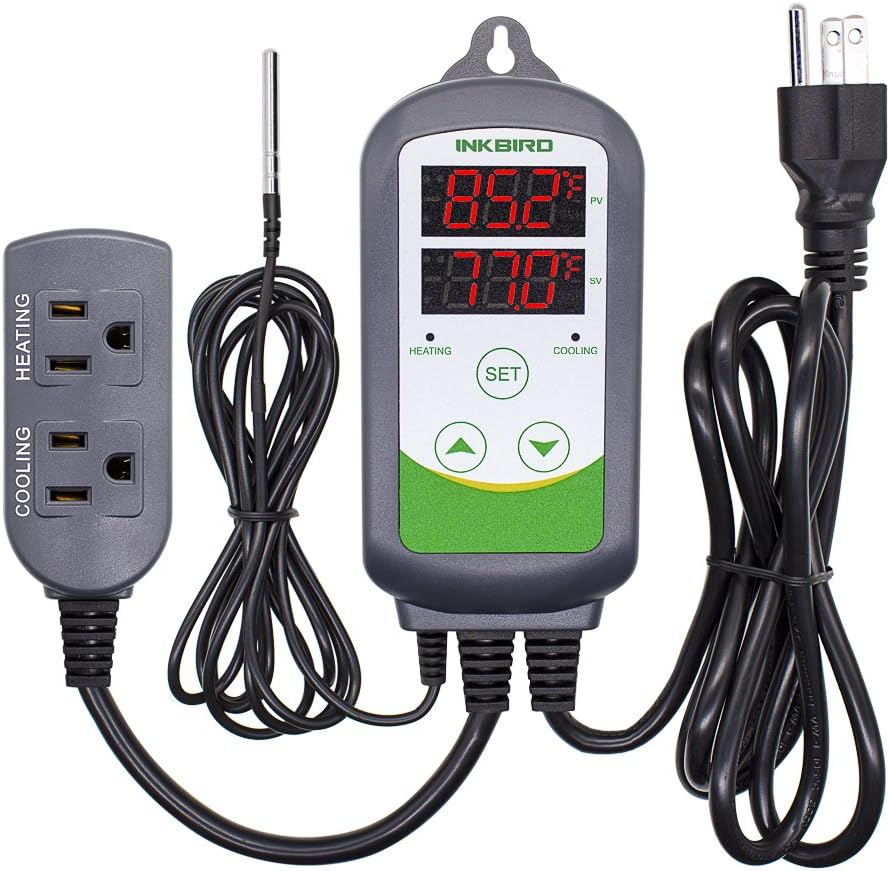
The first example is a dual-output digital thermostat of the kind widely used by reptile keepers, home brewers, and greenhouse gardeners alike. Per the manufacturer's specifications, it offers two independently controlled outlets, each with its own programmable temperature band, so a single unit can manage two enclosures or one enclosure's heating plus a cooling fan. It displays the live probe temperature, includes high and low audible alarms, records minimum and maximum temperatures so you can review overnight swings, and retains settings through a power outage. Verified owner reviews consistently praise the value of getting two channels at a price point where most reptile-branded units offer one.
The trade-offs are real, though. It is an on/off controller, not a dimming one, which makes it a poor match for ceramic heat emitters or basking bulbs that would cycle constantly. The menu system takes some patience to learn, with several button presses required to change a set point, and the plastic housing is light enough that it should be mounted rather than left dangling by its cords. Probes are basic thermistors, and long-term owner reports suggest checking their accuracy against a separate thermometer once or twice a year. For keepers running two or more heat-mat enclosures on a budget, the value is hard to beat; for a single basking setup, it is the wrong tool. You can check the current price on Amazon to see the live specifications and wattage ratings.
The Compact Single-Outlet Unit
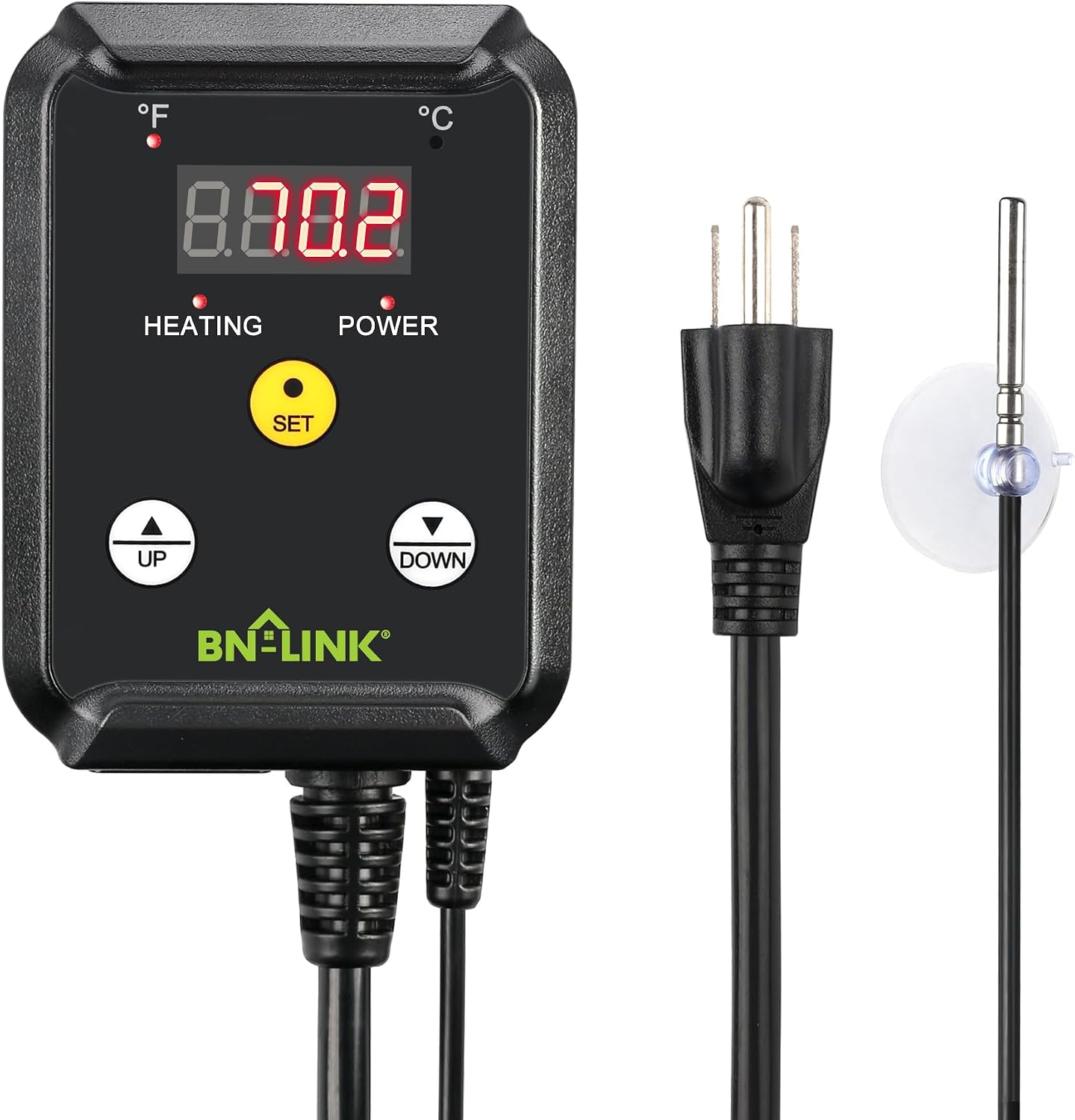
The second example is a simple single-outlet thermostat intended for one heat mat or other resistive heater. Its virtues are the virtues of simplicity: one probe, one dial or one small display, one outlet, and very little that can go wrong or be misconfigured. For a first leopard gecko or fat-tailed gecko enclosure with a single under-tank mat, this covers the entire requirement. Owner reviews describe these units as reliable over multi-year service when the probe is handled carefully and the wattage limit is respected.
The limitations follow directly from the simplicity. One channel means one enclosure, so multi-tank keepers will need several units or a step up to a multi-channel controller. The temperature range and wattage ceiling are modest, so verify before purchase that your mat's rated wattage fits under the limit. And as with all on/off designs, it should not be used with light-emitting bulbs or emitters that would be damaged by constant cycling. If your setup matches its limits, it is a sensible and inexpensive choice; view this option on Amazon to confirm the current model's exact ratings.
Matching a Thermostat to Your Gecko Species
Leopard Geckos and African Fat-Tailed Geckos
These terrestrial species need a warm hide surface temperature in the high 80s to low 90s Fahrenheit, achieved with an under-tank heat mat covering roughly one third of the floor. An on/off thermostat is appropriate here, with the probe taped to the floor of the warm hide at gecko level, ideally sandwiched lightly in the substrate or attached directly to the glass under the hide. If a ceramic heat emitter supplements ambient warmth, run it through a dimming or pulse proportional channel of its own, because two heaters should never share a single probe and set point. Always verify the surface temperature with a separate digital thermometer or infrared temperature gun, since probe placement errors of even an inch can shift readings by several degrees.
Crested Geckos and Gargoyle Geckos
These arboreal, moisture-loving species come from mild climates and do best at ambient temperatures of roughly 72 to 78 degrees Fahrenheit, with many keepers running no heat source at all except during cool winters. Where heating is needed, a low-wattage ceramic emitter or radiant panel controlled to keep the enclosure from dropping below about 70 degrees is the usual approach, and a simple thermostat provides the safety layer. Overheating is actually the bigger danger with crested geckos, since sustained temperatures above the low 80s cause stress and collapse, so a controller with a high-temperature alarm is a genuine advantage. In warm climates, a thermostat's cooling function, switching a small fan, is more useful than its heating function.
Tokay Geckos and Other Tropical Species
Tokay geckos and similar tropical climbers want warm ambient temperatures in the low 80s with a somewhat warmer localized basking opportunity, typically supplied by a ceramic emitter or low-wattage basking bulb mounted above the enclosure's upper reaches. A dimming thermostat suits the bulb; pulse proportional suits the emitter. The probe should sit near the animal's favored resting branch rather than on the floor, because in an arboreal setup the meaningful temperature is the one at perch height. Humidity is high in these enclosures, so choose a probe described as water resistant and route cables outside the spray zone.
Probe Placement: The Detail That Determines Everything
A thermostat can only control the temperature its probe can sense, which makes probe placement the single most consequential decision in the whole setup. For under-tank heat mats, the industry-standard guidance is to place the probe on the floor surface of the warm hide, held in firm contact with the substrate or glass, because that is the surface the gecko's belly actually touches. A probe taped to an outer wall reads glass temperature, not floor temperature, and can leave the true hot spot running many degrees hotter than the display suggests. For overhead heat, position the probe at the level where the animal basks or rests, shielded from direct line-of-sight to the bulb if the manufacturer recommends it. Secure the probe with a non-adhesive method such as aquarium-safe silicone, a cable clip, or a wedge of cork so the gecko cannot dislodge it while digging.
Plan for probe failure from day one. Probes are the most fragile part of any thermostat; insulation stiffens, connectors oxidize, and readings drift. Keep a cheap digital thermometer with a separate probe inside the enclosure as an independent check, and compare it against the thermostat's display weekly. If the two disagree by more than a couple of degrees, trust neither until you have determined which one is wrong. Replacing a probe every one to two years is inexpensive insurance, and labeling the installation date on the cable with a marker makes the schedule easy to follow.
Safety Practices That Prevent Burns
- Never run any heat mat unregulated. Manufacturer documentation for heat mats explicitly instructs users to employ a controller, and veterinary case reports of thermal burns almost always trace back to unregulated equipment.
- Do not stack substrate over a heat mat. Thick bedding acts as insulation and lets surface heat build; follow the mat maker's stated substrate depth limits.
- Raise glass enclosures on feet or spacers so air can move under a mounted heat mat and heat cannot trap against shelving.
- Keep wattage headroom. Running a thermostat at or near its maximum rated load heats the relay and shortens its service life; stay at roughly 80 percent or below.
- Verify after any change. New substrate, a moved hide, or a rehomed gecko can change how heat moves through the enclosure; recheck the warm spot with a separate thermometer afterward.
- Route cables away from water and chewing. Geckos and feeder insects will investigate cables; cable clips and protective trunking prevent damage that could expose live wiring.
Burns are not the only hazard worth planning against. If a pet ever accesses the enclosure, the ASPCA Animal Poison Control service is the standard emergency contact for ingestion emergencies involving substrate, supplements, or cleaning chemicals, and their number belongs on the wall near your reptile room alongside your exotics veterinarian's details.
Common Mistakes and How to Avoid Them
The most frequent mistake, by a wide margin, is buying the thermostat and then never verifying its readings. A controller straight from the box can be out of calibration, and a probe damaged in shipping can read wildly wrong while the display looks perfectly normal. Run the empty, fully set-up enclosure for a full day before the animal arrives, checking the warm spot with an independent thermometer at several points during that period. The second most common mistake is using an on/off thermostat with a ceramic heat emitter; the relay clicks every few seconds, the emitter's element is stressed by constant thermal cycling, and enclosure temperature visibly swings. Match the controller type to the heater type as described above and the problem disappears.
Other recurring errors include taping the probe to the cool end and wondering why the hot spot scorches, running two heaters through one outlet strip controlled by a single probe, and assuming the thermostat's display replaces a thermometer entirely. Keepers also sometimes mount controllers inside humid enclosures where condensation kills the electronics; thermostats belong outside the tank, with only the probe going in. Finally, do not ignore the alarm. A unit that beeps intermittently is telling you something, whether it is a probe coming loose, a set point typo, or a room that has gotten too warm, and silencing it without investigating defeats its purpose.
Setup Walkthrough for a Typical Heat Mat Installation
Begin with the enclosure empty and positioned on a surface that allows airflow beneath it if the mat mounts underneath. Attach the mat per the manufacturer's instructions, usually on the outside bottom glass toward one end, and press the thermostat's probe into position on the floor of the warm hide. Plug the mat into the thermostat and the thermostat into the wall, then set your target temperature, in the high 80s Fahrenheit for leopard geckos, following the species guidance above. Power on and let the system run for two to three hours, checking the floor of the warm hide with a separate probe thermometer every half hour or so. Adjust the set point in small increments until the measured floor temperature, not the display number, lands where you want it. Record the final settings and the verification date so future drift is easy to spot. Only after a full stable day should the gecko be introduced.
Comparison of Thermostat Characteristics
| Controller type | Suitable heaters | Typical channels | Typical price band | Best suited to |
|---|---|---|---|---|
| Basic on/off | Heat mats | 1 | $20-35 | Single heat mat, first enclosure |
| Dual-channel digital on/off | Heat mats, cooling fans | 2 | $35-50 | Two enclosures on a budget |
| Dimming | Basking bulbs, emitters | 1 | $40-100 | Overhead basking setups |
| Pulse proportional | Ceramic emitters, heat cable | 1 | $50-120 | Ambient overhead heat |
| Multi-channel proportional | Mixed, per channel | 2-4+ | $150-350 | Breeding racks, serious collections |
Frequently Asked Questions
Can one thermostat run a heat mat and a ceramic emitter together?
No, not from a single channel. Each heater needs its own probe and its own control loop, because the two operate at different temperatures in different places. A dual-channel unit solves this, provided the channel type matches the heater: an on/off channel for the mat, a dimming or pulse channel for the emitter. Two on/off channels, as found on the dual-output digital controller discussed earlier, work for two heat mats but not for a mat plus an emitter.
Do thermostats need calibration?
Reputable units leave the factory reasonably accurate, but probes drift with age, moisture exposure, and physical stress. The practical approach is verification rather than recalibration: keep an independent trusted thermometer in the enclosure and compare readings monthly. If a controller and thermometer disagree persistently, replace the probe or the unit rather than trying to compensate mentally.
What temperature should the probe read for a leopard gecko?
Published husbandry guidance for leopard geckos centers on a warm-hide surface temperature in the high 80s to about 92 degrees Fahrenheit, with the cool end of the enclosure in the mid 70s. The thermostat probe, placed on the warm-hide floor, should be set so the actual floor surface, measured independently, falls within that band.
Are cheap thermostats dangerous?
Price correlates weakly with safety. What matters is wattage headroom, correct heater-type matching, secure probe placement, and independent verification with a separate thermometer. An inexpensive on/off unit doing proper heat mat duty, checked weekly, is safer than an expensive proportional controller with a dislodged probe. The danger lies in skipping verification, not in saving money on the controller itself.
The Bottom Line
Every heat source in a gecko enclosure belongs on a thermostat, without exception. For keepers with one or two heat-mat enclosures, the dual-output digital controller offers two channels, alarms, and outage memory at a modest price, though its on/off switching makes it a heat-mat tool rather than an overhead-heat tool; check the current price on Amazon to review its specifications. For a single straightforward heat mat, a compact single-outlet unit does the whole job for less, and you can view this option on Amazon as well. Whatever you buy, place the probe carefully, verify with an independent thermometer, and recheck monthly. The cost of the controller is trivial next to a veterinary bill for thermal burns, and the habit of verification is what actually keeps geckos safe over years of keeping.
Affiliate Disclosure: PawCritic.com participates in the Amazon Services LLC Associates Program. We may earn commissions from qualifying purchases at no extra cost to you.