Why Humidity Is the Most Overlooked Aspect of Snake Husbandry
The claim that snakes are desert-adapted animals that never need misting is one of the most persistent and damaging myths in reptile keeping. The most commonly kept pet snakes, including ball pythons, corn snakes, king snakes, milk snakes, carpet pythons, and boas, originate from habitats ranging from African rainforests to North American meadows where ambient humidity routinely reaches 60 to 80 percent. Even species associated with drier regions, such as corn snakes, experience humidity spikes of 50 to 70 percent at dawn when dew forms. The Merck Veterinary Manual section on exotic and laboratory animals notes that inadequate environmental humidity is a recurring contributing factor in dermatological and respiratory disease among captive reptiles.
Without adequate humidity, snakes develop a predictable cascade of health problems. Stuck shed, also called dysecdysis, leaves retained eye caps and rings of dead skin around the tail tip that can constrict blood flow and cause tissue necrosis. Dry mucous membranes crack and allow bacterial invasion, producing respiratory infections that are often advanced before an owner notices. Chronic dehydration produces lethargy, poor appetite, and kidney strain. Paradoxically, stuck shed that traps moisture against the scales creates bacterial hotspots and scale rot. A humidifier or mister is not a luxury item; it is a tool for maintaining the humidity range your specific species needs. This reference guide covers terrarium humidifiers, misters, foggers, and humidity control systems for a range of budgets and enclosure types.
Understanding Your Snake's Humidity Requirements
| Species | Target Humidity | Special Notes |
|---|---|---|
| Ball Python | 60-80% (higher during shed) | Needs 70-80% for shedding, respiratory health |
| Corn Snake | 40-60% | Tolerant of wide range, mist during shed only |
| King Snake or Milk Snake | 40-60% | Low humidity fine, higher during shed |
| Boa Constrictor | 60-80% | Similar to ball python requirements |
| Ball Python (breeding) | 70-80% | Higher humidity supports egg development |
| Burmese Python | 60-75% | Large enclosures need powerful humidifiers |
| Garter Snake | 50-70% | Meadow species but appreciates humidity |
These figures are consistent with care sheets published by herpetological societies and with the husbandry guidance summarized by the Association of Reptilian and Amphibian Veterinarians. They are starting points, not absolutes. A snake in a screen-top glass tank in a dry climate may need a higher output device than the same species in a sealed PVC enclosure in a humid region. Measuring with a digital hygrometer at multiple points in the enclosure, rather than trusting a single analog dial, gives a far more accurate picture of what the animal actually experiences.
Snake Humidifiers and Terrarium Misters
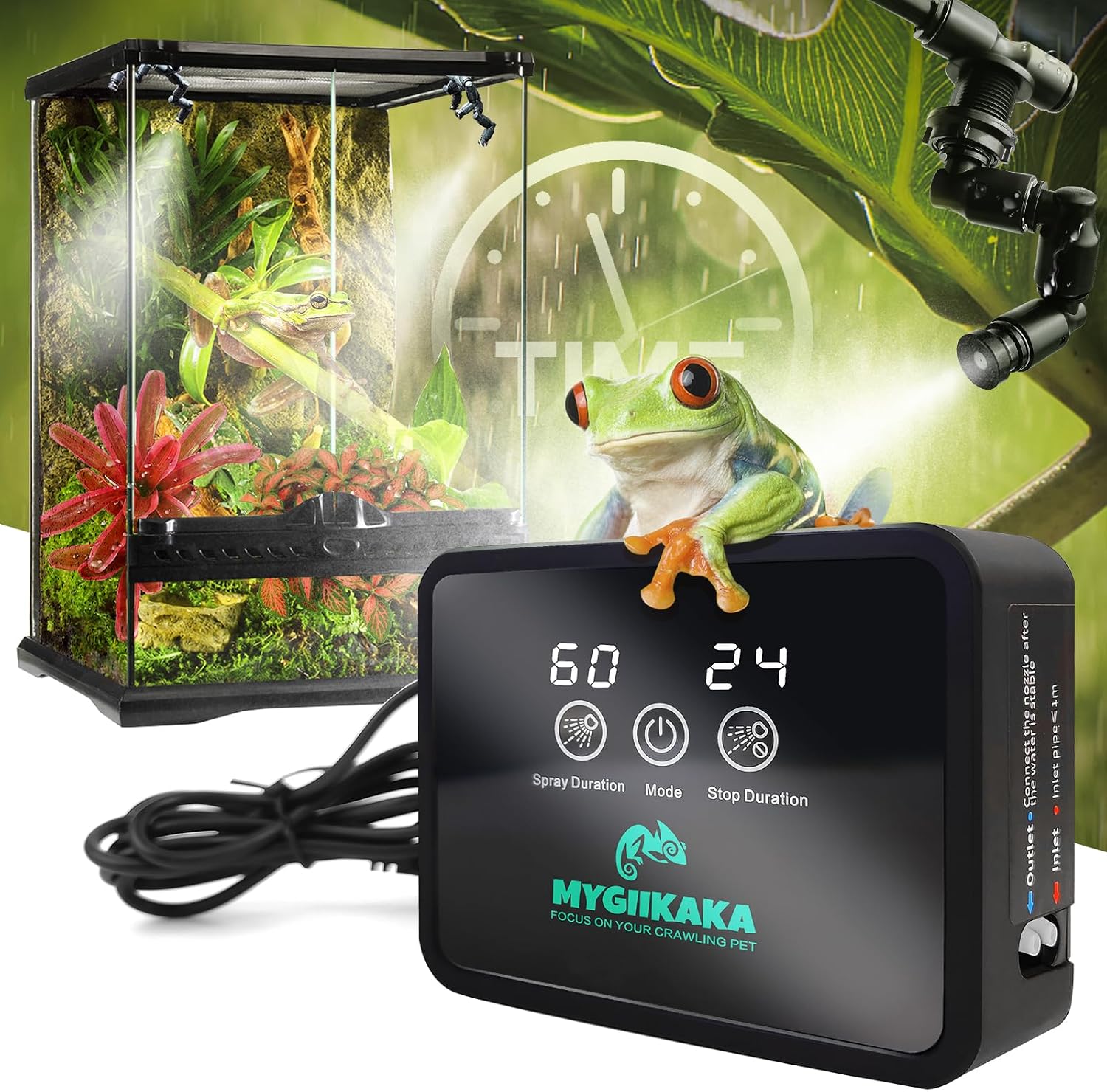
snake humidifiers terrarium misters
1. Exo Terra Fogger: Best All-Around Humidifier
The Exo Terra Fogger generates a cool mist by ultrasonically vibrating a diaphragm, the same principle used in room humidifiers but scaled down for terrariums. It produces a visible fog that raises humidity quickly and can be placed on a timer for automated cycles. The 1.3-liter water reservoir provides roughly 4 to 8 hours of continuous misting depending on ventilation and ambient conditions. The included tubing connects to the fogger outlet port, and the mist nozzle can be directed into one enclosure or split between two with a T-connector. This unit suits keepers running two to four enclosures who want a single device to serve all of them.
The trade-off is that ultrasonic diaphragms wear out. Manufacturer specifications and owner reports suggest replacement every one to two years under heavy use, and tap water accelerates that decline by depositing white mineral scale on the vibrating element. Distilled water is strongly recommended. Because the fogger runs on a timer rather than a humidity reading, it cannot respond to actual conditions in the tank, so pairing it with a separate hygrostat is the practical way to automate it. Aim the nozzle at decor rather than directly at the animal, since a constant stream of fog on a snake can be stressful.
Pros:
- Ultrasonic fogger produces visible mist and rapid humidity increase
- 1.3L reservoir provides 4-8 hours of misting per fill
- Timer-compatible for automated misting cycles
- Tubing included for one enclosure or a split between two
- Cool mist will not raise tank temperature
Cons:
- Ultrasonic diaphragms wear out with heavy use
- Mineral deposits from tap water can clog the diaphragm
- No built-in hygrostat; requires a separate controller for humidity-based on and off
- Misting directly onto the snake can be stressful
2. Zoo Med ReptiFogger: Best for a Single Enclosure
The Zoo Med ReptiFogger is a dedicated single-enclosure fogger designed for one tank. The 0.5-liter reservoir provides roughly 2 to 4 hours of continuous misting, which is appropriate for a single 40 to 80 gallon enclosure. Its defining feature is a built-in digital hygrostat that automatically turns the unit on when humidity drops below a set point and off when it reaches the target. Set it at 70 percent and the fogger runs only when needed rather than on a blind timer. It plugs into a single outlet with no tubing to route, which makes it the simplest automated option for a beginner.
The limitation is capacity and scope. It is not designed to serve multiple tanks, and the small reservoir needs refilling every two to four days under heavy use. It still requires distilled water to prevent mineral buildup, and because it runs purely on the hygrostat rather than a schedule, humidity fluctuates naturally instead of following a predictable cycle. For a keeper with one ball python or boa in a glass or PVC enclosure, that trade-off is usually worth it because the device manages itself.
Pros:
- Built-in digital hygrostat for automatic on and off based on actual humidity
- Single-enclosure design requires no tubing setup
- Compact footprint that sits on the tank lid
- Cool mist with no temperature increase
- Quiet operation thanks to an isolated diaphragm
Cons:
- Only suitable for one enclosure
- Small 0.5L reservoir needs frequent refills
- Requires distilled water to prevent mineral buildup
- No timer, so humidity fluctuates rather than following a schedule
3. Evergreen Misting System: Best Multi-Enclosure Setup
The Evergreen is a pressure-misting system rather than an ultrasonic fogger, producing a fine cool mist through high-pressure nozzles. Its key advantage is that pressure mist evaporates more slowly, creating longer-lasting humidity increases without soaking the tank every few minutes. The system connects to multiple enclosures via tubing and nozzles, and a timer controls when it activates. For breeders running four to ten or more snake enclosures, this is the practical way to handle multiple tanks from one unit, and it avoids the diaphragm wear that limits ultrasonic foggers.
Installation is the main hurdle. Routing tubing, mounting nozzles, and programming the timer typically takes thirty to sixty minutes, and the pressure pump produces an audible low hum during misting cycles. Nozzle tips can clog with mineral deposits and benefit from a weekly flush with a vinegar solution. There is no built-in hygrostat, so humidity-responsive automation requires a separate controller. Keepers who want a set-and-forget system for a single tank will find this overbuilt, while anyone maintaining a rack of enclosures will find the coverage and reliability hard to match.
Pros:
- Pressure mist lasts longer than fogger mist without soaking the tank
- One unit can serve four to ten or more enclosures
- Adjustable nozzle output for fine-tuning mist per enclosure
- Timer-controlled misting cycles
- No ultrasonic diaphragm to wear out
Cons:
- Requires installation of tubing, nozzles, and mounting hardware
- Premium price compared with single-tank options
- No built-in hygrostat
- Audible pump during misting cycles
- Nozzle tips can clog and need periodic flushing
4. Zoo Med ReptiRain Mister: Best Budget Mister
The ReptiRain is a simple pressure-spray mister, essentially a fine-spray head attached to a timer. It connects to a pressure source, points a nozzle into the enclosure, and sprays on a schedule. It is not elegant, but it is inexpensive and has few components that can fail, which makes it easy to troubleshoot and cheap to replace. For a single enclosure on a tight budget, it covers the basic need of adding moisture on a predictable cycle.
The trade-offs are significant. It requires a separate pressure source such as a small pump or hose adapter, and the spray can be wetter than some setups tolerate, creating dripping and damp spots that raise the risk of scale rot if not managed. It is timer-based with no hygrostat, so it cannot respond to actual humidity, and the fine nozzle tip clogs easily with hard water. Distilled water is essentially mandatory. It suits a keeper who wants a minimal, low-cost misting solution and is willing to monitor conditions manually.
Pros:
- Extremely simple with minimal components to fail
- Very affordable compared with foggers and misting systems
- Compact and mounts inside or outside the enclosure
- Adjustable spray from light mist to heavier output
- Works with a standard aquarium timer for scheduled misting
Cons:
- Requires a separate pressure source
- Spray can be too wet and create dripping and damp spots
- No hygrostat, so it is purely timer-based
- Single enclosure only
- Fine nozzle tip clogs easily with hard water
Humidity Troubleshooting
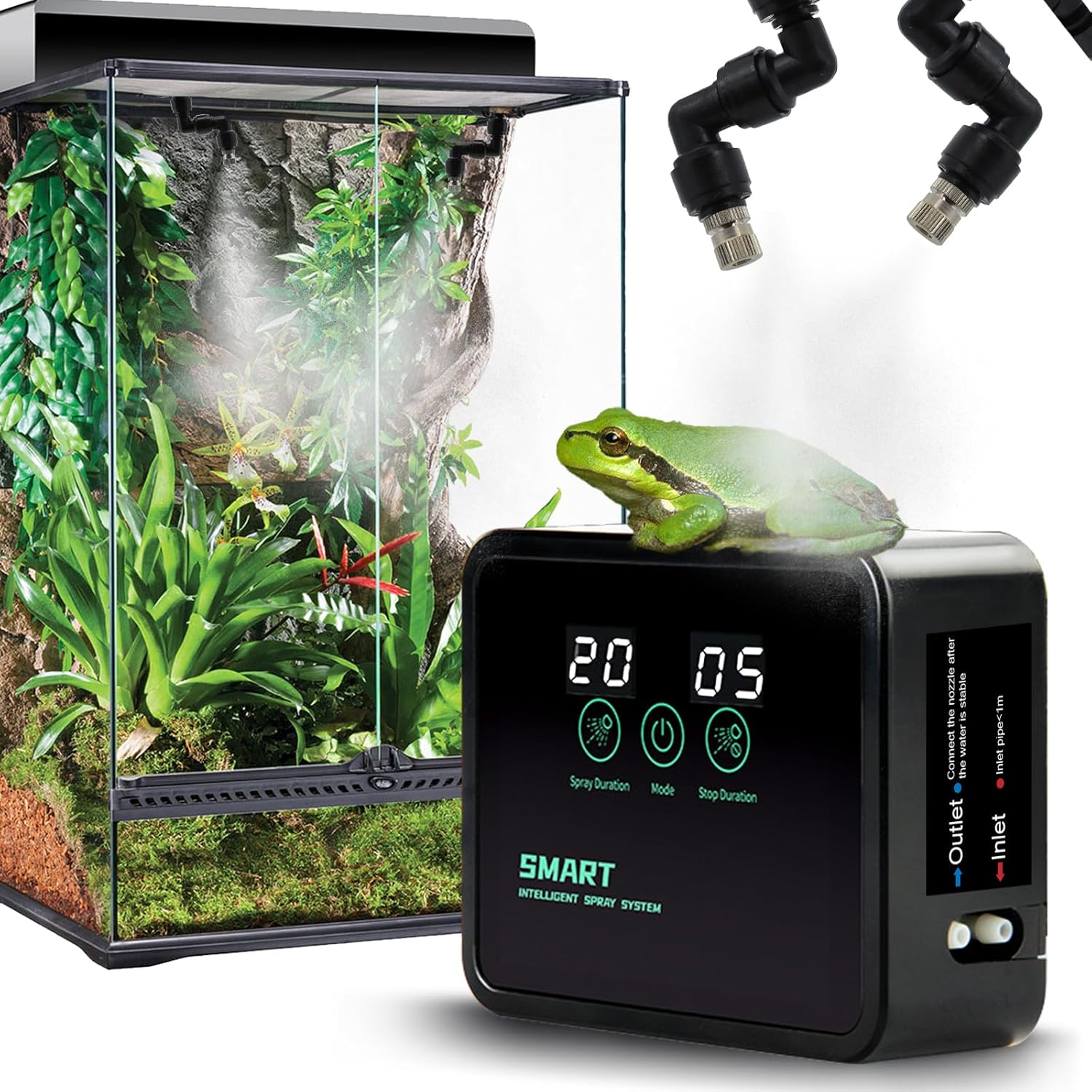
snake humidifiers terrarium misters
When humidity keeps dropping below target, the cause is usually either excessive ventilation or insufficient output. Adding more ventilation holes actually lowers humidity, so the fix for a tank that dries out is typically to reduce ventilation, not increase it. A humid hide packed with damp sphagnum moss raises humidity exactly where the snake spends its time and is often more effective than misting the whole enclosure. If the room itself is very dry, a room-level humidifier may be the only way to keep conditions stable.
When humidity stays too high, above roughly 80 percent for most species, the risks shift toward respiratory infection and scale rot. Reduce misting frequency, add ventilation, and switch from moisture-retaining substrates such as newspaper or paper towels to aspen shavings that dry out faster. A small fan can improve air circulation. Condensation on cold glass usually means the mist is too fine and settling before it evaporates; a pressure mister with larger droplets or a shorter misting duration often resolves it. White powder on enclosure walls is mineral residue from tap water, and the fix is distilled water plus a wipe-down. Algae or slime in the reservoir means water is sitting too long; change it daily, clean weekly with a dilute vinegar solution, and store the unit dry between uses.
Frequently Asked Questions
Is an ultrasonic fogger safe for snakes?
Yes. Ultrasonic foggers produce cool mist at or slightly below room temperature. The safety concern is not the fog itself but over-misting. Constant dampness on the snake can lead to respiratory infection, so a hygrostat that cycles the unit two to four times per day is a better setup than continuous operation. Never aim the nozzle directly at the animal; aim at decor and let the mist disperse. The ASPCA Animal Poison Control also advises against using essential oils or scented additives in any humidifier or mister in a reptile enclosure, since diffused oils can be toxic to reptiles.
How often should I mist my snake's enclosure?
This depends on the enclosure, room conditions, and species. For ball pythons, two to three misting cycles per day raising humidity to 60 to 80 percent, with natural evaporation between cycles, is a common schedule. For corn snakes and king snakes, once per day or every other day is usually sufficient, with extra attention during the seven to ten days before a shed when the eyes turn blue and the skin looks dull. The goal is a humid hide that stays damp and a tank that never becomes soaking wet.
Can I use a reptile fogger with a thermostat?
Use a hygrostat, not a thermostat. A thermostat controls temperature; a hygrostat controls humidity. The hygrostat probe reads the enclosure's humidity and turns the fogger on when it drops below the set point and off when it reaches target. Budget hygrostats start around ten to fifteen dollars. This is the most effective setup for automated, humidity-responsive control without daily intervention.
Comparison Table
| Product | Type | Coverage | Hygrostat | Best For |
|---|---|---|---|---|
| Exo Terra Fogger | Ultrasonic Fogger | 2-4 enclosures | No (timer) | Multi-enclosure fogging |
| Zoo Med ReptiFogger | Ultrasonic Fogger | 1 enclosure | Yes (built-in) | Single tank with auto control |
| Evergreen Misting | Pressure Misting | 4-10 enclosures | No (timer) | Professional multi-tank |
| Zoo Med ReptiRain | Pressure Spray | 1 enclosure | No (timer) | Budget single tank |
Where to Buy
As an Amazon Associate, PawCritic earns from qualifying purchases. This does not affect our reviews or recommendations.
Conclusion
For a single ball python or boa enclosure, the Zoo Med ReptiFogger with its built-in digital hygrostat is the simplest reliable choice: set the target humidity, plug it in, and the unit manages itself. No separate hygrostat is needed and no timer has to be configured. For multi-enclosure setups, the Exo Terra Fogger connected to tubing with T-connectors handles two to four enclosures from one unit, paired with a separate hygrostat for automated humidity-responsive control. For larger collections, the Evergreen pressure-misting system covers four to ten or more enclosures and avoids the diaphragm wear that limits ultrasonic units.
Whatever system you choose, always use distilled water rather than tap. The mineral deposits from tap water clog diaphragms, coat nozzles, and leave white powder on enclosure walls, and they shorten the working life of any humidifier. A humid hide with damp sphagnum moss does more for shed quality than any misting system, so treat humidity devices as support and the humid hide as the primary tool. Monitor with a digital hygrometer, adjust based on what the reading shows rather than a fixed schedule, and consult a reptile-experienced veterinarian if a snake shows signs of respiratory infection, retained shed, or chronic dehydration.
Related reading: Reptile Substrate and Terrarium Bedding, Reptile Terrarium Stands and Enclosure Cabinets, Reptile Cleaning and Disinfectant Supplies, Leopard Gecko Terrarium Supplies and Starter Kits, Reptile Terrarium Backgrounds and 3D Decor, Bioactive Terrarium Kits, Live Vivarium Plants for Reptiles, Snake Enclosures 2026, How to Set Up a Bearded Dragon Enclosure, and Reptile Myths Debunked.
Affiliate Disclosure: PawCritic.com participates in the Amazon Services LLC Associates Program. We may earn commissions from qualifying purchases at no extra cost to you.