Best Hamster and Gerbil Exercise Wheels 2026: Silent Spinners, Flying Saucers and Wooden Wheels for Happy Small Pets
Published on June 20, 2026 by PawCritic — Small Pets Category

In the wild, hamsters and gerbils cover several miles each night while foraging. In captivity that instinct remains, and an exercise wheel becomes the main outlet for it. A properly sized, well-built wheel is one of the most important pieces of enrichment in a hamster or gerbil enclosure. It supports cardiovascular health, helps control weight, and gives the animal a way to burn off the restlessness that otherwise turns into repetitive behaviors such as bar-biting, pacing, and digging at cage corners.
The wrong wheel, however, can do real harm. A wheel that is too small forces the spine into an unnatural curve with every stride, and published small-mammal guidance links that repeated posture to chronic back pain and, over time, spinal deformity. Wheels with rungs, mesh gaps, or spokes trap tiny feet and toes, causing fractures and degloving injuries. A wheel that squeaks, rattles, or vibrates drives many owners to rehome their pets simply because they cannot sleep. The choice of wheel is not a minor accessory decision.
This guide is built from published small-pet care guidance, manufacturer specifications, and patterns reported by owners in hamster and gerbil communities. It is not a hands-on test report. Where a specific wheel appears below, the details come from the maker's published specs and from the experiences owners describe most consistently. For veterinary context on species needs, the Association of Exotic Mammal Veterinarians is a useful starting point, and the Merck Veterinary Manual section on exotic and laboratory animals covers husbandry requirements in detail.
What Actually Matters in a Hamster or Gerbil Wheel
Diameter Is the First Decision
The single most common mistake is buying a wheel that is too small. When a hamster runs on an undersized wheel, the spine curves upward into a U shape with every stride. That posture, repeated for hours each night, is what published care guidance associates with chronic pain and spinal deformation. The animal cannot simply choose to run differently; the wheel decides the posture.
Minimum diameters by species are well established in the hobby and in small-mammal husbandry references. Roborovski dwarf hamsters need at least 6.5 inches. Campbell's, Winter White, and Chinese hamsters need at least 8 inches. Syrian hamsters need 11 to 12 inches. Gerbils generally do best with 8 to 10 inches. Mice can use 6.5 to 8 inches comfortably. When in doubt, go one size larger, since healthy adult hamsters can move surprisingly large wheels and a bigger wheel only improves their posture.
The practical check is visual. Watch the animal run. If the back stays flat or nearly flat, the wheel is correctly sized. If the back arches upward while running, the wheel is too small and should be replaced rather than tolerated.
Running Surface and Foot Safety
The running surface should be solid, or if it has gaps, those gaps should be no wider than about 2 millimeters. Rung-style metal wheels, the old-fashioned kind with visible bars, are unsafe for hamsters and gerbils because toes and nails slip between the rungs. Injuries range from torn nails to broken toes and, in severe cases, degloving injuries that require veterinary care.
Solid plastic surfaces are the most common and are generally safe, though very smooth plastic can offer poor grip. Cork-lined and wood surfaces offer better traction and are gentler on foot pads, which matters for animals prone to sore hocks. Mesh-front wheels such as the Silent Runner provide ventilation but should be inspected regularly; if droppings or bedding pack into the mesh, the surface becomes abrasive. Any sharp edge, crack, or exposed screw end on a running surface is a reason to stop using that wheel.
Bearings, Bushings, and Realistic Noise Expectations
Wheels fall into two mechanical families. Bearing-based wheels use sealed or shielded ball bearings on a metal axle and spin with very little friction; these are the wheels owners most often describe as silent or near-silent, and the quiet usually lasts for years. Bushing-based wheels use a simple plastic-on-metal contact point. They are quiet when new but typically develop a squeak or wobble as the surfaces wear, often within months of nightly use.
Noise has several sources, and only some can be fixed. Squeaking usually comes from the axle and can often be quieted temporarily with a food-grade silicone lubricant. Rattling usually means loose mounting hardware or a worn bushing. Vibration happens when the wheel transmits motion into thin cage bars; a piece of cork or felt between bracket and bars helps. The pitter-patter of feet on a hard plastic surface, however, is simply the sound of a running animal and cannot be engineered away. Wooden and cork-lined wheels produce less foot noise than hard plastic.
Mounting, Stability, and Bedding Depth
Wheels come as free-standing units, cage-mount units, or both. Free-standing wheels with wide, weighted bases or cork-bottomed stands are the most stable and the easiest to place at the correct height above bedding. Cage-mount wheels save floor space but put load on cage bars, and thin bars can flex or bend under a determined Syrian hamster. Adjustable-height stands matter more than many buyers expect, because hamsters and gerbils burrow, and bedding depth changes constantly. A wheel that sits too low drags bedding into the mechanism; one that sits too high is awkward to enter.
Cleaning and Longevity
Wheels get dirty. Hamsters sometimes urinate while running, and gerbils leave oily residues. Plastic wheels can generally be washed with warm soapy water and dried thoroughly, and many are dishwasher-safe. Wooden wheels cannot be submerged; they are typically spot-cleaned with a diluted vinegar solution and allowed to dry completely, because trapped moisture encourages mold and odor. Bearings should be checked monthly for entangled bedding, which is the most common cause of premature bearing failure. A wheel that is never cleaned accumulates bacteria and ammonia, and that contributes to respiratory problems in small pets.
One Wheel Worth Looking At: The Niteangel Super-Silent
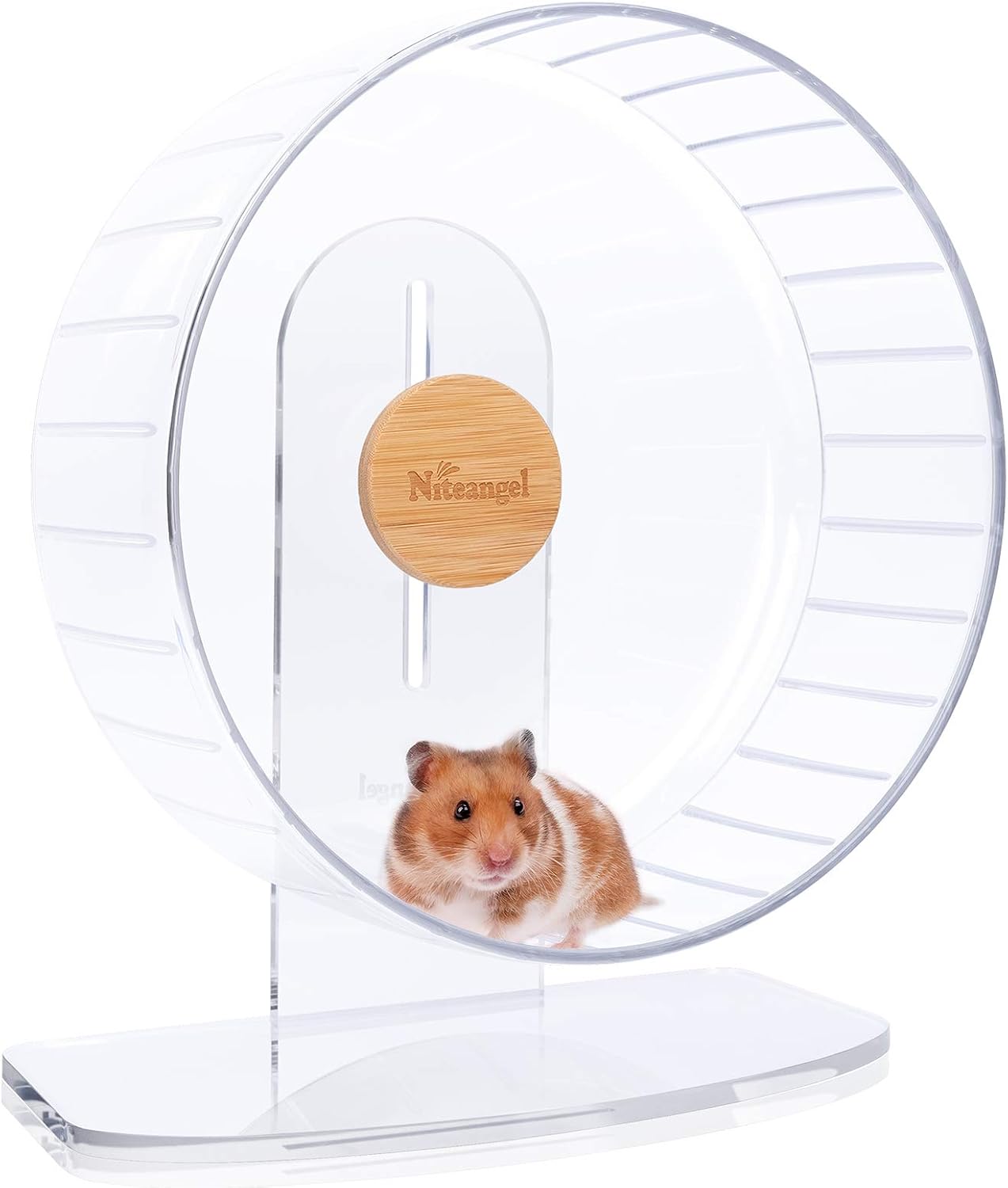
Rather than a numbered list of picks, this section looks at a single concrete example that illustrates what a well-specified wheel looks like. The Niteangel Super-Silent Wheel is widely discussed in hamster-keeping communities and is available in 8-inch, 10-inch, and 12-inch diameters, which covers dwarf hamsters through large Syrians. It uses sealed dual ball bearings on a stainless steel axle, a combination that owner reports consistently describe as silent in normal use, with only foot noise audible.
The stand has a cork base intended to reduce slipping and vibration, and the box includes both a free-standing base and a cage-mount bracket, so the same wheel can be used in different enclosure types. The wheel detaches for cleaning and the manufacturer lists it as dishwasher-safe. The trade-offs are the ones typical of plastic wheels: the price sits above budget options, the ABS surface can show cosmetic scratches over time, the cork base adhesive can weaken if soaked, and a determined plastic-chewer may eventually damage the running surface. For a dwarf hamster the 8-inch size is appropriate; a Syrian needs the 11- or 12-inch class, and the 12-inch version is the one that keeps a large Syrian's back flat.
If you want to see current pricing and available sizes, you can check the current price on Amazon. It is one option among several, and the sizing rules above matter more than the brand.
Wheel Types Compared
| Type | Typical Sizes | Noise | Cleaning | Best Suited To |
|---|---|---|---|---|
| Solid plastic, ball bearings | 6.5 to 12 inches | Near-silent | Washable, often dishwasher-safe | Most hamsters and gerbils |
| Solid plastic, bushing | 4.5 to 12 inches | Quiet when new, squeaks with wear | Washable | Budget setups, backup wheels |
| Metal mesh with solid back | 9 to 12 inches | Very quiet | Washable, mesh needs brushing | Large Syrians, gerbils, rats |
| Wood with cork surface | 8 to 13 inches | Very quiet | Spot-clean only | Naturalistic enclosures, light chewers |
| Tilted flying saucer | 7 to 12 inches | Moderate | Washable | Hamsters that refuse upright wheels |
Detailed Considerations by Category
Small Plastic Wheels for Dwarf Hamsters
Dwarf hamsters are the species most often given wheels that are too small, because the smallest wheels on the shelf look proportionate to a small animal. They are not. A Roborovski needs at least 6.5 inches and does well with 8. A Campbell's or Winter White needs 8 inches. In this size class, sealed-bearing plastic wheels are the practical sweet spot: light enough for a 30-gram animal to start spinning, quiet enough for a bedroom, and easy to wash. The trade-off is that small wheels have small stands, and a vigorous dwarf can occasionally shift a lightweight stand across the cage floor; cork-bottomed bases reduce this.
Large Wheels for Syrian Hamsters
Syrian hamsters are the species where wheel size matters most, because they are large enough that an undersized wheel produces obvious spinal curvature. A 12-inch wheel is the standard recommendation, and 11 inches is the practical minimum. At this size, wheel weight becomes a real factor: a heavy wooden wheel with a stiff wooden axle can be difficult for a hamster to start, while a bearing-based wheel spins freely. Owners of large Syrians most often report success with bearing wheels that have solid running surfaces and wide, stable stands, and they most often report tail or foot injuries with rung-style or mesh-gap wheels.
Gerbils and Long-Tailed Species
Gerbils use wheels less obsessively than hamsters and often split their time between running, digging, and climbing. They do well with 8 to 10 inch wheels. The specific concern for gerbils, and for other long-tailed species such as rats and degus, is tail safety: the gap between the back plate and the front of the wheel must be wide enough that a tail passes through without catching. Mesh-front wheels with a solid back plate are often chosen for this reason, and owners frequently report that gerbils ignore upright wheels entirely in favor of burrowing, which is normal behavior rather than a problem.
Flying Saucers and Alternative Designs
A flying saucer replaces the upright wheel with a tilted disc. The animal runs on the flat top surface while the disc spins around a central axle. The design removes the spinal-curvature concern entirely because the animal chooses its own running angle and radius. The trade-offs are space and predictability: a 12-inch saucer needs roughly a 13 by 13 inch footprint, and some hamsters never figure out how to use one. Small dwarf hamsters can also be launched off the edge at high speed if the disc spins faster than they expect. Saucers work best as a second enrichment item alongside a properly sized upright wheel, or as a solution for a hamster that refuses upright wheels.
Wooden and Cork-Lined Wheels
Wooden wheels with cork running surfaces are the choice for naturalistic enclosures. The cork provides excellent grip, is gentle on foot pads, and naturally absorbs some odor. Wood-on-wood axles are quiet, though they produce more friction than bearings, so very small or elderly animals may struggle to start the wheel moving. The maintenance rules are stricter than for plastic: no soaking, no dishwasher, spot-cleaning only, and a cork liner that typically needs replacing every 6 to 12 months depending on use. Wood can also absorb urine and develop persistent odor, and a determined chewer can gnaw a wooden wheel into an unsafe shape.
Budget and Starter Wheels
Budget wheels occupy an awkward position. They are often the wheel included with a starter cage, and they are usually the wrong size for the animal the cage was sold for. All-plastic construction with a plastic axle eliminates rust and is silent when new, but the plastic axle typically develops wobble within a few months of nightly use, and plastic cage hooks can snap under an enthusiastic runner. A budget wheel is acceptable as a temporary or backup item, but it should not be the permanent wheel for a Syrian hamster or a gerbil, and the size printed on the packaging should never be trusted over the species minimums listed above.
Common Mistakes to Avoid
- Trusting the packaging. Some wheels are marketed for Syrian hamsters at diameters that are unsafe for them. Use species minimums, not box claims.
- Buying a wheel with rungs, bars, or spokes. These designs cause foot and leg injuries. The running surface should be solid or have gaps no wider than about 2 millimeters.
- Ignoring bedding height. A wheel that sits too low drags bedding into its mechanism and stops spinning freely. Adjustable-height stands solve this.
- Skipping the monthly bearing check. Strands of bedding wrapped around an axle are the most common cause of a wheel that suddenly becomes noisy or stiff.
- Submerging a wooden wheel. Water warps wood and encourages mold. Spot-clean only.
- Assuming a saucer replaces an upright wheel. Some animals never adapt to a saucer. An upright wheel remains the safer primary choice.
- Using cooking oil or general-purpose lubricant on an axle. These attract dust and bedding. Food-grade silicone lubricant is the appropriate choice.
Maintenance Schedule That Works
Daily: remove droppings and any food cached in the wheel, and check that it still spins freely. Weekly: wash plastic wheels with warm soapy water and dry them completely before returning them to the cage; spot-clean wooden wheels with a diluted vinegar solution. Monthly: inspect bearings and axles for entangled bedding, check mounting hardware for tightness, and check the running surface for cracks, sharp edges, or worn cork. Every 6 to 12 months: replace cork liners on wooden wheels, and examine bushing-based wheels for wobble that indicates the axle is worn. Any wheel that wobbles, squeals despite lubrication, or has a damaged running surface should be replaced rather than repaired with tape or glue, since adhesives and small parts are a chewing hazard.
Safety Notes and When to See a Vet
Small pets hide illness well, so changes in wheel behavior are often the first visible sign of a problem. A hamster that stops using a wheel it previously ran on every night may be in pain. Watch for limping, swelling or redness on foot pads, a back that stays curved even when the animal is at rest, or a sudden drop in activity. Foot sores can also come from an abrasive or unsanitary running surface, so check the wheel before assuming the cause is medical. For anything that persists, consult an exotic-animal veterinarian; the Merck Veterinary Manual describes common conditions in these species. If you suspect a pet has chewed or ingested part of a wheel, or has been exposed to a household substance, the ASPCA Animal Poison Control is the appropriate resource, and general husbandry guidance is available through the ASPCA pet care library.
Frequently Asked Questions
What size wheel does my hamster need?
Minimum diameters: 6.5 inches for Roborovski dwarfs, 8 inches for Campbell's, Winter White, and Chinese hamsters, and 11 to 12 inches for Syrian hamsters. When in doubt, go larger. The visual test is simple: if the back curves upward while running, the wheel is too small.
Do gerbils need a wheel?
Gerbils benefit from wheels but use them less intensely than hamsters and may prefer digging and climbing. An 8 to 10 inch wheel with a solid surface and tail-safe spacing between back plate and front is appropriate. Some gerbils ignore wheels entirely, which is normal.
How can I make a wheel quieter?
Identify the source first. Squeaking usually comes from the axle and responds to food-grade silicone lubricant. Rattling usually means loose hardware. Vibration through cage bars can be reduced with cork or felt between bracket and bars. Foot noise on hard plastic cannot be eliminated; cork-lined and wooden wheels are quieter in that respect.
My hamster urinates in the wheel. What can I do?
This is common and difficult to prevent entirely. Clean the wheel daily with a pet-safe cleaner, offer a sand bath nearby, and accept that some individuals simply prefer the wheel as a bathroom spot. Wooden wheels are a poor match for these animals because they absorb urine; plastic or sealed wood is more practical.
Is a flying saucer better than an upright wheel?
Neither is universally better. Upright wheels are more space-efficient and more intuitive for most hamsters. Saucers remove the spinal-curvature concern and offer variety but take up more floor space and are sometimes ignored. The ideal setup offers both.
Can mice use these wheels?
Yes, with size adjustments. A 6.5 to 8 inch wheel suits most mice. Solid surfaces are safer than mesh for their very small toes, and 12-inch wheels are generally too heavy for mice to start comfortably.
How do I know if a wheel is causing health problems?
Watch for a persistently arched back while running, redness or sores on foot pads, limping, or a sudden refusal to run. Any of these warrants a check of the wheel and, if signs persist, a visit to an exotic veterinarian.
Putting It Together
A wheel is a small purchase with an outsized effect on a hamster's or gerbil's daily life. The animal may spend four to six hours on it every night, which means the wheel's diameter, surface, and stability shape its posture and its comfort for years. Get the diameter right for the species, choose a solid running surface with no rung gaps, prefer sealed bearings if the cage is anywhere near a bedroom, and plan for cleaning from the start. Those four decisions matter far more than brand or color.
If you want a concrete starting point, the Niteangel Super-Silent is one example that meets the sizing and bearing criteria across a range of species, and you can view this option on Amazon. Whatever you choose, verify the diameter against your species before buying, and replace any wheel that wobbles, squeals, or shows a damaged running surface. A well-chosen wheel is one of the least expensive ways to improve a small pet's quality of life.
Check the current price on Amazon if you want to compare sizes and finishes directly.
Affiliate Disclosure: PawCritic is a participant in the Amazon Services LLC Associates Program, an affiliate advertising program designed to provide a means for sites to earn advertising fees by linking to Amazon.com and affiliated sites. Purchases made through our links help support our independent research at no extra cost to you. Thank you for your support.
Last updated: June 20, 2026. Prices and availability are subject to change. Always verify current pricing on Amazon before purchasing.
View this option on Amazon to see the sizes currently offered.