Why Enrichment Is a Welfare Requirement, Not a Decoration Choice
Walk through any reptile rescue and a pattern repeats: bearded dragons clawing at the front glass for hours, ball pythons pressing against the lid, crested geckos launching themselves at the mesh top night after night. These are not personality quirks. They are stereotypic behaviors, the reptilian equivalent of a tiger pacing a zoo cage, and they are one of the most reliable visible indicators that an enclosure is failing the animal inside it. Published guidance from the Association of Reptilian and Amphibian Veterinarians and the Merck Veterinary Manual section on exotic and laboratory animals both treat environmental quality, including hiding opportunities, thermal gradients, and structural complexity, as core components of captive reptile health rather than optional extras.
The reason is straightforward. Reptiles are not furniture. A leopard gecko in the wild navigates rock crevices, scales boulders at dusk, and squeezes into tight hides after insects. A bearded dragon climbs fallen branches, basks on elevated perches, and digs burrows into packed soil. A crested gecko spends essentially its entire life above the ground, moving branch to branch in search of fruit and insects. Place any of these animals in a glass box with one hide and a water bowl and the result is a sensory deprivation chamber. The animal survives, but the behaviors that signal thriving, exploration, appetite, correct shedding, and relaxed basking posture, tend to disappear.
Climbing branches, cork bark tubes, background panels, elevated basking platforms, and naturalistic decor change what an enclosure can do. They provide exercise, since climbing builds muscle tone and helps counter obesity in heavily fed captives. They provide mental engagement through novel textures and pathways. And they provide security, because a cluttered enclosure with multiple visual barriers reduces stress more effectively than a single hide in an open space. A decorated enclosure is the difference between a reptile that merely persists and one that behaves like a functioning animal.
What Counts as Good Reptile Decor
Good decor is not a style choice. It is a set of functional categories, and most healthy enclosures include at least one item from each. Climbing branches and vines create vertical space. Cork bark and hardwood pieces serve as hides, climbing surfaces, and textural variety. Background panels cover bare glass and give the animal a sense of a solid boundary. Basking platforms and ledges provide elevated flat surfaces where heat and UVB can be absorbed. Naturalistic substrate and leaf litter support burrowing species and help hold humidity for tropical species.
Materials matter as much as categories. Cork bark is lightweight, rot-resistant, and safe to stack because a falling piece is unlikely to injure a burrowed reptile. Dense hardwoods such as grapevine and mopani hold up under a heavy basking lizard and resist warping in dry heat. Bamboo is naturally textured and gives gecko toe pads excellent purchase. Preserved moss and coconut fiber add humidity buffering in tropical setups but crumble in arid ones. Matching the material to the enclosure's humidity and the animal's weight is the single most common point where new keepers get it wrong.
Reptile Climbing Branches and Decor: What to Look For
reptile climbing branches tank decor
Before looking at specific pieces, it helps to understand the four attributes that determine whether a decor item will actually work in a given enclosure: material stability under the enclosure's humidity, weight capacity relative to the animal, attachment method, and how easily the item can be cleaned. A branch that molds in six weeks, a ledge that cannot hold an adult gecko, or a background that traps feces in unreachable crevices all fail regardless of how natural they look.
Natural Cork Bark Rounds: The Universal Starting Piece
Natural cork bark rounds are the most versatile single item in reptile decor. A hollow cork tube functions simultaneously as a hide, a climbing structure, and a humidity retention tool. Arboreal geckos climb on top and shelter inside; ball pythons curl into the hollow center; chameleons perch on the textured outer surface. Cork is naturally rot-resistant because cork oak evolved thick, antimicrobial bark to survive Mediterranean humidity, which means a good cork round holds up indefinitely in tropical enclosures where softer woods mold within weeks. A twelve-inch round typically weighs only a few ounces, so it can be leaned against enclosure walls or stacked without meaningful risk of crushing a burrowed reptile.
The trade-offs are real but manageable. Every piece is unique, so ordering online is a gamble on exact shape and dimensions. Cork sheds small particles over time, which is normal but noticeable in water features. Large rounds can become feeder-insect hotels, with crickets and roaches hiding in the crevices and avoiding the reptile at feeding time. And cork is an insulator rather than a heat retainer, so it does not substitute for a dedicated resin cave when a species needs a warm, tight retreat. For most keepers, though, a cork round is the first purchase that visibly changes an animal's behavior.
If you want to see the current pricing and available sizes for this kind of cork bark, check the current price on Amazon.
Artificial Climbing Vines: Instant Foliage Cover
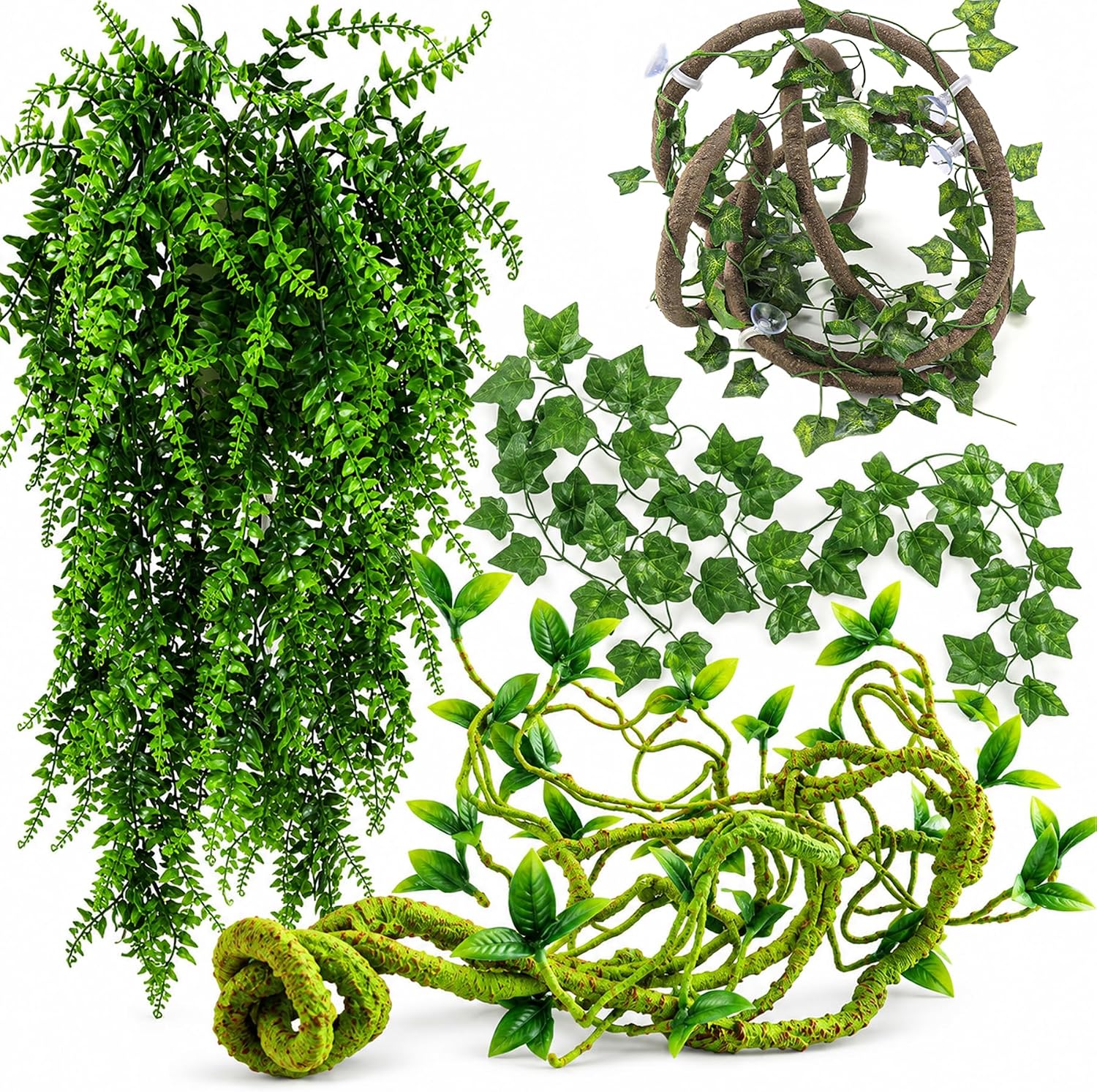
Flexible artificial vines with a wire core wrapped in synthetic foliage solve a specific problem: arboreal geckos, small chameleons, and tree frogs will not settle in an enclosure that feels exposed. In the wild these animals live inside dense leaf cover, and a bare glass box reads as lethal open ground. A bendable vine can be woven through branches to create a canopy, spiraled around a cork tube as a climbing ladder, or draped across the back wall as a curtain. Because the wire core holds whatever shape it is bent into, the same vine can be reconfigured whenever the enclosure is rearranged.
The advantages of artificial foliage are practical rather than aesthetic. It does not rot, does not need watering or grow lighting, does not drop dead leaves into the substrate, and does not introduce the parasites, pesticides, or soil-borne pathogens that live plants from big-box stores sometimes carry. The limitations are equally practical. Cut wire ends can be sharp and should be folded back or covered before the vine goes into the enclosure. The foliage collects dust and shed skin and needs periodic rinsing. And the wire core will not support a large, heavy reptile: a full-grown iguana or tegu will simply bend it out of shape. For a gecko or a small chameleon, though, a few well-placed vines can transform an enclosure in minutes. You can view this option on Amazon to compare vine lengths and styles.
Sandblasted Grapevine: The Arid-Species Branch
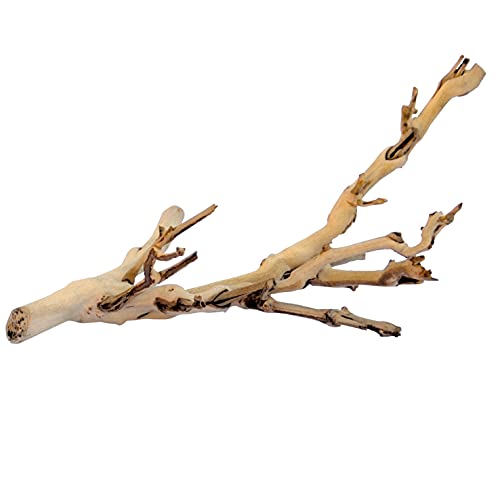
Sandblasted grapevine is a dense hardwood branch with a twisted, gnarled shape and a smooth surface that will not scratch a climbing reptile. The irregular form provides multiple grip angles and branch intersections, so a bearded dragon can shift height and orientation without slipping. Grapevine is dense enough to support a full-grown bearded dragon without sagging, and the sandblasting process removes splinters, loose bark, and surface irregularities that could trap bacteria. In dry, hot enclosures it holds up well without cracking.
The trade-off is humidity. Grapevine eventually molds in sustained high humidity, so it belongs in arid setups rather than tropical ones, where cork bark or mopani is the better choice. Its twisted shape also creates nooks that catch feces and urates, which makes cleaning more fiddly than a smooth branch. And because it is heavy, a large piece dropped during installation can crack a glass enclosure floor, so it is worth setting the branch in place before adding the animal and before finalizing the substrate.
Flexible 3D Background Panels: Turning Glass Into Rock
A flexible polyurethane background panel coated with realistic rock texture addresses one of the most underrated stressors in captive reptiles: the glass box itself. An animal surrounded by transparent walls on all sides has no visual boundary and no sense of a protected retreat. Covering the back wall, and optionally the sides, converts the enclosure into something that reads as a rock crevice rather than an exposed display case. For arboreal species, the textured surface also functions as a climbable vertical wall.
The flexibility of these panels is their main practical advantage. Rigid foam backgrounds must be cut to exact enclosure dimensions, while a flexible panel can be bent, curved, and trimmed with scissors to fit curved-front terrariums and irregular shapes. Installation is typically permanent silicone or removable double-sided tape, and the choice matters: silicone removal later can damage the glass. These panels are also not suitable for very large, heavy climbing reptiles, which will tear chunks off with their claws, and crickets and roaches readily hide in the gap between panel and glass. Letting a new panel air out before installation is a sensible precaution given the polyurethane material.
Magnetic Rock Ledges: Basking Platforms Without Adhesive
Magnetic rock ledges attach to enclosure walls using paired rare-earth magnets, one inside and one outside the glass, with no adhesive, drilling, or silicone. The ledge can be repositioned instantly, which makes it unusually useful for keepers who want to fine-tune the distance between a basking platform and a heat lamp. For crested geckos, gargoyle geckos, day geckos, and small chameleons, a ledge placed high in the enclosure near the heat source tends to become the most-used object in the tank, because arboreal species instinctively seek the highest secure perch available. The same ledge can double as a feeding station for species that will not descend to the floor to eat.
The constraints are weight and wall thickness. These ledges are not appropriate for reptiles over roughly 200 grams, which rules out adult bearded dragons, monitors, and tegus. The magnetic field may not pass through thick glass or PVC, so wall thickness should be checked before purchase. And the pairing process itself deserves care, because the external magnet can snap forcefully onto the internal one if positioned carelessly. Used within those limits, a magnetic ledge is one of the few decor items that measurably changes where an arboreal gecko spends its day.
Bamboo Bridges: Horizontal Pathways Through the Canopy
Bamboo bridges are flexible platforms made from parallel bamboo sticks wired together, and they fill a gap that single branches cannot. Bent into arches, laid flat as elevated walkways, or sloped as ramps, they connect two vertical climbing structures into a traversable network. Bamboo has a naturally textured, slightly rough surface that gecko toe pads grip well, and the gaps between sticks allow an animal to climb across the underside as easily as the top. In tropical arboreal enclosures, a bridge turns isolated perches into a continuous canopy route.
Two limitations are worth knowing before buying. The wire connections can rust in very high humidity over a year or two, so they should be inspected periodically and replaced if rust appears. And bamboo bridges are not weight-bearing for heavy reptiles; they suit geckos and small frogs, not bearded dragons or monitors. They are also a poor choice for herbivorous reptiles that gnaw on decor, since bamboo can splinter when chewed.
Preserved Moss Vines: Realistic Tropical Structure
Preserved moss vines are flexible wire-core vines wrapped in preserved moss and coconut fiber, and they are the most realistic artificial vine category currently available. Rather than mimicking a leafy pothos, they simulate the thick, mossy liana vines that drape through tropical canopies, which is precisely the structure tree boas, green tree pythons, and arboreal geckos use in the wild. The moss is preserved rather than living, so it needs no watering or lighting, and in humid enclosures the ambient moisture actually helps it keep its green, textured appearance. The thicker diameter gives arboreal snakes a substantial surface to wrap around.
The failure modes are specific to humidity and species. In arid enclosures the preserved moss dries out, becomes brittle, and crumbles, so these vines belong in tropical setups. The moss sheds small particles that accumulate on the substrate over time. And in enclosures with poor ventilation and standing moisture, preserved moss can develop mold, which good airflow prevents. Birds and large herbivorous reptiles may attempt to eat the moss, so this is not a suitable decor item for those species.
Species and Setup Matching: The Decision That Matters Most
Most decor failures trace back to a mismatch between material and environment rather than a defective product. Arid setups, meaning bearded dragons, leopard geckos, and uromastyx, do best with grapevine, sandstone, resin, and artificial foliage, because natural mosses and soft woods desiccate and crumble. Tropical setups, meaning crested geckos, tree boas, and tree frogs, do best with cork bark, preserved moss, bamboo, and live plants, because those materials either tolerate or benefit from sustained humidity. Bioactive setups add leaf litter and live moss, which support springtails and isopods that process waste and reduce cleaning frequency.
Weight capacity is the second filter. A branch rated for a forty-gram gecko is not a branch rated for a six-hundred-gram bearded dragon, and a magnetic ledge rated for two hundred grams is not a ledge for a monitor. Attachment method is the third. Silicone is permanent, tape is temporary, magnets are repositionable, and each has consequences for how easily the enclosure can be reconfigured later. Choosing decor in this order, environment first, weight second, attachment third, prevents most of the expensive mistakes new keepers make.
How to Design an Enriching Reptile Enclosure
reptile climbing branches tank decor
A workable enclosure layout can be built in a predictable sequence. Start with the background, because it is the hardest element to add later; cover the back wall and optionally one or both sides. For arboreal species a textured climbing background is close to essential, and for terrestrial species the visual barrier alone reduces stress. From there, build the layout in layers rather than placing items randomly.
Create at least three distinct heights. Arboreal species need a vertical gradient: a low, darker hide for security, a mid-level perch for thermoregulation options, and a high basking spot positioned under the heat and UVB source. A reptile will move between these heights throughout the day as its temperature and activity needs shift, and an enclosure that only offers one height removes that choice entirely.
Treat clutter as security rather than mess. A densely decorated enclosure looks chaotic to human eyes but reads as safe to a reptile, because dense foliage, multiple branches, cork tubes, and background texture break up sight lines. An animal can then move through the space without feeling exposed at every step. The minimalist, clean-looking enclosure that photographs well is often the one producing glass-surfing behavior.
Rotate decor periodically. Moving a cork tube to a different corner or swapping one vine texture for another introduces novelty, and novelty is itself enrichment. A reptile that has looked at an identical layout for months has less reason to explore than one whose environment changes gradually. Finally, match every material to the species and humidity level as described above, and replace any item that shows rust, mold, or structural failure rather than waiting for it to collapse under a basking animal.
Sizing, Safety, and Maintenance
Sizing is where good intentions most often go wrong. A hide should be snug enough that the animal's body contacts the walls when curled, because a hide that is too large does not provide the secure, enclosed feeling reptiles seek. A basking platform should be wide enough for the animal to flatten out fully under the heat source, not just perch. A branch should be thick enough that the animal's grip wraps most of the way around it; a branch that is too thin forces an unnatural posture and can lead to toe and joint strain over time.
Safety considerations are mostly about stability and materials. Anything stacked should be tested for wobble before the animal is introduced, and heavy items should sit on the enclosure floor rather than on substrate that can shift. Wire ends on artificial vines should be folded back. New porous items, including cork and wood, can be baked or boiled before use to reduce the chance of introducing mites or mold spores. Any decor that a reptile has chewed and splintered should be removed, and any item showing rust at wire joints should be replaced.
Maintenance follows the material. Cork and wood pieces can be scrubbed with a reptile-safe disinfectant and allowed to dry thoroughly, and small pieces can be boiled briefly. Artificial foliage should be rinsed every few months in dry enclosures and more often in humid ones, because dust and shed skin accumulate in the leaves. Background panels should be checked for debris trapped behind them. Substrate should be replaced on a schedule appropriate to the species, more frequently in arid setups and less frequently in bioactive tropical setups where a cleanup crew is working. Household cleaning sprays, scented soaps, and essential oils should never be used on or near reptile decor, because reptile respiratory systems are highly sensitive to airborne chemicals. For anything involving a potentially toxic plant, cleaner, or pest, the ASPCA Animal Poison Control database is a useful reference point for owners.
Common Mistakes and What to Avoid
The most common mistake is buying decor for how it looks in a photo rather than how it functions for the animal. A visually striking piece that offers no hide, no climb, and no visual barrier adds nothing. The second most common mistake is under-cluttering. New keepers frequently remove decor because it looks crowded, not realizing that the crowding is the point.
Another frequent error is mixing materials with the wrong humidity. Grapevine in a tropical enclosure, or preserved moss in a desert enclosure, will fail within months and may grow mold or crumble into the substrate. A related mistake is ignoring weight ratings, which is how magnetic ledges end up falling onto animals and how thin wire-core vines end up bent flat under a heavy lizard.
Finally, avoid permanent installations until the layout has been lived in for a while. Silicone-mounted backgrounds are difficult to remove without damaging glass, and a layout that seemed right on paper often needs adjustment once the animal's actual behavior is observed. Removable options first, permanent options later, is the safer sequence.
Frequently Asked Questions
Should I use live or artificial plants in a reptile enclosure?
It depends on species and commitment level. Live plants provide better humidity regulation, support microfauna in bioactive setups, and look authentic, but they require full-spectrum plant lighting, regular watering, and maintenance, and they can introduce pests. Artificial plants require no maintenance, introduce no pests, and cannot be trampled to death, but they provide no humidity benefit and look synthetic at close range. For beginners and arid species, artificial plants are the lower-risk choice. For bioactive tropical enclosures with arboreal geckos or dart frogs, live pothos, snake plants, bromeliads, and ficus work well. A hybrid approach, live plants at ground level and in the background with artificial vines providing canopy density, is common and practical.
How do I clean and sanitize reptile decor?
Remove the item from the enclosure and soak it in hot water with a reptile-safe disinfectant, then scrub with a brush dedicated to reptile cleaning and never used in a kitchen. Small cork and wood pieces can be boiled briefly to reduce bacteria, fungi, and parasite eggs. Allow everything to dry completely before returning it to the enclosure. Substrate should be replaced and decor deep-cleaned on a schedule that matches the species, monthly for many arid setups and less often for bioactive tropical setups where a cleanup crew is active. Never use household sprays, scented soaps, or essential oils.
My bearded dragon does not climb. Do I still need branches?
Yes. A bearded dragon that does not climb because there is nothing to climb is in a different situation from one that chooses not to climb when branches are available. Providing low, sturdy structures, roughly six to ten inches tall, gives the animal the option, and many beardies that appear floor-bound in barren enclosures become regular climbers once appropriate branches are added. Even for an individual that genuinely never climbs, a branch adds a textural element that flat tile or substrate does not, and texture variety is itself a form of enrichment.
How often should decor be replaced?
Replace items when they fail rather than on a fixed calendar. Rust at wire joints, mold on preserved moss, splintering on chewed wood, and cracks in resin pieces are all replacement triggers. Rotating decor between enclosures or between positions within an enclosure every few weeks is a separate practice that adds novelty without requiring new purchases.
Where to Buy
As an Amazon Associate, PawCritic earns from qualifying purchases. This does not affect our reviews or recommendations.
Bottom Line
For a single versatile piece that works across nearly every species and enclosure type, natural cork bark rounds serve as hides, climbing structures, and humidity tools at once, and they resist rot in humid enclosures where other woods fail. For arboreal geckos, small chameleons, and tree frogs, flexible artificial vines provide the dense foliage cover that makes these animals feel secure, and a few well-placed vines can change an enclosure in minutes. Neither item is a complete habitat on its own, and neither replaces correct heating, lighting, and substrate, but together they address the two failures most common in captive reptile setups: nothing to climb and nowhere to hide.
Affiliate Disclosure: PawCritic.com participates in the Amazon Services LLC Associates Program. We may earn commissions from qualifying purchases at no extra cost to you.