Why Belly Heat Matters for Ground-Dwelling Reptiles
Reptiles are ectotherms. They do not generate meaningful internal body heat the way mammals and birds do, so nearly every metabolic process, from digestion to immune function to egg development, depends on heat absorbed from the environment. Published veterinary guidance from the Merck Veterinary Manual's exotic and laboratory animal section consistently describes thermoregulation as the foundation of captive reptile husbandry, and it treats inadequate thermal gradients as a leading contributor to preventable illness.
Heat directionality also matters. A basking lamp delivers heat from above, mimicking the sun. An under-tank heater delivers heat from below, mimicking sun-warmed rock and soil. For many terrestrial species this belly heat is not a luxury. It is the mechanism that warms the digestive tract directly, supporting enzyme activity and gut motility after a meal. A leopard gecko in the wild spends the day in a burrow and emerges at dusk to press its belly against rocks that have been absorbing heat all afternoon. The rock may still be near 90 degrees Fahrenheit while the air has dropped into the 70s. That contact heat is what drives digestion.
When belly heat is missing or insufficient, the consequences are predictable and well documented in herpetological care literature: regurgitation, impaction, slow shedding, poor appetite, and chronic malnutrition. This guide covers the categories of under-tank heating, the specifications that actually matter, sizing math, safety requirements, and the maintenance habits that separate a working setup from a hazardous one. It is written as a reference guide, drawing on published care standards, manufacturer specifications, and verified owner reports rather than hands-on testing.
Under-Tank Heat Mats vs. Heat Tape vs. Ceramic Heat Emitters
These three categories are often discussed as if they compete. In practice they solve different problems, and many enclosures need more than one of them.
- Under-Tank Heat Mat (UTH): A flat, flexible pad adhered to the outside bottom or side of the enclosure. It creates a localized warm zone for belly heat. It must be controlled by a thermostat. It suits terrestrial species such as leopard geckos, ball pythons, corn snakes, and hognose snakes. It should never be placed inside the enclosure, because reptiles can burrow down to the mat and suffer severe burns.
- Heat Tape: Flexible, cuttable strip heating used in rack systems and breeding operations. A single thermostat can control an entire rack, making it far more economical than individual mats once a collection exceeds a handful of enclosures.
- Ceramic Heat Emitter (CHE): A screw-in element that produces heat without visible light. It raises ambient air temperature rather than providing belly heat, and because it emits no light it can run at night without disrupting photoperiod. It is commonly paired with a heat mat in larger or cooler enclosures.
Reptile Heat Mats and Under-Tank Heating: What to Look For
reptile heat mats heat tape
Before looking at any specific product, it helps to understand the handful of specifications that determine whether a heat mat will work in a given enclosure. Almost every complaint about under-tank heating traces back to one of these five factors.
Wattage and the Room-Temperature Problem
Most under-tank heaters are rated to raise the temperature roughly 10 to 20 degrees Fahrenheit above ambient room temperature. That rating is the single most misunderstood number in reptile heating. In a room held at 75 degrees, a mat can plausibly create a warm zone in the mid-80s or low 90s, which suits many species. In a room that drops to 65 degrees overnight, the same mat may only reach the mid-70s, which is inadequate for a leopard gecko or ball python. Keepers in cold rooms frequently discover that the mat is working exactly as specified and still not warm enough. The fix is not a bigger mat; it is supplementary ambient heat from a ceramic heat emitter or radiant heat panel, or raising the room temperature itself.
Surface Area Relative to Enclosure Floor
A heat mat should cover roughly one third to one half of the enclosure floor, leaving a substantial cool zone. If the mat covers the entire floor, the reptile has no way to escape the heat, and overheating becomes a real risk. If the mat covers a small fraction of a large enclosure, the warm zone may be too small to be useful and the heat dissipates into the enclosure volume. This is why mats stop being practical above roughly 40 to 55 gallons. In a four-foot by two-foot enclosure, the floor area is simply too large for a pad to create a meaningful gradient.
Adhesive vs. Non-Adhesive Mounting
Adhesive-backed mats attach to the outside of the glass and stay put. The trade-off is that adhesives degrade under constant heat cycling, typically after one to three years, and the mat begins to peel at the edges. Non-adhesive mats sit beneath the enclosure and are held in place by the enclosure's weight. That approach works well on flat, level surfaces and is common in rack systems, but it cannot be attached to side glass, which some keepers prefer for arboreal or semi-arboreal setups.
Safety Certification
UL listing indicates independent testing for fire and electrical safety. Not every reptile-branded heat mat carries it. Mats sold for horticultural use, such as seedling mats, are often UL listed under a different product category. Certification is not a substitute for a thermostat, but it is a reasonable signal about manufacturing quality and failure behavior.
Thermostat Compatibility
Every heat mat discussed below requires an external thermostat. Some mats include a built-in thermal cutoff switch that prevents runaway heating, but a cutoff is a backup safety device, not a temperature controller. It trips at a high threshold; it does not hold your warm zone at 90 degrees.
A Closer Look at One Option
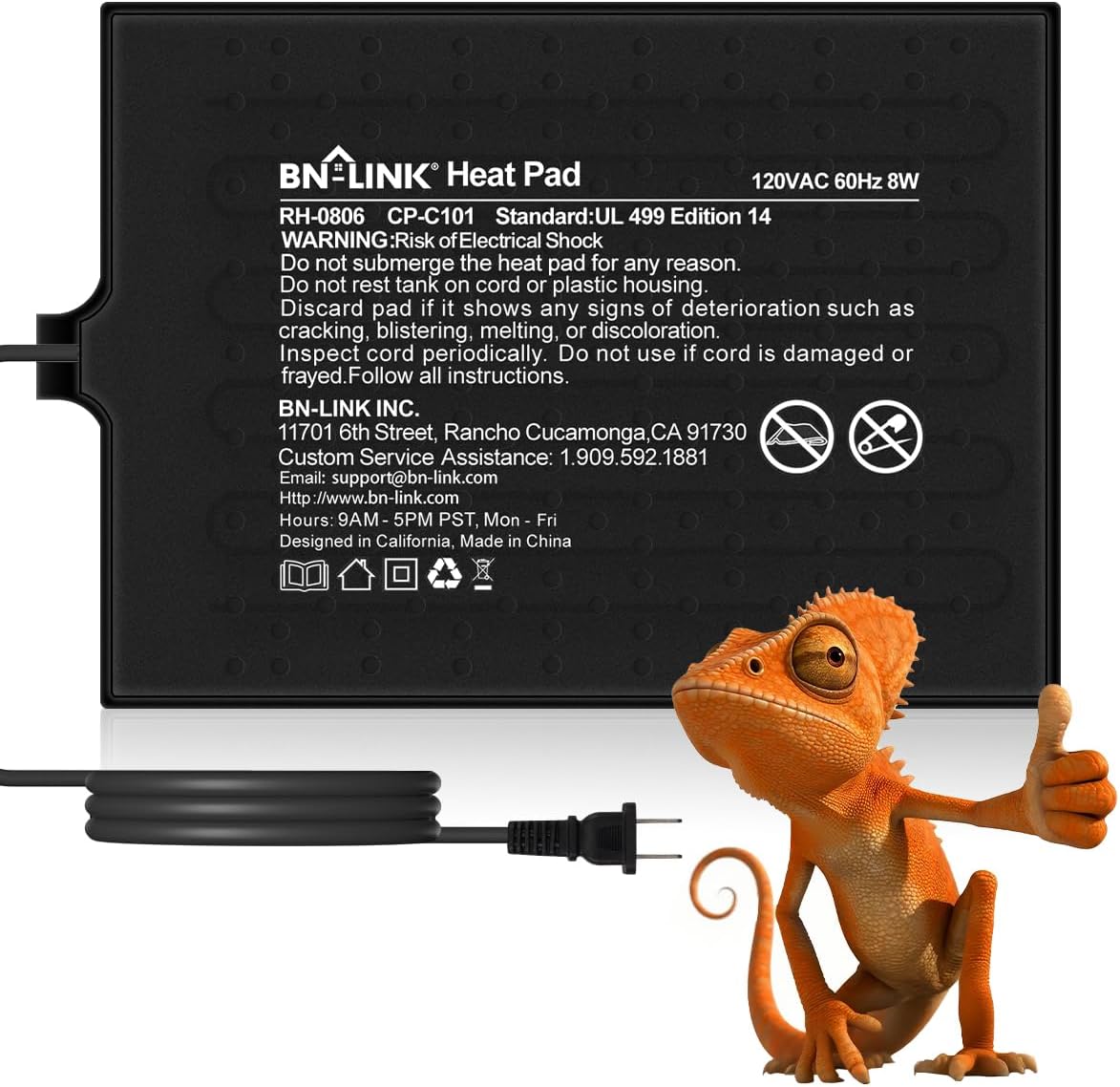
Because the reptile heating market is dominated by a small number of pad designs that differ mainly in size, wattage, and certification, the most useful approach for a buyer is to understand the category thoroughly and then evaluate any specific product against those criteria. One widely available under-tank heater that illustrates the standard design is listed here as a concrete example: check the current price on Amazon.
When evaluating any under-tank mat, including this one, ask four questions. Does it come in a size that covers roughly a third to half of your enclosure floor? Is it UL listed or otherwise independently certified? Does the manufacturer publish a temperature-rise specification relative to ambient room temperature? And does the adhesive or mounting method suit your enclosure material, whether glass, PVC, or wood? A mat that fails any of these questions is not necessarily unusable, but the buyer should know which compromise they are accepting.
For glass enclosures in a temperature-controlled room, a standard adhesive-backed under-tank heater in the correct size, paired with a quality thermostat, remains the simplest reliable belly-heat solution. For PVC or wooden enclosures, adhesive mats are a poor fit because the adhesive does not bond well to those surfaces and the material thickness impedes heat transfer; side-mounted or overhead heat is usually the better answer. For rack systems, heat tape is the established approach. For cold rooms, plan on a ceramic heat emitter in addition to the mat.
If you want to look at the example referenced above in more detail, you can view this option on Amazon.
Sizing a Heat Mat Correctly
Sizing errors are the most common setup mistake among new keepers, and they produce two opposite failure modes. An undersized mat creates a warm zone too small for the animal to use effectively, so the reptile either avoids the heat or crowds onto a tiny hot spot. An oversized mat eliminates the cool zone, removing the animal's ability to thermoregulate at all.
The practical rule is straightforward. Measure the enclosure floor. The mat should cover between one third and one half of that area, positioned at one end so the opposite end stays cool. For a standard 20-gallon long tank, that usually means a mat in the medium range. For a 40-gallon breeder, an extra-large mat or a comparable strip of heat tape is appropriate. For anything above 55 gallons, plan on a different heating strategy, typically a radiant heat panel or a combination of overhead and under-tank heat.
Substrate thickness interacts with sizing in a way that surprises many keepers. A mat rated to produce a 90-degree surface will not produce a 90-degree substrate surface if four inches of loose substrate sit on top of it. Loose substrate is an effective insulator. Most care guides recommend keeping the substrate layer over the warm zone to roughly one to two inches so that heat transfers to the surface where the animal actually sits. Deep substrate is fine on the cool side; it is the warm zone where thickness matters.
Thermostats: The Required Companion Purchase
An unregulated heat mat can reach surface temperatures well above 120 degrees Fahrenheit. At that temperature, a reptile pressing its belly against the glass or plastic above the mat can suffer third-degree burns within minutes, and enclosure materials can degrade or ignite. Every credible reptile care source, including the Association of Reptilian and Amphibian Veterinarians' resource library, treats thermostat control of any heat source as a baseline requirement rather than an optional upgrade.
A thermostat works by reading temperature from a probe and switching power to the heat mat on and off to hold a set point. On/off thermostats, the most common and least expensive type, allow a small temperature swing, often around two degrees, meaning the mat cycles on slightly below the set point and off slightly above it. Proportional thermostats modulate power more smoothly and hold temperature more tightly, but they cost considerably more and are rarely necessary for a single under-tank mat.
Probe placement is where most thermostat setups go wrong. The probe must sit where the animal actually experiences the heat. In practice that means either directly on the mat surface between the mat and the enclosure bottom, or inside the enclosure at the substrate surface directly above the mat. A probe placed on the enclosure floor away from the warm zone, or dangling in the air, reads the wrong temperature entirely and the thermostat will regulate to a number that has nothing to do with the animal's environment.
Thermostats fail. Probes get moved by burrowing reptiles. For those reasons, a separate digital thermometer with its own probe should be placed at the warm zone surface, and a second one in the cool zone. Analog dial thermometers are commonly inaccurate by five to ten degrees and should not be relied on for a heat source that can burn an animal. Checking the thermostat display and the independent thermometers once a day takes seconds and catches failures before they cause injury.
Safety Rules for Under-Tank Heating
- Always use a thermostat. No exceptions. The cost of a basic digital thermostat is a fraction of the cost of treating a burn or replacing a melted enclosure.
- Mount the mat outside the enclosure. Never place a heat mat inside, even under a thick layer of substrate. Reptiles burrow, and direct contact with an unregulated or poorly regulated mat causes severe burns.
- Preserve a cool zone. The animal must be able to move completely away from the heat. A mat covering the entire floor removes that option.
- Secure the probe. Use suction cups, clips, or routing that keeps the probe where it was placed. A probe pushed aside by a burrowing snake will cause the thermostat to overheat the mat.
- Inspect adhesive and wiring regularly. Peeling mats can shift, and damaged cords are a fire risk. Heat cycling degrades both over time.
- Guard any overhead heat source. Ceramic heat emitters and lamps reach temperatures that cause burns on contact. A guard screen around the fixture is standard practice.
Species and Setup Considerations
Desert species such as leopard geckos typically need a warm-zone surface in the low 90s and a cool zone in the mid-70s to low 80s. Tropical species such as ball pythons often do well with a warm-zone surface around 88 to 92 degrees and a cool side in the upper 70s, along with higher ambient humidity. Temperate species such as corn snakes generally tolerate a slightly cooler warm zone. These numbers vary by species and by life stage, and the appropriate reference is a species-specific care sheet or an exotics veterinarian rather than a general article.
Humidity interacts with heat choice in a way that is easy to overlook. Ceramic heat emitters dry the air significantly more than under-tank mats, because they heat the air column and lower relative humidity. Keepers using a CHE for ambient heat in a tropical species enclosure often need to add a humid hide, mist more frequently, or use a substrate that holds moisture. Under-tank heat, by contrast, contributes little to ambient air temperature and therefore affects humidity less.
Nocturnal and crepuscular species benefit from heat sources that produce no light. A ceramic heat emitter running at night maintains ambient temperature without disturbing the animal's day and night cycle. Under-tank mats, which emit no light at all, are also compatible with nighttime heating, provided the thermostat is holding the correct temperature.
Plastic, PVC, and Wooden Enclosures
Glass is the most forgiving enclosure material for under-tank heating because it conducts heat reasonably well and tolerates the adhesive. Plastic storage tubs used in rack systems are a different situation. Many plastics soften and warp well below the temperatures an unregulated mat can reach, and overheated plastic can release fumes. In rack systems, the standard approach is a single strip of heat tape running along the back of each shelf rather than a full-width mat, controlled by one thermostat. That layout provides a warm zone at the rear of each tub while leaving the front cool.
PVC and wooden enclosures present the opposite problem: they insulate too well for an under-tank mat to transfer heat effectively through the floor, and adhesives do not bond reliably to those surfaces. Keepers using PVC or wood typically rely on overhead heat, such as a radiant heat panel or a ceramic heat emitter, sometimes supplemented by side-mounted heat tape. If a mat is used at all on these materials, it is usually mounted on the side rather than underneath.
Common Mistakes and What to Avoid
The most frequent mistake is buying a heat mat and no thermostat, then discovering the problem only after the animal is burned or the enclosure is damaged. The second most frequent is placing the thermostat probe in the wrong location, which produces a setup that looks controlled but is not. The third is relying on the mat to heat the entire enclosure rather than creating a gradient, which leaves the animal with no cool retreat.
Other recurring errors include using an oversized mat on a small enclosure, stacking multiple unregulated mats, running a mat under deep substrate and assuming the surface temperature matches the mat temperature, and trusting an analog dial thermometer for a heat source capable of causing burns. Each of these has a straightforward fix, and each is avoidable with a few minutes of planning before purchase.
Finally, keepers should be aware of what heat mats cannot do. They do not raise ambient air temperature meaningfully, they are not effective in enclosures larger than roughly 55 gallons, they do not work well through thick wooden or PVC floors, and they cannot compensate for a room that drops below the mid-60s at night. Recognizing those limits early prevents the frustrating cycle of buying a larger mat, then a second mat, then a ceramic heat emitter, when the right answer from the start was a mat plus a thermostat plus ambient heat.
Frequently Asked Questions
Can a heat mat be used with any enclosure size?
Under-tank mats work well up to roughly 40 to 55 gallons. Beyond that, the mat's surface area is too small relative to the floor to create an adequate warm zone, and the heat dissipates into the enclosure volume. Larger enclosures generally need a radiant heat panel or a combination of overhead and under-tank heat.
The mat is not warm enough. What is wrong?
Three common causes. The room may be too cold for the mat's rated temperature rise, in which case ambient heat from a ceramic heat emitter is needed. The substrate over the mat may be too thick, insulating the surface from the mat. Or the thermostat probe may be misplaced, causing the thermostat to shut off the mat before the surface reaches the set point.
Can a heat mat be used on a plastic tub or PVC enclosure?
Plastic tubs can be heated with heat tape along the back of each shelf, always with a thermostat, because many plastics warp and degrade at temperatures an unregulated mat can reach. PVC and wooden enclosures insulate too well for under-tank mats to transfer heat effectively; overhead heat is usually the better choice.
Is a thermostat really necessary?
Yes. An unregulated heat mat can exceed 120 degrees Fahrenheit at the surface, hot enough to cause third-degree burns and to damage enclosure materials. A thermostat is the device that makes the mat safe to use, and its cost is small relative to the risk it manages.
How often should the setup be checked?
Once a day, glance at the thermostat display and the independent thermometers. Thermostats and probes fail, and daily checks catch failures before they harm the animal. Adhesive, cords, and heat tape connectors should be inspected periodically for wear.
Where to Buy
As an Amazon Associate, PawCritic earns from qualifying purchases. This does not affect our reviews or recommendations.
If you are ready to look at a concrete example of a standard under-tank heater, you can check the current price on Amazon. Remember that the mat is only half of the purchase; a thermostat and at least one independent digital thermometer are required for a safe setup.
For readers who want to review the option one more time before deciding, you can view this option on Amazon.
Conclusion
reptile heat mats heat tape
Under-tank heating is one of the most reliable ways to provide belly heat to terrestrial reptiles in glass enclosures, and it remains the standard approach for species such as leopard geckos, ball pythons, corn snakes, and hognose snakes. The category is not complicated once the fundamentals are clear: choose a mat sized to cover one third to one half of the enclosure floor, control it with a thermostat, place the probe where the animal experiences the heat, verify with independent digital thermometers, and preserve a cool zone at the opposite end.
For enclosures above roughly 55 gallons, for PVC and wooden enclosures, and for rooms that drop below the mid-60s at night, under-tank heat alone will not be enough. In those situations, a ceramic heat emitter or radiant heat panel provides the ambient heat the mat cannot, and the two approaches complement each other rather than compete. For rack systems, heat tape controlled by a single thermostat is the established solution.
Whatever the setup, the thermostat comes first. An unregulated heat mat is a burn and fire hazard, and no amount of careful placement substitutes for active temperature control. Published veterinary guidance and every credible reptile care source agree on this point. Buy the thermostat with the mat, not after it.
Affiliate Disclosure: PawCritic.com participates in the Amazon Services LLC Associates Program. We may earn commissions from qualifying purchases at no extra cost to you.