Why the Right Dish Matters: More Than Just a Bowl
A reptile's water bowl and feeding dish serve functions far beyond simple hydration and eating. A well-chosen water bowl provides security, since many reptiles soak to aid shedding; supports humidity regulation, because an open water surface releases moisture into the enclosure air; and offers behavioral enrichment, since a significant number of species genuinely enjoy soaking as part of their natural activity cycle. Published husbandry guidance, including material from the Merck Veterinary Manual's exotic animals section, repeatedly stresses that water quality and access are foundational to reptile health, not optional details.
A poorly chosen dish, on the other hand, creates daily maintenance headaches and genuine safety risks. A bowl that is too deep can drown small lizards, frogs, and hatchling snakes. One that is too shallow means constant refills and animals that cannot soak properly. A dish that is too light tips over the moment a snake coils against it, spilling water into substrate where it can drive bacterial growth and scale rot. And a porous dish absorbs bacteria, salmonella, and parasites into its surface in ways that no amount of surface cleaning can fix. Every one of these failure modes is preventable at the point of purchase, which is why the selection criteria below matter more than any particular brand.
Key Factors in Choosing Reptile Dishes
- Material: Ceramic, resin, plastic, glass, and stainless steel are the common options. Resin and glazed ceramic are widely considered the standard for good reason: they are heavy enough to resist tipping, non-porous so they will not absorb bacteria, and finished to look like natural rock in a terrarium.
- Weight and stability: A dish that tips when a snake coils against it means spilled water, saturated substrate, and elevated risk of scale rot. Heavy-bottomed dishes with a low center of gravity prevent this.
- Depth and access: A dish that is too deep is a drowning risk for small lizards, frogs, and hatchlings. A dish that is too shallow for a large snake denies the animal the chance to soak its whole body. Graduated interiors with a shallow ramp on one side address both problems in a single design.
- Non-porous surface: Untreated clay and some budget plastics absorb moisture and microorganisms into the material itself. Smooth, glazed, or sealed surfaces can be disinfected completely.
- Ease of cleaning: Elaborate decorative crevices look attractive but are nearly impossible to sanitize properly. Simple, smooth shapes are healthier in the long run.
- Built-in features: Ramp entries and exits help small animals escape if they fall in; feeding ledges serve arboreal species; and some waterers clip to screen mesh or circulate water for species that respond to movement.
How to Evaluate a Dish Before You Buy
reptile feeding dishes water bowls
The first thing to check is fit. Measure the floor space available in the enclosure before shopping, and measure the animal too. A useful rule of thumb repeated across breeder communities and veterinary husbandry sheets is that a water dish for a soaking species should be long enough for the animal to fit a substantial portion of its body into, with an escape route on at least one side. For snakes, that typically means a dish roughly the length of the animal's coiled body or longer. For lizards, the dish should allow the animal to enter and exit without a vertical leap. When in doubt, oversized is safer than undersized, provided the animal can always climb out.
The second check is the interior finish. Run a fingernail across the inside surface at the store or examine product photographs closely. A glazed ceramic or finished resin interior should feel glassy and uniform. Any roughness, pinholes, or matte patches in the wet zone are places where biofilm will establish itself and where disinfectants will not fully penetrate. Owner reports consistently flag this as the single most common durability complaint with budget resin dishes: hairline cracks and surface defects that develop after a drop or after months of thermal cycling, and that render the dish effectively uncleanable even though it still looks intact from a distance.
The third check is drainage and refill logistics. A very large soaking bowl can hold several liters of water, and you will be emptying it daily, often by carrying it across a room while a curious animal watches from its enclosure. Keepers with tall or front-opening enclosures frequently note in reviews that the heaviest ceramic bowls become a chore at exactly this point. Weight that prevents tipping in the enclosure becomes a liability at cleaning time. Some keepers solve this by keeping two identical dishes and rotating them, so a clean dry one goes in while the dirty one is sanitized at leisure.
Material Trade-offs in Detail
Resin
Resin is the dominant material in the reptile market because it hits a balance of weight, cost, and moldability that nothing else matches. Manufacturers can mold graduated depths, ramp entries, and realistic rock textures into a single piece, and the finished surface is non-porous when intact. The trade-offs are real, though. Resin can crack if dropped onto a hard floor, and a hairline crack in the wet zone becomes a permanent bacterial reservoir. Textured exteriors, while attractive, take more scrubbing than smooth walls. Quality varies considerably between brands, which is why reading recent owner reviews for durability complaints is worthwhile before purchasing.
Glazed Ceramic
Ceramic is the most stable option available. A glazed ceramic dish will not tip under any realistic animal pressure, and the glazed interior is as close to a perfectly sealed surface as husbandry equipment gets. Reviews from keepers of large boas and monitors consistently describe ceramic dishes as permanent enclosure fixtures that outlast the animals themselves. The downsides are weight, which makes removal from tall enclosures awkward, brittleness against impact, and the fact that ceramic holds water at room temperature without any warming, which some keepers report their animals seem to notice. Ceramic also offers a single uniform depth, so it lacks the graduated access of molded resin designs.
Acrylic and Plastic
Clear acrylic dishes have carved out a niche among keepers of crested geckos and other small-to-medium lizards, particularly those who favor clean, minimalist enclosure aesthetics. The transparency is genuinely functional: water clarity and food consumption are visible at a glance without disturbing the animal. Smooth acrylic is also among the easiest surfaces to sanitize. The compromises are weight and scratch resistance. Acrylic is light enough that a determined animal can push it around or tip it, and it scratches and clouds over time, at which point those scratches harbor bacteria and the dish should be replaced. Owner reviews typically describe acrylic dishes as consumables with a service life of a year or two rather than permanent fixtures.
Stainless Steel
Stainless steel is food-safe, effectively indestructible, and trivially sanitizable, which is why some keepers simply use small stainless pet bowls. The reported drawbacks are reflections that can stress certain animals and rapid heat transfer that keeps water noticeably cooler than ambient. For most display enclosures it also looks out of place. It remains a reasonable budget option for quarantine racks and breeding setups where function outranks appearance.
Water Bowls: What to Look For
For a general-purpose water bowl, the features that matter most are a heavy base, a non-porous interior, and safe egress for the smallest animal that will ever access it. Molded resin designs with graduated interiors have become the default recommendation across breeder forums and retail listings alike because they combine all three. The shallow ramp side lets a hatchling or small lizard climb out if it falls in, while the deeper side holds enough water for meaningful soaking and humidity contribution.
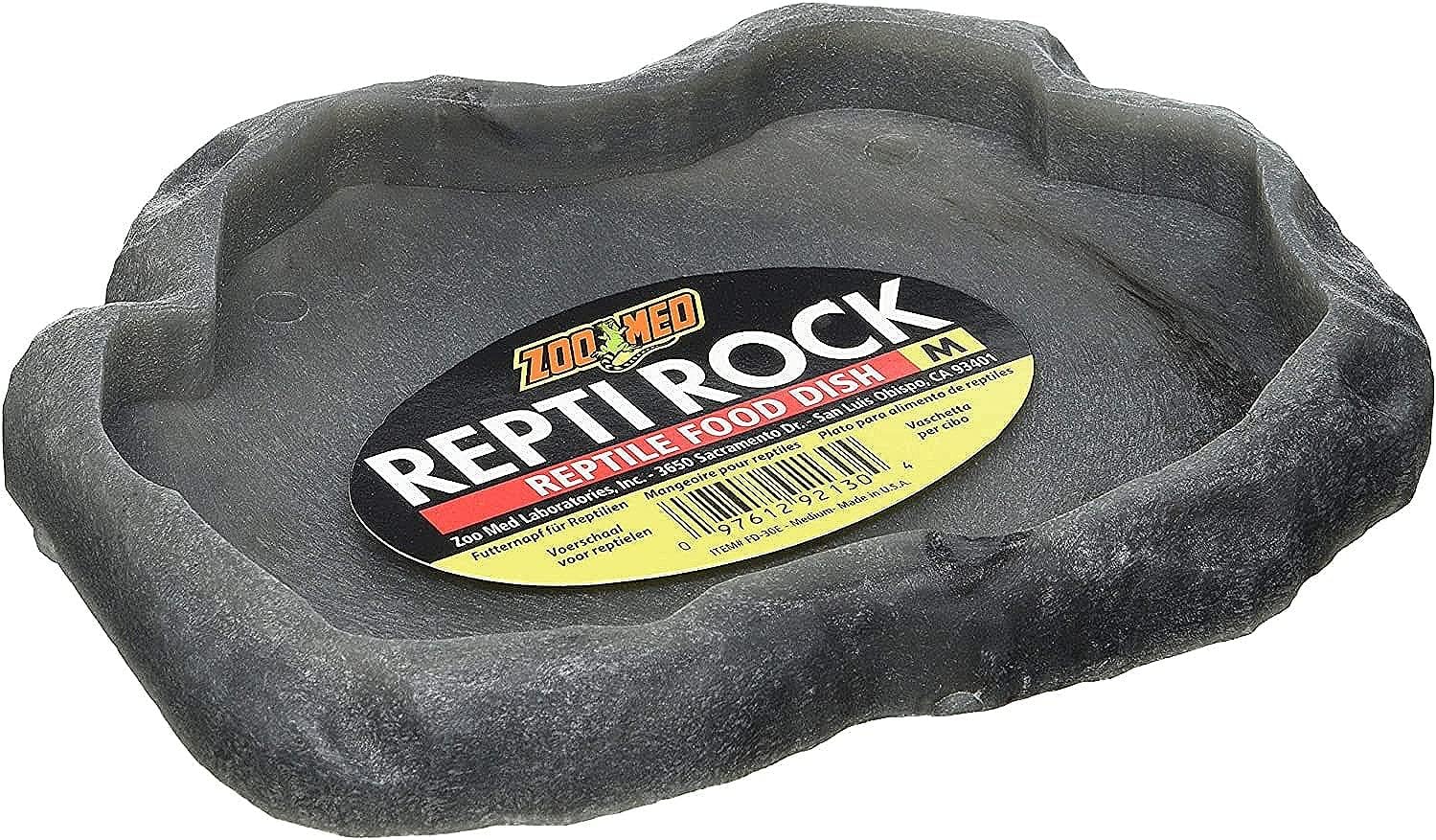
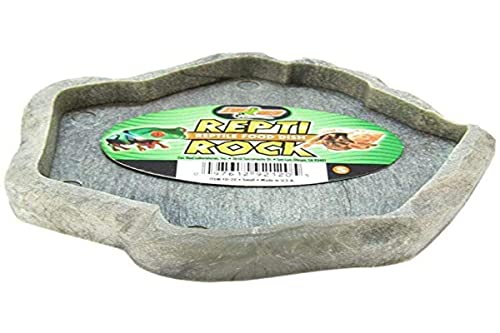
As one concrete example of this design category, the Zoo Med Repti-Rock food dish family is the most frequently referenced option in published care sheets and is available in sizes ranging from nano bowls of roughly two inches for dart frogs and anoles up to extra-large bowls around twelve inches suited to tegus, monitors, and adult boas. Owner reviews consistently describe the heavy base as effectively tip-proof against large snakes, the finished interior as easy to disinfect, and the graduated depth as working as advertised for mixed-size collections. The recurring complaints are also consistent: the weight that prevents tipping makes removal from deep enclosures a two-handed job, textured exteriors take longer to clean than smooth ones, and the deep side of the larger models can be too deep for very small snakes kept in the same enclosure. If you want to evaluate this option against the criteria above, you can check the current price on Amazon.
Feeding Dishes: What to Look For
A feeding dish has a different job than a water bowl, and the design requirements differ accordingly. The surface needs to be wide and flat enough that vegetable matter, pellets, and insects stay contained and visible to the animal. Walls need to be high enough to stop gut-loaded crickets from marching out within minutes but low enough that a short-legged tortoise or gecko can reach the contents. And because food residue is the richest bacterial medium in the enclosure, the dish needs to be smooth and non-porous enough to disinfect between feedings.
Feeding dishes with a molded stone appearance, such as the Zoo Med ReptiRock line, are the other frequently cited example in this category. The wide flat surface keeps mealworms, vegetables, and crickets contained reasonably well, the resin construction resists tipping, and the pieces coordinate into matching food-and-water sets. Verified owner feedback highlights a few honest limitations: the shallow design means constant refills if it is pressed into service as a water bowl, gut-loaded crickets fed carrot and sweet potato can stain the surface over time, and the largest model consumes significant floor space in smaller enclosures. It suits lizards, tortoises, and amphibians as a dedicated feeding station, paired with a separate deeper water bowl. To see current pricing and size options, you can view this option on Amazon.
Feeder Insects and Escape-Proof Designs
Live feeder insects are escape artists, and loose crickets hiding in an enclosure are not merely an annoyance. Crickets are nocturnal opportunists and have been documented chewing on sleeping reptiles, so containing them matters for animal welfare, not just tidiness. Specialized feeding dishes with inward-curved walls are designed so that insects cannot gain the climbing angle to escape while the reptile can still reach in and feed. Owner reports describe these as substantially reducing escapes, though not perfectly: some crickets still find their way out, larger roaches and superworms can defeat the curve, and crickets that huddle motionless in the corner may not trigger a feeding response from a visually hunting lizard. The same option discussed above, check the current price on Amazon to compare sizes, works for many keepers as part of a broader feeding setup.
Arboreal and Screen-Cage Setups
For reptiles housed in screen cages and arboreal enclosures, chameleons, arboreal geckos, and tree frogs chief among them, a floor-level water bowl is close to useless. These animals live in the canopy and may never voluntarily descend to drink. Husbandry guidance for chameleons in particular emphasizes dripping and moving water over standing bowls. Clip-on waterers that attach directly to screen mesh at any height address this by placing a small drinking reservoir where the animal actually spends its time. A second unit placed lower can provide redundant access. The trade-offs reported by keepers are modest: these are drinking stations, not soaking dishes; the clip mechanism can wear on fine mesh over time; and reservoir tubing can grow algae without a regular cleaning schedule. Misting systems and drip systems remain the primary hydration method for these species regardless of what dish is present.
Oversized Soaking Bowls for Large Reptiles
For tegus, monitors, large boas, and adult iguanas, standard retail water bowls are simply not large enough for full-body soaking, which is a real behavioral need for many of these species rather than a luxury. Oversized resin dishes in the sixteen-plus-inch range with ramp entrances exist specifically for this niche. The honest costs are floor space, purchase price, and the volume of water required for every change. Keepers of large species generally consider these trade-offs unavoidable, since the alternative is an animal that cannot express soaking behavior at all.
Species-Specific Selection Notes
reptile feeding dishes water bowls
| Species | What the dish needs to do |
|---|---|
| Ball Python | Large, heavy bowl big enough for soaking during shed; stable against a coiling adult body |
| Leopard Gecko | Shallow access via ramp; heavy base so it does not slide during hunting; smooth sanitized surface |
| Crested Gecko | Lightweight dish easy to lift off a shelf; clear walls help monitor water clarity; smooth surface for cleaning |
| Bearded Dragon | Separate flat feeding dish for vegetables and insects, plus a water bowl sized for occasional soaking |
| Chameleon | Screen-mounted waterer at mid and upper canopy plus a drip or misting system; standing floor water is typically ignored |
| Corn Snake | Medium bowl for soaking; stable against adult movement |
| Russian Tortoise | Shallow entrance the tortoise can walk into; wide flat grazing surface for vegetables |
| Tegu | Oversized full-body soaking dish with ramp entrance and heavy construction |
Water Bowl Hygiene: Preventing Bacteria and Disease
Hygiene is where most preventable reptile illness originates, and husbandry resources such as those collected by the Association of Reptilian and Amphibian Veterinarians treat sanitation as a core pillar of reptile care. A bacterial biofilm begins forming on a wet bowl surface within roughly a day, and it is invisible long before the water looks dirty. The practical routine that experienced keepers converge on is straightforward: replace the water completely every day, and scrub and disinfect the dish weekly with a reptile-safe veterinary disinfectant such as properly diluted F10SC, followed by thorough rinsing and air drying.
- Never wait for the water to look dirty: most pathogens are invisible. Daily full replacement is the baseline, not a stretch goal.
- Use veterinary disinfectants as directed: dilute per the label, soak for the stated contact time, rinse thoroughly, and air dry before returning the dish to the enclosure.
- Avoid household bleach where possible: bleach residue is toxic to reptiles, amphibians, and invertebrates. If bleach must be used, a triple rinse with a dechlorinator soak and a 24-hour air dry is the minimum diligence.
- Keep food and water dishes separate: decomposing food particles in a water dish are an ideal bacterial culture. Dedicated dishes for each purpose eliminate the pathway.
- Replace scratched or cracked dishes: once the surface is compromised, bacteria colonize microscopic crevices that sanitizers cannot reach. Dishes are cheap relative to veterinary bills.
Common Mistakes to Avoid
Several recurring mistakes show up constantly in beginner threads and rescue intake reports. Deep, smooth-walled dishes with no escape route, placed with small lizards or hatchling snakes, are a documented drowning hazard. Lightweight dishes in snake enclosures get tipped within days, and keepers sometimes respond by removing the water bowl entirely rather than buying a heavier one, which is far worse for the animal. Mixing food and water in one dish to save space is another frequent shortcut that reliably produces bacterial problems. Using a dish previously used for a dog or cat, or reusing secondhand dishes of unknown history, risks cross-contamination from gut bacteria; dedicate dishes exclusively to your reptiles. And finally, spraying or wiping around a dish rather than actually removing and cleaning it leaves the biofilm underneath exactly where it was.
Frequently Asked Questions
My snake will not drink from a bowl. What should I do?
First confirm the bowl is large enough, since snakes drink by partially submerging the head and throat. Newly arrived or stressed animals may not drink for two or three days, which is normal. Fresh dechlorinated water matters, as chlorine odor can put animals off. Some snakes respond to moving water, and creating ripples with a drip chain or a small fountain feature can trigger drinking behavior where a still bowl does not.
Why does my reptile defecate in the water bowl every time?
Many reptiles, ball pythons and boas especially, instinctively defecate in water, which is believed to be a predator-avoidance behavior since scent trails dissipate faster in water than on dry substrate. The instinct cannot be trained away. Mitigation options include providing a second shallow bowl that effectively becomes the designated toilet, checking and washing daily, and accepting frequent water changes as part of the routine.
Can I use a dog or cat bowl for my reptile?
A brand-new heavy ceramic pet bowl can work fine and is affordable and easy to sanitize. Avoid stainless steel if cool water or reflections seem to bother your animal, and never use a bowl that previously served a dog or cat, since residue and gut bacteria pose a cross-contamination risk. Clean any repurposed dish with the same veterinary disinfectants you would use on reptile-specific products.
Closing Notes
For a water bowl suited to nearly any reptile, a heavy resin design with graduated depth remains the most widely recommended category, available in every size from nano to extra-large. For feeding stations, a wide flat resin dish keeps food items contained and coordinates with a matching water bowl. For arboreal screen-cage species, clip-on waterers and drip systems fill the role that floor bowls cannot, and for large soaking species, oversized dishes with ramp entries are the only category that truly fits the animal. Whatever specific dishes you choose, the routine is the same: fresh water daily, disinfection weekly, replacement when surfaces scratch or crack, and never one dish for both food and water. If you would like to look at the example water dish discussed earlier, you can view this option on Amazon.
Affiliate Disclosure: PawCritic.com participates in the Amazon Services LLC Associates Program. We may earn commissions from qualifying purchases at no extra cost to you. PawCritic does not perform hands-on product testing; all observations are drawn from manufacturer specifications, published husbandry guidance, and verified owner reports.