Thermometers and Hygrometers for Reptile Enclosures: A Buying Guide
Reptiles are ectotherms, meaning their body temperature is governed almost entirely by their surroundings. A leopard gecko at roughly 85 F has digestive enzymes that function efficiently; at 75 F, digestion slows dramatically, food can sit undigested in the gut, and the animal may regurgitate or develop an impaction. At 95 F and above, metabolic rate climbs into a danger zone and prolonged exposure can cause neurological damage. The margin between a healthy thermal environment and a harmful one can be as narrow as ten degrees, and human hands are not reliable instruments for judging it. A hand at 98 F perceives both 85 F and 105 F as simply warm, which makes touch useless for verifying a basking spot. Published husbandry guidance from veterinary sources such as the Association of Reptilian and Amphibian Veterinarians consistently emphasizes measured, species-specific thermal gradients rather than estimated ones.
Humidity is equally consequential and equally invisible. A ball python kept near 30 percent relative humidity is prone to stuck shed, respiratory infection, and retained shed that traps moisture against the skin and can progress to scale rot. The same snake at 80 percent humidity with poor ventilation faces a different risk: direct bacterial and fungal growth on damp skin. The usable window between too dry and too wet is narrow, and human skin cannot distinguish 55 percent relative humidity from 72 percent. Only a hygrometer resolves that difference. For species-specific humidity targets, the Merck Veterinary Manual section on exotic and laboratory animals is a useful starting reference.
This guide treats thermometers and hygrometers as mandatory monitoring equipment rather than optional accessories, on the same footing as food, water, and the enclosure itself. It explains what to look for in each device category, where readings should be taken, how to interpret them, and what commonly goes wrong. One concrete example of a WiFi-connected monitor is linked below so readers can see current specifications and pricing; the rest of the guidance applies to any accurate digital instrument.
reptile thermometers hygrometers
Why Analog Dial Gauges Are Not Adequate
Analog dial thermometers and hygrometers remain common in pet stores because they are inexpensive and visually appealing, but their accuracy is poor and their calibration drifts. Bimetal coil thermometers frequently deviate by 5 to 10 degrees Fahrenheit, and analog hygrometers often read 10 to 20 percent off. The paper or coil sensing element inside degrades within 6 to 12 months, and there is no user-accessible calibration. For a bearded dragon basking spot that should sit near 105 F, a dial reading 10 degrees low could push the actual surface to 115 F, which risks burns. For a crested gecko enclosure that should stay near 70 to 75 F, a dial reading 10 degrees high could lead a keeper to reduce heating when the enclosure is already too cool. Digital instruments with published accuracy tolerances are the appropriate standard for any reading that affects animal health.
Accuracy specifications matter, and they are published by manufacturers. A typical consumer digital thermometer lists an accuracy of plus or minus 1 to 2 degrees Fahrenheit, while a good digital hygrometer lists plus or minus 3 to 5 percent relative humidity. These tolerances are acceptable for reptile husbandry. What is not acceptable is an unrated analog gauge with no published specification at all. When comparing devices, look for a stated accuracy range, a stated operating humidity range, and a stated operating temperature range. A device rated only for indoor comfort conditions of 32 to 122 F and 20 to 90 percent humidity may drift in a high-humidity tropical enclosure or in a rack system that runs warm.
What to Look For in a Reptile Thermometer
The single most useful feature in a reptile thermometer is a remote probe. A probe lets the sensor sit exactly where the animal sits, on the basking surface or inside a warm hide, while the display remains outside the enclosure where it can be read without opening the lid. Opening the enclosure to read a wall-mounted gauge changes the very conditions being measured and stresses the animal. A probe wire of roughly 36 to 40 inches is enough to route from a basking rock to the exterior of most standard terrariums. Probe thermometers are typically accurate to plus or minus 1 to 2 degrees Fahrenheit and respond within 10 to 20 seconds.
For keepers who want continuous records rather than spot checks, data logging is the second key feature. A logging thermometer records readings at set intervals, often every 30 seconds to every 60 minutes, and stores them in internal memory or in a phone app. This matters for incubation, for seasonal cycling, and for diagnosing problems such as a heat mat that cycles off too early or a room that drops further overnight than expected. A log showing a nightly dip to 68 F in a leopard gecko enclosure explains a refusal to eat far better than a single afternoon reading of 88 F. When reviewing logs, look for the minimum and maximum values rather than the average, because extremes are what harm animals.
Alerts are the third feature worth paying for. A device that pushes a notification to a phone when temperature or humidity leaves a programmed range addresses the most common emergency in reptile keeping: equipment failure while the keeper is away. Heat lamps burn out, thermostats stick closed or open, and space heaters in the room fail. A WiFi-connected monitor that reports a 20-degree drop at 3 AM gives the keeper a chance to act. Bluetooth-only devices cannot do this, because they require the phone to be within roughly 30 feet, so they are best understood as data loggers rather than alarm systems.
What to Look For in a Reptile Hygrometer
Hygrometer accuracy is harder to achieve than thermometer accuracy, and the specification to check is the operating range. General-purpose household hygrometers are often most accurate near 40 to 60 percent relative humidity and less accurate at the extremes. Terrarium use spans a wide range: a desert species such as a uromastyx may need 20 to 40 percent, a ball python 50 to 60 percent, and a tropical species such as a crested gecko 60 to 80 percent with higher spikes. A hygrometer rated for 20 to 90 percent relative humidity with plus or minus 3 to 5 percent accuracy covers most reptile applications. Devices calibrated specifically for terrarium ranges tend to hold accuracy better in the middle bands that matter most.
Placement of a hygrometer is as important as its accuracy. Humidity stratifies: air near a water bowl or damp substrate is measurably more humid than air near a screen top. A hygrometer mounted high on the enclosure wall may read 45 percent while the substrate where the animal actually rests sits at 65 percent. The practical approach is to place the hygrometer at the level and location the animal uses most, and to place a second unit inside a humid hide if the species relies on one. For species that need a humid microclimate, such as many geckos and juvenile snakes, the humid hide reading is more informative than the ambient reading. A device that has been submerged or exposed to condensation should be treated as suspect, because water ingress is a common cause of drift.
How Many Devices Does One Enclosure Need
A functional minimum for a single enclosure is two thermometers and one hygrometer. One thermometer probe goes on the warm side at the substrate surface directly under or above the heat source, which is the temperature the animal experiences when basking. A second thermometer goes on the cool side at substrate level, which establishes the escape zone the animal needs for thermoregulation. The hygrometer goes in the middle of the enclosure at the level where the animal spends most of its time. This three-device setup covers the readings that matter for a single animal in a standard terrarium.
A more complete setup adds a room thermometer and a WiFi-connected sensor. The room thermometer matters because heat mats and lamps raise temperature relative to ambient, not to a fixed absolute value. A heat mat that lifts a surface 15 degrees above room temperature will produce an 85 F warm spot in a 70 F room but only a 78 F warm spot in a 63 F room, which is below the preferred range for many species. A WiFi sensor on the warm side provides remote alerting and a continuous log. Breeders running racks or multiple enclosures typically add one logging sensor per zone rather than per enclosure, and they review logs weekly to catch drift in thermostats and heating elements before animals are affected.
Where to Place Probes and Sensors
Probe placement is the most common source of misleading readings. The thermostat probe and the thermometer probe serve different purposes and belong in different places. The thermostat probe controls the heat source, so it sits on the heat mat surface between the mat and the enclosure floor, or on the basking surface directly under a lamp. The thermometer probe verifies the result, so it sits at the substrate surface in the warm zone where the animal rests. If the thermometer reads higher or lower than desired, the fix is to adjust the thermostat set point, not to move the thermometer. Treating the thermostat reading as the enclosure temperature is a frequent and consequential error.
For arboreal species, the vertical dimension matters as much as the horizontal one. A crested gecko or chameleon uses branches and foliage at different heights, and a probe placed on the floor of a tall enclosure tells the keeper almost nothing about conditions at the basking branch. In these setups, a probe should be secured at the level of the primary basking perch, with a second reading near the bottom to confirm a usable gradient. For burrowing or fossorial species, a probe placed at the substrate surface misses the conditions inside the burrow, where the animal may spend most of its time. In those cases, a probe inserted a few inches into the substrate or a sensor placed inside a hide provides the relevant number.
Temperature and Humidity Targets by Species Group
Targets vary widely, and generic advice is a poor substitute for species-specific research. Desert species such as bearded dragons, uromastyx, and leopard geckos generally need a warm-side basking surface in the 95 to 110 F range depending on species, a cool side in the 75 to 85 F range, and moderate humidity around 30 to 50 percent. Tropical species such as crested geckos, ball pythons, and many tree frogs need lower basking temperatures, often 82 to 90 F, cool sides in the 70 to 78 F range, and humidity between 60 and 80 percent with periodic spikes. Temperate species such as corn snakes and king snakes sit in between, with warm sides near 85 to 90 F and humidity around 40 to 60 percent. These figures are starting points; published care sheets and veterinary references should be consulted for the exact species.
Two patterns are worth internalizing. First, the gradient matters more than any single number. A reptile that can move between a warm zone and a cool zone regulates its own temperature effectively; an enclosure with uniform temperature removes that ability and is a welfare problem even if the single reading looks correct. Second, humidity interacts with ventilation and temperature. Warm air holds more moisture than cool air, so a hygrometer reading taken during a warm afternoon may drop several points overnight without any change in the enclosure. Reviewing logs across a full day and night cycle is more informative than checking a single moment.
One Concrete Example: A WiFi-Connected Monitor
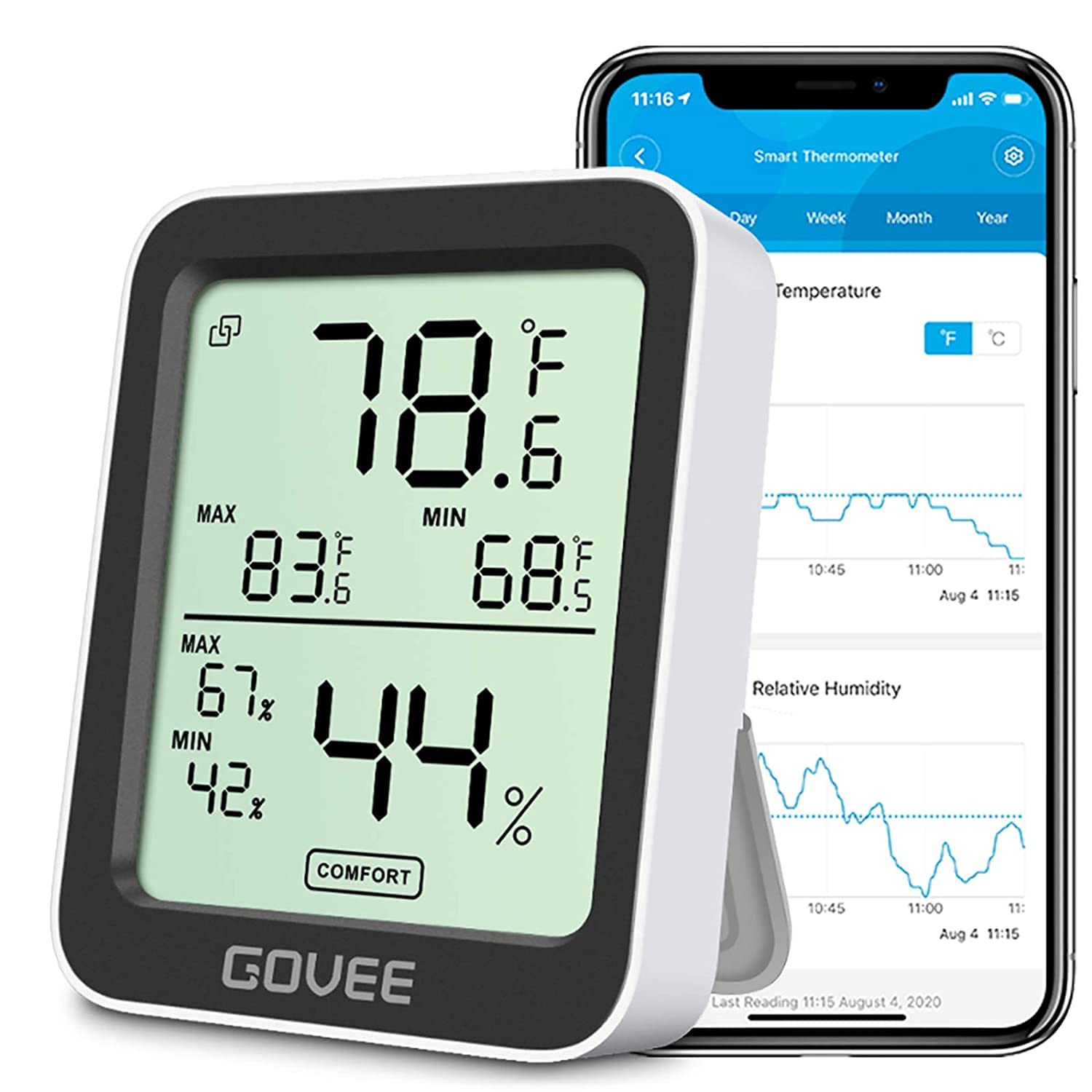
The Govee WiFi Thermometer Hygrometer, model H5179, is a commonly cited example of a consumer-grade monitor that combines temperature and humidity sensing, a local display, data logging, and WiFi push alerts in one unit. Manufacturer specifications list accuracy of plus or minus 0.5 F for temperature and plus or minus 3 percent relative humidity, with a 2.4 GHz WiFi requirement. In practice, that combination means the device can log conditions continuously and notify a keeper when readings leave a programmed range, which addresses the overnight equipment-failure scenario that spot checks cannot. The trade-offs are real: the unit is bulkier than a simple probe thermometer, it needs one device per temperature zone, and alert delivery can lag by seconds to a couple of minutes rather than being instantaneous. It suits keepers who want remote awareness and a recorded history, and it is less suited to very small enclosures or to keepers who prefer a purely local, battery-free setup. Readers who want to compare current specifications and pricing can check the current price on Amazon.
Other Device Categories Worth Knowing
Simple probe thermometers remain the workhorse of reptile keeping. A wired probe thermometer with a display that mounts outside the enclosure costs roughly 10 to 12 dollars, reads accurately to plus or minus 2 degrees Fahrenheit, and places the sensor exactly where it is needed. The limitations are equally clear: temperature only, no humidity, no logging, and no alerts. For a keeper who checks enclosures daily, a probe thermometer is often the most cost-effective accurate instrument available, and it pairs naturally with a standalone hygrometer.
Budget combination units that display temperature and humidity on one screen are widely available for around 10 dollars. They typically use a magnetic back or fold-out stand and run on a single AAA battery. Accuracy is acceptable for general monitoring, often plus or minus 2 degrees Fahrenheit and plus or minus 5 percent relative humidity, but the absence of a probe means the reading reflects conditions at the device location rather than at the basking surface. These units work well as secondary readings or as the primary instrument in a simple setup where the device can be placed at animal level.
Bluetooth data loggers occupy a different niche. Devices in this category store thousands of readings internally and sync to a phone app when the phone comes within range, producing a complete graph of temperature and humidity over days or weeks. They are excellent for incubation, for tracking seasonal cycling in breeding programs, and for diagnosing intermittent problems. They are not alarm systems, because they do not push notifications when the keeper is away. A common and sensible arrangement is to pair a WiFi monitor for real-time alerting with a Bluetooth logger for detailed history.
Reptile-specific combination units from established terrarium brands typically offer a temperature probe plus a humidity sensor in one housing. The probe delivers a targeted temperature reading at the basking spot, while the humidity sensor reads at the body location. This design is convenient and often more accurate than a wall-mounted household unit for the temperature side, but the two readings come from two different locations, which can be confusing if the keeper assumes both describe the same spot. Standalone reptile hygrometers fill the remaining gap for keepers who already have temperature covered and want a humidity-only device calibrated for terrarium ranges.
Maintenance, Calibration, and Replacement
Digital thermometers and hygrometers generally hold calibration for two to five years, but several events shorten that life. Submersion in water, prolonged exposure to condensation, a damaged probe wire, and failing batteries all degrade accuracy. A device that has been misted directly, dropped into a water bowl, or chewed by a large snake should be verified against a known reference or replaced. Battery replacement every 6 to 12 months is good practice even if the display still works, because low voltage can skew readings before the display visibly fades. Button cells such as LR44 and CR2032 are common, and keeping spares on hand avoids gaps in monitoring.
A simple calibration check for a hygrometer is the salt test, in which a sealed container of damp salt creates a known reference humidity of roughly 75 percent. A hygrometer reading outside a few points of that reference is drifting. For thermometers, an ice-water bath at 32 F serves as a comparable check. These tests do not fix a drifting device, but they tell the keeper when replacement is warranted. Because a failed sensor can read plausibly wrong values rather than failing visibly, periodic verification is more useful than waiting for an obvious malfunction.
Common Mistakes in Reptile Monitoring
The most frequent error is trusting a single reading. One thermometer on the warm side tells the keeper nothing about whether a cool retreat exists, and one hygrometer near the top of the enclosure says little about conditions at substrate level. A second common mistake is placing the probe where it is convenient rather than where the animal lives, such as on the enclosure wall instead of on the basking surface. Wall readings can differ from surface readings by 10 degrees or more, particularly under a focused heat lamp.
Another mistake is confusing the thermostat reading with the enclosure temperature. The thermostat measures the heat source; the thermometer measures the habitat. Adjusting a thermostat to match a desired enclosure temperature without verifying with an independent thermometer typically produces an enclosure that is too cool or too warm. A related error is relying on a heat mat or lamp to compensate for a cold room without checking the resulting gradient. In a room that drops to 62 F overnight, a mat rated to raise surface temperature 15 degrees will produce a warm spot near 77 F, which is below the preferred range for many species and may cause the animal to stop eating.
Finally, keepers sometimes treat digital devices as permanently trustworthy. Sensors drift, batteries weaken, and probes corrode. A monitoring routine that includes a periodic accuracy check, a battery schedule, and a review of logged minimum and maximum values catches these problems before they affect an animal. Because reptile illness often develops slowly and subtly, an accurate log is frequently the earliest evidence that something in the enclosure has changed.
Safety and Poison Control Considerations
Monitoring equipment itself is generally low-risk, but the placement of cords, probes, and batteries inside or near an enclosure deserves attention. Probe wires can be chewed by large snakes and monitors, and damaged insulation is a shock and burn hazard. Button batteries are a serious ingestion risk for any animal that can reach them, and loose batteries should never be left inside an enclosure. Devices mounted with adhesive can be dislodged by climbing species and should be secured so they cannot fall into a water bowl. For any suspected ingestion or exposure incident, the ASPCA Animal Poison Control center is a recognized resource for guidance, and an exotics veterinarian should be contacted for reptiles specifically.
Frequently Asked Questions
Can analog dial gauges be trusted at all? Not for readings that affect animal health. Analog thermometers commonly deviate by 5 to 10 degrees Fahrenheit and analog hygrometers by 10 to 20 percent relative humidity, and their calibration drifts within a year. They are decorative instruments. Digital devices with published accuracy specifications are the appropriate standard.
How often should monitoring devices be replaced? Digital thermometers and hygrometers typically hold calibration for two to five years. Replace a device if readings seem inconsistent with a known reference, if it has been submerged, if the display flickers or fades, or if a probe wire is damaged. Replace batteries every 6 to 12 months regardless of display condition.
What is the difference between a thermostat probe and a thermometer probe? The thermostat probe controls the heat source and sits on the mat surface or basking surface directly under the lamp. The thermometer probe verifies habitat conditions and sits at the substrate surface where the animal rests. They are two different sensors in two different locations, and the thermostat reading should never be assumed to equal the enclosure temperature.
Do I need a separate hygrometer inside a humid hide? For species that rely on a humid microclimate, yes. Ambient humidity in the enclosure can read 50 percent while the inside of a humid hide reads 80 percent, and the hide reading is the one that affects shedding. A small secondary hygrometer placed inside the hide resolves the difference.
Is WiFi monitoring necessary? It is not necessary for basic care, but it addresses the most common emergency in reptile keeping: equipment failure while the keeper is away. A WiFi monitor with push alerts provides remote awareness and a continuous log. A Bluetooth logger provides detailed history but no remote alerting, and a simple probe thermometer provides accurate spot readings with no automation at all.
Putting It Together
A workable monitoring setup starts with two accurate digital thermometers and one hygrometer, positioned to capture the warm zone, the cool zone, and the level where the animal spends its time. Adding a room thermometer clarifies how much work the heating equipment is doing, and adding a WiFi-connected monitor with alerts covers the overnight and vacation scenarios that manual checks cannot. For breeders and keepers running incubation, a Bluetooth data logger adds the continuous history that makes trends visible. Readers who want to look at a specific WiFi-connected option can view this option on Amazon.
The underlying principle is simple and worth restating. Reptile health depends on conditions that human senses cannot measure reliably: a ten-degree thermal window and a humidity band that shifts with temperature, ventilation, and time of day. Accurate digital instruments cost roughly the same as a single veterinary visit, and they turn guesswork into verifiable data. The instrumentation is inexpensive relative to the cost of treating a burned, dehydrated, or impacted animal, and it is the difference between keeping a reptile and keeping a reptile well.
reptile thermometers hygrometers
Where to Buy
As an Amazon Associate, PawCritic earns from qualifying purchases. This does not affect our reviews or recommendations.
Affiliate Disclosure: PawCritic.com participates in the Amazon Services LLC Associates Program. We may earn commissions from qualifying purchases at no extra cost to you.
Related reading: check the current price on Amazon for a WiFi-connected monitor, and consult the Association of Reptilian and Amphibian Veterinarians resources page and the Merck Veterinary Manual exotic animal section for species-specific husbandry targets.