Why Automatic Misting Matters for Reptile Keepers
Humidity is one of the most critical — and most frequently mismanaged — parameters in reptile husbandry. Tropical species like chameleons, crested geckos, dart frogs, and green tree pythons generally need consistent relative humidity between 60 and 90 percent to stay hydrated, shed cleanly, and respire comfortably. Husbandry guidance from the Association of Reptilian and Amphibian Veterinarians emphasizes that chronic low humidity is a common contributor to retained sheds, dehydration, and respiratory disease in these species, so getting moisture delivery right is not cosmetic — it is preventive medicine.
Manual misting with a spray bottle can work for a single small enclosure, but it is labor-intensive, inconsistent, and nearly impossible to sustain during work hours or overnight when humidity naturally dips. Automatic misting systems address this by delivering precisely timed bursts of fine mist throughout the day, maintaining stable humidity without constant human intervention. This guide compares four widely used systems based on manufacturer specifications, published husbandry guidance, and verified owner reports — covering who each one suits, what the honest trade-offs are, and how to install and maintain any misting system correctly.
The Four Systems at a Glance
| Rank | Product | Best For | Reservoir |
|---|---|---|---|
| 1 | MistKing Starter Misting System | Hobbyists, multi-enclosure setups | External bucket |
| 2 | Exo Terra Monsoon Solo II | Single terrarium, plug-and-play simplicity | 1.5L built-in |
| 3 | Repti Zoo 4L Programmable Misting System | Large enclosures, advanced timers | 4L built-in |
| 4 | Zoo Med ReptiRain | Entry-level, simple operation | External bottle or bucket |
#1 — MistKing Starter Misting System
Best Overall Misting System
The MistKing Starter Misting System is widely regarded as the reference standard in the reptile-keeping community, and that reputation is built on modular, professional-grade components rather than marketing. The heart of the system is a diaphragm pump that, per manufacturer specifications, runs quietly enough for placement in living spaces and produces an ultra-fine mist that settles evenly across leaves, moss, and enclosure surfaces without creating puddles. Owners consistently report years of daily service with minimal maintenance, which is why the system is a common fixture in breeder rooms and zoological collections.
What sets MistKing apart is expandability. The starter kit includes everything needed for one enclosure, but additional nozzles, T-fittings, and tubing let a single pump cover a dozen terrariums from one reservoir. The seconds-based timer controller allows multiple misting sessions per day — for example, a 30-second morning mist, a 15-second mid-afternoon top-up, and a 45-second evening rainfall simulation. The pump self-primes and maintains pressure, eliminating the sputtering and dry starts that plague cheaper units.
Unlike systems with built-in reservoirs that need frequent refilling, the MistKing draws from any clean container you provide. Many keepers use a 5-gallon food-grade bucket with a lid to keep out debris and slow evaporation, and a single fill can run a multi-enclosure setup for close to a week. The honest trade-offs: higher upfront cost than consumer-grade alternatives, initial setup requires some DIY confidence (drilling a reservoir lid, routing tubing), and the seconds-based timer lacks the LCD interface some competitors offer.
#2 — Exo Terra Monsoon Solo II
Best for Single Terrariums
The Exo Terra Monsoon Solo II is the sensible entry point for keepers with one or two enclosures who want a plug-and-play automatic misting solution. Unlike the DIY-oriented MistKing, the Monsoon Solo II arrives fully assembled: fill the 1.5-liter reservoir, position the adjustable nozzle, select a misting interval (every 1, 2, 3, 4, 6, 8, or 12 hours), set the spray duration (2 to 60 seconds), and it is running — total setup takes only a few minutes, which owners repeatedly cite as the system's biggest advantage.
The integrated reservoir is compact enough to sit beside a standard 18x18x24 terrarium without dominating the space, and the neutral styling blends with enclosure decor. The 360-degree adjustable nozzle lets you direct spray exactly where it is needed — onto basking leaves, moss patches, or enclosure walls where arboreal species drink. Verified owner reports from crested gecko and dart frog keepers indicate that two 30-second cycles per day typically holds humidity in the 75-85 percent range in a reasonably sealed glass enclosure, though mesh-topped setups and arid winter homes may need longer or more frequent cycles.
Limitations are real but predictable: the 1.5-liter reservoir is small for multiple enclosures, the interval timer is preset-based rather than allowing custom clock times, and there is no low-water alert — you will need to check the level visually. For a single-enclosure keeper who values simplicity over expandability, those are acceptable compromises.
#3 — Repti Zoo 4L Programmable Misting System
Best Advanced Timer Features
The Repti Zoo 4L Programmable Misting System occupies the sweet spot between consumer convenience and advanced functionality. Its standout feature is the digital LCD controller, which allows up to ten independent misting schedules per day, each with its own duration from 1 to 600 seconds — a 20-second mist at 7:00 AM, a 10-second mist at 2:00 PM, and a 45-second rainfall simulation at 8:00 PM are all straightforward to program. For keepers trying to mimic dawn dew patterns that trigger drinking behavior in chameleons and day geckos, this level of scheduling granularity genuinely matters.
The 4-liter built-in reservoir is generous for a self-contained system, and the transparent tank lets you check water level at a glance. Repti Zoo includes two brass nozzles (expandable to four), and the fine-thread brass construction produces a mist quality that owner reports describe as comparable to considerably more expensive systems. The pump is reported as audible but not disruptive — louder than the MistKing, quieter than most budget units.
Owners running this system on large arboreal enclosures, such as 24x18x36 chameleon cages, report that the dual nozzles provide good coverage and that the pump handles two enclosures without strain. Trade-offs: the pump is louder than premium systems, the controller interface is somewhat dated, and the tubing is standard vinyl rather than the stiffer polyurethane used by professional setups, meaning it will likely need replacement sooner.
#4 — Zoo Med ReptiRain
Best Entry-Level Automatic Mister
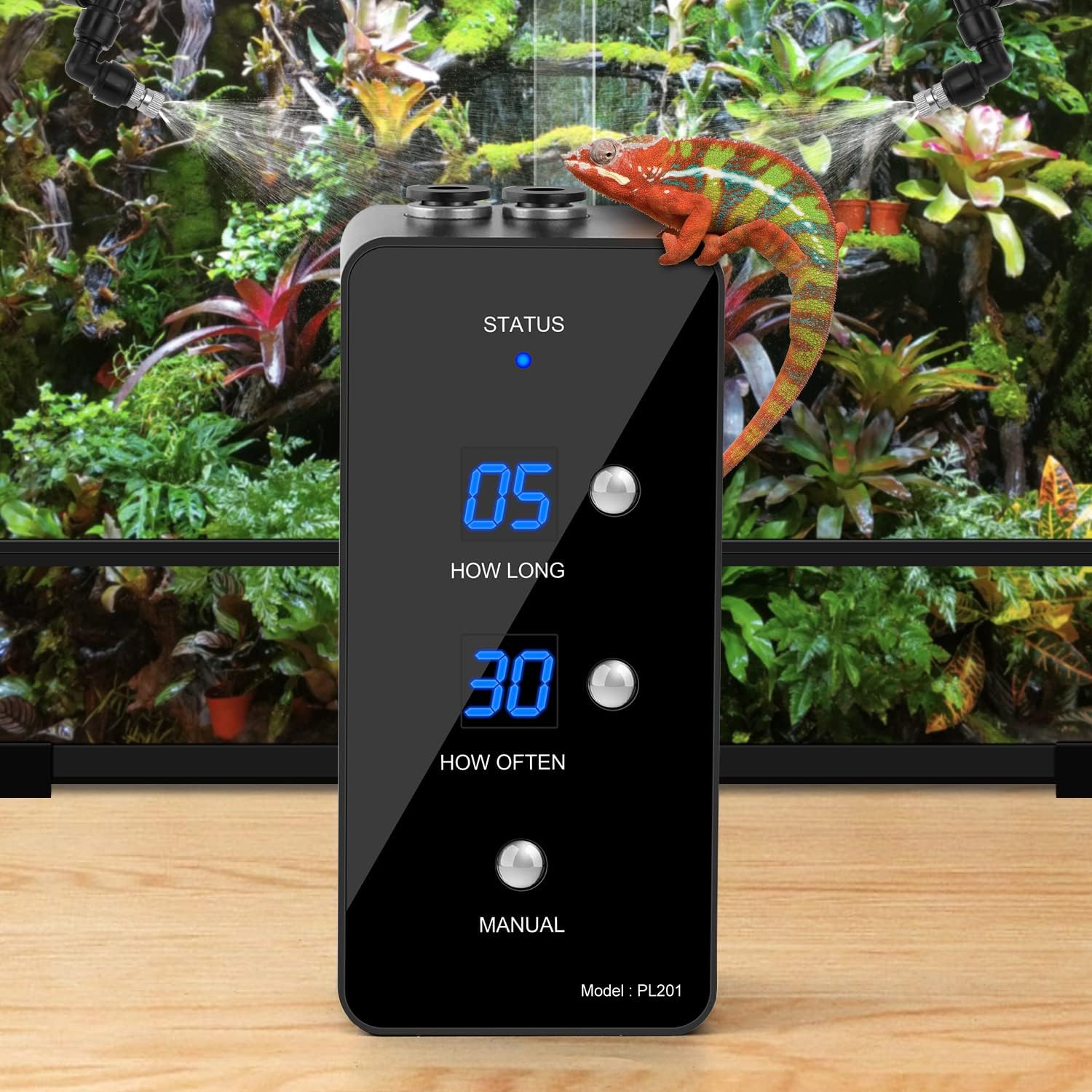
Zoo Med ReptiRain is the budget-friendly introduction to automatic misting that retains core functionality. It lacks the fine programmability of the MistKing or Repti Zoo systems, but it delivers reliable misting from a simple dial-based timer: you set the frequency (every 1, 3, 6, 12, or 24 hours) and duration (15, 30, 45, or 60 seconds), and the system handles the rest. Zoo Med is a long-established reptile brand, which counts for something in warranty support and replacement-part availability.
The pump draws from any standard 2-liter soda bottle or a bucket via the included adapter — a cost-saving design that also lets you swap reservoirs without downtime. The single brass nozzle produces a medium-fine mist adequate for commonly kept tropical reptiles and amphibians; owners report that a 30-second mist every six hours holds a typical 18x18x24 terrarium in the neighborhood of 70 percent humidity in an average home. Whites tree frog and crested gecko keepers are among the most common satisfied users.
At typically under fifty dollars, the ReptiRain is strong value. It is not the system you grow into if you plan to expand your collection, but it is the system to grow out of — reliable service for long enough to decide whether a more advanced setup is worth the investment. Trade-offs: single nozzle only, limited timer presets, no low-water shutoff to protect the pump, and mist quality that is adequate rather than exceptional.
Widely Stocked Mister Brands Worth Comparing
The brand-name systems above are the reference points, but the 2026 marketplace is full of generic automatic misters that undercut them on price, and some are genuinely serviceable if you know what to check. Four are consistently stocked and are described here from manufacturer specifications and verified owner reports rather than brand reputation.
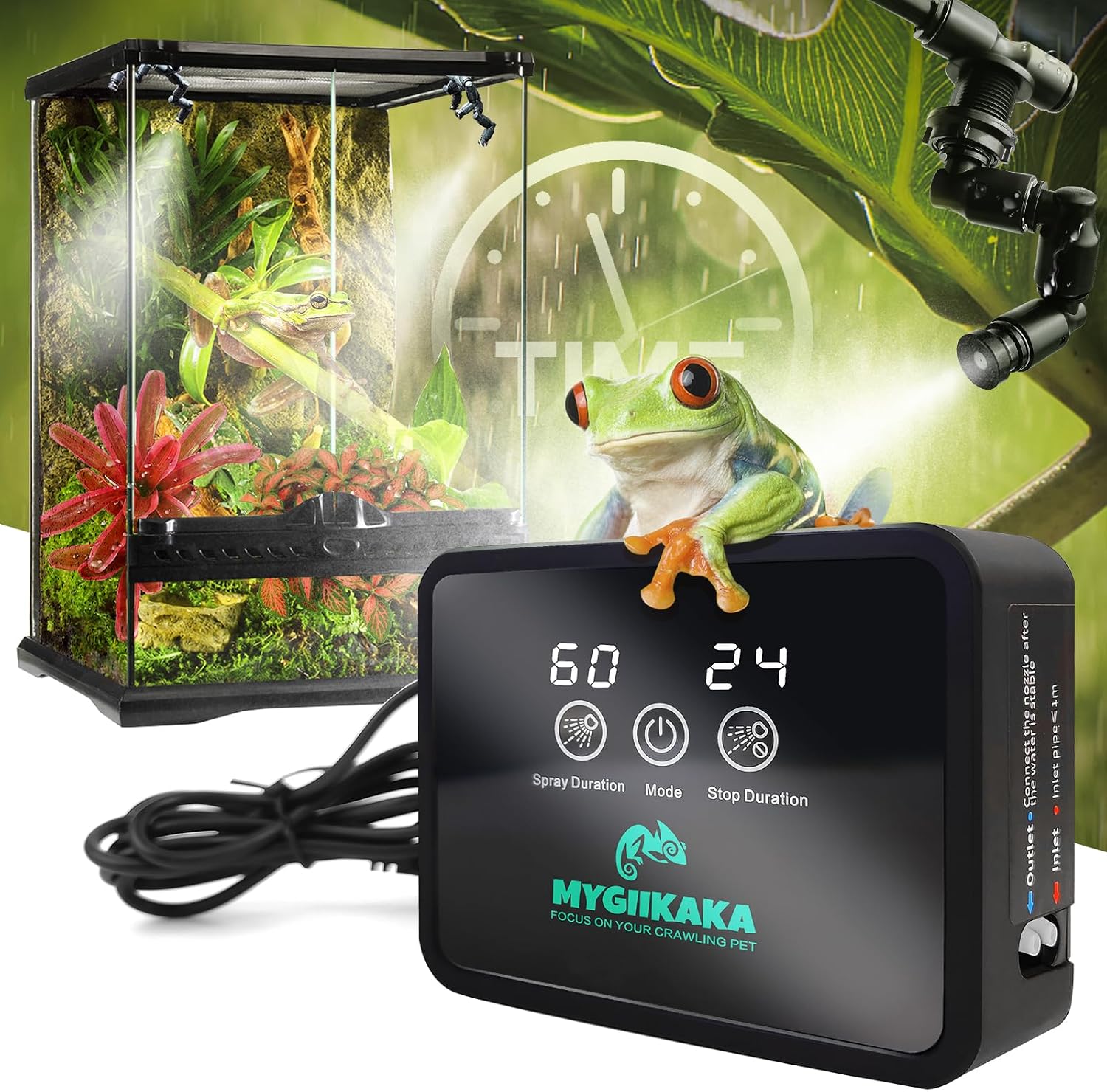
The MYGIIKAKA automatic misting system is a timer-driven pump unit with an external reservoir approach, positioned between the ReptiRain and the Repti Zoo on features. Owners report reasonable mist quality for single-enclosure tropical setups, with the usual generic-brand caveats about tubing quality and long-term pump noise.
The Moistenland reptile mister covers similar ground with an adjustable nozzle and interval scheduling, and verified reviews from crested gecko keepers describe dependable two-cycles-per-day service in glass terrariums. Check the listed reservoir volume against your refill tolerance, since compact tanks mean more frequent topping-up in dry climates.
The Coospider 3.8-liter fogger-mister blurs the line between the two technologies, adding an extended tube for reaching tall enclosures. It suits keepers who want ambient humidity and leaf-wetting from one unit, though hybrid designs generally do neither job as well as a dedicated tool, a trade-off explained in the section below.
The YOUENKITY humidity mister rounds out the budget tier with programmable scheduling and a compact footprint. Generic units like these make sense as first systems or second-enclosure supplements; what they give up is mainly parts availability and the multi-year service records that established brands can document.
Mister vs. Fogger: Which Does Your Reptile Need?
This is one of the most common questions new tropical reptile keepers ask, and the answer depends on your species' natural history. The Merck Veterinary Manual's exotic animal section is a useful reference for species-specific humidity and environmental requirements across reptiles and amphibians.
- Misters produce water droplets that fall from above, simulating rain and coating foliage, walls, and decor. They are ideal for arboreal species that drink from leaves — chameleons, crested geckos, day geckos — and any setup where leaf litter and moss need periodic saturation. Misting also triggers drinking behavior, since many reptiles will only drink moving water droplets.
- Foggers produce ultra-fine cool vapor that stays low, raising ambient humidity without soaking surfaces. They suit amphibians (dart frogs, tree frogs, salamanders) and burrowing species that need consistently moist substrate, and they are less likely to oversaturate drainage layers in bioactive setups.
- Combination approaches — a mister plus a separate fogger — suit complex bioactive vivariums where the fogger maintains the ground-level microclimate while the mister handles foliage hydration and drinking water.
For most keepers with one or two enclosures, a single quality mister handles all humidity needs. Only dedicated amphibian setups or very large collections tend to benefit from adding a separate fogger.
Installation Tips for Automatic Misting Systems
Reservoir Placement and Maintenance
The reservoir is the most overlooked part of any misting system. Use only distilled or reverse osmosis water — tap water contains minerals that clog nozzles, leave white residue on glass, and can irritate sensitive amphibian skin. A covered bucket is the ideal reservoir for external systems because it blocks debris, slows algae growth, and reduces evaporation while providing a week or more of capacity for multi-enclosure setups. Clean the reservoir every two to four weeks; biofilm and slime mold develop in stagnant water and can foul the system. A scrub with hot water and a reptile-only sponge is sufficient — never use soap or chemical cleaners, since residues can be toxic to animals. If you suspect contamination of any sprayed water or substrate additives, the ASPCA Animal Poison Control resource is the appropriate place to check potential hazards.
Nozzle Positioning
Nozzle placement makes or breaks misting effectiveness. Position nozzles so spray hits foliage, branches, and walls rather than the substrate directly. Direct substrate spraying leads to oversaturation, anaerobic pockets in the drainage layer, and stressed cleanup crews such as isopods and springtails. For arboreal enclosures, mount the nozzle high and angle it slightly downward to mimic natural rain. For terrestrial setups, angle nozzles at decor and walls for indirect humidity increase. Check that the fine tubing is not kinked where it enters the enclosure lid, since a pinched line is one of the most common causes of weak spray reported by owners.
Timing and Scheduling
Mimic natural humidity cycles. In most tropical habitats, humidity peaks at dawn and dusk with a drier midday period. A proven schedule looks like this: a 45-second mist at 7:00 AM simulating morning dew, a 15-second mist at 2:00 PM as a midday top-up, and a 60-second mist at 8:00 PM for evening rainfall. Adjust durations based on ventilation — mesh-topped enclosures lose humidity faster and may need longer or more frequent cycles. Verify your actual results with a digital hygrometer placed at animal level, not at the top of the enclosure, and recalibrate schedules seasonally, since winter heating dries indoor air substantially.
Sizing a System to Your Collection
Matching pump capacity to nozzle count is where many buyers go wrong. Entry-level systems like the Zoo Med ReptiRain support a single nozzle; stretching them across two enclosures with a splitter typically produces weak spray at both. Mid-range systems like the Exo Terra Monsoon Solo II and the Repti Zoo 4L handle one to two nozzles at full performance. Professional-grade systems like the MistKing can drive ten or more nozzles from one pump with appropriate tubing diameter. If you plan to expand within a year or two, buying the more capable system up front is usually cheaper than buying twice.
Reservoir sizing follows the same logic. A 1.5-liter tank is fine for one enclosure with two short daily cycles, but a dry climate, heavy ventilation, or a second enclosure can push refill frequency to daily. External-reservoir systems sidestep this entirely because capacity is limited only by the container you choose. Also consider noise placement: diaphragm pumps mounted on resonant surfaces such as thin shelving amplify vibration, so a foam pad underneath and placement away from bedrooms is a simple fix owners frequently recommend.
Safety and Common Mistakes to Avoid
Electrical safety comes first: misting systems combine water and power, so keep pumps and controllers outside the enclosure, use drip loops on all cords, and plug into a GFCI-protected outlet where possible. Verify that tubing entry points in the lid are secure so animals cannot wedge themselves into gaps. Do not rely on misting alone for hydration in species that drink from moving water — chameleons in particular may still need a dripper, since some individuals ignore mist entirely. Finally, avoid the classic over misting mistake: if substrate stays wet rather than cycling between moist and merely humid, you risk scale rot, bacterial growth, and fungal problems. Humidity should spike and recover, not stay pinned at saturation around the clock.
What Changed in Misting Systems for 2026
Two trends define the current generation of automatic misters. The first is sensing. A growing share of mid-range and premium units now pair their timers with humidity probes that pause or extend cycles based on actual readings rather than blind schedules, which is a genuine improvement for mesh-topped enclosures whose humidity swings depend on weather and season. Treat any sensing claim skeptically, though: probe placement matters more than probe presence, and a sensor inside a fogged enclosure reads differently from one mounted at animal level. The calibrated digital hygrometer you already own remains the referee.
The second trend is reservoir design. External-bucket configurations, once the signature of professional modular systems, have spread into consumer units because they eliminate the daily refill problem that built-in tanks create in dry climates. Alongside that, manufacturers have largely moved to quieter diaphragm pumps after years of complaints about rattling compressors, and current owner reports at every price tier describe noticeably less vibration noise than units from a few years back.
Water-quality guidance has hardened as well. Distilled or reverse-osmosis water is now the default recommendation across every manufacturer manual reviewed for this guide, not merely a hobbyist preference, because mineral scale on nozzles remains the single most common cause of weak spray reported by owners. Keepers running multi-nozzle systems increasingly pair their misters with small RO units rather than buying distilled water by the gallon, which changes the long-term cost math for large collections.
None of this changes the sizing logic from earlier sections: match pump capacity to nozzle count, verify results with your own instruments, and buy the expandable system if expansion is plausible within two years. The 2026 additions simply make those fundamentals easier to hit at lower price points.
Reptile Misting System FAQ
Can I use tap water in my misting system?
It is strongly discouraged. Tap water contains dissolved minerals — calcium and magnesium — that gradually clog nozzles, leave white deposits on glass and decor, and in some municipal supplies carry chlorine or chloramines that can irritate sensitive amphibian skin. Distilled or RO water costs pennies per gallon and eliminates all of these problems. If tap water must be used temporarily, descale nozzles weekly with a vinegar solution and rinse thoroughly before reinstalling.
How often should I replace the tubing?
Standard vinyl tubing should be replaced every 12-18 months; over time it stiffens, grows internal algae, and harbors biofilm. Higher-quality polyurethane tubing, used by professional systems, commonly lasts three to five years with proper maintenance. Inspect tubing monthly for discoloration, stiffness, or visible buildup, and replace sooner if any appears.
Is it safe to run a mister at night?
Yes, and many tropical species benefit from overnight misting that mimics natural nighttime humidity spikes. Ensure the enclosure has adequate ventilation so water does not stand and substrate does not saturate overnight. A common approach is one cycle an hour or two after lights-out, providing drinking opportunities while the vivarium cools naturally.
How many nozzles can one pump support?
It depends entirely on the pump's pressure rating. The Zoo Med ReptiRain supports one nozzle. The Exo Terra Monsoon Solo II and the Repti Zoo 4L support one to two at full performance. The MistKing starter pump can drive roughly ten to fifteen nozzles depending on tubing runs, which is why it dominates multi-enclosure and breeder setups. Exceeding a pump's rated nozzle count produces weak, patchy mist at every outlet.
Final Verdict
The right choice depends mostly on scale and appetite for setup work. The MistKing Starter Misting System is the last misting system most keepers will ever need to buy — professional-grade, endlessly expandable, and known for mist quality that tropical species thrive on, at a higher upfront cost. For single-terrarium keepers who want simplicity, the Exo Terra Monsoon Solo II delivers strong performance with almost no setup complexity. The Repti Zoo 4L splits the difference with best-in-class scheduling, and the Zoo Med ReptiRain is the low-risk way to try automatic misting before committing. Whatever system you choose, the result is consistent, hands-off humidity that keeps reptiles hydrated and healthy — without chaining you to a spray bottle twice a day.
Disclosure: PawCritic is reader-supported. When you buy through links on our site, we may earn an affiliate commission at no additional cost to you. As an Amazon Associate, we earn from qualifying purchases. All recommendations are based on manufacturer specifications, published guidance, and verified owner reports — we never accept payment for positive reviews.
Related Reading
Keep planning with our guides on how to raise and lower reptile humidity, reptile foggers for tropical pets, and reptile thermometers and humidity gauges.