Why Small Pets Need a Playpen, Not Just a Cage
Minimum cage size recommendations for small pets, published by organizations such as the House Rabbit Society and the Humane Society, describe the smallest acceptable enclosure, not an ideal one. A rabbit in a four-foot cage or a pair of guinea pigs in an eight-square-foot enclosure still spends more than twenty hours a day in a space that, scaled to human body size, is roughly the equivalent of a walk-in closet. Published guidance from the ASPCA pet care library and exotic-animal veterinary bodies consistently treats daily out-of-cage exercise as a welfare requirement rather than an optional extra.
The behavioral and physical consequences of insufficient exercise space in small mammals are well documented in veterinary literature. Rabbits without adequate floor time can develop hindquarter muscle weakness, which increases the risk of spinal injury and pododermatitis, commonly called sore hocks. Guinea pigs without exploration opportunities may show stereotypic behaviors such as repetitive bar-chewing, circling, and head-tossing, which are generally interpreted as signs of psychological distress. Ferrets, chinchillas, and rats show comparable decline when confined to cages that only meet minimum spatial requirements.
A playpen serves several distinct functions. It provides a supervised, predator-protected area for outdoor grazing, which supports dental wear and digestive health in rabbits and guinea pigs. It creates a larger indoor exercise zone without requiring an entire room to be pet-proofed. It works as a temporary enclosure during cage cleaning, travel, or home repairs. And it gives bonded pairs or groups a neutral, supervised space to interact. For rabbits specifically, regular access to fresh grass in a secure outdoor pen is widely recommended as a way to support normal gut motility and reduce the risk of gastrointestinal stasis, a condition that veterinary references list among the most common serious health problems in pet rabbits.
Species requirements differ in ways that matter when choosing a pen. Rabbits need walls tall enough to prevent hopping out, typically at least 30 inches for larger breeds, plus a secure top for outdoor use. Guinea pigs do not jump or climb, so floor coverage and narrow bar spacing matter more than height, along with a waterproof base or tarp underneath because they urinate frequently during floor time. Ferrets are escape specialists that need closely spaced vertical bars and a secure top. Chinchillas and rats need tall pens with narrow bar spacing and climbing opportunities. The sections below cover what to look for in each category, with a single concrete example of a modular panel pen that fits many of these use cases.
What to Look For in a Small Pet Playpen
The first specification to check is height relative to the species. A 24-inch pen contains most small and medium rabbits, guinea pigs, and adult rats, but not large breeds such as Flemish Giants or Checkered Giants, which can clear a 24-inch barrier. A 30-inch pen handles large rabbits but is heavier and more expensive. Pens under 20 inches are suitable only for ground-dwelling species such as guinea pigs, hamsters, and mice. Matching height to species is the single most common sizing mistake owners make.
The second specification is bar spacing or panel construction. Wire pens with 1.5-inch spacing contain adult guinea pigs and most rabbits, but baby guinea pigs, dwarf hamsters, and mice can slip through gaps that wide. Pens with 5/8-inch spacing are safer for very small species. Solid-panel pens eliminate the squeeze-through problem entirely, but they also block airflow and visibility, which can increase stress in prey animals that rely on sightlines to feel secure.
Material matters for durability and hygiene. HDPE plastic panels resist chewing, do not absorb urine, and wipe clean, which makes them a good fit for indoor use and for species that chew. Powder-coated steel pens handle outdoor weather and resist rust when the coating is intact, but the coating can chip at hinge points over time. Mesh tents are lightweight and packable, but nylon mesh can be chewed through by determined animals, so they are best for supervised, short-duration use.
Finally, consider how the pen connects and whether it can be expanded. Rotating snap hinges allow odd shapes around furniture and corners. Fixed hinges fold flat for storage but limit configuration. Ground anchors matter for outdoor use. Non-slip feet matter on hardwood and tile. A pen that cannot be expanded will eventually feel small as a pet grows or as a bonded group forms.
A Concrete Example: Modular Panel Pens
One widely referenced option in the modular panel category is the Tespo Dog Playpen, a 16-panel system with panels measuring roughly 24 by 20 inches each. Despite the dog-focused name, the panel height and solid construction make it suitable for rabbits, guinea pigs, and other medium small pets when the pen is used indoors or in a covered outdoor area. The panels are made from thick HDPE plastic, the same family of material used in cutting boards, with a smooth, non-porous surface that resists chewing and wipes clean with a damp cloth.
Each panel includes a transparent center window. This is a more important feature than it first appears. Solid opaque walls can trigger isolation anxiety in prey animals that rely on visual awareness of their surroundings, while transparent panels let the pet see out and the owner see in without removing the barrier. The snap-joint hinges rotate 360 degrees, so the pen can be configured as a square, rectangle, octagon, or L-shape around furniture, and additional panel sets can be added to expand the footprint. Integrated non-slip rubber feet help the pen stay put on hardwood, tile, and concrete.
The trade-offs are worth stating plainly. At roughly $50 to $65 for a 16-panel set, this style of pen costs more than basic wire exercise pens. The 24-inch panel height is sufficient for small and medium rabbits and for guinea pigs, but it is not enough for large rabbit breeds that can clear a 24-inch barrier. Transparent windows can fog or scratch after a few years of outdoor use. And because the panels are solid rather than barred, airflow is lower than in a wire pen, which matters in hot weather. For indoor daily use with small to medium rabbits or guinea pigs, the combination of chew resistance, easy cleaning, and flexible configuration is a reasonable fit. You can check the current price on Amazon if you want to compare it against wire and mesh alternatives.
How to Choose by Species
Rabbits
Rabbits need both height and floor area. A single rabbit benefits from at least 16 square feet of exercise space beyond the cage, and bonded pairs need more. Wall height should be at least 24 inches for small and medium breeds and 30 inches or more for large breeds. Bar spacing should not exceed 1.5 inches to prevent head entrapment. For outdoor use, a secure top is essential because birds of prey can strike from above, and the pen should be placed in partial shade with a hide box available. Indoor pens should sit on fleece, low-pile rugs, or interlocking foam mats rather than bare hard flooring, because slippery surfaces contribute to splay-leg and joint strain.
Guinea Pigs
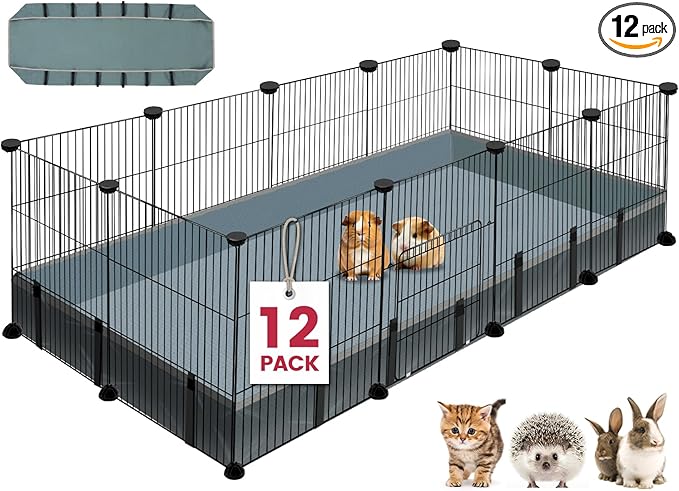
Guinea pigs do not jump or climb, so height is less critical than floor area and containment at ground level. A pair needs at least 10 square feet, and more is better. Bar spacing of 1.5 inches contains adults, but baby guinea pigs need narrower spacing or a solid-panel pen. Because guinea pigs urinate frequently during floor time, a waterproof base or a tarp under the pen saves significant cleanup. Smooth PVC-bottom pens with raised side walls are a practical choice for this reason. Guinea pigs also need constant access to hay, so a pen large enough to hold a hay rack and a water bowl without crowding is preferable.
Ferrets
Ferrets are escape artists. They need vertical bars spaced closely enough that they cannot squeeze through, and a secure top, because they climb well. A pen that is merely tall is not enough; the top must latch. Ferrets also benefit from 12 or more square feet with tunnels, hammocks, and climbing structures. Mesh tents with zippered tops are a common choice for supervised ferret play, but the mesh must be checked regularly for chew damage.
Chinchillas and Rats
Chinchillas and rats are climbers and need tall pens with narrow bar spacing. Chinchillas are also prone to overheating and should not be placed in direct sun or in pens that trap heat. Rats are social and benefit from vertical enrichment such as hammocks and ledges. For both species, a pen with a secure top is safer than an open-topped design, because both can climb out of pens that would contain a guinea pig.
Hamsters and Mice
These species are small enough to slip through standard exercise pen bar spacing, so they need either a solid-panel pen or wire with 5/8-inch or narrower spacing. Height requirements are modest, but escape prevention is the priority. Hamsters are also nocturnal and may be stressed by bright, open play areas, so a pen with some cover or a hide box is helpful.
Outdoor Playpen Safety Checklist
small pet playpens exercise pens safe rabbit guinea pig
small pet playpens exercise pens safe rabbit guinea pig
- Predator protection. Hawks, eagles, foxes, raccoons, coyotes, and even neighborhood dogs and cats are real threats. Any outdoor pen must have a secure top cover, and the pet should remain under direct supervision. A hawk can spot a rabbit from a considerable distance and strike quickly.
- Temperature safety. Small mammals are vulnerable to heat. A safe outdoor range for rabbits and guinea pigs is roughly 55 to 75 degrees Fahrenheit. Above 80 degrees Fahrenheit, skip outdoor time. Place the pen in partial shade, never full sun, and provide a hide box for retreat from both sun and open-sky stress.
- Ground inspection. Before setup, inspect the grass for toxic plants and for pesticide or herbicide treatment. The ASPCA Animal Poison Control maintains a searchable list of plants and household substances that are toxic to small animals, and treated grass can remain hazardous for weeks after application.
- Escape prevention. For pens without a bottom, confirm that ground anchors are firmly seated. A rabbit or guinea pig can squeeze under a gap of only a few inches. On hard surfaces, add anti-slip mats underneath.
- Fresh water always. Outdoor time increases water consumption, especially in warm weather. Provide a heavy ceramic water bowl in the shade, refreshed frequently.
- Never leave unattended. Even with a top cover and anchored panels, a small pet should not be left outdoors alone. A predator can collapse a pen, and overheating can occur within minutes.
Playpen Sizing and Layout
Sizing guidance for small pet playpens is usually expressed as a minimum floor area per animal. A single rabbit benefits from at least 16 square feet of exercise space beyond the cage, with bonded pairs needing more. A pair of guinea pigs benefits from at least 10 square feet. Ferrets benefit from 12 or more square feet with vertical climbing opportunities. Rats benefit from 8 or more square feet with hammocks and climbing structures. These figures are minimums; larger is generally better, and a pen that can be expanded with additional panels is more flexible over time.
Layout matters as much as raw area. A long, narrow pen that allows only back-and-forth movement provides less useful exercise than a square or L-shaped pen that allows turning, circling, and exploration. Placing the pen around a corner or along a wall can create a more natural exploration path. Adding a hide box, a tunnel, and a litter area gives the pet destinations within the pen, which encourages movement rather than standing still.
Flooring choice affects both hygiene and joint health. Fleece liners with absorbent layers underneath work well for guinea pigs and rabbits indoors. Interlocking foam mats covered with a washable layer protect joints on hard floors. Bare hard flooring should be avoided for rabbits because it provides poor traction and contributes to splay-leg. Cedar and pine shavings should be avoided because the aromatic oils are respiratory irritants. Newspaper is a poor choice because inks can be toxic if chewed.
Maintenance and Cleaning
Playpen maintenance is straightforward but should be consistent. Solid plastic panels can be wiped with a pet-safe cleaner and water after each use, and a deeper clean once a week is usually sufficient for indoor pens. Wire pens should be checked for coating chips, because exposed metal can rust and can also snag fur or skin. Mesh tents should be inspected for chew damage and for seam separation, and the fabric floor should be wiped and dried fully before storage to prevent mildew.
Waterproof-bottom pens, such as those with a molded PVC base, are the easiest to clean for species that urinate frequently. A single molded base with no seams wipes dry in seconds, whereas fabric bottoms with stitched seams can trap moisture and odor. If the pen uses a separate tarp or liner, wash or replace it regularly to prevent ammonia buildup, which is a respiratory irritant for small mammals.
Storage also affects lifespan. Plastic panels should be stored flat or stacked loosely rather than bent, because HDPE can warp under sustained pressure. Pop-up mesh tents should be folded according to the manufacturer instructions; storing them bent or under heavy objects can warp the frame. Wire pens fold accordion-style and should be hung or laid flat rather than leaned, which can bend the hinges.
Common Mistakes to Avoid
- Buying a pen that is too short for the species. A 24-inch pen contains most small and medium rabbits but not large breeds. A 16-inch pen contains guinea pigs but not rabbits.
- Ignoring bar spacing. A pen with 1.5-inch spacing can contain adult guinea pigs but not baby guinea pigs, dwarf hamsters, or mice.
- Using a pen as permanent housing. Playpens are supplemental. Permanent housing needs consistent temperature control, protection from household hazards, constant access to food and water, a defined toilet area, and a secure hide space.
- Skipping the top cover outdoors. An open-topped outdoor pen leaves the pet exposed to birds of prey and climbing predators.
- Placing the pen in full sun. Small mammals overheat quickly. Shade and a hide box are not optional in warm weather.
- Using unsafe bedding or flooring. Cedar and pine shavings, newspaper, and bare hard floors all carry risks for small pets.
- Leaving a chewer unsupervised in a mesh pen. Nylon mesh can be chewed through, and the resulting hole is an escape route.
Frequently Asked Questions
How much playpen space does my small pet need?
As a general rule, a single rabbit needs at least 16 square feet of exercise space beyond the cage. Guinea pig pairs need at least 10 square feet. Ferrets benefit from 12 or more square feet with vertical climbing opportunities. Rats need 8 or more square feet with hammocks and climbing structures. These are minimums, and more space is generally better.
Can I leave my rabbit in the playpen unsupervised?
Indoors, yes, after the surrounding area has been rabbit-proofed with cord covers, no toxic plants within reach, and no gaps behind furniture. Outdoors, no. Outdoor supervision should be continuous because predators, escape, temperature changes, and toxic plant ingestion are all time-sensitive risks.
What is the best flooring for an indoor playpen?
For rabbits, fleece blankets or interlocking foam mats covered so they cannot be chewed. For guinea pigs, fleece liners with absorbent layers underneath or washable pee pads. Avoid newspaper, cedar or pine shavings, bare carpet, and bare hard floors.
Can I use a dog playpen for my rabbit?
Yes. Many modular panel pens are marketed for dogs and work well for rabbits. The key specification to check is bar spacing, which should not exceed 1.5 inches for adult rabbits, and height, which should be at least 24 inches for small to medium breeds and 30 inches or more for large breeds.
How do I keep guinea pigs from pushing the playpen around?
Guinea pigs can nudge lightweight pens across the floor. Anti-slip mats under the pen, ground anchors even indoors, and heavier pens with molded bases all help. A heavier pen is harder for pigs to move.
Should the playpen replace the cage?
No. Playpens are supplemental exercise spaces, not permanent housing. Permanent housing needs consistent temperature control, protection from hazards, constant access to food and water, a defined toilet area, and a secure hide space. A playpen in a living room does not provide those around the clock.
Where to Buy
As an Amazon Associate, PawCritic earns from qualifying purchases.
If you are comparing options and want a concrete starting point, the modular panel pen described above is one example in the category. You can view this option on Amazon and compare its panel height, material, and configuration against wire and mesh alternatives. For outdoor use, look for a pen with a secure top cover and ground anchors. For guinea pigs, look for a waterproof base or plan to add a tarp underneath. For very small species, check bar spacing carefully before purchase.
Whatever pen you choose, the routine matters more than the model. A daily playpen session of 30 to 60 minutes, supervised and enriched with a hide box, a tunnel, and a litter area, does more for a small pet's physical and mental health than any single product feature. The playpen is not a luxury purchase; it is a core welfare tool that gives a small pet room to move, explore, and behave like the animal it is.
Affiliate Disclosure: PawCritic.com participates in the Amazon Services LLC Associates Program. We may earn commissions from qualifying purchases at no extra cost to you.