The Tag Nobody Updated, the Gate Somebody Left Open
Here is a number that should change how you look at your dog's collar tonight: in a study published in the Journal of the American Veterinary Medical Association, dogs with microchips were returned to their owners 52.2 percent of the time, while dogs without one came home only 21.9 percent of the time. More than half of microchipped dogs that did not make it home came down to a single boring failure: the registration record was never filled in, or it still pointed at a phone number the family abandoned years ago.
We keep thinking of a lost dog as bad luck. Most of the time it is a sequence of small, predictable gaps. A tag engraved with an old number. A chip registered to an apartment the family moved out of in 2022. A gate propped open during a delivery. A guest who does not realize the dog has a door-dashing history. None of these feel dangerous on their own, and together they explain why so many dogs that run out the front door never run back in. According to the ASPCA, roughly 6.3 million companion animals enter U.S. shelters every year, and the ones that get home fastest are almost always the ones wearing working identification.
This article is the prevention plan our team walks through with every dog owner who asks what actually matters. It is built in layers, because every single layer fails sometimes: tags get snagged and fall off, collars get pulled over a fence, chips stop being registered, and no tracker works underground. The goal is not one perfect product. The goal is five independent chances for a stranger to figure out where your dog lives, plus a first-hour plan for the day the layers all fail at once. The whole setup takes one evening and about ten minutes a month to maintain.
Why Dogs Actually Leave, and When They Do It
Dogs rarely wander off on a whim. The escapes our team hears about cluster around a handful of triggers, and knowing them is half the prevention work.
Open doors and gates during transitions. Moving day, a contractor coming through, a delivery driver, a party where the front door keeps swinging. The dog is not plotting an escape; a scent or a sound pulls, and the door is simply open. Holiday season is the worst stretch of the year for this exact reason, which is why we are publishing this in early November rather than after the first preventable loss.
Sound phobia events. Fireworks, thunderstorms, construction blasting. A panicked dog does not navigate like a calm one; it runs flat out in a straight line until the noise stops, then hides. Dogs lost during fireworks displays routinely turn up miles away, which is why prevention for sound-sensitive dogs has to be physical containment, not just identification.
Prey drive and wildlife. A deer crossing the yard at dusk can take a scent hound three properties deep before the brain catches up with the legs. Terriers and hounds end up in shelters for this reason more than any other single cause we see discussed in behavior literature.
Mating and roaming. Intact dogs, especially males, travel for a scent. The fix is surgical and it is permanent, but until the appointment happens, the identification layers below matter even more.
Boredom and under-stimulation. A dog that spends every day alone in a featureless yard will eventually test the fence line. This is the escape nobody blames anyone for, and it is also the one that repeats every week until something changes.
Match the trigger to the layer: door dashers need the house protocols, sound phobic dogs need containment plus ID, and roamers need everything, because they will meet all five failure modes eventually.
Layer 1: The Tag, Done Right, Is Still the Fastest Way Home
A stranger who finds a friendly dog will check the collar before anything else. No phone call, no scanner, no shelter visit. The tag is the single highest-return item in the entire plan, and it is also the one most often done carelessly.
What to engrave, in priority order: your mobile number, then a second number if someone in the family travels, then your city. The mobile number comes first because it is the one you actually answer at 11 p.m. on a Tuesday. Leave the landline off if nobody answers it. We are also skeptical of cramming a full street address onto a small tag; city plus phone is what a finder needs, and it does not tell everyone at the dog park exactly which empty house your dog sleeps in on travel days. The dog's name is optional. Some handlers prefer to leave it off so a thief cannot bond the dog to a new identity quickly, though in practice the deterrent value is modest. If you want the name on there, fine; just do not let the name crowd out a legible number.
Engraving quality decides whether any of this works. Laser-etched script on a thin aluminum tag fades within a couple of years of collar jingle, especially on a dog that swims. Deep diamond-cut engraving on stainless steel stays readable for the life of the tag. For most dogs, a sturdy set like the GoTags Stainless Steel Pet ID Tags covers the practical requirements: stainless steel, deep engraving, several sizes so a 12-pound dog is not wearing a dinner-plate medallion. Check the engraving under a bright light once a month. If you have to squint, a stranger with cold hands on a dark road will not read it at all.
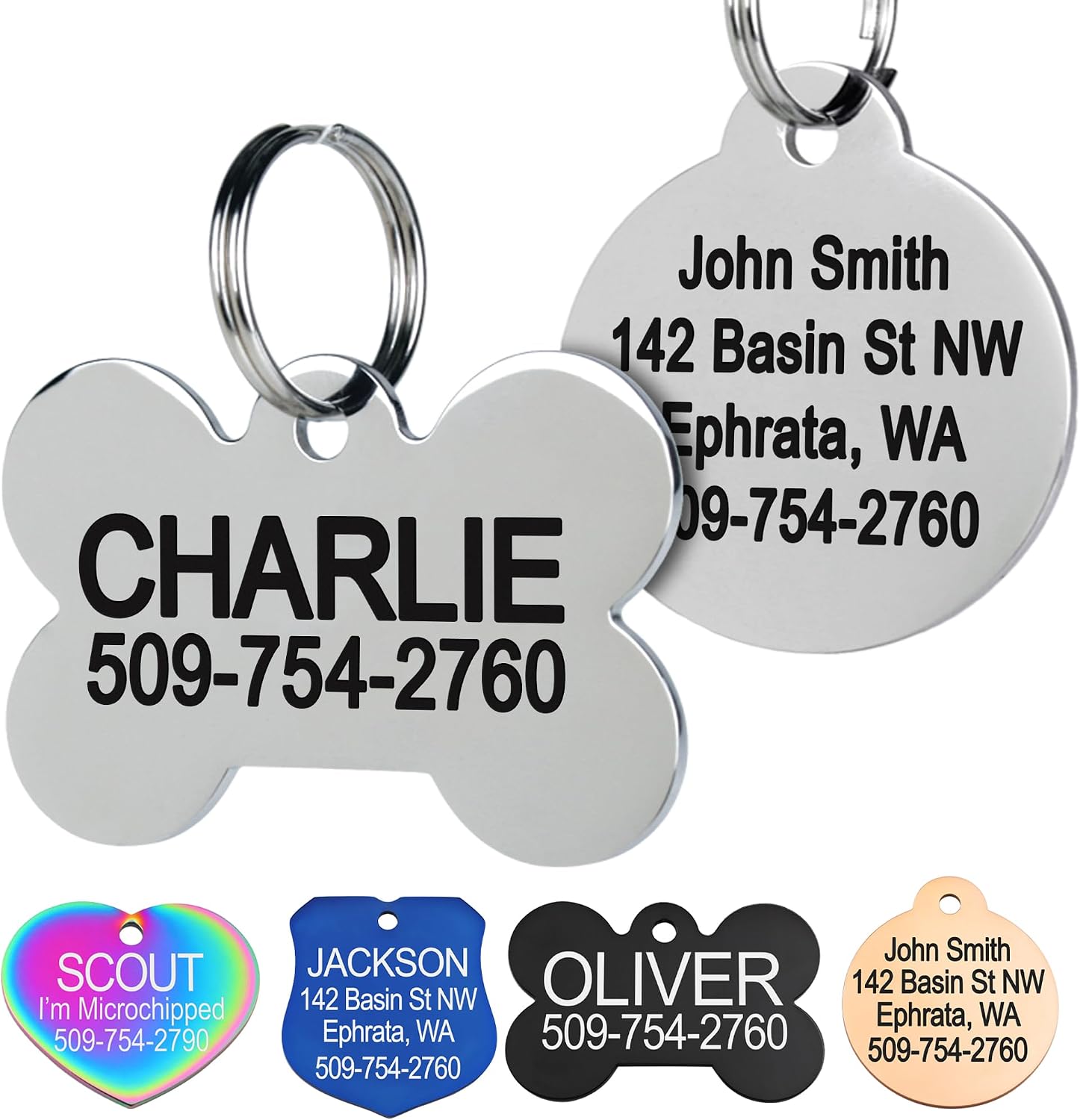
Hardware matters nearly as much as the metal. Split rings fail at the exact moment a tag catches on a crate door or a fence link, and most owners never notice the tag is gone until weeks later. Two cheap fixes: check the ring monthly, and consider a tag that rivets flat against the collar or a slide-on style for escape-artist dogs. A silent tag is also a readable tag; some dogs object to constant jingling, and a silicone silencer does not reduce legibility.
One more rule from the shelter-world side: the tag is only current if the number on it is current. Every time you change a phone number, move, or hand the dog's care to a family member for a season, the tag gets redone the same week. Unupdated tags are the heartbreaking standard in any shelter's intake room.
Layer 2: The Collar That Cannot Fall Off a Hook
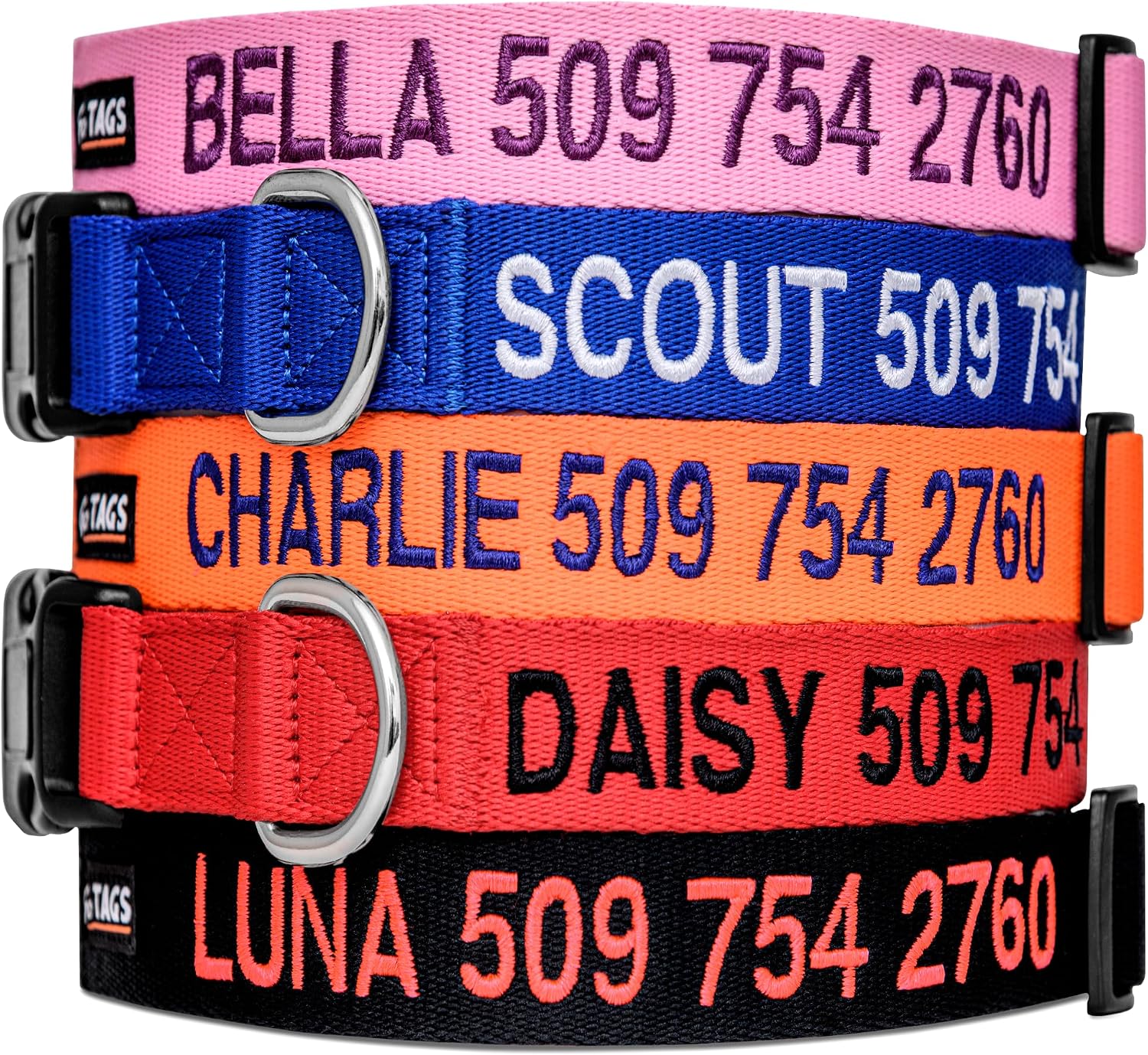
Tags hang, snag, and drop. The fix is to put identification on the part of the setup that stays with the dog even when hardware fails. An embroidered collar puts your phone number directly into the webbing of the collar itself. There is no separate piece to catch on a branch, no ring to pry open, nothing to jingle. If a finder can read at all, they can call you.
The trade-offs are real and worth stating plainly. Embroidery holds less text than a tag, so it carries a number and little else, and it is fixed: change your number and you change the collar. That is exactly why we treat it as the second layer rather than the first. For a dog that loses tags on a quarterly basis, though, or one whose collar spends more time on the dog than on a hook by the door, an GoTags Personalized Embroidered Dog Collar is the sturdier half of the identification system. Deep, high-contrast thread on a standard-width collar stays legible for years of daily wear.
Fit is part of identification, oddly enough. A collar a determined dog can back out of, or one loose enough to slide over the ears in a panic, does not matter how well it is embroidered. The two-finger rule applies: you should fit two flat fingers under the collar, and no more. Dogs with narrower heads relative to their necks, like greyhounds and some sighthound mixes, need a martingale-style collar rather than a flat one, or the whole identification conversation is academic the first time they hit the end of a lead in reverse.
Layer 3: The Microchip, Which Only Works If You Finish the Boring Part
The microchip is the only layer that survives the dog slipping a collar entirely, and it is the one the return-rate statistics above are built on. A chip the size of a grain of rice sits under the skin between the shoulder blades, holds a registration number, and nothing more. Any shelter, most vet clinics, and many police departments can scan for it in seconds.
Two myths need killing right away. First, a chip is not a GPS device. It stores a number; it does not broadcast a location, has no battery, and tells nobody where your dog is until someone physically scans the animal. Anyone selling a chip as live tracking is describing a different product. Second, the chip is not registered automatically. The vet implants it, hands you a form or a web link, and the system only works from the moment you complete the registration. This is the single most common break in the chain: according to the AVMA, the main reason microchipped pets fail to be reunited with their owners is incorrect or missing registration information in the database.
So finish the boring part, and then keep finishing it. Register the chip the week it is implanted, with current phone numbers and an emergency contact who is not you. Move? Update the registry. New phone number? Update the registry. Adopted a dog that came chipped from a rescue? Verify whose name the chip is under, because a chip registered to a rescue organization three states away is functionally the same as no chip. Our team suggests a simple trigger: check chip registration every time you renew the rabies vaccine, because the annual or triennial vet visit is a date you already remember. Ask the clinic to scan the dog while you are there anyway; it takes ten seconds and confirms the chip is where it should be and reading correctly.
One practical note on scanners: different regions and registries have quirks, and a chip from an overseas breeder occasionally uses a standard some U.S. scanners read poorly. If your dog was imported, confirm at the next vet visit that the chip reads cleanly on a universal scanner. It is a five-minute question that prevents a very slow discovery at the worst possible time.
Layer 4: Trackers, and Their Honest Limits
Bluetooth trackers have earned a cautious place in the plan. A slide-on holder like the Waterproof Slide-On AirTag Holder for Dog Collars lets you ping the tag from your phone when the dog is in Bluetooth range, and the wider network of nearby iPhones can relay a location whenever the tag passes close to one. For a door-dashing dog loose in its own neighborhood, that is often enough to end the search within the hour.
Now the limits, because marketing has blurred them badly. A Bluetooth tag is not a GPS unit. It has no cellular connection, no subscription service, no live map. In a rural area with few passing phones, a lost dog wearing one may as well be wearing a pebble until a stranger's phone wanders close. Battery life is finite and easy to forget, and determined dogs have chewed through housings that were not rated for their jaw strength. Treat the tracker as a fast-response layer for neighborhood escapes, never as the plan itself. GPS collars with cellular service are a different and more capable category, with monthly fees and their own battery math, and they make sense for hunting breeds, hiking dogs, and properties backing onto open land. For an apartment dog whose risk window is the front door and the building lobby, a Bluetooth tag plus the layers above covers the realistic scenarios at a fraction of the cost.
Whatever hardware you pick, mount it so the dog cannot remove it. Slide-on designs and riveted holders beat hanging charms for exactly the same reason embroidered collars beat tags: the failure mode of the attachment point is the most common failure of the whole device.
Layer 5: The House Protocols That Make the ID Layers Unnecessary
Identification is the backup. The primary defense is a household where escapes do not get the chance to happen, and it costs nothing but habits.
The two-barrier rule at the front door. For any dog with a dash history, there should be a second closed barrier between the dog and the outside world whenever the front door opens: a baby gate across the hallway, an exercise pen, or the dog behind a closed interior door. A product like the Cideny Auto-Close Dog Gate earns its place in the plan because it closes itself; hardware that depends on a distracted human remembering is hardware that fails on the busiest day of the year.
The guest script. Everyone who enters the house gets one sentence: the dog bolts, so door behind you, all the way. Say it the same way every time. The families whose dogs stay home are not calmer households; they are households where the sentence has become automatic.
Contractor and moving-day containment. Repeated door traffic is the highest-risk day in a dog's calendar. The dog goes into a closed room with water, a bed, and a sign on the door, or stays with a family member for the day. No collar, tag, or chip makes up for forty door-swings with a nervous dog in the hallway.
Fence-line walks. Once a month, walk the perimeter yourself. Loose boards, a dug channel under the gate, a latch that no longer seats fully, the trash bin that creates a step-stool over a four-foot fence. Dogs find the gap weeks before owners do.
Exit training that pays for itself. A solid sit-stay at the threshold, and a door policy where the dog never crosses an exterior door without permission, is ordinary training with extraordinary returns. Pair it with a rock-solid recall and you have moved most of the risk from identification back into prevention, where it belongs.
If It Happens Anyway: The First-Hour Plan
Prevention fails for good dogs on bad days. When it does, the first sixty minutes matter more than the next six days, and the single worst instinct is the most common one: chasing.
Do not chase. A running dog being chased reads the pursuit as play or as threat, and either way it runs harder and farther. Every shelter volunteer has watched an owner sprint after a dog and push it half a mile deeper into unfamiliar territory. Instead, resist the sprint. Move calmly in the direction the dog went, kneel, and use the happiest voice you own. If the dog glances back, drop to the ground; sitting dogs are interesting, standing humans chasing are not.
Anchor the dog to home. Leave the yard gate open and something scent-heavy at the spot the dog was last seen: your worn jacket, the dog's bedding. Lost dogs hide close by and move at night. A familiar smell at a fixed point gives them a reason to stay in the area and a landmark to circle back to.
Call it in and log it. Report to your municipal shelter and animal control within the first hour, not the next morning. Shelters intake dogs constantly, and a report on file the same day is what connects their intake log to your phone call. Post to local lost-pet groups and neighborhood apps with two photos, the cross-streets, and one behavioral detail that makes your dog distinctive. Look physically at the shelter, or at minimum at their online intake photos, every day; descriptions over the phone are unreliable, and your brown dog with the white chest is somebody else's tan dog with no markings.
Know your holding window. Legal holding periods for stray animals vary by jurisdiction and are often as short as three to five days. This is not a reason to panic; it is a reason to be exhaustive in the first seventy-two hours rather than spending them hoping. Flyer the neighborhood within that window, with tear-off numbers, at intersections where cars stop.
If someone has your dog. A finder who cannot reach you will do one of three things: keep the dog, take it to a shelter, or take it to a vet clinic to scan for a chip. This is why the layers above matter, in exactly the order they were built. The tag gets the first call. The embroidered collar is the fallback. The chip catches the dog that arrived with no collar at all. Each layer exists because the previous one had a failure mode.
One more line for the plan, and it is an uncomfortable one: prepare for the possibility that a stranger will need to prove ownership. Keep a folder, physical or digital, with clear photos of your dog from several angles, including one of distinctive markings, plus vet records and registration paperwork. Owners of chipped dogs occasionally discover the chip is registered to a breeder or a previous home; sorting that out takes days you will not have, which is the same boring-registry argument from Layer 3 arriving from the other direction.
The Ten-Minute Monthly Audit
Every layer above decays quietly: rings loosen, thread fades, batteries die, registries go stale. The fix is a standing appointment, ten minutes on the first Saturday of every month, and it fits on one list:
- Read the tag under a bright light. Can you make out every digit without squinting? Is the split ring still closed?
- Check the embroidered collar for fading and fit. Two fingers under it, no more.
- Walk the fence line. Boards, latches, dig marks, new climbable objects.
- Test the tracker battery level in the app and glance at the holder for chew damage.
- Confirm the chip registry shows current phone numbers. Set the annual deep-check to the rabies vaccine date instead of trusting memory.
- Re-brief anyone new in the house, including short-term guests, on the door sentence: the dog bolts, so door behind you.
With the holidays approaching, run one extra pass before travel or before the first big gathering: the door traffic those days bring is exactly the pattern that turns a settled dog into a shelter intake photo. ID layers do not make a dog immune to leaving. They change the ending. The dog that slips out on the Fourth of July wearing a legible tag, an embroidered backup, a registered chip, and a tracker has five separate strangers between itself and a kennel run. The dog wearing a tag engraved with a number nobody answers anymore has none. Ten minutes a month is the whole difference, and there is no version of this where doing it later works out as well as doing it tonight.
Related Reading
Want more on this topic? Check out our guides on best dog ramps stairs joint friendly access cars, best dog training collars remote ecollars, best dog food for large breeds in top picks reviewed.