The room dropped ten degrees and your enclosure dropped with it
There is a specific kind of confusion that shows up in reptile forums every November. The basking bulb is the same wattage. The thermostat dial has not moved. Yet the warm side that held 92 degrees all summer now reads 84, and the gecko that used to camp under the dome every afternoon has relocated to the coolest corner and gone quiet about food. Nothing broke. The room got colder, and every number inside the glass slid down with it.
Reptiles do not manufacture their own body heat the way mammals do, so every process in their body, digestion included, runs at the speed of the temperature around them. An under-heated reptile is not just uncomfortable. It is an animal whose gut chemistry has slowed to the point where a meal can sit undigested, and the downstream problems, from regurgitation to secondary infections, are well documented in exotic vet practice. Winter is the season when marginal setups stop being marginal. A gradient that had just enough headroom in July has none in January, and the animal is the first to notice.
Why the math that worked in July fails in January
Every enclosure temperature you have ever measured was built on a hidden assumption: a room that hovers near 72. The heaters inside the enclosure are sized to add a fixed number of degrees on top of whatever the room supplies. When the furnace cycles off overnight and the room slides from 72 to 62, the entire gradient inside the tank shifts down by roughly the same amount. A heat mat rated to lift substrate 20 degrees above ambient now lifts it 20 degrees above 62, not 72. A 100-watt basking bulb that held a spot at 95 in summer now tops out near 88.
The clearest evidence is on the thermostat itself. Watch the duty cycle, the percentage of time your controller is actually feeding power to the heater. In summer, a mat on a healthy setup might run 40 percent duty overnight. If the same controller pegs near 100 percent for hours and the warm side still sags below target, you are not looking at a settings problem. You are looking at a wattage ceiling or a heat-retention problem, and raising the setpoint will not fix either one. It will just hold the heater flat out, which is how heating equipment ages fast and failures start.
How low can the night lows go, species by species
There is no single safe number for all reptiles, because the species we keep come from climates that behave very differently after sunset. The night drop that a leopard gecko shrugs off can push a ball python into a weeks-long hunger strike. Here are the maintenance ranges we consider reasonable for healthy adults in winter, based on commonly published husbandry guidance for each species.
Leopard geckos come from arid regions of Afghanistan and Pakistan, where nights get genuinely cool. A healthy adult tolerates night lows in the mid 60s without trouble, and many keepers deliberately allow the drop. We still hold the enclosure in the upper 60s on the coldest nights of the year, because a marginal animal benefits from the buffer even if a robust one does not need it.
Bearded dragons live in central Australian deserts where summer nights are warm but winter nights are not, and the commonly recommended range for a sleeping dragon runs from about 65 to 75. The top of that band matters more for juveniles, who have no fat reserves to coast on and less thermal mass to lose. An adult that ate three days ago can sleep through a 66-degree night. A six-week-old should not have to.
Ball pythons are the species that punishes winter drift hardest. They come from west and central Africa, where the temperature never performs the kind of nightly plunge our living rooms do. We would not let the warm side of a ball python enclosure fall below the mid 70s at night, and the classic pattern of a python refusing food for six weeks in December usually traces straight back to a cold floor and a heat mat that lost the race against a cold room.
Crested geckos and their New Caledonia relatives are the reverse case. Their ideal band sits around 65 to 72, and heat stresses them faster than cold does. A winter night drop into the low 60s is well inside their comfort zone, but below that, feeding and activity slow noticeably, so the floor we would set for them is around the low 60s rather than the mid 50s.
One caveat applies across all of these ranges. A reptile that is sick, underweight, gravid, or freshly arrived has no business riding the bottom of the species band. For those animals, winter is the season to hold temperatures at the top of the normal range and skip the experiments entirely.
Audit first: measure before you buy anything
The most common winter mistake is buying heat before checking whether the readings are even trustworthy. Dial thermometers stuck to the glass routinely miss the actual air temperature by five degrees or more, and a probe that sits in the wrong spot makes the thermostat lie in the other direction. Before spending money on more watts, spend three nights gathering data.
Set a minimum-maximum digital thermometer at substrate level on the warm side and let it record overnight lows. Point an infrared thermometer at the basking surface, the warm substrate, and the cool side, and write the numbers down. Compare the thermostat display with an independent probe sitting next to the thermostat sensor. If the two disagree by more than a couple of degrees, the thermostat probe is misreading, and no amount of new hardware will fix a sensor that is measuring the wrong thing.
Probe placement deserves its own check. A thermostat sensor dangling mid-air above a heat mat reads the air, not the surface the animal lies on, and it will let the mat run hotter than intended. Sensors belong where the heat is controlled: sandwiched between the mat and the bottom glass on the outside of an under-tank heater, or positioned at animal level inside the enclosure, per the controller manufacturer's instructions. Verify with the infrared gun after any change.
Add retention before you add watts
Once the measurements confirm the sag, the instinct is to buy a bigger heater. Resist it for a moment, because heat that escapes through glass has to be paid for every single night. Glass conducts; plastic and wood insulate. An enclosure built from PVC or finished wood holds its gradient with dramatically less wattage than a glass tank of the same footprint, which matters twice in winter: the setup resists the room's overnight slide, and the heater never needs to run flat out to keep up.
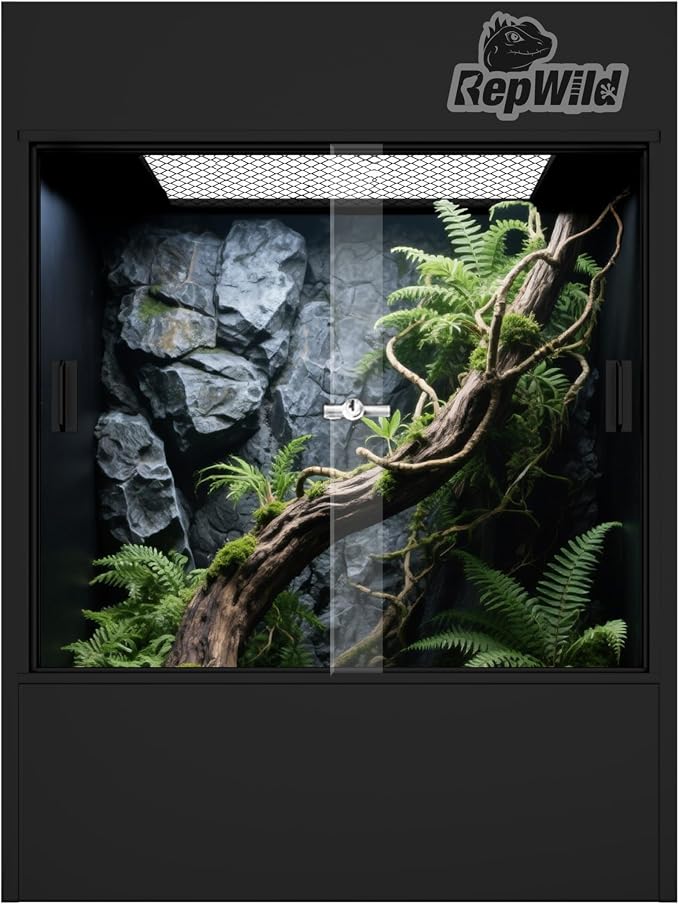
This is the point in the year where enclosure material stops being a style preference and becomes a thermal decision. For a terrestrial setup, something like the RepWild 20 gallon PVC enclosure, a 30 by 12 by 12 inch tank with glass sliding doors and a heavy-duty screen top, holds substrate warmth far better than a comparable glass tank. We would treat that footprint as right for leopard geckos, juvenile lizards, and similar-sized animals; the listing also mentions bearded dragons and ball pythons, but an adult of either species needs a much larger footprint than 30 inches of length, and no material advantage changes that math.
For arboreal species, height changes the strategy, because a hanging heat source has to warm an air column rather than a slab of substrate. The REPWILD 33 gallon PVC tall terrarium at 18 by 18 by 24 inches is the sort of enclosure where a ceramic heat emitter above a mesh crown can hold a usable warm zone through the night, largely because the PVC panels do not bleed the warm air out the walls. This is the setup we would point a crested gecko keeper toward if their glass vivarium keeps sliding into the 50s after midnight.
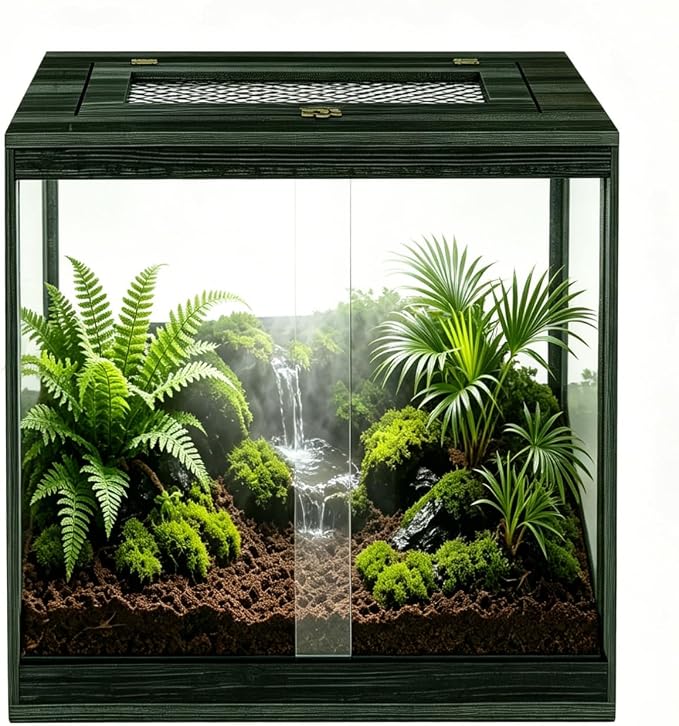
Wood is the third material worth a mention. The 16 gallon wooden reptile terrarium with an openable metal mesh top insulates better than any glass tank in its size class, and for a leopard gecko or a similarly sized species it makes a genuinely efficient winter enclosure. The listing markets it toward bearded dragons as well, and we will be blunt about that: a 16 gallon footprint is far below what an adult bearded dragon needs, and we do not recommend it for that species at any season, no matter how well it holds heat.
For keepers staying with an existing glass tank, retention upgrades are cheap. Cork or foam background panels glued to the inside back wall cut radiative loss. Aluminum foil tape or a cut piece of plexiglass covering up to half of the mesh top slows the chimney effect without sealing the enclosure. Moving the tank off an exterior wall, away from a window, and a few inches off a cold floor removes the three coldest neighbors it has. Holding the reptile room itself at 68 or better does more than any single accessory, because it raises the baseline every heater is working from.
Choosing and controlling night heat
Whatever heat source you run, control is not optional. According to the AVMA, reptiles are unusually sensitive to their environment, and heat sources that lack a thermostat can burn animals or start fires; uncontrolled under-tank heaters on glass can push surface temperatures well past safe levels, and heat rocks in particular have caused severe, sometimes fatal, burns that veterinarians have documented for decades. Merck's veterinary manual lists the same warning. Every heater in this section assumes a quality thermostat between it and the wall.
The controller we consider the default recommendation is the Inkbird ITC-308 temperature controller, a two-stage unit that handles up to 1100 watts on its heating outlet. In winter the heating outlet runs the mat or emitter, and the second, cooling outlet mostly sits idle, though it earns its keep for species kept in warm apartments where daytime spikes out of range. Set the probe correctly, set the setpoint to the low end of the target range rather than the high end, and let the controller hold the floor through the night.
For raising air temperature after lights-out, ceramic heat emitters remain the workhorse: no light, long life, and enough radiant output to lift the air in a PVC or wood enclosure several degrees. Deep heat projectors are the newer option, emitting infrared wavelengths that penetrate tissue somewhat like the sun does, which makes them a good match for a dim night basking zone. What we would avoid is any colored bulb running around the clock. Reptiles need a real photoperiod, and a light left on all night, red or otherwise, disturbs the day-night cue that regulates feeding and activity, which is the last thing an animal that has already gone off its food needs.
Plugging leaks without breaking ventilation
Covering mesh is the fastest retention win in the kit, and it needs one boundary. Cover up to half of the screen top with foil tape or plexiglass and leave the rest open. The open section preserves the passive airflow that moves fresh air through the enclosure, which the RSPCA identifies as a basic requirement of reptile housing; seal every vent and you trade a temperature problem for a stagnant-air and humidity problem, and respiratory infections follow stagnant air the way hunger strikes follow cold floors.
Watch the humidity gauge for a few nights after any change to the top. Tropical setups usually drift toward the middle of their range, which is welcome in winter when furnace air is dry. Desert setups can tip too humid, and if that happens, uncover a little more mesh rather than adding a dehumidifier nobody needs.
A deliberate brumation is not the same as a winter drift
Some of the species in this article, bearded dragons especially, have a natural cold-season slowdown, and experienced keepers sometimes run a planned, controlled brumation with empty guts, vet clearance, and monitored temperatures. That is a decision, executed on purpose. What kills animals is the accidental version: a room that slid to 60 over a long weekend, a python with a recent meal in a gut that can no longer process it, and an owner who assumes the snake is simply settling in for winter. If you have not chosen to brumate your animal, the correct winter posture is to hold temperatures steady and let the photoperiod, not the thermometers, tell the season. Sick, thin, or young animals stay warm regardless.
The winter mistakes we see most
A short list of the recurring errors, so you can check yourself against it:
- Trusting stick-on dial thermometers for decisions that animals depend on. They read the glass, not the air, and they are off by enough to matter.
- Stacking two uncontrolled heat mats under one tank. Doubling unregulated heat doubles the failure mode; one controlled source beats two wild ones.
- Cranking the setpoint on an undersized heater to fight a losing battle, which runs the heater at 100 percent duty for months and shortens its life while barely moving the number.
- Sealing every vent to hold heat and then wondering why the humidity spiked and the animal is breathing with an open mouth.
- Leaving a red or black light bulb on 24 hours a day through the whole season.
A 20-minute winter checklist for tonight
Here is the whole plan compressed into an evening of work:
- Point an infrared thermometer at the basking surface, warm substrate, and cool side, and record all three.
- Put a min-max thermometer on the warm side and let it run for three nights to capture true overnight lows.
- Verify the thermostat probe placement and compare its reading against the independent thermometer.
- Check the duty cycle overnight. Sustained 100 percent means you need more wattage or better retention.
- Cover up to half the mesh top and add a background insulator to glass walls if the lows still sag.
- Confirm every heat source runs through a thermostat, and retire any heat rock permanently.
- Start a weekly weight log on a gram scale, because appetite changes are much easier to interpret against a baseline.
None of this requires a rebuild or a four-figure shopping trip. Measure first, fix retention before wattage, put every heater behind a thermostat, and keep the species-appropriate floor under the night lows. Do that in the first cold week of the season and the November mystery, the sagging gradient and the gecko who stopped caring about dinner, never has a chance to develop.
Related Reading
Want more on this topic? Check out our guides on reptile salmonella safety family guide, best reptile enrichment toys cage decor, best reptile uvb lighting heat lamps.