The Lizard Pressed Against the Glass Is Sending a Message
Somewhere tonight, thousands of bearded dragons are doing the same thing: nose flattened against the front glass, body propped upright, front legs paddling like the tank is slowly filling with water. Owners call it glass surfing, glass dancing, or glass scratching. Online advice splits into two camps — one insists it is harmless exploring, the other treats it as a five-alarm stress signal. Both camps are usually wrong, and both miss what makes the behavior genuinely useful: glass surfing is a symptom with a short, checkable list of causes, and an owner who works through that list in order can usually solve it inside a week.
This guide walks the list in the order we recommend checking. Temperature and light come first because they are free to fix and the most common culprits. Enclosure size comes next, then reflections, hunger pacing, breeding season, settling-in periods, and genuine boredom. We close with the red flags that turn a behavior problem into a veterinary one, and a seven-day audit you can run on any pacing beardie.
Rule Out the Numbers Before You Blame Behavior
Restlessness has a physical explanation more often than a psychological one, and temperature tops that list. A bearded dragon that cannot find a comfortable spot anywhere in its gradient will pace. The two failure modes look identical from the couch: the basking side is too cool, so the lizard keeps hunting for heat it cannot find, or the cool side is too warm, so the lizard cannot dump excess heat and keeps looking for an exit that does not exist. Either way, the fix starts with a thermometer, not with intuition.
An adult bearded dragon needs a basking surface around 95 to 110 degrees Fahrenheit, measured on the surface itself with an infrared thermometer or a probe, never read off the air two inches above it. The cool end should sit near 75 to 80 degrees. When winter drags a morning basking spot down into the low 90s, or a warm apartment pushes the cool retreat past 85, pacing is a predictable consequence. A plug-in thermostat such as the Inkbird ITC-308 takes the guesswork out permanently: plug the heat lamp or heat mat into it, park the sensor where the lizard actually sits, and let the unit hold your target for you. It is a two-stage controller, so it can run a cooling device in summer as well as a heater in winter, which matters if your reptile room swings hard with the seasons.
Light matters nearly as much. A basking bulb on a fancy dimmer does nothing for a lizard whose UVB tube faded out months ago, because UVB output decays long before the bulb visibly burns out. An under-lit or over-lit enclosure produces the same restlessness with different paperwork. While you are auditing, confirm the photoperiod too: twelve hours on, twelve off, on a timer, with no light leaking in at night. A red bulb glowing at midnight counts as light to a reptile eye even when it looks cozy from the hallway.
The Tank May Be Too Small, and the Label Is Probably Lying
The second most common cause is the least popular answer: many bearded dragons pace because the enclosure they live in is smaller than the animal needs. Repeated laps along the same perimeter, day after day, in a tank where the lizard can touch both ends without taking three full strides, is often not exploration. It is an animal with walking motivation and nowhere to walk.
The welfare standard has moved in the last few years, and a lot of care sheets have not caught up. According to the RSPCA, a bearded dragon's enclosure must be large enough for normal locomotion, and the widely adopted minimum for a single adult is a 4-foot by 2-foot footprint — roughly 120 by 50 centimeters at the base. That works out to around 75 gallons of volume, well beyond the 40-gallon breeder that older guides treated as generous, and nowhere near the starter kits sold at mall pet stores.
Marketing makes this harder than it should be. The RepWild 20 gallon PVC enclosure at 30 by 12 by 12 inches, for example, lists bearded dragons among its intended species, and for a hatchling or young juvenile it is a workable grow-out tank. For any beardie past about six months, that footprint is the pacing problem itself. The same honesty applies to the 16 gallon wooden reptile terrarium class of compact enclosures in the 17 by 15 by 12 range: they suit a leopard gecko or a juvenile lizard for a season, and they are not adult bearded dragon housing no matter what the listing title implies.
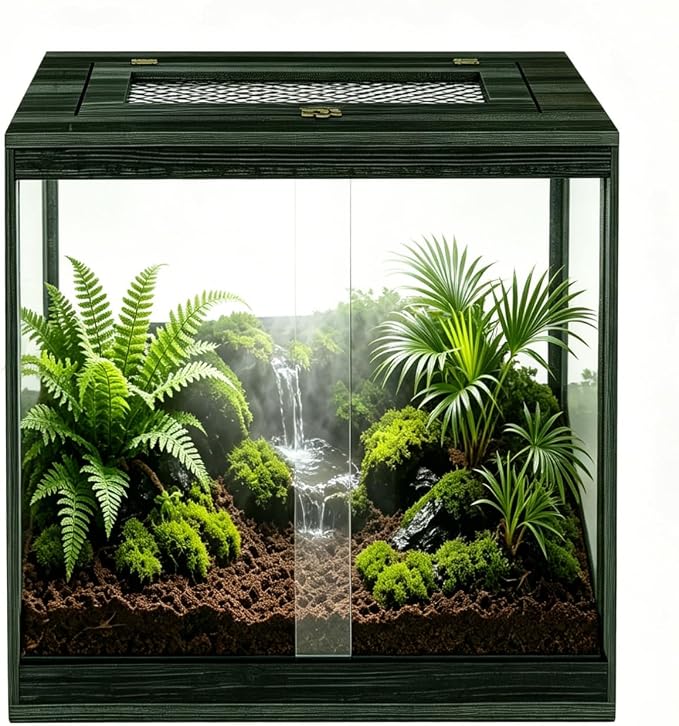
If your lizard has outgrown the tank, the upgrade conversation cannot be postponed forever. Chronic pacing in an undersized enclosure tends to arrive alongside other problems, from stress marks on the belly to worn snouts from rubbing on the glass. But size alone does not explain every surfer, which is why we put temperature first and why you should keep reading before ordering anything with two-day shipping.
The Rival in the Glass: Reflections
Mature male bearded dragons in breeding condition are territorial, and a clear glass wall hands them something the wild never does: a rival lizard that copies their every move, lives one inch away, and cannot be driven off no matter how many times they charge it. Head bobbing at the glass followed by pacing, arm waving, or black-bearding at one specific wall is the classic reflection response. It peaks in spring, and it can turn a calm adult into a pugilist overnight.
The fix is cheap and boring: break the mirror. An opaque background on the outside of the glass, cork panels, botanical prints, even butcher paper taped to the exterior of the front wall will do it. Some owners resist covering glass because they like the view, and that is fair — a partial band across the lower third of the pane, exactly where the lizard patrols, defuses the reflection while preserving the sightline from above. If the behavior is anchored to one wall, that wall is your experiment: cover it first.
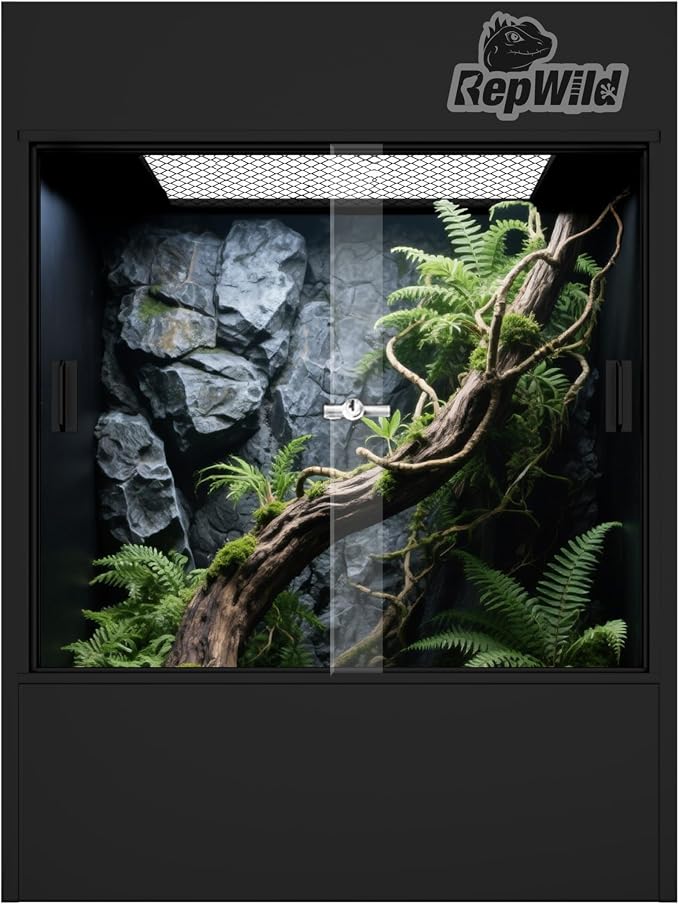
This is also where enclosure material quietly changes the math. Glass reflects; PVC and wood mostly do not. A PVC build like the REPWILD 33 gallon tall arboreal terrarium takes the mirror problem off the table entirely for climbing species, though its 18 by 24 inch vertical layout suits crested geckos and gargoyle geckos far better than a floor-walking beardie. The transferable lesson is not the specific tank but the material: if you are buying a new enclosure for a glass-surfing male anyway, wall material deserves as much thought as the dimensions printed on the box.
Hunger Pacing and the Dinner Clock
Not every surfer is distressed. Bearded dragons learn feeding routines with startling precision, and the half hour before a usual mealtime often produces exactly the patrol-and-press pattern people photograph and post online. Anticipatory pacing around feeding is normal, it stops within minutes of eating, and it needs no intervention beyond a consistent schedule. If the surfing clusters around one time of day and the rest of the afternoon is calm, you are watching a lizard ask for salad, not signal a crisis.
One caveat belongs here. A dragon that paces through the day and begs every time a human walks past may be underfed rather than theatrical. Growing juveniles need live insects twice daily, adults still need regular vegetable meals even when they act indifferent, and weight loss paired with increased activity is a combination that deserves a kitchen scale, not a shrug.
Spring Fever Is Real for Lizards Too
Even with perfect temperatures, adequate space, and a defused mirror, intact males in breeding condition pace in spring. Lengthening days and warming basking spots flip hormonal switches that no husbandry fix disables. The pacing often arrives paired with head bobbing, beard blackening, aggressive posturing toward hands, and frantic digging at enclosure corners, and it generally eases over several weeks as the season passes.
There is no supplement, gadget, or feeding schedule that reliably shuts this down, and we would rather say that plainly than hand you a product that does not exist. What helps is trigger control: keep the visual barriers up, avoid rearranging the enclosure mid-season, skip the extra handling, and accept a few weeks of restlessness as biology rather than as a failure of your care.
The New-Home Settling Window
A bearded dragon in its first two weeks in a new enclosure surfs the glass the way a new dog paces a new house: mapping the space, testing the boundaries, looking for edges. This is expected, and the best response is patience plus structure. Keep the light schedule identical from day to day, feed in the same spot, limit handling to short sessions, and resist the urge to redecorate mid-adjustment. According to the AVMA, environmental change is a recognized stressor for reptiles, and stress in these animals shows up in behavior long before it shows up on any lab report. Give the animal a fortnight of stability before diagnosing anything deeper.
Boredom Looks Different From Distress
True boredom surfing has a tell. It happens in an otherwise healthy animal, in a correctly sized and heated enclosure, usually on a quiet afternoon. The pacing is loose rather than frantic, the lizard eats normally, and it stops the instant something interesting happens. The fix is environmental, and it costs less than a new tank:
- Clutter beats openness. Wild bearded dragons live in complex, broken terrain, not empty floors. Add hides, branches, rock stacks, and sight-line breakers so the enclosure reads as terrain instead of a stage.
- A dig box filled with plain topsoil or a safe substrate mix gives digging motivation a legal outlet, and for many females it doubles as a lay bin when the time comes.
- Rotate one item every week or two — a new branch angle, a repositioned hide — instead of rebuilding everything at once, which restarts the settling window you just closed.
- Scatter-feeding insects or moving the salad bowl between two fixed spots turns mealtime into light foraging instead of a drive-through window.
- Supervised time in a secure outdoor pen on warm days adds real sensory input, and it is the single most effective boredom fix available, weather and local predators permitting.
None of this replaces correct temperatures or an adequate footprint. Enrichment built on top of bad husbandry just decorates the problem. Fix the numbers first, then decorate.
When Pacing Means the Vet, Not the Enclosure
Glass surfing earns a veterinary appointment — not an enclosure tweak — when it arrives alongside any of the following: refusing food for more than a few days, weight loss, lethargy between pacing bouts, open-mouth breathing or wheezing, head tilting, stargazing, tremors, or unusual postures. Those pairings point past behavior and toward parasites, respiratory infection, adenovirus, metabolic bone disease, or neurological trouble, and no amount of décor swapping addresses any of them.
Two specifics deserve emphasis. First, a dragon that surfs and rubs its snout raw — discoloration, scabbing, or dented scale rows at the nose — is injuring itself, and persistent self-trauma paired with pacing warrants an exam even when everything else looks normal. Second, sudden onset in a previously calm animal matters more than chronic mild pacing. A lizard that never surfed and now does it hourly is a different case from a juvenile that has surfed since the day it arrived. According to the AVMA, behavior changes are among the earliest visible signs of illness in reptiles, which is exactly why the timeline matters as much as the behavior itself.
If you do not already have an exotics vet on file, find one before you need one. Reptile appointments book out more slowly than dog slots in most cities, which is a reason to book early rather than an excuse to wait.
What Not to Do While You Diagnose
A few common responses make things worse. Never add a second lizard to keep the first one company — cohabitation is its own welfare problem, and bearded dragons are not social in the way that phrase implies. Do not answer begging-pace with constant treats; obesity arrives faster than guilt wears off. Do not increase handling to reassure a stressed animal; extra handling during the settling window prolongs it. And skip the reflective backgrounds, mirrored décor, and glass-side feeding stations that hand a territorial male one more rival to fight.
The Seven-Day Glass-Surfing Audit
Run this once, top to bottom, and write the numbers down instead of trusting memory:
- Day one: measure the basking surface and both ends of the gradient at three times — morning, midday, and evening — and log them.
- Day two: check the age of the UVB tube against its rated output window; if you cannot remember installing it, it is overdue.
- Day three: measure the enclosure footprint with a tape measure and compare it to the 4-by-2 standard for adults, not to the label on the box.
- Day four: watch for an hour at the usual surf time and note whether the pattern clusters around meals, a specific wall, or a specific time of day.
- Day five: if the pattern is wall-specific, add an opaque band to the exterior of that wall and give it a week.
- Day six: add exactly one enrichment element — a dig box, a new branch, or scatter feeding — and change nothing else.
- Day seven: re-read the red-flag list. Any pairing of pacing with appetite loss, breathing changes, or neurological signs goes to the vet, full stop.
Most glass surfing ends somewhere inside that week. The cases that do not are the reason the vet section sits before the enrichment section in this guide, and the audit is how you tell the two apart before a small behavior problem becomes an expensive one.
Related Reading
Want more on this topic? Check out our guides on reptile basking spot temperature setup guide, should you house two reptiles together cohabitation guide, best live vivarium plants for reptiles bioactive terrarium.