A bed that comfortably supports a Beagle will often flatten within weeks under a Great Dane. Large dogs place fundamentally different demands on a sleeping surface: more weight pressing into the same area, more force during the nightly circling-and-flopping ritual, and more wear on seams and zippers from dogs who dig at their bedding before settling. This guide explains what actually matters when choosing a bed for a large breed, which specifications to check before buying, and where two widely available options on Amazon fit into the picture as concrete examples.
Context worth knowing: hip and elbow dysplasia screening data from the Orthopedic Foundation for Animals shows large breeds account for the majority of diagnosed joint degeneration cases, which is why surface support matters more as these dogs age. General canine health guidance, such as the Merck Veterinary Manual's dog owner reference, describes osteoarthritis as a common condition in older, heavier dogs, and a supportive resting surface is one of the more affordable interventions an owner can make.
Why Large Breed Dogs Need a Different Bed
Large breed dogs face structural challenges that small dogs simply do not encounter at rest. A dog weighing between 50 and well over 100 pounds concentrates substantial force on whichever joints bear their weight while lying down, and that pressure concentrates on the hip, elbow, and shoulder points that press hardest into the surface. On a thin, low-quality filling, those pressure points bottom out against the floor, which defeats the purpose of a cushioned bed entirely.
Breeds such as German Shepherds, Great Danes, Labrador Retrievers, Rottweilers, and Bernese Mountain Dogs are all prone to joint stress as they age, and several are also predisposed to elbow or hip dysplasia. Veterinarians who contribute to resources like the AVMA's pet owner materials consistently emphasize weight management and comfort-focused care for senior dogs, and the resting surface is part of that equation. A mattress that keeps the dog's body aligned, rather than sagging into a hammock shape, reduces the strain on already-stressed joints.
There is also a durability angle. Large dogs are heavier on hardware, zippers, and fabric in a purely mechanical sense. A cover that survives years of a 12-pound terrier may pill, tear, or blow out a seam within months under a 90-pound dog who kneads the bedding before every nap. This is why manufacturers of large-dog beds emphasize fabric denier, foam density, and warranty terms, and why those specs deserve your attention at purchase time.
The Core Specification: Foam Type and Thickness
The single most important specification in a large-dog bed is what is inside it. Cheap beds use polyester filling, shredded foam scraps, or low-density fiberfill. These materials compress quickly under heavy weight, flatten unevenly, and offer almost no pressure relief. A bed that was four inches thick at purchase can lose half its loft within a few months under a large dog, leaving your dog effectively sleeping on the floor with a fabric layer for decoration.
Memory foam, also called viscoelastic foam, is the benchmark for orthopedic support because it contours to the body and distributes weight across a wider contact area. Manufacturer specifications for quality orthopedic beds typically list solid memory foam, sometimes layered over a sturdier support foam base. For dogs over about 80 pounds, look for a total thickness of at least 4 inches, and ideally more. Beds in the 6 to 7 inch range are marketed specifically for giant breeds, and the extra depth exists to prevent pressure points from bottoming out under heavy occupants.
A useful way to verify claims is to check whether the manufacturer publishes a foam density figure, usually expressed in pounds per cubic foot. Denser foam, generally 4 lb/ft3 or higher for memory foam, resists compression and recovers its shape better over time. If a listing says only 'plush orthopedic foam' with no density, treat the claim cautiously and look at long-term owner reviews for words like 'flattened' or 'still holding up after a year.'
Cooling-gel infused memory foam has moved steadily into mid-range pricing, which matters if you own a Newfoundland, Great Pyrenees, or any thick-coated breed that runs warm. Gel infusion is designed to draw heat away from the sleeping surface, and while it will not replace air conditioning, verified owner reports commonly describe it as noticeably cooler than standard memory foam. Standard memory foam is known for retaining heat, so hot-sleeping dogs may benefit from gel-infused or convoluted (egg-crate style) foam that allows airflow.
Cover Durability, Washability, and Waterproofing
The cover is where most beds fail first. Large dogs dig, circle, and scratch at bedding, so fabric toughness matters as much as foam quality. Manufacturers specify fabric weight or weave type for premium covers; tighter weaves and heavier fabrics resist pilling and tearing better than loose-knit plush. Canvas and ballistic-style nylon weaves are the toughest options, though they trade away softness, which some dogs genuinely seem not to mind and others clearly do.
Washability is non-negotiable for a large dog bed. Look for a removable cover with a zipper, because washing a whole foam bed is impractical and foam should never go through a machine. Check whether the cover is machine washable or spot-clean only, since spot-clean-only covers become a real burden after the first muddy-paw season. Reading the care instructions before buying, rather than after the first accident, will save genuine frustration.
Waterproofing deserves special attention for senior dogs, dogs with incontinence issues, or dogs who come home wet from walks. The most useful design places a waterproof or water-resistant liner between the foam and the outer cover, so accidents soak the cover but never reach the foam. Wet memory foam is extremely slow to dry and prone to holding odor, so a compromised waterproof liner usually means replacing the whole bed. Some manufacturers list a waterproof inner liner as a feature; verified owner reviews are the best place to confirm how well it actually holds up to repeated exposure.
Sizing: Getting It Right the First Time
Undersizing is one of the most common and most expensive mistakes in this category. A large dog needs enough length to stretch fully on their side, which is how many dogs sleep. Measure your dog from the tip of the nose to the base of the tail, then add 4 to 6 inches of buffer for stretching room and a bit more if your dog sprawls diagonally. Compare that measurement to the manufacturer's stated sleeping surface dimensions, not the outer dimensions of the bed, because bolsters and rails can eat a surprising amount of interior space.
Weight ratings deserve the same scrutiny. Many beds list a recommended maximum weight, and exceeding it accelerates foam breakdown dramatically. If your dog is close to the limit, size up. For giant breeds over 100 pounds, choose beds explicitly engineered for that class, which typically means thicker foam, reinforced seams, and longer warranties.
Height matters for seniors. Older dogs with arthritis sometimes struggle to step up onto a very thick mattress, even though that thickness provides the support they need. Look for beds with a low step-on height or position the bed so your dog can approach it from a non-slip floor. Conversely, elevated cot-style beds sit several inches off the ground, which helps with airflow and keeps dogs off cold or damp floors, but they offer essentially no cushioning and are better suited to younger dogs or warm climates than to arthritic seniors.
Two Concrete Examples Worth Examining
Because construction quality varies enormously across this category, it helps to look at specific listings and read them against the criteria above. The two options below are widely available examples that illustrate different points on the price and feature spectrum; both are worth a look as reference points for what a well-specified large-dog bed listing should contain.
A Seven-Inch Orthopedic Bed Built for Dogs Over 100 Pounds
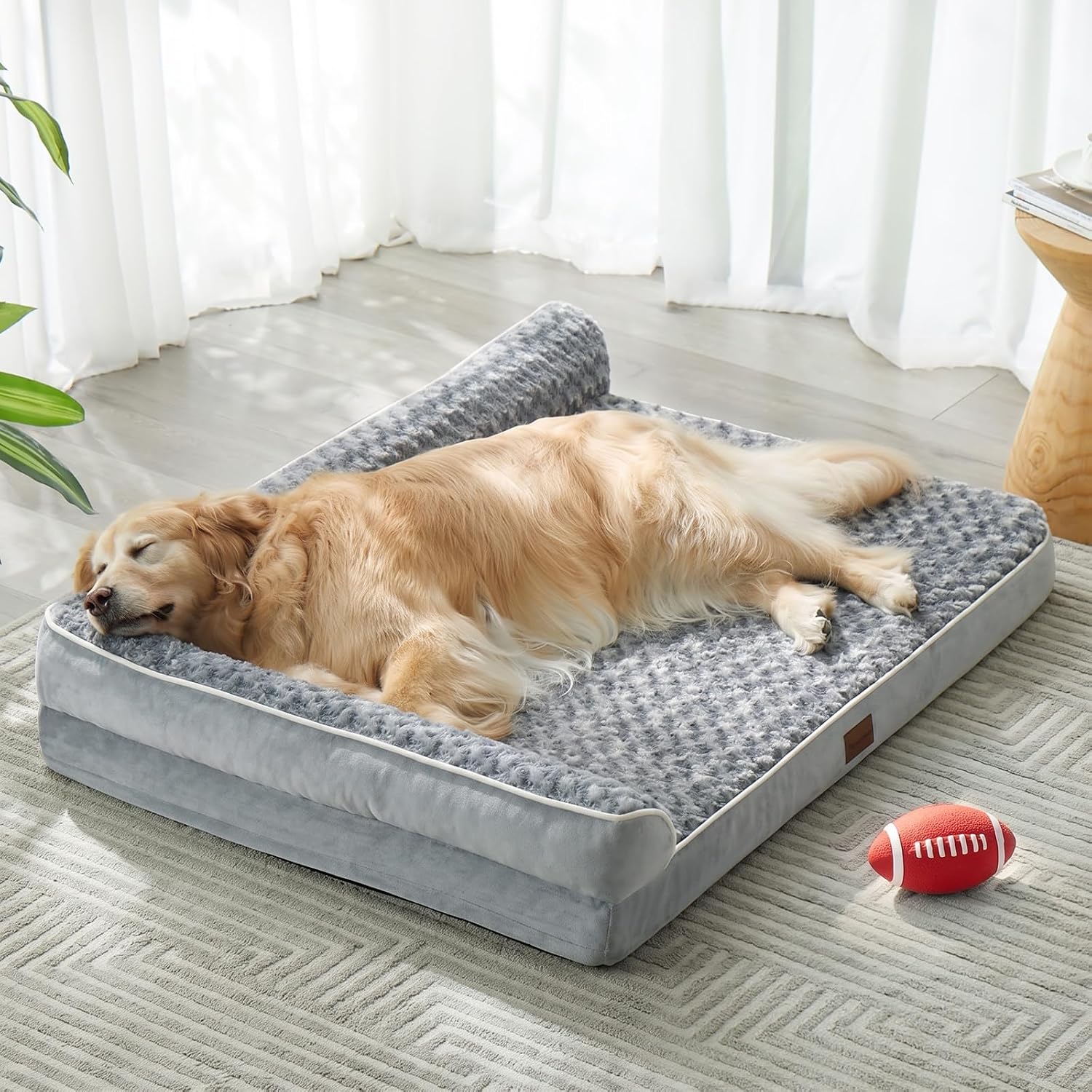
This style of bed is engineered specifically for the heaviest dogs, with a 7-inch foam profile designed so that pressure points on hips and elbows do not compress through to the floor. Manufacturer specifications for this class typically include a solid foam core rather than shredded fill, a machine-washable removable cover, and a long warranty, often in the range of ten years, which signals real confidence in foam longevity. The trade-off is price: beds built this way sit at the top of the category, and the substantial weight that makes them durable also makes them awkward to move for washing. It suits multi-dog households and giant breeds like Great Danes, Mastiffs, and Saint Bernards, and it is overkill for a lean 55-pound dog who is gentle on bedding. You can check the current price on Amazon and compare the listed foam specifications against the guidelines earlier below.
A Pressure-Relieving Memory Foam Bed from a Mattress Brand
The second example comes from a company best known for human mattresses and brings that design philosophy to pet bedding, with pressure-relieving memory foam aimed at aging large breeds. Listings of this type typically advertise supportive foam layers, a removable washable cover, and a trial period borrowed from the human-mattress business model, which reduces purchase risk if your dog rejects the surface. The trade-offs are a premium price and, in many versions, limited waterproofing, which is a meaningful gap for senior dogs or accident-prone households. It suits owners of senior large breeds who prioritize joint contouring and are willing to add a waterproof liner separately. You can view this option on Amazon and read the verified owner reviews, which are the best available evidence on how the cover and foam hold up over time.
A Chew-Resistant Alternative for Destructive Dogs
For dogs who destroy conventional beds, a chew-resistant style built from heavy ballistic nylon with recessed or protected seams is the category to investigate. These beds sacrifice plushness in exchange for surviving dogs who treat bedding as a project, and many are marketed as waterproof as well. The honest limitation is comfort: a very tough fabric over firm foam will never feel like a pillow-top, so some dogs take time to accept it. If chewing is driven by anxiety rather than habit, addressing the underlying behavior with guidance from veterinary resources, such as the AVMA pet owner resources, is more effective than simply buying tougher furniture. A listing in this chew-proof class is also available to view on Amazon if you want a concrete example of how these products describe their fabric and seam construction.
Bed Styles and Who They Suit
Beyond foam mattresses, several other styles serve different needs, and understanding them prevents buying the wrong category entirely. Bolster and sofa-style beds surround the sleeping surface with raised rails that support the head and neck; dogs who like to rest their head on an armrest prefer them, but the bolsters reduce usable sleeping area, so size up accordingly. Donut and bagel beds are plush, enclosed, and cozy, ideal for anxious dogs who curl tightly and like feeling surrounded, but they generally lack real orthopedic foam and can sleep warm.
Elevated cot beds keep the dog off the floor on a breathable mesh stretched over a frame, which is excellent in hot climates or damp environments like screened porches, and they are light and portable. Their weakness is the absence of cushioning, which makes them a poor primary bed for arthritic seniors. Heated beds are a separate niche for cold-climate dogs and thin-coated breeds, but they require careful attention to chew-proof cords and manufacturer safety certifications. Matching the style to your dog's actual sleeping posture, which you can observe over a few nights, is more reliable than matching it to how the bed looks in product photography.
Maintenance and Longevity
A good maintenance routine extends a large dog bed's life considerably. Vacuum the surface weekly to remove hair, dander, and tracked-in grit, because grit works like sandpaper against fabric and foam during every position change. Wash the removable cover roughly monthly, or more often during mud season, following the manufacturer's temperature instructions, since hot water and aggressive drying can shrink covers and damage waterproof coatings. Spot clean accidents immediately with an enzymatic cleaner rather than detergent alone, which masks odor for humans but leaves enough residue for a dog's nose to find, encouraging repeat accidents.
Rotate the bed periodically so the same spot does not absorb all the compression, the same principle as rotating a human mattress. If the foam develops a permanent body-shaped crater, that is compression fatigue, and no amount of fluffing will restore it; at that point the bed is no longer providing support and should be replaced. Inspect zippers and seams every month or two, because a small tear repaired early is cheap, while an ignored one grows into a foam-exposing split that invites chewing.
Common Mistakes to Avoid
Several recurring errors show up in buyer reviews and cost owners money. Buying on price alone is the most frequent one: the cheapest beds in this category almost always use filling that flattens within months under a large dog, and repeatedly replacing a $40 bed costs more over two years than buying a well-made one once. The inverse also holds, since the most expensive option is not automatically the right fit for your dog's habits.
Ignoring weight ratings and sleeping-surface dimensions wastes money in a different way. A five-star bed sized for a medium dog is useless to a Great Dane no matter how well it is made. Always check the manufacturer's stated weight capacity and the interior sleeping dimensions against your own measurements.
Skipping material safety checks matters for dogs who chew or lick their bedding. Look for covers and liners described as non-toxic, and be cautious with strong chemical odors reported in reviews of new foam products, which usually indicates off-gassing that needs airing out before use. If your dog has destroyed and swallowed bedding material, the ASPCA Animal Poison Control resource explains when a veterinary call is warranted.
Assuming waterproof means washable, or vice versa causes surprise after the first accident. A waterproof liner protects foam but does not clean itself; a machine-washable cover without a waterproof layer lets liquid reach the foam. The best combination is a washable cover over a waterproof liner, and it is worth confirming both features before checkout.
Buying without reading reviews from similar households rounds out the list. Filter owner reviews for mentions of your dog's size range and habits, including multi-dog homes if you have one, because a bed that holds up for a single sedate senior may not survive two young Labradors who treat it as a wrestling mat.
Special Considerations for Senior Dogs
For dogs past roughly seven years of age in large breeds, the calculus shifts toward support and accessibility. Senior large breeds have high rates of arthritis, and published veterinary guidance consistently recommends soft, supportive resting surfaces as part of managing chronic joint discomfort alongside veterinary care and weight control. Skip thin pillow-style beds entirely at this stage; the marginal savings are not worth the lost support.
Practical senior-focused features include a low step-on height, a non-slip bottom that keeps the bed from sliding when an unsteady dog climbs on, and a waterproof liner for age-related incontinence. Watch for signs the current bed is no longer adequate: reluctance to lie down, stiffness on waking, or choosing a cold hard floor over the bed can all indicate the surface has bottomed out. Nutritional support also interacts with joint health, and the WSAVA Global Nutrition Guidelines are a sound evidence-based reference for discussing diet with your veterinarian.
What to Avoid Entirely
Some products in this category deserve a hard pass regardless of price. Beds with no removable cover are effectively disposable for large dogs. Cedar-filled beds can irritate sensitive skin and airways, and their scent fades quickly anyway. Beds with exposed zippers or dangling tags invite chewing and can result in swallowed hardware. Unbranded foam slabs with no stated density or certification may contain low-grade filler materials. Very cheap 'memory foam' beds under about $40 in extra-large sizes are almost never real memory foam at that price point and typically use bonded or shredded scraps.
Bottom Line
Choosing a bed for a large breed comes down to four verifiable checks: solid memory foam of sufficient thickness and stated density, a tough removable and washable cover, accurate sleeping-surface dimensions with a weight rating above your dog's weight, and a warranty that reflects real expected lifespan. Beyond those, match the style to how your dog actually sleeps, read verified owner reviews from households like yours, and treat the linked examples above as starting points for comparison rather than the only options worth considering. A well-chosen bed is one of the cheaper interventions that meaningfully improves a large dog's daily comfort, particularly as they age.
Disclosure: As an Amazon Associate, we earn from qualifying purchases.
Product review for dog beds for large breeds: ultimate comfort for big dogs