Heater Failure Season Starts Now
Every November our inbox fills up with the same story. The tank read 78 degrees yesterday morning. Today it reads 71 and falling. The heater is plugged in, the light turns on, the fish are stacked near the bottom, and nobody can say what changed. What changed is the season. Heater failures cluster in the cold months, and the reason is simple arithmetic. A heater sized for your tank in a 72-degree room might cycle for a few minutes each hour. Put that same heater in a room that drops to 62 overnight and it runs nearly flat out, sometimes for days. Continuous duty is where aging heaters die. Seals stiffen, thermostat contacts pit and weld, internal fuses let go, and the unit that limped through last summer quits on the coldest week of the year.
The failure usually announces itself quietly. No smoke, no sparks, no error message. Just a glass tube that looks exactly like it did the day you bought it and a thermometer that keeps sliding. That is why the emergency plan below matters more than any product recommendation: the equipment rarely gives you warning, but the response in the first hour decides whether you lose a fish or lose a whole tank.
The First Hour: Slow Beats Fast Every Time
When you discover a cold tank, resist the urge to fix the temperature immediately. Most tropical fish handle a slow drift of several degrees far better than a rapid correction. A tank that fell from 78 to 70 over six hours should climb back at a similar pace. Chasing the number with boiling water or scalding tap water is the single fastest way to turn a thermal scare into a thermal casualty, because fish cannot shed excess heat quickly and a hot pocket near the pour point can scald gills and skin long before the thermometer on the far wall shows a problem.
Here is the sequence we recommend, in order. First, unplug the dead heater and confirm it is actually dead, because a unit that cycles intermittently can fool you. Second, slow the heat loss. Wrap the sides and back of the tank in blankets or sleeping bags, leaving the top uncovered for gas exchange. Glass loses heat in every direction, and insulating three sides can cut the loss rate roughly in half in a cold room. Third, add warmth gently. Float clean bottles filled with warm tap water, around 100 degrees, and replace them as they cool. Fourth, aim for stability first and the target number second. A tank holding 74 steady is in far better shape than a tank swinging between 70 and 80 while you experiment.
How much time do you actually have? It depends on the tank. Small tanks cool fast because their surface area is large relative to their water volume. A 10-gallon in a 62-degree room can shed 6 to 8 degrees within a few hours, while a 75-gallon in the same room may only lose 2 or 3. That asymmetry surprises people: the little betta jar in the bedroom is at far more risk than the big community tank in the living room, even with identical equipment.
The Other Failure: A Heater Stuck On
The mirror-image emergency gets less attention and can be uglier. A thermostat that welds itself closed does not stop heating at the set point. It keeps the element energized until someone notices, and in a small tank that can push the water into the high 80s within hours. The early signs are easy to miss at a glance: fish hovering near the surface and gasping, because warm water carries less dissolved oxygen; rapid gill movement; unusual lethargy in fish that are normally busy; corals or plants that look suddenly limp.
Response is the same discipline in reverse. Unplug the heater first, not after checking whether it is the culprit. Then cool gradually. Remove the lid to increase evaporative cooling, float sealed bags of ice or cold water in the tank, and if the drift is large, do a modest water change of 20 to 25 percent with dechlorinated tap water a few degrees cooler than the tank. Never dump cold water straight onto fish, and never swap more than about a third of the volume at once, because the temperature swing itself becomes the new emergency. According to the AVMA, sudden environmental changes are a leading source of preventable stress in ornamental fish, and rapid temperature swings sit at the top of that list.
Verify Before You Trust: Thermometers and Dials Both Lie
Plenty of heater emergencies turn out to be calibration problems wearing an emergency costume. The dial says 78, the internal thermostat clicks, and the tank still sits at 73 because the dial was never accurate in the first place. Cheap bimetal thermostats drift with age, and a unit that held its set point two winters ago may be off by several degrees today. The fix costs almost nothing: an independent glass thermometer or a digital probe placed near the substrate, checked against the heater setting once a week and after every big weather change.
Placement matters as much as the instrument. A thermometer suctioned near the top of the tank, close to the light, will read warmer than the water your corydoras actually live in. A probe buried in the substrate behind a piece of driftwood reads colder than reality if the outflow pushes warm water across it. We suggest one thermometer low in the tank near the opposite end from the heater, and a quick check with an infrared thermometer against the front glass if you want a second opinion. When the two disagree by more than a degree or two, trust the in-water probe, not the glass surface.
During cold snaps, check twice a day rather than once. Most heater deaths we hear about were discovered 8 to 12 hours after the failure, in the evening after work or the next morning. A 15-second glance at breakfast and another at dinner compresses that window dramatically, and in a tank that holds fish you cannot bear to lose, that glance is the cheapest insurance on the market.
Sizing and Placement: The Rules Pet Stores Skip
The old rule of thumb is 3 to 5 watts per gallon, and it is a decent starting point, but it hides the variables that actually decide whether a heater survives winter. Room temperature is the big one. A 40-gallon tank in a heated living room does fine on 150 watts. The same tank in a basement at 60 degrees wants 250 to 300 watts, and an insulated cover, because the heater will otherwise run nearly continuously and age out early. Err large rather than small. An oversized heater with a quality thermostat cycles gently; an undersized one runs at 100 percent duty for months and fails sooner, usually at the worst moment.
Placement is the other half of the equation. Heat that stays in one corner does not help the fish at the far end, so position the heater where water moves: near the filter outflow or a powerhead, so heated water gets swept across the tank instead of stratifying around the glass. Never bury the heating element in gravel or wedge it under decor, which blocks convection and creates hot spots on the glass. Check the suction cups each season too. They harden and lose grip with age, and a heater that slips horizontal in a shallow tank can overheat locally or crack against the frame.
If you keep long-finned fish such as bettas, consider a heater guard. The manufacturer specifications on most units assume the element will not be hugged, and a resting betta draping itself over a glass tube is a burn waiting to happen. Guards cost a few dollars and solve the problem permanently.
Circulation: The Half of Heating Nobody Markets
Warm water sits above cold water. That single physical fact explains a whole family of winter problems: fish that shiver at the substrate while the thermometer at mid-height reads fine, heaters cycling constantly because their internal thermostat sits in the warm layer they just created, and slow-cooked plants near the glass. The fix is not more watts, it is more movement. A modest filter outflow angled along the tank breaks up the layers and drags cold bottom water past the heater.
You do not need an aggressive powerhead for this. On tanks from 10 to 30 gallons, something like the AquaClear 30 Power Filter moves plenty of volume with an adjustable flow you can dial down for bettas and other slow swimmers, and its media basket is easy to service in winter when you would rather not pull apart a complex canister in a cold room. The goal is turnover without a current that pins fish to the glass: on most community tanks, turning the tank over 4 to 6 times per hour is plenty.
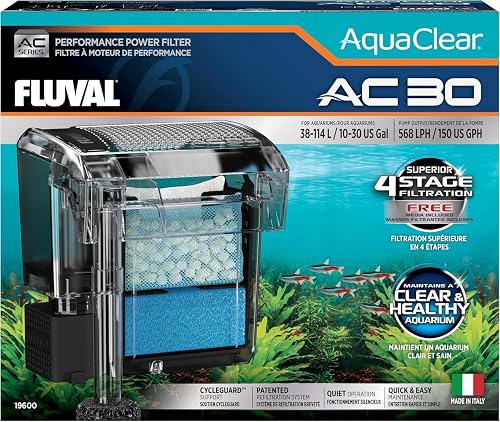
Watch the interaction between circulation and your heating strategy, too. If you insulate the back and sides with foam board or blankets, keep the filter intake and output clear, and remember that reduced surface agitation reduces both gas exchange and evaporative cooling. In a sealed, poorly circulated tank the warm layer near the lamp can hit 82 while the substrate sits at 74, and the only symptom is fish behaving strangely at the bottom.
Redundancy: The Cheapest Insurance You Will Ever Buy
A single heater is a single point of failure in a system that cannot tolerate failure, so for any tank with real value, financial or emotional, we recommend doubling up. Two smaller heaters on opposite ends of the tank cost about the same as one large unit, spread the thermal load, and if one dies the other keeps the tank in the survivable zone until you notice. Pair them with the independent thermometer from the section above and you have covered the two failure modes that actually sink tanks: silent death and silent drift.
Integrated options exist as well. External canisters with built-in heater modules, such as the OASE BioMaster 2 Thermo 350, move the heating element out of the display and into the filter body, where water is heated as it passes through and returned already mixed. That design solves the stratification problem neatly and removes the glass from the tank entirely, which is worth considering in households with large cichlids that bash equipment or toddlers with curious hands. The trade-off is serviceability: the heater module lives inside the filter, so failures are less visible, and the independent thermometer becomes even more important.
One more redundancy note for cold climates: know what your tank does in a power cut. Insulation slows heat loss whether the heater is broken or the power is out, and the wrapped-bottle technique works in both scenarios. Households in areas with frequent winter outages often keep a small power inverter rated for the heater and filter on hand, sized to run both off a car or portable battery station. It is not a generator, but it bridges a 6-hour outage without drama.
After the Scare: Watch Water Quality, Not Just Temperature
Tanks that survive a thermal event are not out of the woods when the thermometer recovers. Temperature stress suppresses the immune function of ornamental fish, and the classic aftermath plays out over the following week: white spot eruptions, fin rot, or an ammonia bump nobody expected. Stress ich is so common after cold snaps that any tank that dropped more than about 5 degrees should go on watch status for 7 to 10 days, even if every fish currently looks fine.
Feeding is the first adjustment. Cut back to a light meal every other day for the first 48 hours after a big drift, because stressed fish digest slowly and uneaten food in a stressed biofilter is how ammonia problems start. Then verify the water itself. A full panel with the API Freshwater Master Test Kit on day one and day four tells you whether the biological filter rode out the event; ammonia and nitrite should read zero on both. If ammonia appears, that is a biofilter problem, not a temperature problem, and it needs its own response: light feeding, an ammonia detoxifier if levels cross 0.25 ppm, and patience.
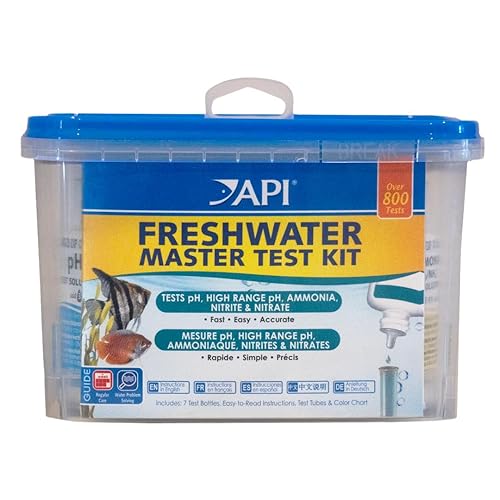
Watch behavior with the same attention you gave the thermometer during the emergency. Flashing against decor, clamped fins, white pinhead spots on fins and body, or a sudden rise in gill rate are the standard early warnings. Treating ich in a stable, correctly heated tank is routine; treating it in a tank that is still drifting between day and night temperatures is much harder, which is one more reason the recovery climb back to the set point should be slow and boring.
The Mistakes We See Every Winter
Most heater emergencies are compounded by well-meaning fixes, so here is the list we would nail to the door of every fish store in November. Topping it, again, is pouring hot water directly into the tank, which scalds fish and cracks nothing you want cracked, including cheap glass thermometers. Close behind is the giant corrective water change: swapping half the volume for 85-degree tap water swings the chemistry as much as the temperature and routinely triggers the very ich outbreak you were trying to prevent.
Then there is the dial-trust problem. Owners set the dial in September, never cross-check with a second thermometer, and discover in December that the tank has been living at 73 instead of 78 for weeks, with the immune consequences that implies. Related to it is the set-point guess: stocking fish whose ideal range does not match the tank at all, then interpreting their low-grade chronic stress as mystery illness. A discus tank at 76 and a white cloud mountain minnow tank at 78 are both being slowly harmed by kindness.
The last cluster is hardware neglect. Suction cups that hardened three summers ago. Heaters older than five winters still running the most important job in the house. One thermometer, placed where it flatters the setup. And the classic: a spare heater in the closet that has never once been tested, discovered dead on the night it was needed. Test the spare before the season, not during the crisis. Five minutes with a bucket of water in October is the difference between a non-event and a loss.
The 15-Minute Winter Heater Audit
Run this once in early December and again in late January, and you will sidestep the large majority of winter heater failures. It is deliberately boring. Boring is what reliability feels like.
Start with the numbers. Read the tank temperature with your independent thermometer at the start and end of the audit hour and confirm the tank holds its set point within a degree. Cross-check the heater dial against reality and note the offset if there is one. Next, the hardware. Unplug and inspect the heater glass for hairline cracks and mineral scale, confirm both suction cups grip firmly, and check the cord for kinks near the drip loop. If the unit is past five winters, put a replacement on the shopping list now, while it is a choice rather than an emergency.
Then the system around it. Confirm circulation reaches the far end of the tank by watching a few flakes of food drift from the outflow. Confirm the lid or hood fits, because open tops evaporate and evaporate-cool in dry winter air. Verify the spare heater works in a bucket, and that the spare thermometer agrees with the primary. Finally, plan for the worst hour: know where the blankets are, have two clean bottles earmarked for warm water, and know your nearest source of dechlorinated water if a corrective change is ever needed. Write the plan on a card taped inside the stand. The tank does not care that you remember the plan under pressure. It cares that the plan exists.
Peer-reviewed work on teleost fish has shown repeatedly that chronic mild thermal stress measurably suppresses immune response even when the animals look outwardly normal, which is the quiet argument behind everything above. Winter is not the season for heroics with a thermometer. It is the season for redundant equipment, verified readings, and a householder who glances twice a day. Do that, and the November emails we dread answering become emails we never receive.
Related Reading
Want more on this topic? Check out our guides on best fish medications disease treatments, best aquarium canister filters powerful filtration crystal clear, drip acclimation vs float and pour fish introduction guide.