That Cage Looks Fine. Give It Twenty Minutes Anyway.
A cage can be structurally sound, reasonably clean, and still be working against your bird. Rust blooms under the tray rim where nobody looks. A powder coat flakes inside the door track. A perch cover wears down to nothing. None of it announces itself, because birds are prey animals and they hide trouble until they cannot anymore. By the time a cockatiel sits fluffed on the cage floor, the problem has usually been developing for weeks — and sometimes the problem is the cage itself, not the bird.
We put together the audit we wish every owner would run: bar spacing, coating condition, perch hardware, toy hardware, latch mechanics, bowl placement, and the room the cage stands in. None of it needs special tools beyond a ruler, a flashlight, and twenty minutes. The case for doing it is grim but simple — heavy metal toxicosis from cage hardware and airborne fumes from the kitchen are both well documented in avian veterinary literature, and both are almost entirely preventable.

Bar Spacing: The Number That Prevents Broken Beaks and Escaped Toes
Bar spacing is the single measurement most owners never take, and it carries the most direct injury potential. Spacing that is too wide lets a small bird wedge its head between the bars — and a wedged head panics, thrashes, and can break its own neck trying to get free. Spacing that is too narrow snags toes and strips primary flight feathers as the bird climbs.
The ranges avian veterinarians and cage manufacturers converge on are these: budgerigars, canaries, finches, and lovebirds do best with spacing between one quarter and three eighths of an inch, with half an inch as the absolute ceiling. Cockatiels need half an inch to five eighths. Green cheek conures, quaker parrots, and similar mid-small birds run five eighths to three quarters. African greys, Amazons, and small macaws take three quarters to one inch, and large macaws and cockatoos go from one inch up to about one and a half.
Here is the field test we recommend: if the bird can fit its whole head between the bars, the spacing is wrong — no matter what the box said. Box labels are optimistic; manufacturing tolerances are not. Take an actual ruler to the cage, measure at several points, and write the number down. Wire gauge matters too. Thin wire on a large cage flexes, and a determined beak can spread bars over time. On that note, horizontal bars along at least one side give climbing value that vertical wire alone does not.
If the measurement came out wrong for your species, the honest fix is a different cage, not optimism. A Prevue Pet Products wrought iron bird flight cage with wheels is built around half inch spacing and suits budgies and cockatiels far better than the decorative cages sold as starter kits. Flight-style models also add width, which matters more than height for animals that move horizontally.
Rust, Flaking Powder Coat, and the Zinc Problem Nobody Checks For
Run a bare finger along the bars, the tray rim, the door track, and every weld you can reach. You are feeling for three conditions: orange-scale rust, powder coat that is flaking or bubbling, and galvanized coating that feels chalky. All three can end up inside a bird, and birds explore with their beaks by design.
The heavy metal concern is not theoretical. Galvanized wire — zinc-dipped steel used on some older and budget cages and on many cheap chains and quick links — is a recognized source of zinc toxicosis in parrots. Avian vets have documented it often enough that the syndrome has a nickname in the field: new wire disease. The standard advice is to scrub new galvanized hardware with white vinegar and a wire brush before it enters a cage, but the better answer for cages is to skip galvanized coating entirely and buy powder-coated or stainless steel.
Lead is the worse sibling. Old paint, some solder joints, and certain hardware store fittings can carry it, and lead toxicosis produces the classic emergency picture: wobbliness, weakness, green or blood-tinged droppings, sometimes seizures. According to the AVMA, heavy metal toxicosis remains one of the more common toxicities seen in pet birds, and caged birds chew their surroundings, which makes the cage itself the primary exposure route. If you find flaking coating inside the cage — not outside where the bird cannot reach, inside — the cage has failed the audit. Sanding and repainting with hardware-store spray paint is not the fix; coatings not formulated for animal contact add their own risk.
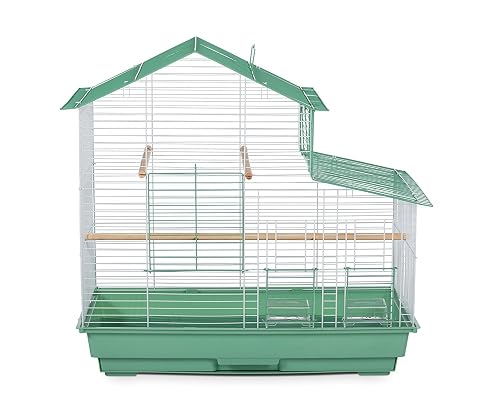
A powder-coated cage with a slide-out tray, like the Prevue Pet Products house style bird cage with removable tray, keeps the inspection surface small: one tray, one grate, a dozen visible welds. That is the kind of design that makes the quarterly re-check take five minutes instead of twenty.
Where the Cage Stands Kills More Birds Than the Cage Itself
The deadliest thing near a bird cage is usually not in it. It is the kitchen.
Overheated nonstick cookware releases polytetrafluoroethylene fumes — PTFE — and birds are so sensitive to them that a parrot can die of respiratory failure minutes after exposure, sometimes before an owner understands what happened. Self-cleaning oven cycles, air fryers, toaster ovens with nonstick interiors, and some nonstick-coated space heaters and hair dryers carry the same risk. According to the ASPCA Animal Poison Control Center, birds are exceptionally sensitive to airborne toxins because of their highly efficient respiratory system, and PTFE fumes sit among the fastest killers on the list. The rule we hold to is blunt: no bird cage in the kitchen, no exceptions, and no nonstick cookware in an open-plan home without closing doors and ventilating first.
Placement has quieter failure modes as well. A cage in front of a window takes direct sun that can overheat the bird by midday; a cage beside a door or a vent sits in a permanent draft; a cage under an air conditioning register does the same in summer. The sturdy compromise is a wall-adjacent spot with one side facing the room, out of the cooking airflow, and away from the bathroom where aerosols and scented products concentrate. Candles, incense, plug-in diffusers, and aerosol sprays should never be used in the bird's room — essential oil diffusers included.
Sleep is part of placement too. Most parrot species need ten to twelve hours of dark, quiet sleep, and a cage in a room with a television running until midnight chronically shortens that. If the living room is the only option, a cage cover on a fixed schedule — same hour every night — is the minimum fix.
Perches: The Part Your Bird Actually Lives On
Now the parts your bird physically stands on all day. Start with the sandpaper perch covers sold as nail trimmers. The marketing claims they file claws; the veterinary reality is harsher — they apply constant abrasive pressure to the footpad and are repeatedly implicated in pressure sores and bumblefoot-style lesions, especially in birds that favor one spot. Our advice is to remove every sandpaper sleeve from every perch today and file nails properly instead, which takes about ninety seconds with the right clippers and better light.
The second issue is diameter. A cage shipped with two identical wooden dowels gives the foot one grip size, hour after hour, year after year — a known contributor to pododermatitis. Feet stay healthier when perches vary: a cockatiel-sized bird does well with perches ranging roughly three quarters to one and a quarter inches across, enough difference that the grip changes as the bird moves around. Natural branches from bird-safe, pesticide-free trees add texture variation for free.
Rope perches deserve a standing appointment: check them weekly for frayed strands. Loose threads catch toes, and swallowed fibers can impact the crop. Trim fuzz with scissors, and retire the rope when the core starts showing. Placement matters as well — no perch directly over the food or water bowls, one perch at the highest point for roosting, and enough clearance between perches and the cage walls that the tail does not scrub the bars.
Toys and Hardware: The Small Parts Audit
Toys fail through their hardware more often than through their materials. The short list we check: jingle bells with visible clappers, which trap toes and beak tips — closed bells only; split key rings, which famously trap tongues; galvanized chain and quick links, which put zinc back into a cage you just cleared of it; and cotton string toys that have gone furry, which are an ingestion risk. Stainless steel quick links and stainless hangers cost more and outlast several toy cycles, which makes them the cheaper choice per year.
Chain deserves its own sentence: any chain with gaps wide enough to fit a toe or a beak tip is a trap in waiting. Welded-link chain with tight tolerances is the safer form. And inspect the attachment point itself — many accidents involve not the toy but the clip that lets it swing down into a bowl or pinch against a cage wall.
Rotation is the maintenance fix. A bird with the same four toys for six months chews the same four toys into failure states — frayed, rusted, unclipped — without anyone noticing the decay. Swapping and inspecting on a two-week rhythm takes less time than the audit itself.
Doors, Latches, and the Escape Math
Cockatiels and budgies are better latch engineers than most people expect. Lift-and-turn latches on older cages are routinely defeated, and an escaped bird in a home with ceiling fans and closed windows is an emergency with a short fuse. The fix is mechanical: a stainless carabiner or a small padlock-style clip on the primary door takes the bird out of the equation. Test the latch yourself first — if a distracted human can pop it one-handed while holding a coffee mug, assume a bird can too.
Bowl placement rounds out this section. Water bowls under perches become droppings soup by afternoon; the fix is to move the bowl or switch to a hooded feeder. Check that bowls mount securely from outside the cage so fingers and beaks are not negotiating through the same gap, and that the bowl door cannot double as an escape hatch.
Trays, Grates, and the Cleaning You Skip
Pull the tray out and look at it in daylight. You are checking three things: that the tray slides without binding, because a binding tray means warped metal and warped metal usually pairs with flaking coating somewhere you have not looked yet; that the wire grate above it sits flush and has no broken welds; and that the liner you use is safe. Newspaper and paper-based liners are the standard. Cedar and pine shavings release aromatic compounds that avian vets advise against, scented liners are marketing at the bird's expense, and flimsy plastic liner sheets get chewed into swallowed shards — skip all three.
The 20-Minute Audit: What We Check, in Order
Here is the sequence we run, one evening per quarter:
1. Measure bar spacing at four points with a ruler and write the number down. 2. Run a bare finger along every bar, weld, and the tray rim, feeling for rust scale, flaking, or chalky galvanized coating. 3. Shine a flashlight inside the door track and under the tray lip — the two spots where grime and corrosion hide. 4. Test the door latch with one hand while distracted, and add a stainless carabiner if it passes anyway. 5. Pull-test every perch and rotate any rope perch with visible fuzz. 6. Inspect every toy's hardware: bells, rings, chain, clips. 7. Confirm no bowl sits under a perch and that the water came out clean. 8. Look at the room itself: draft paths, hours of direct sun, distance from the kitchen, and the noise level at the bird's sleep hour.
Eight checks, one ruler, one flashlight. Anything that fails goes on a list with a deadline — not eventually, this week.
Repair or Replace: Where We Draw the Line
When the audit turns up damage, the line we use is this: surface rust on a bar the bird cannot reach can be watched; flaking or reachable corrosion means the cage is done. There is no bird-safe home spray-paint solution worth the risk, and a replacement cage is cheaper than a toxicology workup at an avian vet, which runs to four figures at many clinics.
One more lever reduces cage wear and cage boredom together: time out of the cage on a dedicated stand. A Prevue Hendryx Parrot Playground gives supervised out-of-cage hours a fixed home, which aims the chewing and beak-testing energy at hardware designed for it instead of at the cage door track.
The takeaway: pick the evening this week, get the ruler, and run the eight checks. Write the bar spacing number on a piece of masking tape inside the tray area so the next audit starts from data instead of memory. Cages fail slowly, in the places nobody looks, and the twenty minutes you spend now is the cheapest insurance in birdkeeping.
Related Reading
Want more on this topic? Check out our guides on best bird cages aviaries parrots, best bird feeders water dispensers, best bird safety products hazards prevention.