Most 'My Bird Hates Its Cage' Stories Are Layout Stories
Watch a familiar scene play out. A cockatiel screams every evening around seven. The owner tries new toys, new food, a different room, a white-noise machine. Nothing sticks. Then somebody finally asks where the favorite perch sits, and it turns out the bird's sleep perch is bolted directly in front of the room's air vent. Every night the bird shivers through a cold draft while trying to rest, and every evening it announces the problem the only way it can.
Nothing about that cage is wrong. The arrangement inside it is.
We spend a lot of space on this site talking about cage size, and the numbers do matter. But the shell is the least interesting part of the cage. Two owners can buy the identical enclosure and end up with opposite results, because one filled it like a well-planned room and the other filled it like a junk drawer. Perch heights, dish placement, toy spacing, and the flight path between them decide almost everything about a bird's daily life: how much it moves, where its droppings land, whether its food gets showered with seed hulls, and whether its feet stay healthy for the next twenty years.
So this is a layout guide, not a buying guide. We will assume the cage itself is already an appropriate size and bar spacing for the species, and we will focus on the part that most owners improvise: the inside.
Start With the Wire: Bar Spacing Decides the Whole Plan
Before you place a single perch, confirm the bar spacing, because it caps every decision downstream. The numbers are not decorative. If the gaps are too wide for the species, a small bird can wedge its head between bars, which is a genuine entrapment emergency and not a theoretical one. If the gaps are too narrow, a large bird cannot grip the bars cleanly, climbing turns clumsy, and the bird loses one of its main ways to move around the enclosure.
Working ranges that hold up in practice:
- Finches, canaries, and budgies: roughly 1/4 to 3/8 inch, with some keepers accepting up to 1/2 inch for budgies.
- Cockatiels and lovebirds: about 1/2 to 5/8 inch.
- Green-cheeked conures and similar small conures: about 5/8 to 3/4 inch.
- Amazons, African greys, and comparable parrots: about 3/4 to 1 inch.
The second thing to internalize is that advertised volume is a lie of convenience. Every perch, every dish, every hanging toy subtracts from the interior the bird can actually use. A 32-inch cage packed edge to edge behaves like an empty 24-inch cage. That is why we treat one diagonal of the cage as reserved airspace: a clear lane running from the upper rear corner down to the lower front corner, with nothing crossing it. Any perch or toy that interrupts that lane has to justify itself against the cost of a shorter flight path. Most of them do not.
According to the Humane Society of the United States, a bird's cage should allow the bird to stretch its wings and flap vigorously without touching the walls, perches, or toys. Translate that into layout language and it means wing clearance is a floor requirement, not a bonus feature you add if there is room left over.
Perch Placement: Build a Traffic Pattern, Not a Ladder
The most common interior arrangement we see in owner discussions and store listing photos is a single long dowel running wall to wall at mid-height, food bowls on the floor below. It is tidy. It photographs well. It is also close to the worst possible layout, because the bird gets one option, no vertical choice, nowhere to tuck away, and a tail that clips the wire every time it turns around.
Here is the set of placement rules we apply instead:
- Stagger heights by 4 to 6 inches. Birds hop more than they climb, and a ladder of evenly spaced perches turns movement into a workout. Each perch should be reachable with one short hop from the next, which encourages the bird to actually use all of them.
- Pull the perch ends an inch or two clear of the wire. A conure's tail feathers should not brush the bars when it turns on the perch. Press any perch flush against the wire and you will eventually find a tail with chewed, broken feathers on one side.
- Reserve the upper rear corner as the sleep perch. Birds instinctively seek the highest point farthest from the room's activity and door. Give it to them deliberately, make it the most comfortable perch in the cage, and keep toys away from that corner.
- Never place a perch directly over a dish. Droppings and seed hulls fall straight in. This one rule eliminates the single most common hygiene complaint in cage-keeping.
- Vary the diameters. A bird gripping the same-diameter dowel in the same spot every night applies constant pressure to the same pads of its feet. Offer at least three distinct grip sizes across the cage so weight shifts around during the day.
- Skip the sandpaper perch covers. They do not trim nails safely; they abrade the bottom of the feet. The Merck Veterinary Manual lists inappropriate perch surfaces among the husbandry factors behind pododermatitis, the pressure-sore foot condition that gets far more painful before it ever looks serious.
One more note on grooming perches: a cement or pumice perch earns its place as a passing-traffic item at mid-height, somewhere the bird steps on for a minute going from A to B, not as a destination perch in the sleep corner. Position decides how much value a perch delivers.
Divide the Cage Into Three Zones
Think of the interior as three zones with soft borders rather than one undifferentiated space.
The sleep corner is the upper rear, away from the room door and any window that gets blasted by afternoon sun. One comfortable perch, no toys competing for the space, nothing that needs cleaning above it. Birds defend this corner, and a layout that respects it produces a calmer bird at dusk.
The dining station sits in the lower third or on a side wall at the bird's chest height when it lands. Two dishes, ideally not right next to each other if the cage is wide, because separating food and water slightly cuts down on the hulls and droppings that end up in the water cup.
The activity strip is the middle band between the two, and this is where foraging toys and the rotating cast of chewables live. The vertical arrangement matters: food low, sleep high, play in between forces the bird to traverse the cage several times a day, which is exactly the movement most caged birds are missing.
Zones pay a second dividend that owners underrate: they make health monitoring easier. When droppings concentrate predictably under the sleep perch and the dining station, a change in quantity, color, or consistency becomes visible on the tray at a glance instead of being smeared across a uniform mess.
Food and Water Placement: The Fouling Problem
Dish placement is where good cages start failing. A bowl directly beneath any perch gets rained on all day by seed hulls, feather dust, and droppings, and the bird ends up eating out of a garbage can it did not choose. The fix costs nothing: check every perch position and move each dish at least a perch-length away from any spot the bird regularly sits above. If the cage is too small to guarantee that, mount the dishes higher on the front wall than any perch above them, so gravity works in your favor.
Water deserves its own paragraph because it fouls fastest. Open cups collect hulls, dust, and the occasional dunked piece of food, and bacteria get a head start in warm rooms. Change water daily no matter what the cup looks like, place it at mid-height out of any draft line, and keep it out of the tray's dirtiest corner. Some owners switch to a bottle for cleanliness; if you do, watch that the bird actually drinks from it for the first several days, because a bird that never learned the nipple can go thirsty next to a full bottle.
Finally, consider a second, tiny feeding station on the opposite wall: a small cup with a teaspoon of dry mix or a leaf of greens. It is the cheapest foraging enrichment available. The bird has to cross the flight lane to find it, and you have just added a commute to its day.
Toys: Fill the Middle, Protect the Airspace
Toy layout has two failure modes, and we see both constantly. The first is the bare cage: one swing, one mirror, nothing else, which is how boredom behaviors like screaming, plucking, and obsessive cage-floor pacing get started. The second is the forest: a dozen toys hung at every height until the bird has to shimmy sideways to reach its own food bowl, with wing clearance gone and the flight lane blocked twice over.
The workable middle ground: two to four toys in the cage at a time depending on species and cage size, hung from the cage top into the middle activity strip, and rotated weekly rather than stacked. Rotation, not accumulation, is what keeps a toy interesting. A toy that has hung in the same spot for two months is furniture.
According to the American Veterinary Medical Association, caged birds need environmental enrichment, including toys and foraging opportunities, to prevent the boredom-related behavior problems that show up in under-stimulated birds. But enrichment that forces the bird to brush past objects every time it flies is its own stressor. Before you hang anything, trace the flight lane with your eyes and keep it empty. Hang toys so the bird can flap its full wingspan at mid-cage without touching them, and check the hardware weekly: a fraying rope toy with loose strands is a toe-snagging hazard, and loose links or clips are how toes and beaks get caught.
Perch Material by Position, Not by Hype
Material selection gets argued about endlessly online, and most of the argument is noise. The practical version: natural branch wood perches with an irregular diameter make the best main traffic perches, because the varying grip exercises the feet and keeps pressure points moving. Rope perches are comfortable and forgiving on landings, but they fray, so they need a weekly fraying check and retirement once strands hang loose. A flat platform perch near the lower front gives the bird a place to stand flat-footed and rest, which older birds in particular seem to appreciate.
Uniform dowels are the material to avoid as the only option. They are cheap, they come with the cage, and they are the classic on-ramp to pressure sores on the feet. If the cage shipped with two identical dowels, keep one, reposition it, and add a branch-style perch at a different diameter as the primary perch.
And the position rule applies to materials too: cement and pumice grooming surfaces belong at mid-height on passing routes, never as the highest or most comfortable perch in the cage. A bird that sleeps eight hours a night on an abrasive surface is not getting its nails trimmed; it is getting the bottom of its feet sanded.
A Worked Layout: One Cockatiel, One Mid-Size Flight Cage
Abstract rules are hard to apply, so here is the whole plan executed on a concrete example: a single cockatiel in a cage like the Prevue Pet Products wrought iron flight cage, which offers a footprint in the neighborhood of 32 by 21 inches, an interior height near three feet, bar spacing around 5/8 of an inch, and a stand with wheels that makes zone cleaning easier.

The build order we would follow:
- Sleep perch in the upper rear corner: a natural branch perch about an inch and a half in diameter, ends pulled two inches clear of the wire.
- A rope perch five inches lower and forward-left, so the hop from the sleep perch is one short move.
- A short cement grooming perch at mid-height on the right wall, on the passing route between the rope perch and the dishes.
- Two dishes mounted on the front wall at the lower third, staggered horizontally, with no perch positioned above either one.
- A small foraging cup on the rear wall near the tray line, refilled with a teaspoon of dry mix.
- One chewable toy hung from the top into the middle strip, offset to the left so the diagonal from upper rear to lower front stays clear. A second toy rotates in weekly.
- A flat platform perch near the lower front for loafing, under which the tray will catch most droppings, which keeps cleaning predictable.
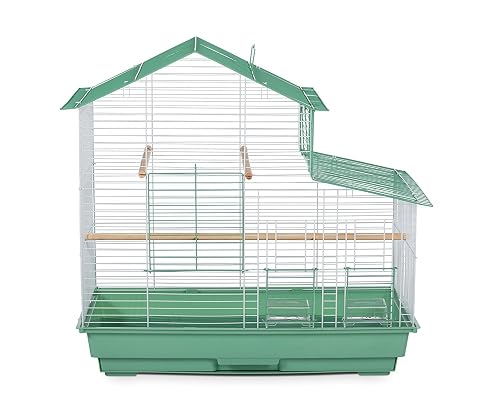
For a pair of budgies, a canary, or finches, the same rules shrink down cleanly to a smaller enclosure such as the Prevue house style bird cage, which pairs a removable tray with wood perches and feeder cups, making the zone-and-clean rhythm simple: smaller zones, same diagonal, same no-perch-over-dishes rule.
The Half of the Plan That Lives Outside the Cage
A surprising amount of cage crowding is really a crowding-in-spirit problem: the bird's owner keeps adding toys and perches inside because that is the only place the bird has any life. Give the bird a fixed home for out-of-cage time and the pressure on the interior drops immediately.
A dedicated play stand is the cheapest de-cluttering tool we know of. Something like the Prevue Hendryx Parrot Playground, a table-top style gym with ladders, perches, and cup holders, gives chewing and climbing a place to happen that is not inside the cage. The toys the bird loves can live on the stand, the cage keeps its flight lane, and out-of-cage time stops being an unstructured perch-on-your-shoulder-and-chew-the-remote session.
Placement of the stand matters too: keep it away from the kitchen, because overheated nonstick cookware fumes are dangerous to birds even at concentrations humans cannot smell, and the AVMA lists kitchen fumes among the household hazards bird owners should keep their animals away from.
The Layout Mistakes We See Most
Every one of these shows up over and over in owner photos and questions, and every one is fixed in under ten minutes:
- A single wall-to-wall dowel at mid-height as the only perch.
- A perch mounted dead center directly above both food dishes.
- Toys hung exactly across the diagonal the bird flies every time it startles.
- Five perches, all the same diameter, all the same material.
- The grooming perch installed as the highest, most-used perch in the cage.
- A mirror as the only companion toy, which pushes hormonal and frustrated behavior in many budgies and cockatiels rather than curing loneliness.
- Food and water cups wedged into the back corner above the tray's dirtiest spot, where nobody notices how foul they have become.
The 15-Minute Layout Audit
Layouts drift. Toys accumulate, a new perch gets shoved in, and six months later the flight lane is a memory. Run this audit once a month:
First, watch the bird for ten quiet minutes at a normal hour and note where it actually spends its time, because the bird will tell you which parts of your layout it endorses. Second, run the wing test: watch a flap at mid-cage and check that the wings clear every object. Third, trace the flight lane from the upper rear to the lower front and remove whatever crosses it. Fourth, look straight down from each perch and confirm nothing it can foul sits below. Fifth, hold a strip of tissue at the sleep perch and at dish height to check for drafts from vents, doors, and windows. Sixth, count the diameters of perches on offer; if the answer is one, that is the week to add a branch.
Then change one thing at a time. Birds notice rearrangement more than dogs or cats do, and a cage rebuilt all at once can spook a nervous bird for a day. One adjustment per week keeps the bird confident and gives you honest feedback about whether the change actually improved anything.
None of this requires a new cage. It requires an hour with the door open and a willingness to move four hooks and two cups until the interior works as a room instead of a storage unit. The bird whose evening screaming turned out to be a draft did not need a new cage, a new toy, or a behaviorist. It needed its sleep perch moved eighteen inches to the left. Start there.
Related Reading
Want more on this topic? Check out our guides on best bird travel cage carrier small, best bird vitamins supplements, best bird cage stands rolling bases heavy duty.