The 5 p.m. Scream Has a Cause Most Owners Never Check
Every evening around five, the same scene plays out in thousands of homes. A parrot paces the length of its cage, grips the bars, and screams in bursts that stop the instant the cage door opens. Owners respond by buying new toys, rotating perches, upgrading the seed mix. The fix in most of these cases is not inside the cage at all. It is the roughly twenty-three hours a day the bird spends in one.
We think out-of-cage time is the most under-delivered item in parrot care. Food gets measured, cages get cleaned, toys get bought and rotated. But the daily block of supervised time outside the cage — the thing wild parrots spend most of their waking day doing — is the requirement owners skip, shorten, or quietly replace with shoulder time on the couch. This guide lays out how much time different parrots actually need, how to make a room safe before the door opens, and how to build a routine that ends with the bird walking back into its cage on its own instead of turning bedtime into a wrestling match.
Why Confinement Shows Up as Behavior
According to the Humane Society of the United States, parrots are intelligent, social animals that need daily time and interaction outside their cages to stay healthy and well-adjusted. Wild parrots fly, forage, and move with a flock for hours every day. A cage, even a generous one, is a fraction of that range. When the remaining hours are empty, the energy has to go somewhere, and it does.
The bill usually arrives as behavior. Predictable evening screaming. Cage territoriality that turns the door into a battlefield. Feather destructive behavior, which the Merck Veterinary Manual associates with stress, boredom, and an under-stimulated environment among other causes. None of these are character flaws. They are the output of a smart, social animal whose schedule has no structure in it.
There is a physical side too. Foot health depends on varying surfaces and shifting pressure throughout the day — the same logic behind rotating perch diameters applies double to a bird that only ever stands on the same three dowels. Flight muscles, even on birds who never fly more than a few feet, need use. A parrot that climbs the same ladder to the same food bowl every day is doing the avian version of never leaving a chair. The body keeps score even when the bird looks fine.
How Much Time: Numbers by Species
There is no single official minimum, so we use the ranges that avian shelters, behavior consultants, and welfare organizations converge on, then adjust for the individual bird in front of you.
- Budgerigars, canaries, and finches: 1 to 2 hours daily, and more if the bird is tame and eager.
- Cockatiels: 2 hours or more.
- Conures, lovebirds, and Poicephalus parrots: 2 to 3 hours.
- African greys, Amazons, and eclectus: 3 to 4 hours.
- Cockatoos and macaws: 4 hours or more, and frankly the more you can give, the calmer the bird.
Consistency beats total. A bird that gets 90 minutes at roughly the same time every day does better than one that gets a five-hour marathon on Saturday and nothing until Wednesday. Parrots are clock-watchers. A predictable window becomes something they settle into and even anticipate calmly; an unpredictable one becomes something they scream to demand. If you have ever met a bird that starts vocalizing at 4:55 p.m. like an alarm going off, you have met the second kind of schedule.
One honest caveat: these are targets, not laws. A sick bird, a new arrival still settling in, or a household in temporary chaos may run short for a stretch. What matters is that short days are the exception rather than the rule, and the schedule bends back to normal within a day or two.
Picking the Window
Most parrots have two natural activity peaks: morning and late afternoon into evening. Either works. We lean toward a late-afternoon block for working households, because it lands exactly where the bird is already most restless and vocal — the 5 p.m. scream is often a request for precisely this. If your evenings are chaos, a solid morning hour plus a shorter evening session works fine. What does not work is a different time every day and a bird that spends the whole afternoon on alert, waiting to see what happens.
The Room Audit: What to Check Before the Door Opens
An out-of-cage session is only as safe as the room it happens in. Birds find the one hazard you forgot; that is close to a law of physics. Run this audit before the first session and re-run it after any furniture or appliance changes.
- Windows and glass doors: keep them closed, and mark clear glass with decals, tape, or partially drawn blinds so a flying bird reads the surface.
- Ceilings fans: off, and we mean a hard rule, not a habit-of-mind. One absent-minded switch flip is a life-ending event. If anyone else in the household might turn the fan on, remove the pull chain or the breaker habit entirely.
- Open water: toilet lids down, pots covered, buckets and sinks empty. A bird can drown in a toilet it never intended to visit.
- The kitchen is off-limits during sessions. Fumes from overheated nonstick cookware can kill a bird in minutes with no warning smell. According to the ASPCA Animal Poison Control Center, birds are exceptionally sensitive to airborne toxins, and cooking fumes are among the most common household dangers.
- Other pets: cats and dogs stay behind a closed door for the whole session, no exceptions for 'friendly' animals. Prey drive does not negotiate.
- Toxic plants: According to the ASPCA, common houseplants including pothos, philodendron, and many lilies are toxic to pets. Move them out of the flight zone or into another room.
- Electrical cords: route them behind furniture or cover them. Chewing a live cord is a common parrot injury precisely because cords look exactly like the vines and branches birds are built to explore.
- Fireplaces, space heaters, and open flames: no sessions in a room where any of these are active.
- Escape gaps: the gap behind a bookcase, the mechanism of a reclining chair, the space under a low couch. Birds wedge themselves into places they cannot back out of, and recliners in particular injure and kill birds every year.
None of this needs to be perfect on paper. It needs to be perfect in the actual room, from the bird's eye view. We recommend doing one pass kneeling, at parrot altitude, and we promise you will spot things the standing pass missed.
Start With One Room
Bird-proofing the whole house at once is a project that never finishes, so do not start it. Pick one room, bird-proof it properly, and run every session there for at least the first month. The bird learns the layout, the exits, and the landing spots; you learn its habits in a contained space. Free-roaming the whole home is a later milestone, and some households decide it is never worth the risk. That is a legitimate call.
The room should be organized around the cage door. If your setup is a tall, narrow tower, note that width beats height for usable living space, and a wide door that opens directly into the room changes everything about how sessions start. Something like the Prevue wrought iron flight cage with wheels gives small and mid-sized birds room to move and makes the cage itself a usable home base rather than a hatch the bird squeezes out of. Position the cage so the open door faces into the room, with a clear perch or platform within a step of the doorway.

Give the Session a Destination
Shoulder time counts as companionship. It does not count as exercise, and it quietly builds two problems: a bird that treats your body as territory, and a bird with nowhere to be when you stand up. A designated out-of-cage anchor fixes both.
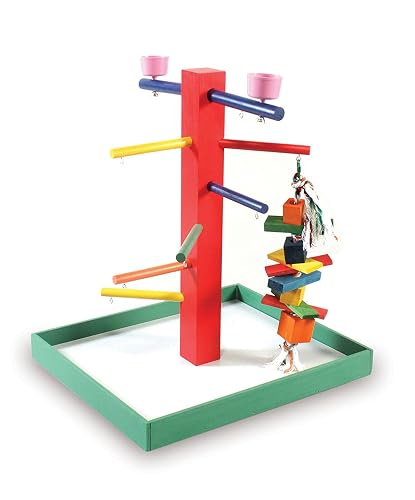
A play gym gives the session a geography. The Prevue Parrot Playground play gym is the classic version — ladders, multiple perch heights, and cups for food or forage — and the point is not the specific model but the concept: the bird has a place to land that is not your shoulder, a curtain rod, or the top of a door. Put it near the cage, within sight of you, and park yourself nearby for the first stretch of each session. A gym plus a human in the same room is enrichment. A gym plus a human who left to do dishes is a bird alone in a strange room, which is its own behavior problem waiting to happen.
What the Time Should Actually Contain
An hour of sitting on a human watching television is not an hour of exercise. It is an hour of sitting. Structure the session so the bird does things, and the good news is that structure takes less effort than it sounds.
Scatter foraging comes first. Tuck a millet spray behind a cushion, sprinkle a few pellets on the gym tray, hide a walnut piece under a paper cup. Wild parrots spend most of their day finding food; a captive bird that gets every calorie from a bowl has a large hole in its schedule, and out-of-cage time is the natural place to fill it. Two or three hidden food items per session is enough to change the character of the whole hour.
Micro-training comes second. Two or three sessions of 60 to 90 seconds — step-up onto your hand, a recall across the room for a favorite treat, a target touch — count double. They burn mental energy, they rehearse the skills that get the bird home safely at the end of the session, and they give the hour a beginning and an end. Recall practice during structured play is far more reliable than recall you only ever ask for in an emergency.
Climbing and novelty fill the rest. A rope, a laddered chair back, one new safe object per session rotated in and out. Novelty does not mean new purchases; a cardboard box, a paper bag with a treat inside, and a bunch of clean kale clipped to the gym all qualify. The pattern to avoid is the same one the cage has: nothing to do, nowhere to go, nobody to be with.
Getting the Bird Back Without a Chase
The end of out-of-cage time is where most routines break, and the reason is almost always the same: returning to the cage has become a punishment. If the door only closes when the fun stops, the bird learns to make the fun not stop, and you get the under-the-sofa standoff that ends with a towel and a bite.
Build the return as a routine instead. Give a ten-minute heads-up using the same short phrase every time — the words do not matter, the consistency does. End with the best treat of the day, and make that treat available only in the cage. Within a couple of weeks, most birds are back on the perch waiting before you finish the phrase, because the cage has become the place where the good thing happens. For flighted birds, dimming the room lights slightly triggers the settle-down instinct and makes the return flight shorter and calmer.
Never end a session by grabbing, chasing, or covering the cage mid-panic. If the bird genuinely will not return, walk away for two minutes and take the audience with you; most parrots rejoin their humans before they enjoy being alone. The one thing you cannot do is teach the bird that non-compliance earns a longer, louder game.
Flighted or Clipped: The Rules Change, the Requirement Does Not
We have covered the wing-trimming debate in its own article, so here we will just say the part that matters for scheduling. Clipping removes flight. It does not remove the need for out-of-cage time — a clipped bird still needs climbing, walking, foraging, and social hours, and arguably needs them more, since it cannot burn energy in short flights around the room. Flighted birds need all of the same hours plus stricter room rules: closed windows, marked glass, no ceiling fans, and a recall that has been actually rehearsed. Whichever camp your household sits in, the daily clock does not change.
Multi-Pet Households
If you share your home with cats or dogs, out-of-cage time happens in a closed room with the other pets on the other side of the door. Not in the same room under supervision. Not 'just for a minute.' The relationship between a cat and a bird can be calm for three years and end in one second, and the bird pays the entire price. If you want cross-species exposure, do it through sight and sound — a bird in its cage watching the household go by — not through shared floor time.
Signs the Schedule Is Too Thin
The schedule itself will usually tell you when it is not working. Watch for these patterns:
- Predictable scream bursts at the same time each day, especially late afternoon.
- Bar-walking and pacing along the cage front, particularly in the hour before your usual window.
- Cage territoriality — lunging, biting, or screaming when a hand reaches in — which often means the cage is the bird's entire world and it is defending the only thing it has.
- Feather destructive behavior or over-preening, which warrants a vet check to rule out medical causes but is frequently entangled with boredom.
- A bird that sleeps most of the day and only wakes to eat.
There is a reverse trap worth naming: a chronically cage-bound bird sometimes becomes afraid of the open door and refuses to come out. Rebuild from zero. Trail treats from the cage floor to the doorway, let the bird set the pace, and do not lift it out. Choice is the whole point of the exercise; a bird that is carried out is not having out-of-cage time, it is having an experience done to it.
Six Mistakes That Waste the Effort
- Compensating on weekends. A Saturday marathon does not cancel five short weekdays; it just sets up the Sunday scream.
- Counting couch shoulder time as exercise. Companionship, yes. Enrichment, no.
- Skipping the room audit after furniture changes. The new recliner, the new plant, the new space heater — each one resets the audit.
- Using the cage as punishment. It poisons the return routine and the cage itself.
- Chasing the bird at session end. One chase can cost you weeks of recall training.
- Shared time with cats and dogs in the room. No supervision level is fast enough.
The 10-Minute Weekly Audit
Run this once a week and the routine maintains itself:
- Did the bird get its target hours, at roughly the same times, at least five of seven days?
- Did sessions include foraging or training, or did they drift into pure shoulder time?
- Any new furniture, plants, or appliances added to the session room since last week? Re-audit.
- Is the return-to-cage routine still ending calmly, without grabs or chases?
- Did the other pets stay on their side of the door for every session?
If the answers are mostly yes, keep the wheel turning. If not, the fix is almost never more toys — it is the same hour of structured, supervised, bird-proofed time tomorrow, and the day after. The 5 p.m. scream quiets down when the 5 p.m. schedule shows up first.
Related Reading
Want more on this topic? Check out our guides on best bird vitamins supplements, best bird feeders water dispensers, how to choose first pet bird buying guide.