The Delivery-Day Mistake That Ends in a Midnight Vet Search
The scene repeats in bird households everywhere: the new cage arrives in the morning, the owner assembles it over coffee, moves the bird across after lunch, and by the second night the bird has barely touched its food. The owner is now reading forum threads about antibiotics at midnight. In a large share of these cases nothing is medically wrong. The bird is stuck in a badly managed transition, and the stress spiral was entirely preventable with about a week of planning.
A cage is not furniture to a parrot, a cockatiel, or a finch. It is territory, food cache, sleeping burrow, and the fixed reference point the whole day is organized around. Swap all of that in one afternoon and the bird does not register an upgrade. It registers displacement, and displacement in a prey animal reads as danger.
The good news is that cage moves follow a predictable pattern, and the pattern is teachable. We have pulled the protocol below from avian veterinary guidance, experienced breeder practice, and the recurring failure points owners report, then compressed it into roughly ten days and six steps. Follow it and most birds settle within two days. Skip it and you may spend a week coaxing a fluffed-up, silent bird to eat, wondering whether a cage upgrade was worth it.
Why Cage Moves Hit Birds Harder Than They Hit Dogs or Cats
Start with neophobia. Parrots are among the most neophobic animals commonly kept as pets, wired to treat anything genuinely new as a potential predator until proven harmless. A brand-new cage with unfamiliar bars, unfamiliar perches, and a factory smell is, to a budgie, exactly the kind of object that earns weeks of suspicion. That trait kept wild flock members alive. In your living room it turns delivery day into a crisis. According to the Merck Veterinary Manual, environmental changes and unfamiliar objects are recognized stressors in psittacines and can drive appetite loss, increased vocalization, and the onset of feather damaging behavior.
Layer territory on top of that. Inside the old cage the bird never has to be vigilant. It knows every perch placement, every sightline, every escape route, and exactly where the food dish sits without looking. Remove the cage and you remove the only space in the house where vigilance is optional. That is a far bigger loss for a bird than a new bed is for a dog.
Then comes the metabolic math. Small birds run hot, burning through calories nearly continuously, and a budgie or canary cannot afford long fasts. Anorexia lasting 24 to 36 hours in a small bird is not a waiting game; it is an emergency in progress. According to the AVMA, changes in appetite, droppings, or behavior are among the earliest signs of illness in pet birds, which means the gap between a stressed bird and a seriously unwell one is measured in droppings and hours. That is why the protocol below front-loads familiarity. The goal is zero appetite interruption, not a dramatic recovery story afterward.
Step 1: Get the Dimensions Right Before Anything Ships
Width beats height, and it is not close. Birds fly horizontally, stretch to their full wingspan in both directions, and judge a space by how far they can move, not how high they can climb. A cage should let the bird flap across the long axis without brushing either wall, with room left over for two perches, dishes, and a toy or two. Height matters mainly for climbing species and for keeping droppings away from perches; it does not substitute for horizontal room.
Bar spacing is the second number, and it is species-specific. Finches, canaries, and budgies need roughly a quarter to half inch. Cockatiels and lovebirds do well at half to five-eighths of an inch. Conures and caiques suit five-eighths to three-quarters. African greys, amazons, and cockatoos need three-quarters up to a full inch. Spacing that is too wide invites head entrapment between bars, which is a genuine emergency risk, while spacing far too narrow wastes the view and the light inside the cage.
A concrete example helps. For a cockatiel or small conure, a wide wrought-iron flight model with a rolling base, in the class of the Prevue Pet Products wrought iron bird flight cage with wheels, delivers roughly thirty inches of width, which clears the wingspan test for most cockatiel-scale birds with room to spare. The wheels matter more than they look: during the transition week you may want to reposition the cage a foot or two to reduce drafts or glare, and a rolling base lets you do that without disassembling anything.
The trap to avoid is the tall, narrow tower sold in pet store aisles as a parrot cage. A bird in one of those climbs like a lizard and flies almost never. It looks spacious on the shelf and functions like a cage-shaped ladder. Spend the budget on width instead, and your bird gets an actual flight path through the transition and afterward.

Step 2: Assemble Early and Move the Furniture, Not the World
Assemble the new cage seven to ten days before the move, in the same room, a few feet from the old cage. This is deliberate. A bird that watches the strange new object sit quietly in the corner for a week does its own desensitization work. Neophobia is defused by repeated harmless exposure, not by novelty on a deadline.
When the cage is ready, transfer two or three of the bird's actual perches and its actual dishes into it. Do not buy an all-new furniture set for the new cage, and do not scrub the old perches first. Wear marks and familiar scent are orientation anchors; the bird should find its own smell waiting inside the unfamiliar box. New perches can be added later, once the bird has decided the cage is safe.
Keep food and water in the same relative positions too. If the dish hung on the left wall at chest height in the old cage, put it on the left wall at chest height in the new one. The bird's foraging map transfers intact, which removes one more thing it has to relearn during an already demanding week.
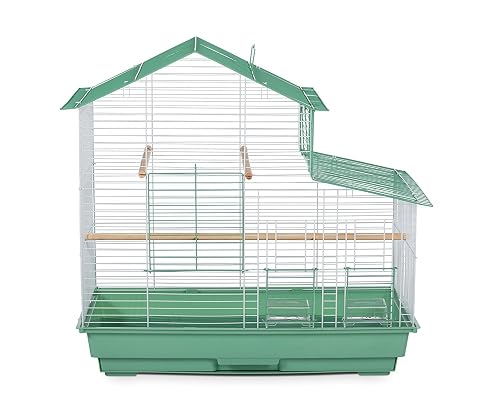
One practical note favors certain designs here. Cages with a slide-out tray, such as the Prevue Pet Products House Style Bird Cage, make the monitoring week noticeably easier. You can check dropping volume and position each morning and clean without opening the doors or handling the bird, which keeps your data clean and your interference at zero exactly when the bird needs calm.
Step 3: Freeze Every Other Variable
A bird's tolerance for novelty works like a budget, and the cage move is about to spend most of it. Do not let anything else draw from the same account. That means no diet changes, no new toys, no rearranged furniture, no harness training, no new people in the house during the transition window. If the seed-to-pellet conversion has been on your list, it waits. If a room swap has been planned, it waits longer.
Leave the old cage open and unchanged during this phase as well. Resist the urge to begin packing things up early or removing perches one by one. The old cage stays fully intact until the move is done, because it remains the bird's emergency fallback for the entire side-by-side week.
Step 4: The Side-by-Side Week
With both cages standing open next to each other, the acclimation work is mostly invitation. Place a high-value treat, a sprig of millet or a piece of walnut, inside the new cage's doorway once or twice a day. The bird discovers on its own schedule that the frightening object contains snacks, familiar perches, and its own dishes. Owner-directed coaxing adds pressure; discovery builds ownership.
During supervised out-of-cage time, let the bird land on the new cage's open door or roof if it chooses. Voluntary contact counts for more than any amount of encouragement, and a bird that has already perched on the new cage outside it will enter it far sooner. If the bird shows no interest for a couple of days, say nothing and keep the treats coming. Progress here runs on the bird's clock, not ours.
The readiness signals are easy to read once you know them. The bird eats inside the new cage. It takes a nap in it. It hops between the two cages through a shared doorway if you have aligned one. When visiting the new cage is routine rather than an expedition, you are ready for move day, usually somewhere between day four and day seven of the side-by-side phase.
Step 5: Move Day Should Be Boring
Pick a morning after you have seen normal droppings and during the calmest stretch of the household day. No vacuuming, no visitors, no school-run chaos. The move itself should take under a minute, because the transition already happened during the side-by-side week; move day is just the last door closing.
For a bird that steps up reliably, use your hand or a target stick and move it door to door in one motion. Never chase the bird around the old cage, and never resort to netting a bird that is not already conditioned to towels. A panicked capture at the threshold teaches the bird that the new cage is where captures happen, and that lesson can undo the whole week. For a bird that is not hand-tame, shuttle it in a small travel carrier instead; the carrier ride is forgettable, a chase is not.
Finches, canaries, and other birds that will not step up move best at dusk. Dim the room, work slowly, and transfer them gently in a carrier or cupped hands; low light slows them down and they settle as the household quiets. For the first evening, partially cover the new cage. A half-covered cage reads as a secure cave rather than an exposed stage, and most birds settle to sleep faster with the visual boundary in place.
Afterward, leave the old cage standing empty and open for two or three days if space allows. A bird that double-checks its former territory finds nothing alarming there, just familiarity, and stops looking sooner. Then remove it without ceremony, ideally while the bird is out of the room or occupied with food.
Step 6: Score the First 72 Hours Like a Vet Would
The first evening tells you most of what you need. A settling bird eats within a few hours, produces droppings of normal size and color by nightfall, and tests the new perches with cautious nibbles. A brief appetite dip on day one is common and not alarming on its own. Watch droppings rather than behavior; they are the honest witness in a species that hides distress.
If your bird is scale-trained, weigh it each morning during the transition. A drop beyond a few percent from baseline, or a steady slide across two consecutive days, is a veterinary conversation rather than a wait-and-see. Weight drifts quietly in birds, and by the time a visibly fluffed bird stops eating, the reserves are already spent.
Know the red lines cold. No food taken by the second morning. Few or no droppings. A bird sitting fluffed on the cage floor, silent, with no interest in a favorite treat. Discharge from the eyes or nostrils, or visible tail bobbing at rest. Any one of these means an avian vet, the same day, not tomorrow. According to the AVMA, behavior and appetite shifts are the earliest signals of illness in birds, so treat the second morning as your deadline rather than the end of the week.
Normal adjustment, by contrast, looks busy. Wariness that fades within a day or two. Eating readily once you step back from the cage. A restless first night followed by a proper sleep the next. Perch testing, a little exploratory chewing, and renewed normal vocalizations. If day three looks like day minus one, the transition worked.
The Six Mistakes Behind Most Hunger Strikes
The first is sterilizing everything before the move. A disinfected new cage plus scalded old perches erases every scent anchor the bird had. Clean what actually needs cleaning, leave the familiar wear alone, and skip the hospital-grade scrub unless there is a disease reason for it.
The second is stacking changes: a new cage and a new room on the same day, or a new cage and a new diet in the same week. Each one spends the same limited novelty budget. Space them out and the bird absorbs one change at a time without collapsing under the total.
The third is rearranging the whole room to make space for the new cage. The bird comes back to a home where the bookshelf moved, the couch moved, and the cage moved, all at once. If the room needs reorganizing, do it the following week.
The fourth is moving a bird that is already unwell or mid-treatment. A bird on medication, or one recovering from an illness, has no spare capacity for environmental upheaval. Postpone the move until the vet clears it.
The fifth is splitting a bonded pair across two cages or two rooms during the move. Bonded birds take much of their security from each other, and separating them at the exact moment everything else changed doubles the stress load on both. Bonded birds move together, same day, same area.
The sixth is rushing the side-by-side phase because the old cage is needed elsewhere. Almost every hunger-strike story we have reviewed includes a move compressed into a single afternoon. The week of overlap is not optional decoration; it is the actual transition, and move day is just the punctuation.
Multi-Bird Households: Move the Flock Logic, Not Just the Furniture
Pairs and bonded groups move together and land in a cage with the same dish count and the same perch arrangement they left. Familiar hierarchy maps matter more in multi-bird settings, because territory disputes flare when nobody knows the new map. Reproduce the old layout as closely as the new cage allows, down to which side each bird favored.
For birds that squabble or were only recently introduced, stagger the moves by several days instead, and add extra dishes spaced widely for the first week. A space that feels unfamiliar reads as smaller, and resource guarding shows up in new cages where it never existed in old ones. Watch for dish monopolizing during the first few mornings and separate feeding stations early if it appears.
The One Investment That Makes Every Future Move Cheaper
Birds whose entire world is one cage cope worst with any change to that cage, because the cage is not their home base, it is their whole map. Birds with a second anchor, a play stand or gym outside the cage, treat the cage as home base and the wider room as known territory, and they absorb relocations with far less drama. A dedicated out-of-cage station like the Prevue Hendryx Parrot Playground gives the bird perches, dishes, and a routine away from the cage, and it pays off again at every vet trip, vacation, and future cage upgrade. According to the Humane Society, parrots need daily time outside the cage and a varied environment to stay behaviorally healthy; a fixed play station is the structural version of that advice.
The placement rules for that station match the ones you already follow for the cage. Keep it out of kitchen traffic and away from any nonstick cookware fumes, out of direct drafts, and in a spot with a wall behind it so the bird never has to watch its back. A station in the wrong place is just a second stressor; a station in the right place is a genuine second home.
The Ten-Day Transition Checklist
Run the move against this list and the gaps show up before the bird does.
1. Cage sized for wingspan width first, bar spacing matched to species. 2. Cage assembled a week early, same room, near the old one. 3. Two or three familiar perches and the original dishes transferred unwashed. 4. Food and water in the same relative positions. 5. Every other change, diet, room, furniture, training, frozen for two weeks. 6. Daily treat invitations inside the new cage through the side-by-side week. 7. Move triggered by the bird's readiness signals, not the calendar. 8. Move day calm, short, chase-free, with a partially covered cage for the first night. 9. Droppings and weight tracked daily for three days, red lines written down in advance. 10. Old cage left standing empty until the bird stops checking it.
The finish line is not a bird that tolerates the new cage. It is a bird that never noticeably registers the move: eating on schedule the first evening, sleeping in the usual corner posture, vocalizing at the usual times. Watch the droppings, freeze the other variables, and let the bird make the first voluntary move, and delivery day stops being the crisis it used to be.
Related Reading
Want more on this topic? Check out our guides on how to teach parrot to talk step by step guide, best bird training tools speech aids clickers target sticks, household dangers pet birds safety guide.