Why your cat scratches, and why the sofa keeps winning
Walk into almost any cat household and you can map the damage within seconds. One arm of the couch, the corner of the recliner, maybe the side of the mattress — scratched in the same spots, over and over, until the fabric looks like it lost a fight with a box grater. Owners read this as rebellion or revenge. It is neither. Scratching is one of the most hardwired behaviors a cat has, and your furniture keeps winning for reasons that have almost nothing to do with spite and everything to do with placement, texture, and stability.
According to the Humane Society of the United States, scratching serves three core functions at once: it strips the dead outer layer from the claws, it stretches the muscles of the shoulders and back after a long nap, and it leaves both a visible mark and a scent signature from the glands between the paw pads. Every healthy cat does it. A cat that never scratches is not a well-behaved cat — it is usually a cat in discomfort or one whose claws have not been maintained at all.
That distinction matters more than most advice admits. The goal of this guide is never to stop the scratching. The goal is to relocate it onto a surface your cat finds just as satisfying as the corner of your sofa. Cats denied every acceptable outlet do not quit; they quietly expand the operation to carpets, door frames, and wallpaper. An approach built purely on denial tends to trade one problem for three, which is why every serious behavior resource starts with the same word: redirect.
There is also a timing detail worth knowing. Kittens begin practicing scratching motions remarkably early, often before eight weeks, and the habit consolidates fast. The household that sets up an acceptable scratching surface in week one rarely has a shredded couch in year five. The household reading this article after the fact is not doomed, though — adult redirection works too. It just needs a plan instead of wishful thinking.
Why the sofa beats the post you already bought
Before the training plan, we owe you an honest answer to the question every frustrated owner eventually asks: why their cat ignores the expensive post and walks straight past it to the armchair? In our experience going through veterinary behavior literature and owner reports, failed posts almost always fail for the same three reasons, and all three are fixable.
Height comes first. A full scratching stretch starts at the front paws and travels up through the shoulders and into the lower back. For an average adult cat, that stretch can reach 28 to 36 inches. A 20-inch tabletop scratcher physically cannot accommodate it, so the cat gives it a token scrape and returns to the tall, tall arm of the sectional. If your cat is a Maine Coon or a long-legged young male, add several more inches to the requirement.
Stability comes second. A post that wobbles or tips when a cat throws its body weight into it teaches the animal, within two or three attempts, that the post is unreliable and the furniture is not. Cats do not trust surfaces that move under them, and they will not file their claws on something that feels like it might fall. A heavy base plate is not a luxury feature; it is the feature.
Texture decides the rest. Most cats prefer a coarse, shreddable surface — sisal rope or sisal fabric — that lets them really dig in and pull downward. Carpet-covered posts are a gamble, and some behaviorists argue they actively backfire by teaching the cat that carpet-like textures are fair game, which is an uncomfortable message in a wall-to-wall carpeted apartment. Horizontal cardboard scratchers suit a different personality type entirely: the cat that scratches your rugs rather than your vertical surfaces.
The redirection plan, step by step
Here is the sequence we recommend, assembled from published guidance by the Humane Society and the ASPCA and from patterns that recur across veterinary behavior sources. Give it a full two weeks before judging the results. Individual cats vary in speed, but the sequence itself is not optional — skipping steps is what turns a two-week fix into a two-month grudge match.
- Put the new surface within three feet of the target furniture. Proximity beats aesthetics. A beautiful post in the quiet back bedroom solves a problem your cat does not have; the scratching urge fires where the interesting surface is. Move the post to the crime scene first. Decorate later.
- Match the orientation to your cat's existing style. Sofa arms and door frames call for a tall vertical post. Ruined rugs and carpeted stairs call for horizontal cardboard scratchers laid flat. Watch which one your cat has already chosen, then buy that orientation in better quality. Unsure? Offer both for the first week and let the cat vote.
- Make the post attractive instead of making it mandatory. Rub dried catnip or silvervine into the surface. Dangle a favorite toy off the top platform. Drop a treat next to it after meals. You are building an association, not issuing an ultimatum.
- Reward contact, not performance. The first sniff, the first paw touch, the first real scratch — each earns a treat and calm, quiet praise. Never grab your cat's paws and drag them down the post. Forcing the motion is one of the few reliable ways to teach a cat that the post is a trap, and it can set the project back weeks.
- Make the furniture boring at the same time. While the post earns its reputation, cover the targeted corner with a throw blanket, or apply a deterrent product to the spot itself. Cats avoid sticky and unpleasant textures, so the sofa corner starts losing its appeal on the same days the post gains its own.
- Shrink the gap gradually once the post is in daily use. After a few consistent days, move the post a foot or two at a time toward wherever you want it to live permanently. Rushing this stage — teleporting the post across the room the first good day — is the single most common reason a formerly popular post ends up abandoned behind the laundry basket.
None of these steps require your cat to be unusually smart or cooperative. They require consistency from the humans, which is honestly the harder part. Set a phone reminder to reapply deterrents and re-up the catnip every few days for the first fortnight.
What a post your cat will actually use looks like
If you would rather buy one sturdy structure than assemble a collection of loose scratchers, a proper cat tree solves several problems in one purchase: it provides a legal, tall, sisal-wrapped scratching target, a climbing route, and an elevated resting spot — and cats that nap near their scratching surface scratch it more often, not less, because the behavior is partly maintenance performed on the way to somewhere else.
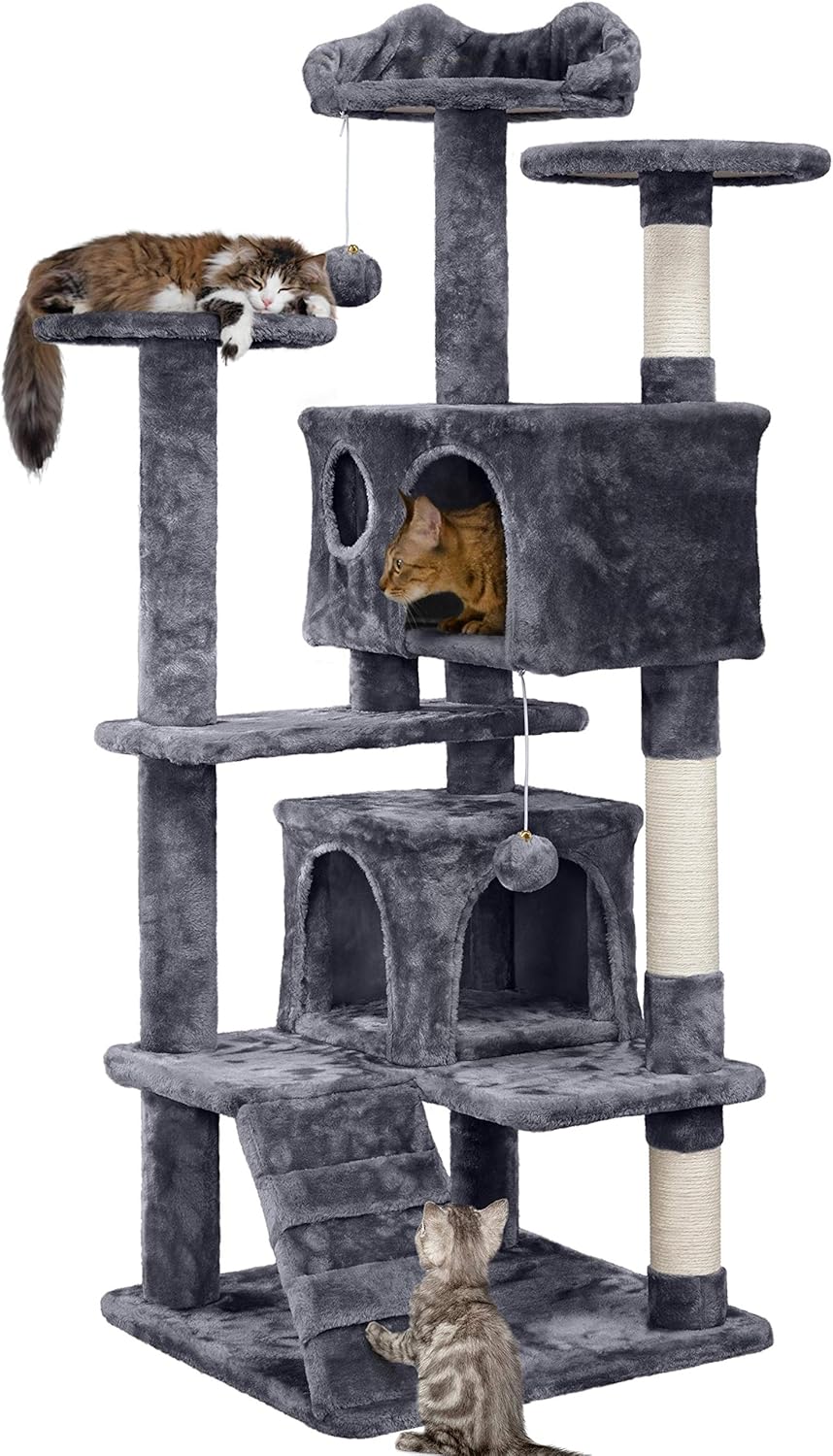
The specs that matter are the ones most listing photos hide. Check the post height first — you want the primary sisal post to run roughly your cat's full stretch length, and 54 inches of overall structure gives almost every domestic cat room for a complete extension. Check the base plate second; a wide, weighted bottom is what keeps the tower standing when a cat launches into it at speed. As a concrete reference point, something like the Yaheetech 54in cat tree tower with two caves and sisal scratching posts hits the three requirements — height, stability, coarse sisal texture — at a mid-range price, and its multi-level layout adds the perch factor that keeps cats spending time on the structure instead of beside it. We are not saying that specific model is the only option; we are saying use its spec sheet as the checklist for whatever you buy.
Placement within your room matters as much as placement relative to the sofa. Cats like their scratching-and-perch stations near family traffic and next to windows — sightline real estate, not exile corners. A post tucked behind a door is a post chosen by a human, and your cat noticed.
Protecting the couch while the training is under way
The two-week training window creates an awkward problem: your cat needs the sofa corner to become unattractive, but you also need the sofa to survive the transition. Temporary physical protection fills that gap, and it comes in two broad formats. Pick the one that fits your furniture and your tolerance for visible gear.
Rigid panel guards are the heavy-duty option. These are clear plastic sheets that pin or strap over the damaged corner, physically blocking claws from reaching fabric. A typical example is the FixZilla anti cat scratch furniture protector kit with twist pins, a ten-pack of heavy panels sold with the pins needed to fix them to upholstery corners and door frames. They are visible, and nobody will pretend a pinned-on plastic sheet is interior design — but they are also the most reliable option for a corner already under active assault, and they come off without residue once the habit has moved.

Adhesive deterrent sheets are the subtler alternative: transparent, double-sided tapes applied directly to the targeted spot. The Panther Armor double-sided tape sheets work on exactly the principle the ASPCA describes when it recommends sticky textures as deterrents — cats dislike the feeling on their pads and learn to avoid the area. Two practical cautions apply. Test any adhesive on an inconspicuous patch first, because delicate weaves and some leather finishes can mark, and expect to replace sheets periodically as dust flattens their stickiness.
One framing note, because it changes how you use all of this gear: barriers are training wheels, not the cure. Their job is to keep the corner boring for two weeks while the post becomes attractive. Households that apply tape and never buy the post usually see the scratching resurface somewhere else, because the underlying drive was never addressed.
What not to do: yelling, squirt bottles, and declawing
Punishment delivered after the fact does nothing to reduce scratching, and it actively damages the relationship. Cats do not connect delayed scolding with a scratch that happened hours ago; they connect the scolding with you. The result is a cat that avoids the room, hides more, and scratches exactly as much — just when you are out of sight.
Squirt bottles are only slightly better, and mostly worse than they feel in the moment. The cat learns that the couch corner is dangerous only when the human is visibly present holding a bottle. That is not a behavior change; that is scheduling around your availability. Deterrents that work are the ones attached to the furniture itself — texture, not surveillance.
Then there is the option that should not be an option. According to the American Veterinary Medical Association, declawing — onychectomy — is not a nail trim; it is the surgical amputation of the last bone of each toe, the equivalent of cutting off a human finger at the final knuckle. The AVMA characterizes the procedure as an amputation with documented potential complications and guides veterinarians to treat it as a last resort for genuine medical or human-safety cases, not a furniture-preservation service. A growing list of countries and territories has banned it outright, and veterinary behavior research has linked it to higher rates of litter box avoidance and biting, likely because tender paws make litter feel painful and a cat without claws feels defenseless. Our position is simple: we will not present declawing as a behavioral fix, because the veterinary consensus does not support it as one.
A note on maintenance instead: trimming your cat's nails every two to three weeks blunts the damage any single scratch can do and is a genuinely useful supplement to redirection. It does not replace the post — the scratching drive is not only about claw sharpness — but it keeps the sharp edges of the learning curve manageable while you work the plan.
When scratching changes suddenly, pay attention
A cat that scratches normally for years and then abruptly doubles the volume, or starts attacking door frames it always ignored, is sending information rather than misbehaving. The most common triggers are environmental: a new pet in the house, a recent move, a schedule disruption, or a neighborhood cat that has started patrolling the window line. Scratching rates rise when territorial anxiety rises, because the marking function of scratching is doing overtime.
Medical causes deserve a look too, especially in older cats. Senior cats often stop maintaining their claws effectively — the outer sheaths shed less readily, nails thicken and can curl into the pads — and a cat with sore feet may scratch more, or oddly, in an attempt to relieve discomfort. If the change in scratching arrives alongside hesitating at jumps, hiding more than usual, or grooming changes, book a veterinary exam before you buy anything. Redirection plans do not work on pain.
The two-week timeline, and what success actually looks like
Days one through three: the new post goes next to the furniture, catnip goes on the post, and every scrap of interest earns a treat. Expect curiosity, maybe a first exploratory scratch, possibly nothing at all — the early window is about installing the option, not about results.
Days four through seven: deterrents go onto the sofa corner now, in the middle of the sequence rather than at the start, so the post has a head start on becoming appealing. Most cats deliver their first genuine, full-stretch scratching session on the post during this week. Reward it enthusiastically and immediately.
Week two: begin moving the post in small increments toward its permanent home, keep reapplying deterrents, and trim nails if you have not already. A cat using the post daily can handle the post relocating a couple of feet at a time without losing the habit.
What counts as winning? Not zero furniture scratches forever — opportunistic scrapes happen, and a cat that occasionally tests the couch is normal, not failed. Success looks like a roughly ninety percent shift, with the post getting daily use and the furniture getting only occasional, immediately discouraging contact. If you get there, the tape comes off and nobody misses it.
And if you only remember one instruction from this entire guide, make it this one: put the scratching surface where the problem already is, not where it would look nice. The sofa corner your cat has been marking for months is prime advertising space — the post that stands there starts with an audience. Meet the behavior where it happens, give it a better surface, and the furniture quietly goes back to being furniture.
Related Reading
Want more on this topic? Check out our guides on best cat microchip pet doors electronic access systems, best self cleaning litter boxes automatic sifting smart, best cat food bowls slow feeders elevated stands.