The Feeding Chart on the Bag Is Not a Weight Loss Plan
Here is a small experiment every owner of a chunky dog should try. Find the feeding chart on your bag of kibble, then read the fine print most people skim past. Those recommended portions are calibrated for intact, highly active adult dogs, which describes a sled dog in training season, not a neutered beagle who spends his afternoons on the couch. Feed a typical house dog according to that chart and weight gain is not a risk. It is the expected outcome, and the numbers prove it: according to the AVMA, more than half of adult dogs in the United States are overweight or obese.
The stranger part is how invisible the problem stays. Weight creeps on at a few grams a day, so a dog who gains a pound a season looks roughly the same in month-to-month photos. Our editorial position is blunt on this point: if you cannot easily feel your dog's ribs with flat fingers, your dog almost certainly does not need a bigger dinner. What he needs is a plan, and this article is that plan, built on veterinary guidance and published research rather than guesswork or guilt.
What Extra Weight Actually Costs a Dog
The strongest argument for getting a dog lean is a fourteen-year study most owners have never heard of. Researchers at Purina kept forty-eight Labrador retrievers in paired groups for their entire lives, feeding one group twenty-five percent fewer calories than their littermates. Published in the Journal of the American Veterinary Medical Association, the results were hard to argue with. The lean-fed dogs lived a median of thirteen years against eleven point two for their heavier siblings, a difference of roughly one point eight years, and the onset of osteoarthritis in the lean group was delayed by years. Same genetics, same environment. Less food, more life.
That study matters because extra fat is not inert padding. Adipose tissue is metabolically active, pumping out inflammatory compounds that aggravate joints and interfere with insulin. A heavy dog faces elevated risks of arthritis, type 2 diabetes, pancreatitis after fatty meals, breathing difficulty in flat-faced breeds, and anesthesia complications, since fat alters how anesthetic drugs distribute through the body. According to the AVMA, keeping dogs at a healthy body weight is one of the most effective things an owner can do to extend healthy lifespan. There is no supplement, gadget, or wellness trend with evidence anywhere near that strong.
Step One: Score the Body, Not the Scale
Veterinarians rarely talk about ideal weight in pounds. They use a nine-point body condition score, or BCS, and you can learn the basics in your kitchen in two minutes. Run flat fingers along your dog's ribcage just behind the shoulder blades. You should feel the ribs with light pressure, the way you would feel bones through a thin sweater. If you have to press to find them, the score is climbing past five. Look at the dog from above: there should be a visible waist behind the ribs, an hourglass rather than a rectangle. From the side, the belly should tuck upward toward the hips. A sagging, straight-lined belly scores seven or higher on most dogs.
One honest caveat before you cut calories: some diseases impersonate fat. Hypothyroidism slows metabolism and causes weight gain that diet alone will not fix, and Cushing's disease produces a pot-bellied look along with increased thirst and hair thinning. If your dog gained weight quickly, gained it despite no change in food, or shows other symptoms, book a vet visit first. Bloodwork rules out these conditions in a single appointment, and any weight loss plan for a dog with an underlying endocrine problem will fail without treating it. For a dog who simply ate too many biscuits for two years, the rest of this plan applies.
Step Two: Put Real Numbers on the Calories
Weight loss is arithmetic before it is anything else. The veterinary starting point is the resting energy requirement, calculated as seventy times the dog's body weight in kilograms raised to the zero point seven five power. That sounds like algebra, so here it is in practice. A fifteen-kilogram dog, about thirty-three pounds, has a resting requirement near five hundred thirty calories per day. A thirty-kilogram dog needs roughly nine hundred. Most weight loss plans begin at or just below this resting figure, because a neutered adult dog burning a normal amount of energy simply does not need much more than that to maintain health.
Then comes the step we consider non-negotiable: measure food by weight, not by cup. A standard measuring cup can over-serve kibble by twenty percent or more depending on kibble shape and how heaped the cup is, and twenty percent is enough to erase an entire weight loss program. A ten-dollar kitchen gram scale removes the ambiguity. Weigh the daily portion once, write the number on a sticky note on the container, and every member of the household serves exactly that amount.
Check the calorie count printed on your food bag, stated in kilocalories per cup or per kilogram, and convert your portion. If the math says your dog should be losing on five hundred thirty calories and the scale will not move over three weeks, the honest explanation is almost always uncounted calories from treats, table scraps, or another family member's secret donations. Which brings us to the next section.
Step Three: Rebuild the Feeding Routine
Two meals a day at measured times beats free-feeding for weight control, and the reason is simple. You cannot audit calories you did not watch go into the bowl. Pick morning and evening slots, put the bowl down for fifteen minutes, then pick it up whether the food is finished or not. Most dogs adjust to the schedule within three or four days, and the ones who hold out longest are usually testing you, not starving.
Slow the eating down while you are at it. Dogs who inhale food in ninety seconds beg harder in the hours after a meal because their satiety signals have not caught up. A slow feeder bowl with ridges the dog has to work around stretches a two-minute meal into ten and visibly reduces post-meal begging in most households. 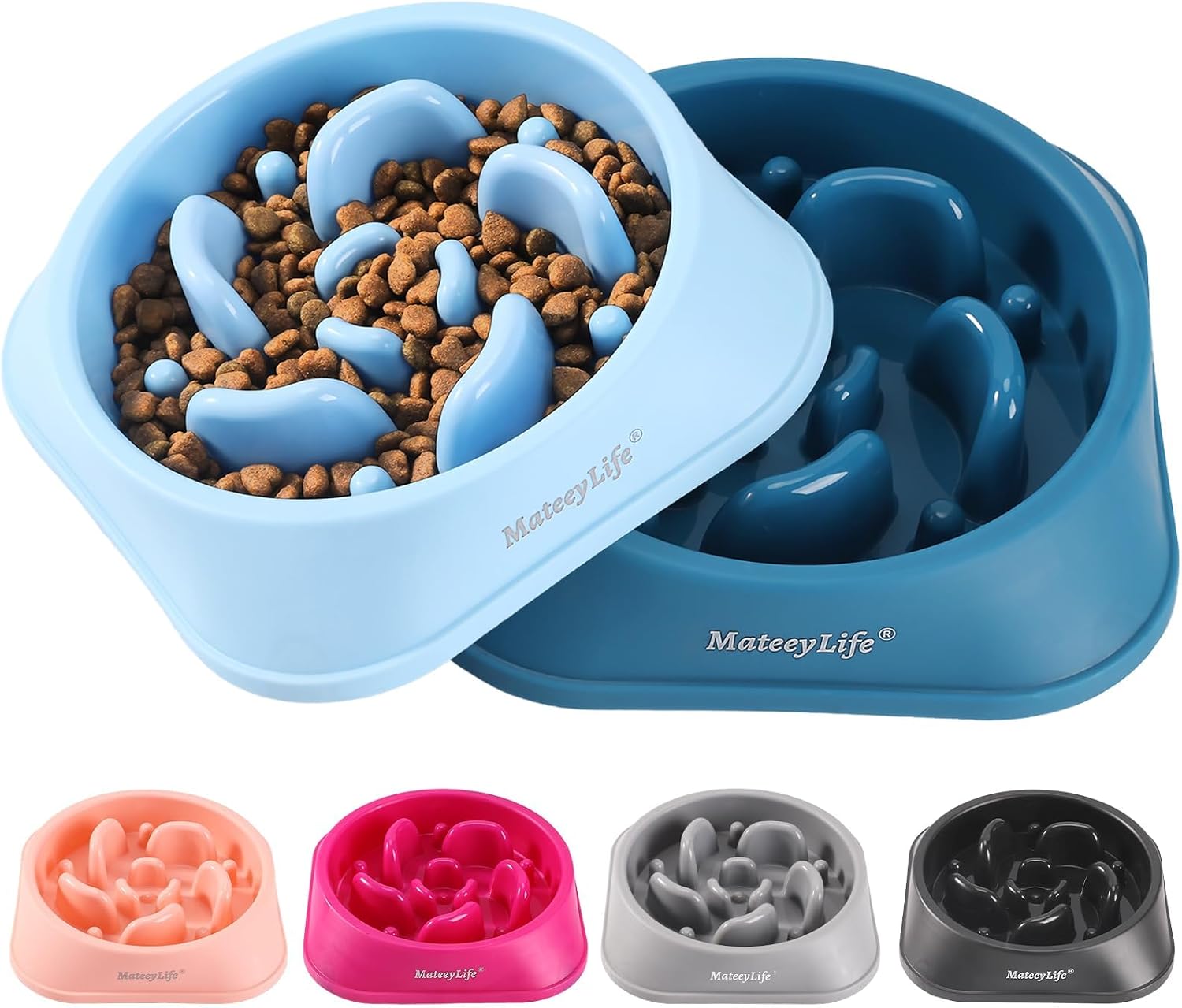 Something like the MateeyLife 2-pack slow feeder dog bowls does the job for a modest price, and having two bowls means one can be in the dishwasher while the other is in service. It will not make a fat dog thin by itself, but it removes one of the speed-eating patterns that makes measured meals feel like theft.
Treats deserve their own audit, because this is where most plans die quietly. Veterinary nutritionists set a hard ceiling: treats and extras should stay under ten percent of daily calories. On a five-hundred-calorie budget that is fifty grams of kibble equivalent, and a single cube of cheddar runs about a hundred and ten. A bully stick can carry thirty to eighty calories per inch. We recommend doing what behaviorists do with training clients: take ten percent of the daily kibble ration out in the morning, put it in a jar, and draw all training rewards and snacks from that jar. Nothing else gets handed over. The dog does not know the difference, and the calorie ledger stays honest.
For dogs who act permanently famished, vegetables are the legal loophole. Green beans, baby carrots, cucumber slices, and plain cooked pumpkin carry single-digit calories and enough bulk to trigger real fullness. Swap out half the treat jar for these and the begging usually fades within two weeks, because the dog is getting volume he was not getting before.
Step Four: Make the Dog Work for His Dinner
Every calorie a dog eats should cost a little effort. That principle, called enrichment feeding, turns weight loss from deprivation into a game. Puzzle feeders and treat-dispensing toys make a dog push, roll, and problem-solve for pieces of his measured ration, converting thirty seconds of gulping into twenty minutes of engagement. 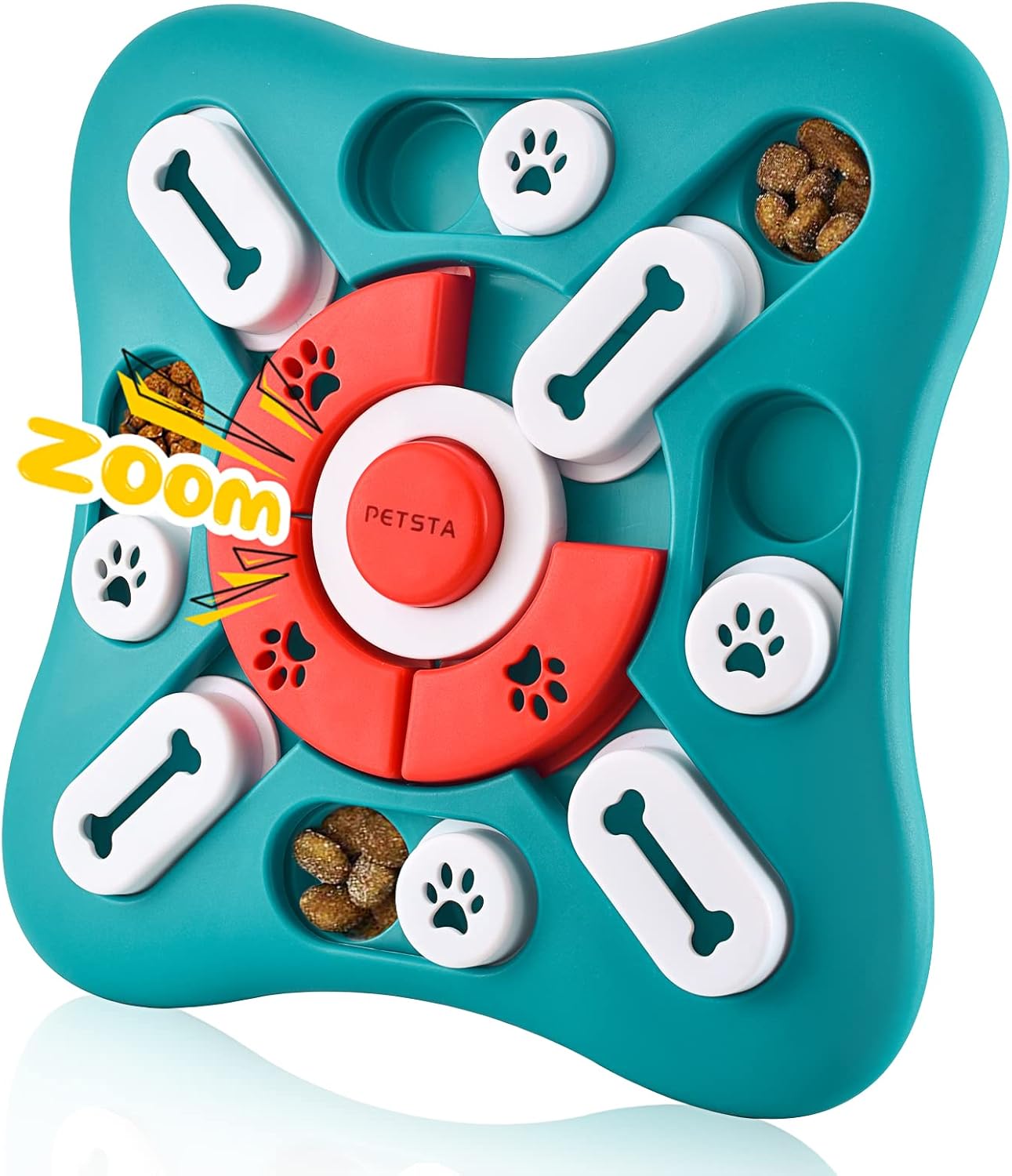 The PETSTA treat-dispensing puzzle toys are a solid pick for this, with difficulty levels you can adjust as the dog gets clever. Mental work tires dogs in a way physical exercise alone does not, which helps with the other problem heavy dogs often have: boredom eating driven by an under-stimulated day.
Scatter feeding costs nothing and works almost as well. Throw a portion of kibble across a rug or the yard and let the dog hunt for it piece by piece. Nose-driven searching is genuinely tiring, and a dog who spent twenty minutes foraging dinner lies down afterward with the satisfied look of a dog who has eaten a much larger meal.
Step Five: Move More, but Start Smaller Than Feels Worthwhile
The exercise mistake we see most often is the weekend warrior pattern: a heavy dog does nothing all week, then gets a four-mile hike on Saturday and spends Sunday limping. Fat dogs carry real orthopedic risk in their joints, and sudden loading of deconditioned muscles and ligaments is how a weight loss project turns into a cruciate injury and a four-thousand-dollar surgery bill.
Start with ten to fifteen minutes of brisk leash walking twice a day and add five minutes per week if the dog is recovering well the next morning. On hot days, walk early or late; a dog in a winter coat version of a fur suit handles heat poorly even when thin. Swimming is the gold standard for overweight dogs with any joint soreness, since water removes most of the load from hips and elbows while demanding full-body effort. A canine hydrotherapy facility is worth the money for a large, arthritic dog, though a calm lake or a kiddie pool with supervision serves smaller budgets.
Sniff walks count, too, and they are underrated. Letting the dog set the pace and follow his nose for forty minutes burns less energy per minute than jogging but produces a calmer, more satisfactorily tired dog, which means less evening demand for snacks. Movement does not have to look like a workout to move the scale.
Protect the Joints While the Weight Comes Off
There is an uncomfortable feedback loop in canine weight loss: the heavier the dog, the more his joints hurt when exercised, and the less he wants to move. Breaking that loop sometimes means supporting the joints directly. Ask your veterinarian whether a glucosamine and chondroitin supplement makes sense for your dog; for a middle-aged heavy dog showing stiffness after walks, vets frequently recommend starting one alongside the diet. Products like Wuffes Hip and Joint chews combine glucosamine, chondroitin, MSM, and green-lipped mussel in a format dogs accept as a treat, but count the chew in your ten percent treat budget and treat it as a conversation with your vet, not a purchase decision. Supplements carry weaker evidence than weight loss itself, and no chew offsets the load of twenty extra pounds. The lean dog's joints get better because the lean dog exists, not because of what he chews.
If your dog is already lame, diagnosed arthritic, or older than about eight, get a vet exam before ramping exercise at all. Physical rehabilitation therapists can design water-treadmill and controlled-movement programs that shed weight without flare-ups, and many owners of senior dogs tell us the rehab consult was the turning point they wish they had reached a year earlier.
Track It Like You Mean It
Weight loss in dogs should run at one to two percent of body weight per week. For an eighty-pound dog that is roughly one to one and a half pounds weekly; for a twenty-pound dog it is a quarter to half a pound. Faster than that risks muscle loss and, in small breeds, dangerous drops in blood sugar. Slower than that means the calorie estimate needs revision.
Use the same scale, the same time of day, and the same person holding the dog, every two weeks, and write the number down. Dogs mask body changes in daily viewing the same way a slow-boiling pot hides its own heat, and a written log defeats the creeping sense that nothing is happening. Take a side-view photo on day one and repeat it monthly; the camera catches the waist returning before the bathroom scale does. If two consecutive weigh-ins show no loss, cut the daily ration by another ten percent or audit treats again. If the dog loses more than two percent weekly for two straight weeks, add a bit back. Adjust, wait two weeks, repeat. That loop is the entire method.
The Four Mistakes That Sink Most Weight Loss Attempts
First, the crash diet. Slamming a dog to half portions overnight invites muscle loss, nutritional gaps, and in small and toy breeds, hypoglycemia that can progress to seizures. Calculated, gradual reduction is what veterinary nutritionists prescribe for a reason.
Second, trusting the word lite on a food label. Some light formulas cut calories by a real margin; others cut fat slightly and call it a day. Judge foods by printed kilocalories per cup, nothing else, and remember that light food fed in double portions is just regular food with better marketing.
Third, the multi-person sabotage problem. In most households with a dieting dog, someone is still slipping him cheese because the dog performs hunger convincingly. The fix is social, not nutritional: the measured portion gets weighed in front of everyone, the treat jar holds exactly the morning ration, and the person who cannot resist those sad eyes gets assigned the vegetable duty instead.
Fourth, quitting at the plateau. Nearly every dog stalls somewhere around the two-month mark as metabolism adapts to the smaller ration. A stall is not failure; it is a signal to recalculate against the dog's new, lighter weight. The resting requirement of a dog who has lost eight pounds is lower than it was, and the plan should follow the body down.
Where to Start Tomorrow Morning
Do not try to change everything at once, because plans that require ten simultaneous lifestyle changes tend to last about four days. Our suggested first week: buy the kitchen scale and weigh tomorrow's portions, calculate the resting requirement for your dog's target weight rather than his current one, move all treats into a single jar holding ten percent of daily calories, and book a two-week weigh-in on the calendar. Everything else, the slow feeder, the puzzle toys, the longer walks, layers on top of that foundation.
The payoff is not abstract. The Labrador study puts a number on it, close to two extra years of life for dogs kept lean, and the daily dividends arrive sooner than that: easier rising from the floor, better breathing on walks, fewer vet bills, and a dog who plays at ten the way he played at two. Your dog cannot read a feeding chart, count calories, or open the treat jar. That part was always your job, and now it comes with a plan.
Related Reading
Want more on this topic? Check out our guides on best dog ramps stairs joint friendly access cars, dog hot spots acute moist dermatitis treatment guide, dog heatstroke recognition treatment emergency.