Halloween Is Not Dangerous Because Dogs Are Fragile. It Is Dangerous Because Routines Break.
On an ordinary weeknight, your front door opens for a delivery driver or a neighbor, maybe three or four times. On October 31, that same door can open sixty times in three hours, and every single time, the person on the other side looks wrong. Masks, wigs, capes, a six-foot stranger standing where a nine-year-old in a raincoat usually stands. For an animal built to notice that something in the environment has changed, Halloween is a full evening of false alarms.
That single fact explains most of what goes wrong that night. Candy gets the headlines, but when we looked at what actually sends dogs to emergency clinics on October 31, the pattern was consistent: dogs bolting through propped-open doors, dogs eating chocolate left on a coffee table at kid height, dogs snapping after hours of accumulating stress nobody tracked. Each one is a routine failure, not a freak accident.
The good news is that routine failures have routine fixes. Almost everything that keeps a dog safe on Halloween happens before 5 p.m. — a long walk, a lockable room, a tag with a readable phone number, a conversation with the household about who handles the door. None of it costs much, and none of it requires your dog to be a superstar with doorbells.
This guide walks through the five failure points in the order we would fix them: the candy, the identification, the door, the costumes, and the room your dog should be sitting in by the time the first trick-or-treater rings.
The Candy Question: Separating Real Danger From a Long Night
Chocolate is the classic Halloween hazard, and the danger scales with darkness. The toxic compound is theobromine, which dogs clear from their bloodstream far more slowly than people do. Mild signs — vomiting, restlessness, a racing heart — can show up around 20 milligrams of theobromine per kilogram of body weight, and doses approaching 40 to 50 milligrams per kilogram can turn into tremors, seizures, and cardiac emergencies.
Translated into dessert: two ounces of unsweetened baking chocolate carries enough theobromine to put a 20-pound dog into that serious range. The same two ounces of milk chocolate usually means vomiting and a very watchful night instead of an ICU stay. Dark chocolate, cocoa powder, and anything labeled 70 percent or higher sit uncomfortably close to the baking-chocolate end of that scale. Bowl height matters here, because candy left on a coffee table is candy at nose level for most dogs.
The quieter threat is xylitol, the sweetener in sugar-free gum and a growing share of sugar-free candy. In dogs, xylitol triggers an insulin release that can crash blood sugar within 30 to 60 minutes, and one or two pieces of gum can be enough for a small dog. Higher doses can injure the liver. Because xylitol hides in products people do not think of as candy — breath mints, protein bars, some peanut butters — the rule we suggest is simple: anything sugar-free that enters the house on Halloween gets read like a prescription label.
Raisins and grapes deserve their own warning. They turn up in trail mix and candy assortments, and veterinary toxicologists have never established a safe dose — some dogs eat a handful and stay fine, others lose kidney function. There is no calculating your way out of that one, so it is a straight call-the-vet situation every single time.
According to the ASPCA Animal Poison Control Center, Halloween is consistently one of its busiest call days of the year, with chocolate cases leading the list. Wrappers and lollipop sticks are less dramatic — they are not toxic, but a stomach full of foil is a foreign-body appointment waiting to happen.
If your dog does eat something, skip the home remedies. Do not induce vomiting unless a veterinarian tells you exactly how; salt and hydrogen peroxide both cause real harm when used wrong. Grab the packaging, note the time and the estimated amount, and call. With chocolate and xylitol, the treatment clock starts before symptoms do. Save two numbers in your phone tonight: your nearest emergency clinic, and the ASPCA Animal Poison Control Center hotline at 888-426-4435. At 9 p.m. on Halloween you do not want to be googling which clinic is open while a 15-pound terrier works through a candy wrapper pile.
Before Dark: The Ten-Minute Identification Audit
Every escaped dog on Halloween had an owner who assumed it would not escape. Plan for the opposite. Sometime on the 31st, ideally before the afternoon walk, put ten minutes into identification.
Start with the tag. Engraving wears down, phone numbers change, and a tag polished smooth by three years of dog-park collisions is a tag that cannot help anyone. Hold yours at arm's length and squint at it — if the number is not readable in two seconds, it fails. A replacement like a deep-engraved stainless steel ID tag costs less than the candy you are about to hand out and stays legible for years. 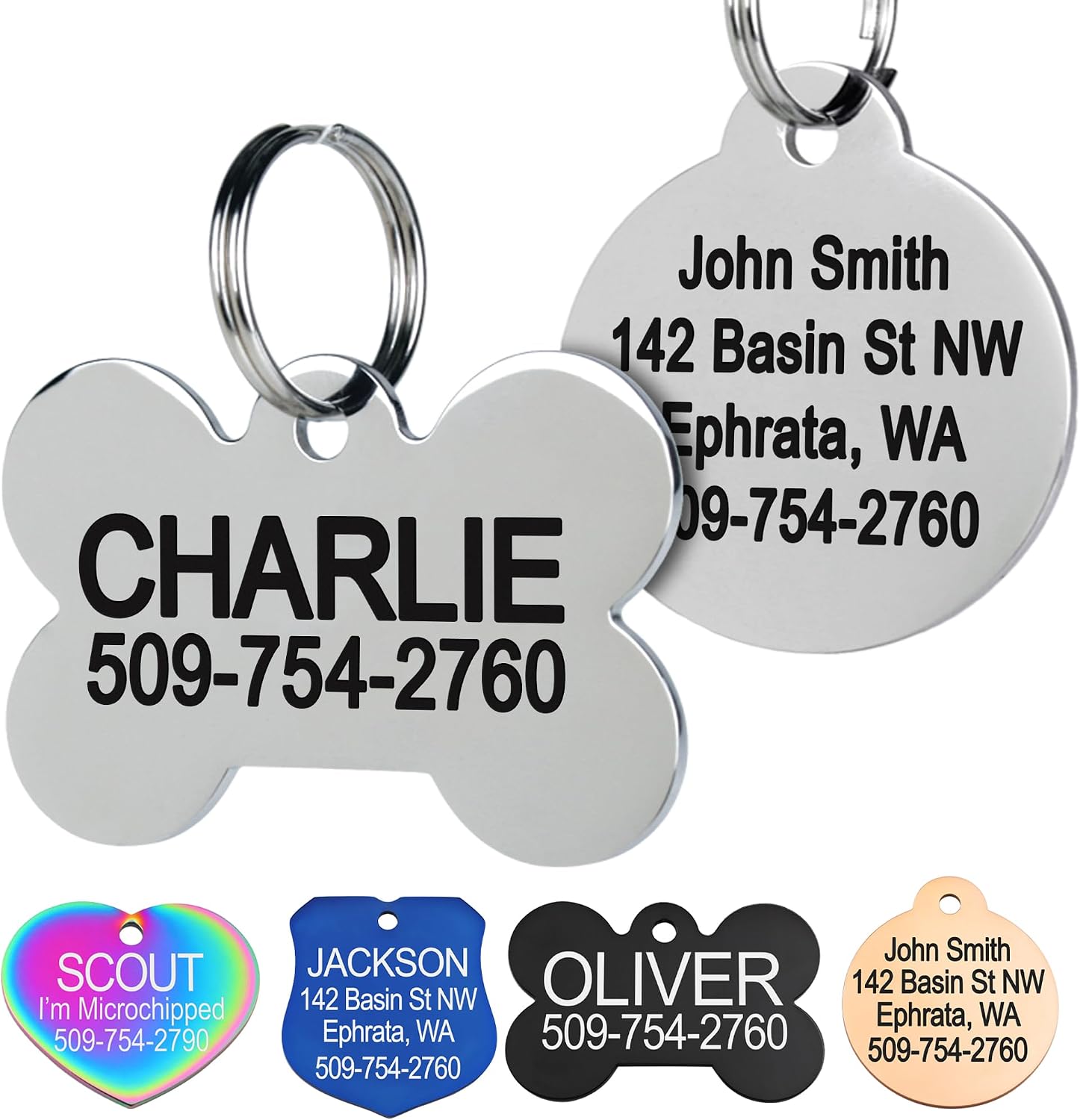
Then build a backup layer. Tags snag on fences and crate doors and come off exactly when they are needed most, which is why a second layer of identification earns its keep. a GoTags collar embroidered with your dog's name and your phone number keeps contact information on the dog even if the tag disappears mid-escape. 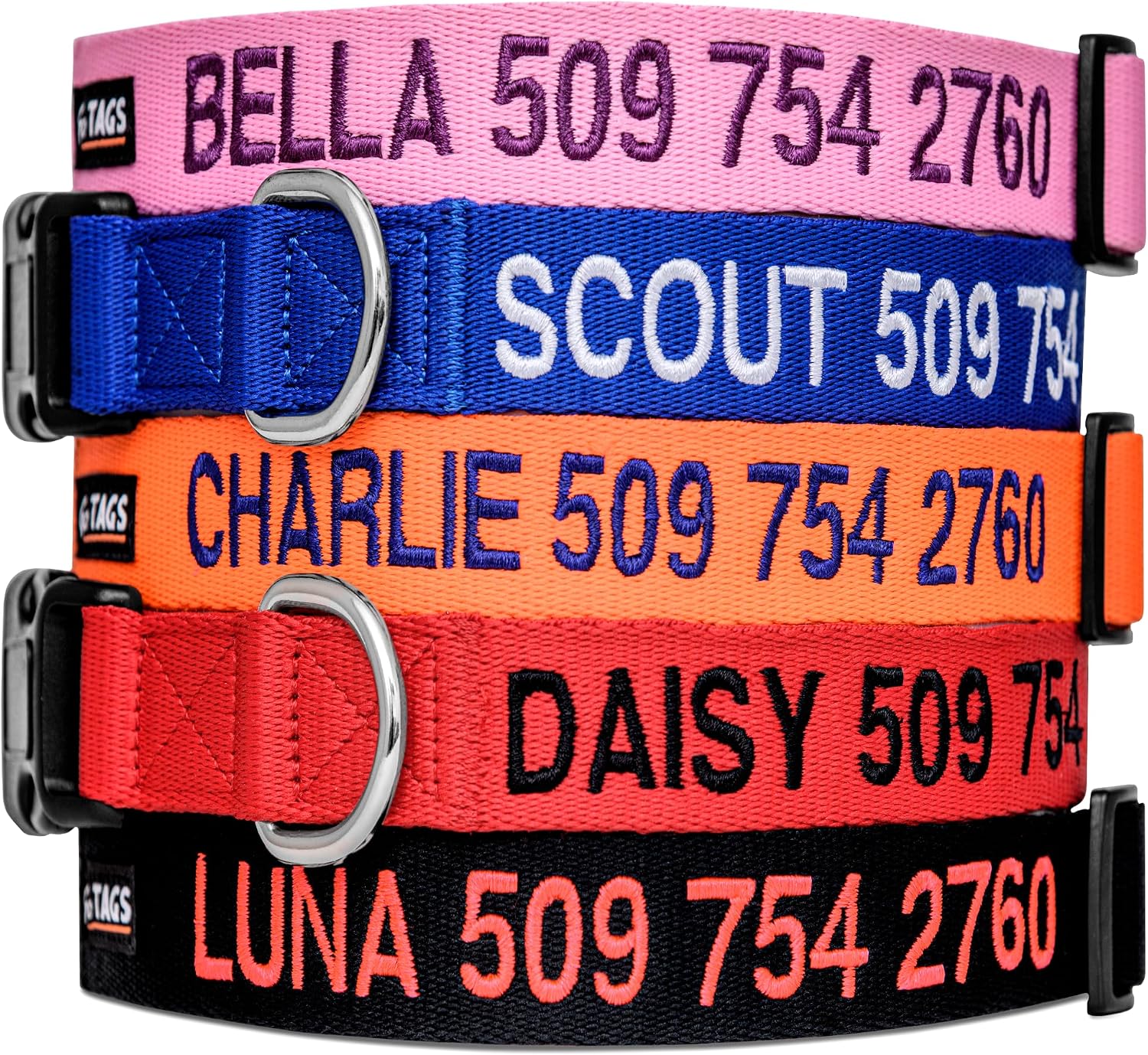
Finish with the microchip. A tag helps a neighbor; a chip helps the shelter twenty miles away. Log into the registry this week and confirm your phone number is current — a surprising share of chipped dogs cannot be traced because the registration still lists an apartment someone moved out of two years ago. Take a clear photo today as well. If your dog goes missing, you will want a recent image without a costume on it, not a shot from last spring.
The Door Is the Emergency: Managing Sixty Openings
Here is the mechanics of a Halloween escape: the doorbell rings, the dog crowds the entryway, the owner opens the door a shoulder-width to hand out candy, and the dog slides through the gap sideways. It takes about one second, and it happens to trained dogs too, because a door opening forty times in one evening is not something training reliably generalizes to.
So do not rely on training alone. Rely on geometry. Set up a barrier one room back from the entry — a closed door, a playpen, or an auto-close baby gate across the hallway — so that no open front door ever has a dog standing behind it. With the hallway gated, the entire trick-or-treat evening becomes a non-event, because the dog physically cannot be at the door when it opens. Decide now which household member handles the door and which one handles the dog; the classic failure mode is both jobs landing on one person who is also holding a candy bowl.
The evening schedule does real work too. A long walk that ends at dusk burns off the arousal the doorbell would otherwise feed, and it gets potty out of the way so nobody is clipping a leash mid-rush at 7 p.m. Feed dinner early as well — a dog with a full stomach and tired legs is a calmer roommate for the next four hours.
If you have the luxury of a week before Halloween, spend one evening on a rehearsal: ring the doorbell yourself, walk to the gate, and drop a treat on the far side. Five repetitions teach most dogs where they are supposed to be when that sound happens, and the gate turns the lesson into a habit. Dogs learn patterns fast; we mostly fail to give them one worth learning.
One more unglamorous rule: potty breaks after dark stay on-leash, even in fenced yards. The yard that reliably contains a bored dog at noon does not necessarily contain an overstimulated one at 7:30 p.m. with a screaming skeleton costume two houses down. According to the AVMA, keeping pets in a secure room away from the front door is one of its core Halloween recommendations, and shelters report that lost-pet intakes climb in the days right after the holiday.
Costumes: Read the Dog, Not the Calendar
Two different costume problems happen on Halloween, and owners tend to fix only one of them.
The first is dogs in costumes. Some dogs genuinely do not care, and a few seem to enjoy the extra attention. But a costume is clothing with a job: it must not cover the eyes, ears, or muzzle, must not restrict the legs or tail, must have no small chewable parts, and must come off the moment the dog asks. The asking is quiet, which is why it gets missed — lip licking, yawning when nothing is boring, pinned ears, whites of the eyes showing, a full-body shake, or freezing in place. A dog that lies down and refuses to move is not being lazy; that is a stop sign. If dressing your dog would take a desensitization plan longer than two days, skip it. A festive bandana delivers the photo and skips the stress entirely.
The second problem is humans in costumes, and it is the one that catches people off guard. Dogs read silhouettes, gaits, and smells, and a masked person is all three scrambled at once. A dog that greets strangers politely all year can lose composure when a six-foot masked figure reaches over its head. Keep greetings boring: no reaching, no looming, no high-pitched screaming — which is exactly what excited children produce. If a visiting kid wants to say hi, the dog approaches at ground level on its own terms, or the greeting does not happen.
The Quiet Room and the Decoration Sweep
The highest-value thirty minutes of setup for the whole evening is a retreat room. Pick an interior room away from the entry — a bedroom or the room behind the gate — and stock it with water, a long-lasting stuffed chew, the dog's own bed with its familiar smell, and white noise from a fan or radio. The household rule is absolute: nobody visits the dog in that room, and the door stays shut. Check in every 45 minutes, keep it boring, and leave again. A dog that can opt out of Halloween entirely usually does, and comes out on the other side calmer than the dog that spent four hours managing the front hallway.
Then do a fifteen-minute decoration sweep at dog height. Get on the floor and look at your home from nose level. Glow sticks and glow jewelry deserve a mention first: the liquid inside tastes bitter and causes dramatic drooling, pawing at the mouth, and panic, but it is not poisonous. Rinse the mouth, offer water, and call your vet only if the drooling will not stop. Candles inside jack-o-lanterns are a different story — a wagging tail and an open flame is a burn or a knocked-over fire waiting for a reason, so swap in battery candles and delete the whole category. Fake cobwebs and small decorative parts are an obstruction risk for dogs that chew, and cords powering inflatables draw puppies and adolescents like a magnet. Old pumpkins growing fuzzy mold belong outside reach too, because moldy food of any kind is a mycotoxin problem.
If the Door Wins Anyway: The First Thirty Minutes
Even good setups fail, so know your moves before you need them. Do not chase — a running dog reads pursuit as a game and speeds up. Move slowly, kneel sideways, use your happiest voice, and produce the best treat in the house. Search where the dog was last seen and spiral outward in slow loops; most Halloween escapees are found within a few blocks, often hiding under parked cars or porches with the costume traffic still going.
While one person searches, another should post: the photo you took that morning, the cross streets, the words lost dog, and your phone number, into local groups and the microchip registry. Leave your own front door open with a familiar blanket or the dog's bed nearby and someone stationed at home — a disoriented dog often circles back to the last place it felt safe. If the dog is not home by morning, visit shelters in person rather than calling with a description. A black labrador mix is every second dog in the facility, and your eyes will catch yours when a phone description will not.
The Five O'Clock Checklist
If it is 5 p.m. on Halloween and everything below is done, the biggest risks of the night are already handled:
- Candy stored up high and out of reach, including the coats and treat bags guests set down in the hallway.
- ID tag readable at arm's length, collar fitted to the two-finger rule, microchip phone number current.
- Gate or closed door standing between the dog and the front entry.
- Long walk finished, dinner fed, potty handled before dark.
- Quiet room stocked with water, a stuffed chew, the dog's bed, and white noise.
- Decoration sweep done: no candles, cords, cobwebs, or glow items anywhere at nose level.
- Household agreement reached on who opens the door and who watches the dog.
Halloween rewards preparation over training, and it rewards it hours before the first doorbell. The door will open sixty times either way. The only variable is whether your dog is behind a barrier reading the whole evening as background noise, or standing at the threshold deciding whether the masked stranger counts as a threat.
Related Reading
Want more on this topic? Check out our guides on best dog harnesses, the best dog foods for active dogs and high energy breeds in, dog myths debunked common beliefs.