Your Rabbit Grows a Ruler of Tooth Every Year
Run a fingernail across the front teeth of a healthy rabbit and you are touching a surface that did not exist a few weeks ago. A rabbit's upper incisors grow about two millimeters every week, which works out to roughly ten centimeters a year — the length of a school ruler, ground away and regrown, over and over, for the animal's entire life. Guinea pigs and chinchillas run the same program. Every tooth they own is built to erupt forever, and the only thing standing between that design and a medical emergency is the mechanical work the teeth do every day. Dental disease is one of the most common reasons small herbivores end up at exotic vets, and the uncomfortable truth is that most of it traces back to what the animal was given to chew on. This piece is our working guide to keeping a small pet's teeth worn down the way nature intended, and to catching the warning signs while they are still cheap to fix.Open Roots: The Anatomy Behind the Problem
Most animals, humans included, get one set of adult teeth with closed roots. Once the root seals, the tooth stops growing, and it had better last. Rabbits, guinea pigs, and chinchillas took the other path. Their teeth are open-rooted — the pulp chamber stays open at the base, so the tooth keeps producing new material and erupting at the gumline for as long as the animal lives. A rabbit carries 28 teeth in this permanent-growth arrangement: the two pairs of incisors everyone sees, plus a cheek arcade of premolars and molars tucked so far back that most owners have never looked at them. Guinea pigs and chinchillas carry 20 each, with the same open roots on every one. That biology sets the terms of the deal. A tooth designed to erupt ten centimeters a year is also designed to be worn down ten centimeters a year by grinding against its partner on the opposite jaw, against silica-rich grass, and against coarse stem fiber. When wear matches growth, the system hums along for a decade. When wear falls short — because the diet is soft, or the alignment is off by a degree or two — the surplus has to go somewhere. Incisors overgrow into curls or wedges that stop the mouth from closing. Cheek teeth overgrow into sharp enamel points called molar spurs that lacerate the tongue and the inside of the cheeks. In the worst cases the roots themselves push deeper into the jawbone. None of this happens overnight, which is both the good news and the trap: by the time the animal stops eating, the problem has usually been building for months.Hay Is a Toothbrush, Not Just a Meal
If we could leave new owners of rabbits and guinea pigs with one sentence about teeth, it would be this: hay is not a food, it is a tool that happens to contain food. The coarse, abrasive, long-strand fiber in grass hay forces the animal to chew side-to-side, hundreds of times a minute, in exactly the grinding motion that wears the cheek teeth evenly across their whole surface. Grass hay also carries microscopic silica — the same mineral as sand — which turns every chewing session into a gentle abrasive polish. Timothy, orchard grass, meadow hay, and oat hay all do this job. Alfalfa does not; it is a legume, far softer and richer, and belongs in the diets of growing babies and pregnant females rather than healthy adults. How much hay are we talking about? According to the Humane Society, grass hay should make up the overwhelming majority of a rabbit's diet — the standard veterinary guidance puts it at 80 to 85 percent of everything the animal eats, available in unlimited quantity, every day. The same framework applies to guinea pigs, with the added note that they cannot make their own vitamin C and need vegetables to supply it. For chinchillas, hay is likewise the foundation, and it is the single most important item in the cage. A pile of hay the size of the animal itself, each day, is not an exaggeration for any of these species. When owners tell us their rabbit picks at hay and holds out for pellets, we read that the same way a dentist reads a candy habit: the teeth are being shortchanged, and the bill arrives later.Why Pellets Alone Fail the Teeth
Pellet food deserves a specific warning, because it is the most common structural mistake we see in small-pet feeding. A pellet is compacted, uniform, and soft. An animal eating pellets finishes its ration in a fraction of the time and with a fraction of the chewing strokes that the same calories in hay would require. Worse, the jaw motion on pellets is different — less lateral grinding, more straightforward crushing — so even the chewing that does happen wears the teeth unevenly. The cheek teeth of a pellet-fed animal are exactly the ones most likely to develop sharp spur points, because they simply never get the long, grinding workout that flattens them. There is a secondary failure mode, too. Pellets are tasty and dense, and animals fed unlimited pellets commonly fill up on them and then ignore hay. A guinea pig that eats a full bowl of pellets has little appetite left for the one food that maintains its molars. Our position is blunt: pellets are a supplement, roughly an eighth of a cup or two per day for an adult rabbit depending on size and body condition, not a base diet. The bag may claim to be complete. It is complete for nutrition on paper and incomplete for dentistry in practice, and the animal has to chew to live, not just absorb vitamins.Chew Toys: Incisor Insurance, Not a Hay Substitute
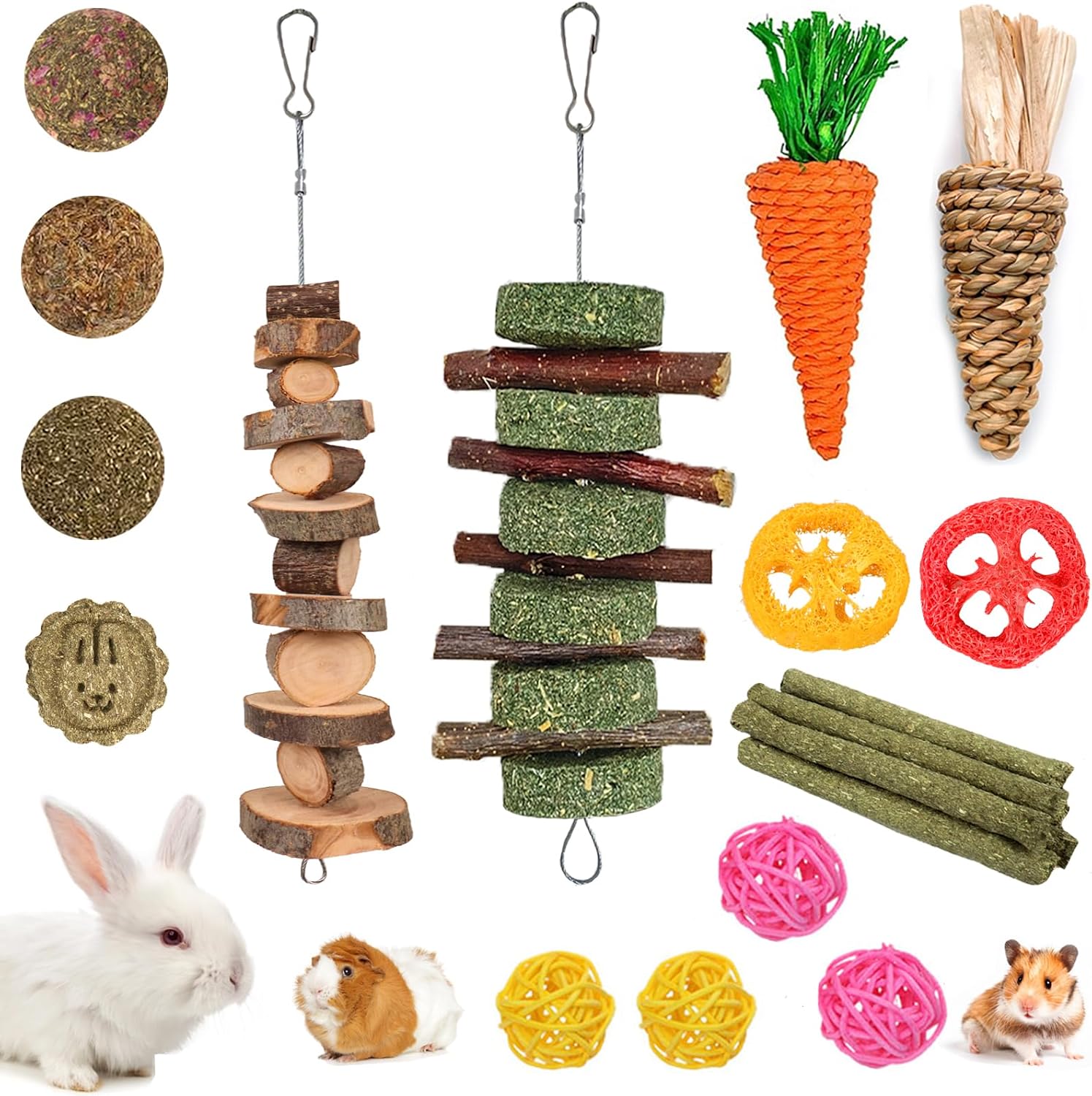 Where do chew toys fit, if hay does the heavy lifting? They matter most for the front teeth. Incisors get their workout from gnawing — pulling apart hay stems, stripping bark, working on wood — and a steady supply of safe, chewable wood keeps those front teeth engaged and worn. Wood chews made from untreated apple, willow, pear, or kiln-dried pine are the standard safe options; anything aromatic like fresh cedar is off the list, as is any wood treated, painted, or sourced from trees sprayed with pesticides. Plain woven grass mats, willow balls, and cardboard from clean, unprinted boxes round out the rotation.
A good example of the category done right is the Grddaef 20-piece chew toy set of apple wood and timothy sticks, which mixes natural apple wood branches with pressed grass and timothy sticks — the kind of variety that keeps a rabbit or guinea pig actually interested in gnawing instead of ignoring the basket. For a straight, no-frills wood supply, the Bojafa 250-gram bag of apple stick chew treats is a practical pick: quarter-inch apple branches, dried, that small animals strip down to the cambium over days. Both are honest versions of a product type that gets oversold, so let us be equally honest about the limit: chews work the incisors, and they barely touch the molars. An animal that chews wood all day but eats no hay can still develop molar spurs. Chews are insurance, not a substitute for the abrasive grind of grass hay, and no chew product on the market changes that equation.
The Warning Signs Owners Catch Too Late
Dental disease announces itself quietly, and the signals are easy to misread as fussiness. The first and most reliable one is a change in how the animal eats hay. Rabbits and guinea pigs with sore cheek teeth still come to the food bowl — they are hungry — but they pick at pellets and vegetables and leave the hay that hurts to grind. Owners often describe this as the animal becoming picky. It is not pickiness; it is pain avoidance, and it can precede visible tooth changes by months. Weight loss follows, usually slow enough that nobody notices without a scale, which is why we tell every small-pet owner to weigh their animal weekly on a kitchen scale and keep a log. A gram here and there is noise. A steady five percent drop over two weeks is an appointment. The mouth itself offers clues if you know where to look. A damp or crusty chin and chest — vets call it slobbers — means saliva is escaping a mouth that cannot close properly around overgrown teeth. Food falling out of the mouth mid-chew, called quidding, means the cheek teeth are catching. One or both eyes watering can trace back to molar roots pressing on the tear duct, which runs directly past the tooth roots in all three species. A hard lump on the lower jaw is the most alarming sign of the set: jaw abscesses around infected tooth roots are common in rabbits with advanced dental disease, and they are serious, expensive, and slow to resolve. Run a hand along both sides of the jaw weekly during cuddle time. It takes ten seconds and it finds lumps long before fur hides them. According to the AVMA, rabbits with dental disease commonly show reduced appetite, drooling, and weight loss before their owners notice anything wrong with the teeth themselves — and because rabbits and other small herbivores cannot safely go long without eating, an animal that stops eating entirely is an emergency, not a wait-and-see. The gut of a rabbit or guinea pig depends on constant movement of fiber; twelve hours without intake is already a red line for guinea pigs, and gastrointestinal stasis can follow. If your animal is not eating, the question is not whether to call the vet. It is whether the clinic has an opening today.What a Dental Exam Involves, and Why You Cannot Fix It Yourself
Say the signs add up and you get the animal in. What happens next is worth understanding in advance, partly so the invoice does not shock you and partly so nobody attempts a home version of it. A proper dental exam on a rabbit, guinea pig, or chinchilla requires the animal to be still and the mouth to be held wide open, which in practice means light anesthesia and a long otoscope cone or a speculum. The vet inspects the entire cheek arcade, looking for spur points, bridges where adjacent molars have overgrown into each other, step defects where one tooth is longer than its neighbors, and discoloration that hints at root infection. X-rays of the skull round out the picture, because tooth-root problems live below the gumline where no scope can reach. Molar spurs are corrected by filing or burring them flat under that same anesthesia — a procedure many rabbits and guinea pigs need repeated periodically once it becomes necessary. Severely overgrown incisors get ground down with a burr as well. And here is the sentence we would tattoo inside every small-pet care guide if we could: never clip a tooth with nail clippers. Clipping cracks the tooth lengthwise, can expose the pulp cavity, and leaves sharp fractured edges that cause worse damage than the overgrowth did. Home tooth trimming videos exist, they are convincing, and they are how animals end up with fractured teeth and pulp infections. Trimming belongs to a vet with a rotating burr and a sedated patient, full stop. Cost and frequency are real considerations. A dental under anesthesia typically runs from a couple hundred dollars to substantially more with imaging and complications, and an animal with a malocclusion may need corrections every few months for life. That recurring reality is exactly why the cheap prevention — unlimited hay, limited pellets, daily chews, weekly weighing — is the highest-return investment in small-pet keeping. Every dollar of hay that gets eaten properly is dental work that never gets scheduled.Chinchillas and the Molar Root Problem
Chinchillas earn their own paragraph because their dental troubles run a slightly different playbook. They share the continuously growing dentition of rabbits and guinea pigs, they need the same hay-driven grinding, and they are enthusiastic chewers with a genuine physiological need for wood — in the wild they strip bark from arid-climate shrubs, and their teeth are built for that workload. But chinchillas are also notorious for a deeper problem: tooth roots that elongate and push into the jawbone and even the eye socket, a condition vets call apical elongation or root impaction. Early signs include firm bumps along the lower jawbone and watery eyes, and the diagnosis is radiographic, not visual. Once roots elongate, it cannot be reversed, only managed. The practical takeaways for chinchilla owners are specific. First, the hay bar stays full at all times — chinchillas graze in bursts through the night, and an empty rack for even a day is lost wear. Second, wood chews are not optional accessories for this species; kiln-dried pine, apple, and willow should be rotated through the cage continuously. Third, any chinchilla that begins dropping food, drooling, or rubbing its mouth gets seen quickly, because chinchilla dental disease tends to progress deep before it shows wide. And skip the exercise-ball and plastic-tunnel aisle entirely for this species — plastic is a chew hazard rather than a chew tool, and a chinchilla will prove it to you within the week.Genetics, Face Shape, and the Luck Factor
One uncomfortable caveat belongs in any honest dental guide: not every case is preventable, because not every case starts with diet. Tooth alignment is heritable. Lop-eared rabbit breeds, with their shorter, flatter faces, carry a higher rate of congenital malocclusion than straight-faced breeds, and dwarf lines have their own predispositions. An animal born with jaw misalignment of even a degree or two will grind its teeth imperfectly for life and accumulate overgrowth no matter how impeccable the hay supply is. Owners of lops, mini lops, and brachycephalic-type rabbits should treat twice-yearly vet dental checks as routine rather than optional, because in these animals early detection is not a nicety — it is the difference between periodic filing and permanent tooth extraction. Extraction, if it ever reaches that point, is more survivable than it sounds. Rabbits with removed incisors can learn to eat hay and greens cut into short lengths, and many live full lives afterward. Guinea pigs that lose cheek teeth need tailored diets and closer monitoring, but the goal of every intervention is the same: keep the animal eating fiber. The point of this section is not pessimism. It is calibration — diet prevents the majority of dental disease, but a genetic case caught early is a manageable animal, while a genetic case discovered at the weight-loss stage is a long, expensive road. Screening is how you tell those two stories apart.Treats and the Sugar Problem
 Treat culture deserves its own honesty check, because the small-pet treat aisle is stacked with products that work against the exact dental system we just spent this whole article defending. Sugary binders — molasses, honey, fruit glues — hold many commercial treat logs and yogurt drops together, and sugar does two bad things at once: it encourages the animal to eat fewer of the abrasive foods that wear teeth, and it feeds the wrong gut bacteria in a digestive system built for fiber. A treat habit that displaces hay is a dental problem wearing a bow.
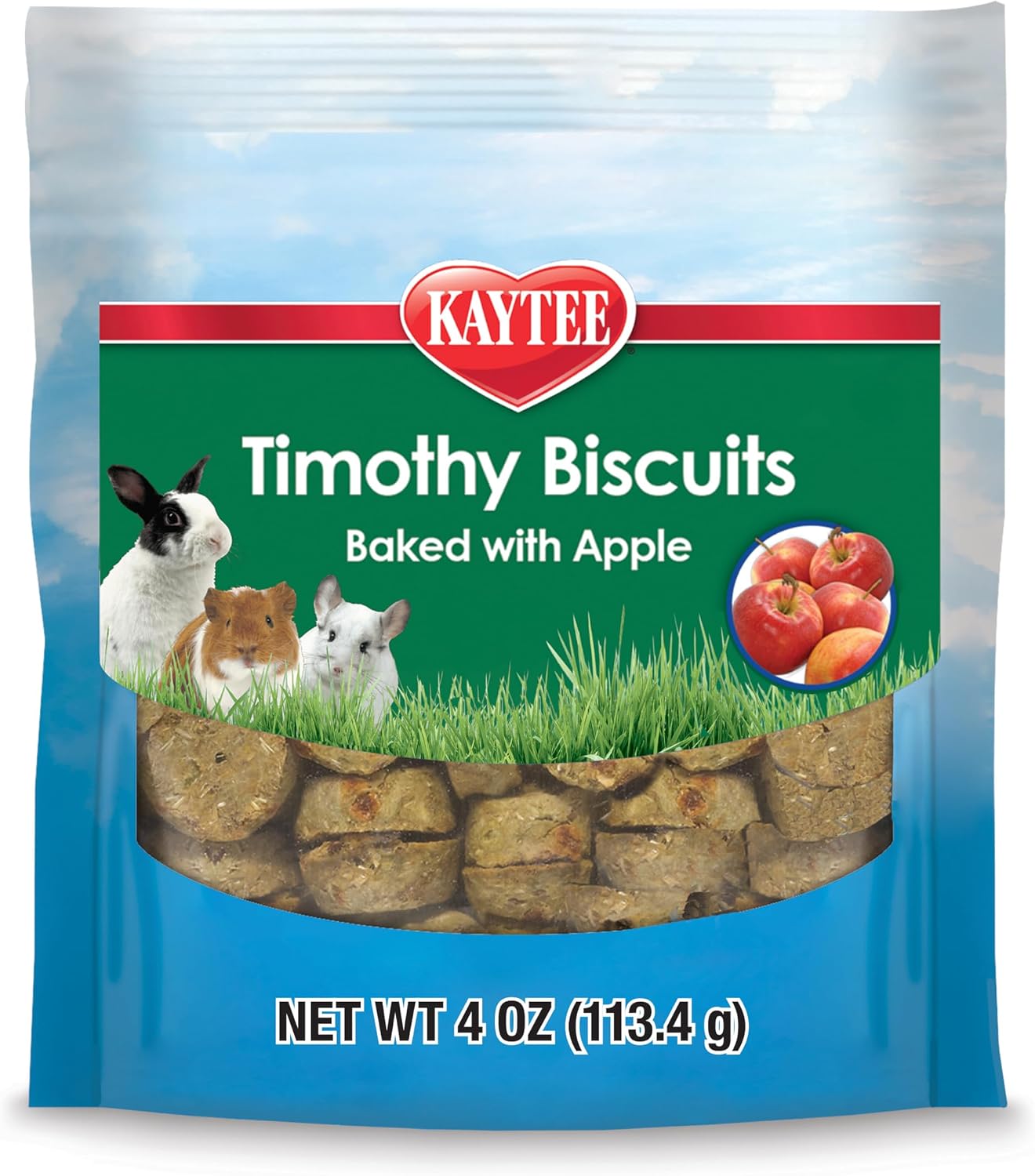
The workable version of treats is simple. Choose products whose first ingredient is hay or grass rather than sugar, keep portions small, and count them inside the daily calorie budget rather than on top of it. Baked timothy hay options such as Kaytee Timothy Biscuits put the abrasive fiber of hay into a hand-feedable form — a sensible middle ground for training and bonding. The Oxbow Simple Rewards baked treats with apple and banana follow the same logic, hay-forward and made for rabbits and guinea pigs in modest portions. What we do not recommend: muesli-style seed mixes marketed for rabbits, yogurt drops, honey sticks, and anything whose ingredient list reads like a cereal box. The animal cannot read the marketing, but its molars will file the complaint.
A Weekly Dental Routine You Can Actually Keep
Everything above compresses into a routine short enough to survive real life, so here it is as we would hand it to a new owner on day one. Daily: refill the hay rack before it empties, not after — a rack that runs dry is a rack the animal treats as gone. Drop pellets to supplement level, roughly one to two tablespoons daily for an adult guinea pig and proportionally more for a rabbit, adjusted to body condition. Swap in fresh wood chews whenever the current ones wear to splinters, and refresh water. Weekly: weigh the animal on a kitchen scale and write the number down; run fingers along both sides of the jaw checking for lumps; glance at the chin for dampness; watch one full meal and note whether hay gets ground all the way down or merely mouthed. Monthly: check the incisors through the parted lips — they should meet cleanly like pliers, with the uppers in front of the lowers, not splayed, not curled, not meeting edge to edge. And annually at minimum, or twice a year for lops and any animal with a dental history, have a vet look past what lips can show. None of these steps requires equipment beyond a scale and your hands, and together they catch the overwhelming majority of dental disease while it is still a correction instead of a crisis. Teeth that grow forever were never a design flaw — they were a design for a life spent grinding coarse grass for eight hours a day. The animal in your living room still runs the same program. Give it the workload the program expects, watch the numbers, and the ruler of tooth growing inside its jaw every single year stays exactly where it belongs: worn flat, functional, and invisible.Related Reading
Want more on this topic? Check out our guides on how to set up guinea pig cage step by step, best small pet hay feeders hay racks, how to bond two guinea pigs step by step guide.