Most Hamster Wheels Sold With Starter Kits Are Too Small. Measure Yours Tonight
Walk down the small pet aisle of any chain store and look at the wheels bundled with hamster starter kits. Most measure 6.5 to 8 inches across. Now look at the Syrian hamster they are supposedly built for: an animal whose body alone runs 6 to 7 inches long from nose to tail base. When that animal sprints, its spine has to bow upward just to fit inside the ring. That is not exercise equipment. That is a posture problem packaged as a gift set.
And hamsters run. A lot. Captive hamsters commonly log 5 to 9 kilometers a night on a wheel, and the behavior is not a cage-crazed artifact. In 2014, researchers Johanna Meijer and Yuri Robbers set up free-standing wheels in an open natural area in the Netherlands and documented wild mice choosing to run on them repeatedly, night after night, with no food reward attached. The findings, published in Proceedings of the Royal Society B, made a strong case that running on a wheel is something rodents genuinely want to do. If we are going to provide one, the size has to respect the animal's actual stride.
This guide covers why wheel diameter matters so much, the right numbers for each species, the flat-back test you can run tonight with a phone camera, and the surface and bearing details that separate a wheel your hamster will use for years from one that ends up in a closet by February.
Why the flat-back rule decides everything
When a hamster runs inside a properly sized wheel, its spine forms a straight line parallel to the floor. When the wheel is too small, the spine arcs upward into a permanent backward stretch, and the animal holds that contorted position for thousands of strides a night. According to the RSPCA, the wheel you offer must be big enough for a hamster to run with its back held straight rather than arched upward. Veterinary welfare guidance in Germany attaches numbers to that same rule: the Tierärztliche Vereinigung für Tierschutz, an animal welfare advisory group of German veterinarians, recommends a minimum wheel diameter of about 30 centimeters (11.8 inches) for golden, or Syrian, hamsters and at least 20 centimeters (8 inches) for dwarf species.
Those figures line up with simple mechanics. A running animal needs its full stride length inside the wheel. A Syrian hamster takes strides of roughly 10 to 14 inches at a trot, which is why an 8-inch wheel physically cannot accommodate a flat back. The hamster has two options: run with an arched spine, or shorten its gait into an awkward hop. Many do a bit of both, and neither is what a wheel is for.
Here is the part that frustrates our editorial team the most: the wrong size is the default. Manufacturers size wheels to fit starter cages, not hamsters, because a 12-inch wheel will not hang neatly inside a cage with 13 inches of height. The product is designed around the box it ships in. Once you see that, the entire starter-kit economy makes a different kind of sense, and checking the wheel you already own stops feeling optional.
What goes wrong when the wheel is too small
An undersized wheel is not just uncomfortable. It produces a recognizable cluster of problems that show up in sequence:
- Chronic spinal flexion. Running with the back arched for 5 to 9 kilometers a night keeps the spine loaded in extension for hours. No published study has yet tied hamster wheel size directly to long-term spinal injury, but posture that abnormal for that many strides is not something we would gamble on, and no welfare body recommends it.
- Gait changes and reluctance. Hamsters in undersized wheels often shorten their stride or run at an angle. Some quietly cut their running time, which owners misread as the hamster outgrowing the wheel. In most cases the wheel outgrew the hamster.
- Tail and head contact. In a wheel that is too small, the tail scrapes the running surface or the head brushes the crossbar on every stride. Watch for a tapping or thumping rhythm inside the wheel, which is the sound of a body part hitting plastic.
- Displaced energy. A hamster that cannot run properly tends to spend the energy somewhere else: bar biting, corner digging, monkey bars along the cage lid. Studies of captive rodent stereotypies consistently link inadequate opportunity for natural locomotion with repetitive compulsive behaviors. The wheel is often the cheapest and easiest fix for behaviors owners otherwise try to train away.
None of this requires the wheel to be replaced with something exotic. It requires a diameter that matches the animal, which brings us to the numbers.
The sizes we recommend by species
These are the diameters we suggest, combining the German veterinary guidance above with the stride lengths of each species. Minimum means the point at which the flat-back rule is satisfied for most individuals of that species; preferred is where comfort and posture stop being a question at all.
- Roborovski dwarf hamster (body about 2 inches): minimum 8 inches, preferred 10 inches or more. Robos are the smallest and fastest of the lot and, pound for pound, the most tireless runners.
- Campbell's and winter white dwarf hamsters (body about 3 to 4 inches): minimum 10 inches, preferred 12 inches. An 8-inch wheel works for short individuals but arches the back of most adults.
- Syrian hamster (body 6 to 7 inches): minimum 11 to 12 inches, preferred 12 inches or larger. This is where store-bought wheels fail hardest, because the vast majority of retail wheels top out at 8 inches.
- Gerbils: minimum 10 to 11 inches with a solid surface, and expect jumping rather than smooth running. Gerbils kick hard and change direction mid-stride, so a wider running track helps more than extra diameter.
Two caveats belong here. First, females and larger bloodlines vary: a big female Syrian may need 14 inches, and there is no harm in oversizing. Second, when in doubt, size up. A wheel that is slightly too large costs nothing in welfare; a wheel that is slightly too small costs posture every single night. We have never encountered a case where an owner regretted buying the bigger wheel.
Run the flat-back test tonight
You do not need to trust any table, ours included. The test takes five minutes and settles the question for your specific animal:
Step 1. Wait until your hamster is actually running. Hamsters are crepuscular and nocturnal, so this usually means 9 p.m. to 3 a.m. Do not wake the animal for the test; you will get a slow, unrepresentative jog and a false pass.
Step 2. Film from the side at wheel height. A phone propped against a book works. You need a profile view, not a top-down one, because the arch shows up at the spine, seen from the side.
Step 3. Pause the video mid-stride and look at the spine line. It should be level, forming a straight bridge from shoulders to hips. If the middle of the back peaks upward like a tent, the wheel fails the test. The tent shape is unmistakable once you have seen it once.
Step 4. Listen. A rhythmic tap or thump under the footfall sound usually means the tail or head is clipping the wheel. A squeal from the axle is a different problem, covered below.
Step 5. Check the exit behavior. A hamster that finishes a run, hunches, and stretches its back downward is telling you something. That post-run stretch exists because the running position was not neutral.
If the spine arcs, replace the wheel. There is no breaking-in period, no training adjustment, no scenario where a hamster grows into a wheel that currently bends it. The size chart above is the correction.
Bumblefoot and the bar-wheel problem
Diameter is only half the equation. The running surface matters just as much, and this is where wire and mesh wheels earn their bad reputation. A wheel made of metal rungs or plastic mesh concentrates the animal's entire weight on a few narrow contact points, hundreds of times a minute, for hours. The result can be pododermatitis, commonly called bumblefoot: swollen, reddened, sometimes ulcerated foot pads that are painful to walk on and, in small rodents, can worsen quickly because the pads are tiny and close to bone.
According to the Humane Society, foot and skin problems in small pets often trace back to the surfaces they live and move on, and fixing the surface is the first intervention, not an afterthought. Our own reviewing of welfare guidance across species converges on the same point: wire floors and wire running surfaces have no place under a hamster's feet.
The standard is a solid, continuous running track, at least 4 to 5 inches wide for a Syrian, with no gaps for toes to slip through and no seams raised enough to create pressure points. Wood and smooth one-piece plastic are both fine. If you inherit a wire wheel, a solid insert can rescue it temporarily, but the insert tends to shift and the wheel rarely becomes genuinely comfortable. We treat a solid surface as a requirement, not a preference.
Noise, bearings, and why cheap wheels fail in week three
Size rules aside, the reason owners abandon wheels is noise. A wheel that squeals at midnight for a week ends up in the garage, and the hamster loses its main outlet. The noise almost always comes from the axle interface, not the running surface. Cheap wheels use plastic bushings that wear against a metal or plastic axle, and the friction point develops a high-pitched squeak within weeks. Quality wheels use sealed ball bearings, which roll silently for years and survive the occasional nightly marathon without complaint.
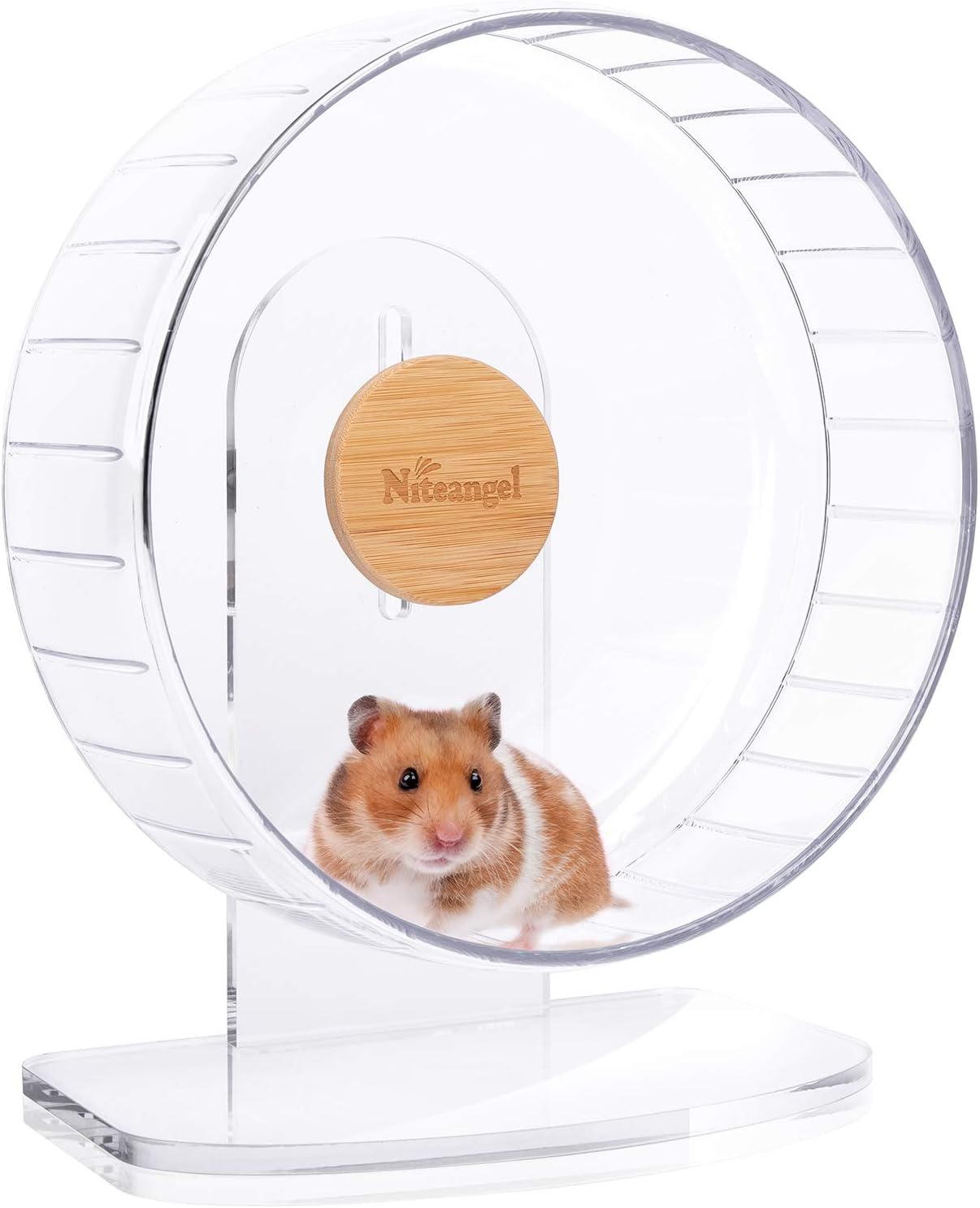
This is also where a modest upgrade budget pays for itself. For dwarf hamsters, we point owners to the Niteangel Super-Silent 10 inch running wheel, which clears the flat-back rule for Roborovskis and Campbell's dwarfs with room to spare and rides on a sealed bearing that stays quiet through heavy nightly use. For Syrians, the same wheel exists in a larger diameter: the Niteangel Super-Silent 11 inch running wheel meets the minimum for most Syrians, and if your Syrian still shows any arch on the video test, the honest correction is the next size up rather than hoping posture improves.
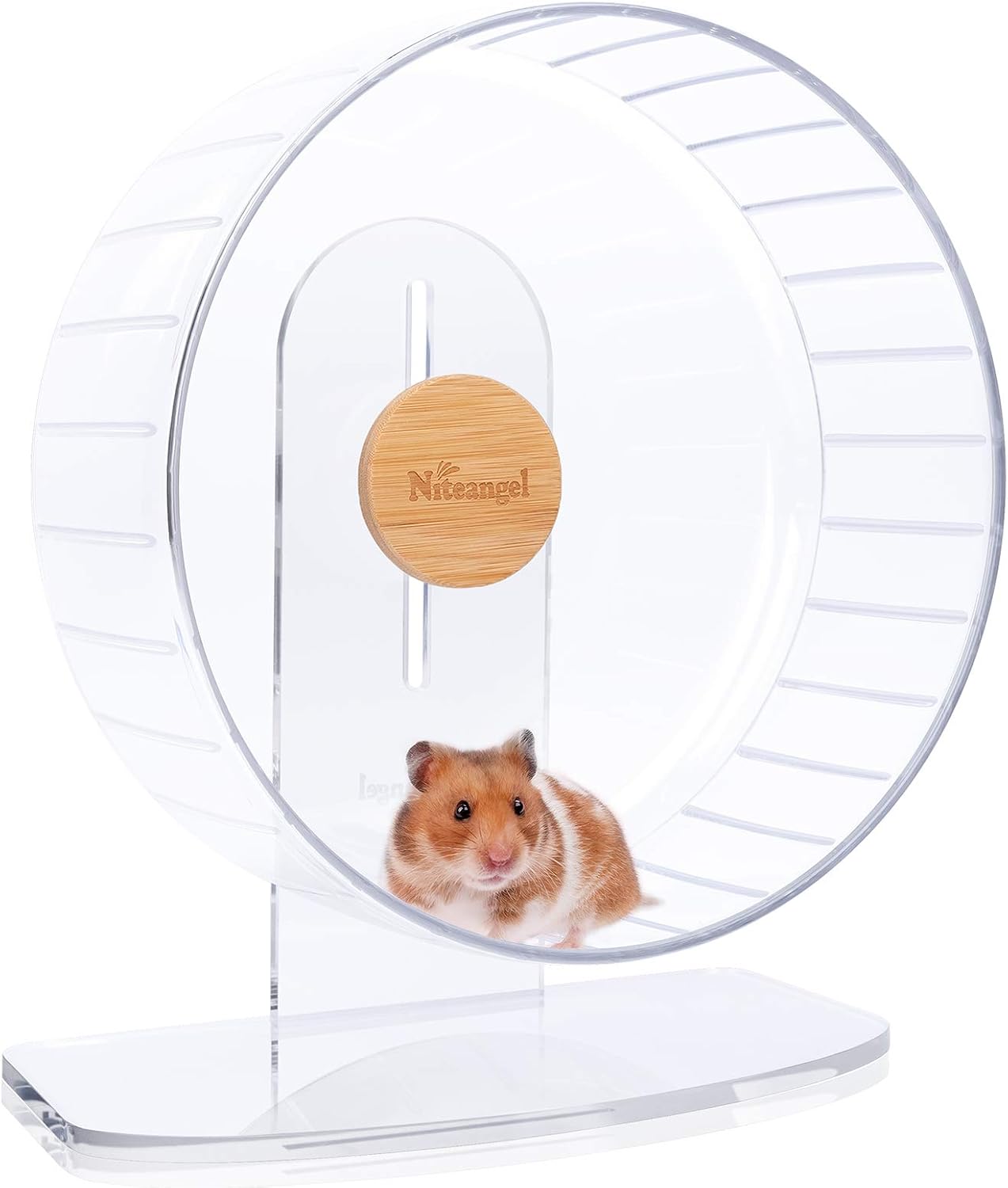
Both are solid-surface wheels, which matters for the bumblefoot reasons above. If you buy nothing else after reading this article, the pairing of correct diameter plus a sealed bearing solves the two problems that end most wheels' careers: posture damage and midnight squeaking.
Placement, stability, and the small details that get ignored
A correctly sized wheel can still fail if it is mounted badly. Three details decide whether the wheel gets used:
- Stability. A wheel that wobbles or rocks on its base makes nervous hamsters reluctant to run. Check the stand on a hard floor, not carpet, and tighten the axle collar if there is side-to-side play. Free-spinning is the goal; rattle is not.
- Clearance. The wheel needs headroom above and clearance on all sides. A 12-inch wheel jammed under a low cage shelf forces the hamster to duck entering and exiting, and some simply stop bothering.
- Location within the cage. Put the wheel away from the food stash and the sleeping quarter. Hamsters prefer to toilet near the wheel, which keeps the food corner cleaner and makes spot cleaning easier.
One more mechanical point: check the spin. Lift the wheel and give it a flick. It should rotate smoothly for several seconds with no scraping. A wheel that stops almost immediately has drag in the bearing or the base mount, and drag is what turns a nightly 6-kilometer runner into an occasional jogger.
When your hamster ignores the wheel entirely
Not every hamster runs. Some individuals, particularly older animals, treat the wheel as furniture, and that is not automatically a welfare failure. Before deciding your hamster is simply lazy, rule out the fixable causes:
- The wheel is too small or uncomfortable to bother with. Paradoxically, undersized wheels get used less. Run the flat-back test even if the wheel is barely used; you may find the hamster tried it, hated it, and moved on.
- Drag or noise. A stiff or squeaky axle discourages use. Fix the bearing and watch what happens over the next week.
- Age and weight. Older hamsters run less, and overweight hamsters often avoid the wheel entirely. For weight, scatter feeding, which makes the animal forage for its kibble across the cage floor, tends to work better than wheel encouragement.
- Enrichment competition. A deep burrowing substrate, a sand bath, and tunnels give a hamster other ways to spend the night. Wheel running is one outlet, not the only legitimate one.
If the animal is healthy, active elsewhere, and simply indifferent to the wheel, let it go. If it is gaining weight and inactive everywhere, the standard advice from small mammal veterinarians applies: check the diet first, then enlarge the activity options, and involve an exotics vet if the weight trend continues. According to the AVMA, small mammal pets benefit most from daily opportunities for natural behaviors, and for a hamster those behaviors are burrowing, foraging, and running. A good setup offers all three rather than leaning on the wheel alone.
Cleaning and replacement: the boring part that keeps the wheel in service
Wheels collect everything: urine on the track, fecal pellets wedged in the axle housing, dust from bedding. A dirty wheel is used less and smells more, and the smell concentrates in exactly the corner you placed it away from the food. The schedule we suggest is simple. Wipe the running track with warm water and a drop of unscented dish soap every week, dry it fully so the bearing does not corrode, and do a full monthly disassembly if your model allows it. Avoid vinegar soaks on wooden wheels, which can warp the track; a damp wipe is enough for wood.
Replace the wheel when the surface develops cracks, gouges, or a wobble you cannot true out at the axle. Cracked plastic is a toe-catcher, and a toe-catcher on a running surface is how injuries happen. There is no service life number to quote; a well-built wheel with a sealed bearing can last the animal's entire life, which is roughly three years for a Syrian and slightly less for some dwarfs. Buy once, size correctly, and the wheel stops being a recurring purchase.
The takeaway: five minutes of video, one correct number
The whole argument fits in three sentences. Hamsters run kilometers a night because running is what their bodies and brains are built to do, so the wheel you provide is not a toy but the single most-used object in the cage. The flat-back test tells you in five minutes whether the wheel you own deserves its place. And the numbers are not mysterious: 10 inches for dwarfs, 11 to 12 inches minimum for Syrians, solid surface always, sealed bearing preferably.
Tonight, prop the phone against a book, film thirty seconds from the side, and pause it mid-stride. If the spine is a straight line, you are done, and you can stop reading wheel reviews forever. If it tents upward, replace the wheel this week, not next month. Your hamster will run regardless. The only question is whether it runs in a posture you would accept for an animal you claim to love.
Related Reading
Want more on this topic? Check out our guides on best small pet cages habitats guinea pigs hamsters rabbits, best small pet chew toys dental health, best sugar glider cages accessories.