Best Budgie and Parakeet Cages and Accessories 2026: Habitat Guide for Small Birds
Published: June 13, 2026 — Category: Birds
Source note: The AVMA reports that birds have highly efficient respiratory systems that are sensitive to airborne toxins, which makes ventilation and the avoidance of non-stick cookware fumes, candles, and air fresheners a genuine welfare issue rather than a preference.
Summary: This guide covers what published avian guidance and manufacturer specifications say about budgie housing: minimum cage width, safe bar spacing, why dowel perches cause foot problems, how to build enrichment into a small cage, and which three linked product options match which kind of owner. It is a reference guide, not a hands-on test report.
Disclosure: As an Amazon Associate, commissions are earned from qualifying purchases made through the affiliate links below (tag: nannan09-20). This does not change the price paid. Recommendations below are based on published guidance, manufacturer specifications, and verified owner reports, not on laboratory or instrument testing.
Why Housing Is the First Welfare Decision for a Budgie
Budgerigars are small parrots, not decorative cage birds. In Australia they travel long distances in flocks, and that biology does not disappear when a bird moves into a living room. The single most common housing mistake is buying a tall, narrow cage because it looks tidy in a corner. Budgies fly horizontally, so width is the dimension that matters. A tall cage with a small footprint gives a bird the illusion of space while denying it the one thing a cage should provide: room to move between perches under its own power.
The Association of Avian Veterinarians publishes owner-facing guidance on cage sizing and husbandry, and the practical takeaway is that a single budgie needs a cage wide enough to fly a short hop, not merely to stand and turn around. For one bird, treat 18 inches of width as an absolute floor, not a target. For a pair, which is the kinder arrangement for such a social species, plan for at least 30 inches of width. Anything advertised as a starter cage at 20 inches wide is a temporary container, not a habitat.
Respiratory safety is the second non-negotiable. Birds have a highly efficient air-sac respiratory system, which means they absorb airborne irritants far more readily than mammals do. Polytetrafluoroethylene fumes from overheated non-stick pans, scented candles, aerosol fresheners, and some cleaning sprays have all been associated with acute respiratory injury in pet birds. The ASPCA Animal Poison Control maintains guidance on household hazards, and avian-specific detail is available through the Merck Veterinary Manual section on exotic and laboratory animals. Cage placement in a well-ventilated room away from the kitchen is part of the equipment decision, not an afterthought.
What to Look For in a Budgie Cage
Bar spacing and wire gauge
Bar spacing is a safety specification, not a style choice. For budgies, spacing between roughly 3/8 inch and 1/2 inch is the accepted range. Wider than that and a small bird can push its head through and become trapped; narrower is safe but usually signals a cage built for finches, which will not have the structural strength for a parrot that chews. Wire gauge matters too: thin, springy bars flex when a bird climbs, and flexing welds eventually fail. Powder-coated steel in the 2 mm to 2.5 mm range is a reasonable benchmark for a small-parrot cage.
Door design and access
A cage is cleaned weekly for years, so door design determines whether maintenance is a two-minute task or a twenty-minute ordeal. Look for at least one door large enough to pass both hands through, and prefer doors with a latch that cannot be opened by a beak. Budgies are accomplished escape artists, and owner reports repeatedly describe birds learning to slide simple hooks. A secondary food-door that opens independently of the main door is genuinely useful because it lets a keeper swap bowls without giving the bird an exit.
Base, tray, and seed control
Seed hulls and feather dust travel. A cage with a deep base and a fitted seed guard keeps a meaningful share of debris inside the cage instead of on the floor. Rounded base corners are easier to wipe than square corners, where hulls and droppings collect. The tray should slide out smoothly on its own rails and should sit below a grate that keeps the bird off its own waste. Trays that require lifting the whole cage to remove are a design failure for daily use.
Materials and coatings
Non-toxic powder coating over steel is the standard for quality cages. Zinc-plated or galvanised wire is a concern with parrots because ingested zinc is toxic; a bird that chews a galvanised bar over months can accumulate exposure. Painted cages must use a coating rated as non-toxic and lead-free, and the finish should not chip under a fingernail. Stainless steel is the gold standard for durability and hygiene, and it is priced accordingly. Wooden cages are unsuitable for budgies because they cannot be disinfected properly and a determined bird will remodel them.
Perch placement and interior layout
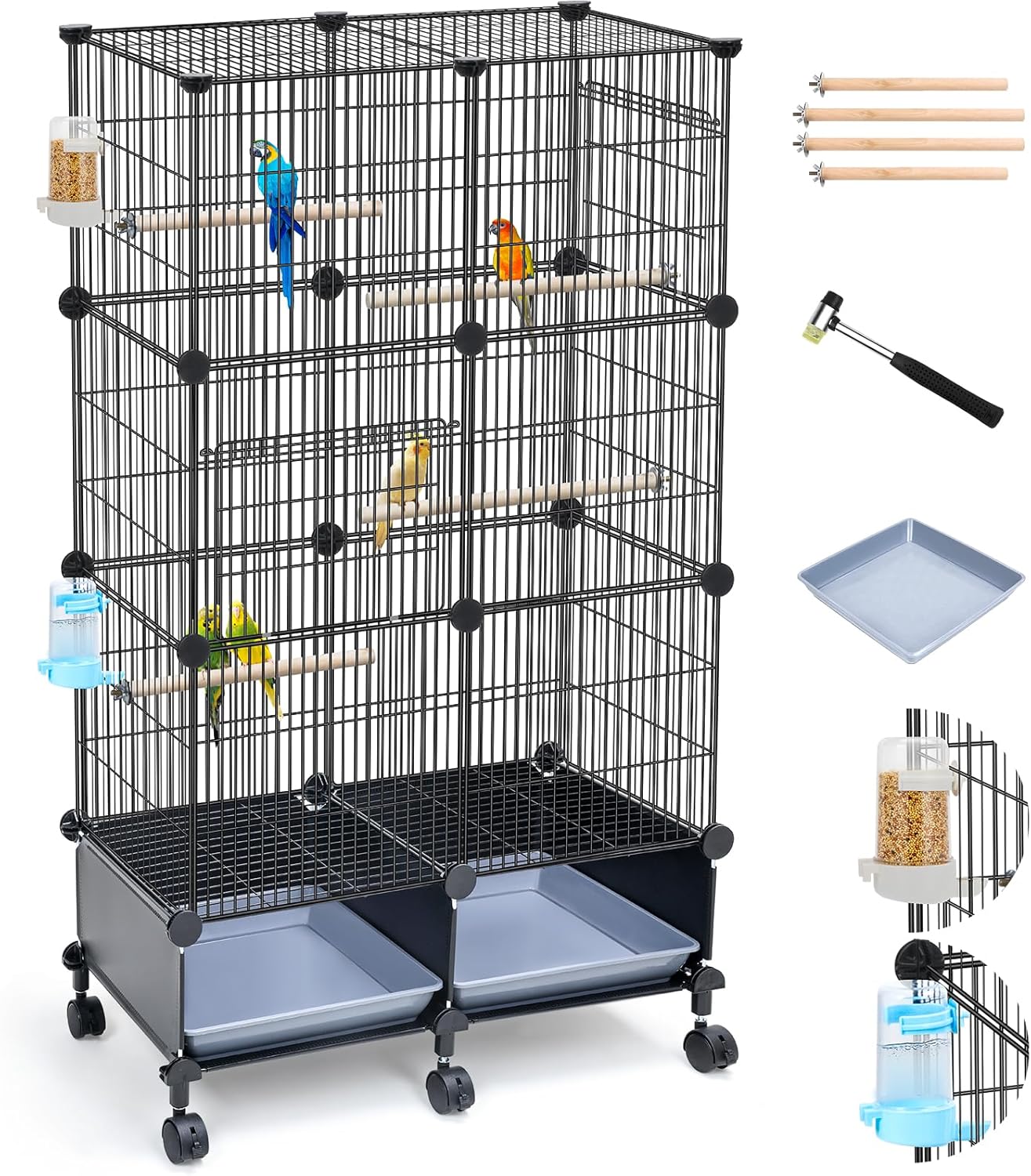
Perches should be arranged so a bird can hop or fly from one to the next without crossing its own droppings, and so that no perch sits directly above a food or water bowl. At least one perch should sit high, because budgies roost as high as the cage allows, and at least one should be positioned near a wall for a sense of security. The layout should leave an open flight lane across the widest part of the cage. Cluttering the middle with toys removes exactly the space the cage was bought to provide.
Perches: The Cheapest Upgrade That Actually Matters
Uniform dowel perches are the default in almost every budget cage, and they are the most common cause of preventable foot disease in small parrots. A bird standing on a constant-diameter dowel puts pressure on the same small area of the foot every hour of every day. Over time that produces pododermatitis, commonly called bumblefoot: a painful, sometimes infected swelling on the sole. Natural branch perches of varying diameter, roughly 0.4 inch to 0.8 inch for budgies, let a bird shift its weight and exercise its toes the way it would on real branches.
Material choice matters as much as diameter. Untreated fruitwood, manzanita, and similar hardwoods are appropriate; avoid perches made from treated timber, aromatic softwoods such as cedar, and any wood with visible chemical staining. Bark left in place gives a bird something to strip and helps keep nails worn, though bark does flake for the first week or two. Perches should be scrubbed weekly with a stiff brush and warm water, because droppings on a perch are a direct route to foot infection. Hardware should be stainless steel with wing nuts or bolts that can be re-tightened, since threaded fittings work loose over months of use.
Enrichment: Foraging, Shredding, and Rotation
A cage with perches, food, and water and nothing else is a holding pen. Budgies are foragers by nature and will spend hours working for food in the wild; a bowl of free-access seed removes that entire behaviour from their day. Foraging toys that require a bird to extract food through a narrow opening restore some of that work. The design detail that matters is adjustability: a fixed-difficulty puzzle is solved once and then ignored, while an adjustable opening lets a keeper tighten the challenge as the bird learns.
Enrichment should be rotated rather than accumulated. Three to four toys in the cage at a time, with a weekly swap from a stored set, keeps novelty high without crowding the flight lane. A balanced set includes one foraging item, one shreddable item such as paper or balsa, and one item that makes noise. Toys should be checked weekly for loose parts, exposed wire, and frayed rope, because a budgie can become entangled in a loop of thread or ingest a fragment of plastic. Cleaning matters too: plastic and hard rubber toys should be washed with warm water and a bird-safe cleaner, and any toy that cannot be cleaned should be treated as disposable.
Product Options: Three Linked Picks
The three entries below correspond to the three affiliate links below. Each describes the category of product the link represents and the owner it suits, along with the trade-off that comes with it. Nothing here is based on laboratory measurement; specifications are as published by manufacturers, and behavioural notes reflect patterns described in verified owner reports.
1. A wide powder-coated flight cage
The first option is a wide, powder-coated steel flight cage with a fitted seed guard and a pull-out debris tray, in the general class of a 52-inch horizontal flight cage. This is the category to choose if the priority is genuine horizontal flight space for two to four budgies at a mid-range price. The trade-off is footprint: a cage this wide needs a dedicated wall or table, and the included dowel perches and small plastic bowls should be replaced on arrival. Assembly is typically diagram-only, and the supplied tools are usually the weakest part of the package.
2. A heavier-gauge wrought iron cage with a rounded base
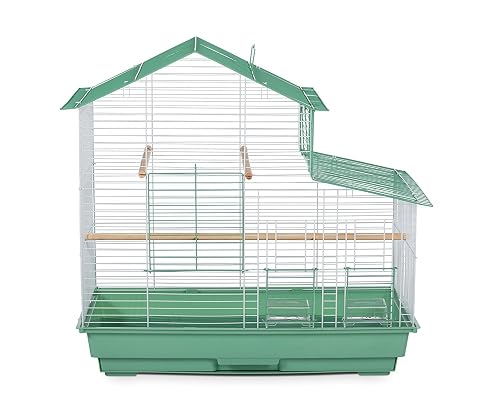
The second option is a smaller wrought iron parakeet cage with a rounded base, a pull-out grille and tray, and locking feeder doors, in the class of a roughly 31 by 20 inch cage on a stand. It suits an owner who values build quality and easy cleaning over maximum dimensions, and it works for one or two budgies that get daily time outside the cage. The trade-offs are height, which is limiting for larger English budgies, and included plastic cups that are better replaced with stainless steel. The stand may need felt pads on hard flooring.
3. A clear-base cage and natural wood perches
The third link covers two complementary items that address the two most common owner complaints: mess and foot health. The clear-base cage in this class uses an outward-flaring plastic apron to contain seed hulls and wipes clean in under a minute, which makes it a strong choice for a single budgie or for an owner with limited mobility or dexterity. Its trade-off is size: an 18-inch cube is a one-bird cage and should not house a pair permanently. The natural wood perch set in the same link provides mixed-diameter hardwood branches with stainless mounting hardware, and it is the single most cost-effective health upgrade for any cage still running dowels. Expect to scrub perches weekly and to re-tighten fittings periodically.
Sizing by Bird Count
| Birds in cage | Minimum width | Comfortable width | Bar spacing |
|---|---|---|---|
| 1 budgie | 18 in | 24-30 in | 3/8 to 1/2 in |
| 2 budgies | 30 in | 36-40 in | 3/8 to 1/2 in |
| 3 budgies | 40 in | 48 in | 3/8 to 1/2 in |
| 4 budgies | 48 in | 52 in or larger | 3/8 to 1/2 in |
These figures assume the birds also get daily out-of-cage time. A cage used only as a sleeping and feeding station can be smaller than one that houses birds all day, but the width floor for a single bird does not drop below 18 inches under any arrangement. When in doubt, buy the wider cage: budgies use horizontal space every waking hour, whereas vertical space above the highest perch goes unused.
Setting Up the Cage: A Practical Sequence
Start with placement. Put the cage against at least one wall, out of direct draughts and direct sun, away from the kitchen, and at roughly eye level if possible. A cage at floor level puts a small bird below the feet of everyone in the room, which is stressful, and a cage above head height makes daily handling awkward. If the cage comes on a stand with casters, check the locks and add felt pads on hard floors to stop creeping.
Next, fit perches before toys. Place two or three natural wood perches at different heights and angles, leaving a clear flight lane across the widest span. Position food and water stations so that no perch sits directly above them. If the cage has a grate, confirm it sits above the tray and that the tray slides freely; if the tray catches, adjust the rails before the bird goes in, not after.
Then add enrichment. Introduce one foraging toy, one shreddable item, and one noise-making item, and keep the rest in storage for rotation. Finally, replace the stock bowls with stainless steel if the cage shipped with plastic. Stainless is easier to disinfect, does not scratch, and does not harbour bacteria in scratches the way plastic does. Bowls should be washed daily with hot water and a bird-safe cleaner, and dried before refilling.
Maintenance Schedule
Daily tasks take about five minutes in a well-designed cage: replace the tray liner, wash food and water bowls, spot-clean perches, and check that toys are intact. Weekly tasks take twenty to thirty minutes: remove and scrub the grate and tray, wipe down bars, scrub perches with a stiff brush, and rotate toys. Monthly, disassemble what can be disassembled, deep clean perches and hard toys, inspect welds and door latches for movement, and re-tighten any threaded perch fittings.
A cage with a clear apron base changes the daily routine rather than the weekly one. Wiping the apron takes under a minute, but the weekly grate scrub and monthly deep clean still apply. No cage design eliminates maintenance; the good ones simply move effort out of the daily column. Owners who consistently fall behind on cleaning should choose a cage with the fewest parts and the largest single access door, because friction is what causes missed cleanings.
Safety Checks and Common Mistakes
The most frequent avoidable injuries in small-parrot cages come from bar spacing that is too wide, perches placed above food and water, and toys with loops of thread or exposed wire. Check bar spacing against the specification before purchase rather than after, and measure the actual gap on arrival, because manufacturer figures are sometimes rounded. Inspect every new toy for loose bells, split plastic, and long rope loops, and trim or discard anything that could catch a toe or a tongue.
Other common mistakes include using sandpaper perch covers, which abrade the sole and worsen foot problems rather than preventing them; using bedding or loose substrate in the tray, which hides waste and grows mould; and placing the cage in a kitchen. Non-stick cookware overheated on a hob has been associated with acute respiratory failure in birds, and the safest policy is to keep birds out of the kitchen entirely. Scented candles, plug-in air fresheners, and aerosol sprays belong in the same category of avoidable risk. The ASPCA pet care library and the Association of Avian Veterinarians bird owner resources both cover household hazards and basic husbandry for new owners.
Finally, avoid the round cage entirely. A round cage has no corner for a bird to retreat into, and the curved bars make climbing awkward. It is a decorative object that happens to hold a bird, not a habitat, and no amount of accessories fixes the shape.
Frequently Asked Questions
What size cage does a single budgie need?
Treat 18 inches of width as the absolute minimum and 24 to 30 inches as the realistic target for a bird that spends most of the day caged. Bar spacing should be between 3/8 and 1/2 inch. Height is less important than width, and round cages should be avoided. A bird that gets several hours of out-of-cage time daily can live comfortably in a smaller cage than one that does not, but the width floor does not change.
How many budgies can share one cage?
Budgies are highly social and generally do better in pairs than alone. Two bonded birds need at least 30 inches of width; three need around 40; four need 48 to 52. Provide more than one food and water station once there are three or more birds, because resource guarding at a single bowl is a common cause of squabbling. Introduce new birds gradually and watch for bullying, which can be subtle in budgies.
Are dowel perches actually harmful?
They are harmful when they are the only perch type in the cage. Constant-diameter dowels concentrate pressure on one area of the sole and are associated with pododermatitis, or bumblefoot. Natural wood perches of mixed diameter let a bird shift its weight and exercise its feet. Sandpaper perch covers are not a fix; they abrade the foot and can make the problem worse.
How often should a budgie cage be cleaned?
Daily for tray liners and bowls, weekly for the grate, tray, bars, and perches, and monthly for a full deep clean of perches, toys, and hardware. A cage with a large single access door and few removable parts is easier to keep on schedule than a cage with many small doors and tight corners, and consistency matters more than the specific product.
Do budgies need toys?
Yes. A cage with only perches, food, and water does not meet the behavioural needs of an intelligent, foraging bird, and boredom is associated with screaming, feather damage, and stereotypic behaviour. Keep three to four toys in the cage at a time and rotate weekly. Include at least one foraging item, one shreddable item, and one item that makes noise, and inspect everything for wear each week.
Final Recommendation
Spend the budget on width first, then on perches, then on enrichment. For two to four budgies, the wide powder-coated flight cage in the first link is the strongest value below, provided the stock dowels are replaced immediately. For one or two birds in a smaller space, the heavier-gauge wrought iron cage in the second link is the better-built option, with the caveat that its height limits larger English budgies. For a single bird and an owner who wants the least daily cleaning friction, the clear-base cage in the third link is the most practical design, paired with the natural wood perch set from the same link. Whichever cage is chosen, the accessories matter as much as the enclosure: mixed-diameter perches, stainless bowls, and a rotating set of foraging and shredding toys turn any of these cages into a habitat rather than a container.
Related reading: Bird Cage Accessories and Essentials, Bird Cages, and The 6 Best Bird Cages for Parrots and Parakeets in 2026.