The first walk usually ends at the front door, and that is fine
Put a leash on a dog and it pulls toward the sidewalk. Put a harness on most cats and they lie down, legs splayed, radiating quiet betrayal. If that has happened in your hallway, nothing is wrong with your cat. The harness is a strange, heavy shell that hijacks her balance, and the plan you were following skipped the three steps that come before the front door. Our position after watching this pattern repeat across owner forums, vet behavior resources, and training guides is blunt: leash training a cat is really harness training, and almost every failure happens before the leash clip ever clicks.
So this guide lives almost entirely indoors. We will fit the vest properly, get your cat moving in it like it is nothing, rehearse the door, and only then step outside for a first trip measured in minutes, not blocks. Done in that order, the ending is a cat who asks to go out. Done out of order, the ending is a cat who bolts the moment the door opens and a harness you never touch again.
Why a harness is worth three weeks of patience
An indoor cat sees the same rooms every day. The enrichment case for controlled outdoor time is strong: new smells, moving insects, real grass, wind. According to the American Association of Feline Practitioners, environmental enrichment that offers novelty and choice is a core part of keeping indoor cats behaviorally healthy, not a luxury. A harness is one of the few tools that delivers genuine novelty with a physical safety line attached.
There is a middle path argument too. A cat with scheduled outdoor adventures often demands them less obsessively than a cat who darts at every open door. The routine gives the instinct an outlet, and the harness converts door-dashing from a gamble into a trained behavior with a cue. That is a housekeeping benefit most owners do not anticipate until they see it.
Start with the fit, not the walk
Harness fit decides everything downstream. A loose vest lets a cat back out in one smooth reverse-wiggle, which is exactly the move cats save for the moment they panic. A tight one changes their gait so much that they blame the harness for the discomfort and reject the whole project.
Measure first: girth around the widest part of the chest, just behind the front legs, plus a rough neck measurement. Most cats wear small sizes even at healthy weights, so ignore the size label and trust the tape. The classic test is the two-finger rule: you should slide two flat fingers under every strap, with contact but no pinch. Vest-style harnesses spread pressure across the chest instead of concentrating it at the throat, which matters when a cat lunges at a pigeon. The rabbitgoo Cat Harness and Leash Set is a vest design with four adjustment points that owner feedback consistently rates as escape-resistant when fitted snugly, and it comes with a matching short leash. If your cat is between sizes, the PetThem Adjustable Cat Harness and Leash Set offers a similar vest layout with a wide adjustment range, which is the feature that actually saves you when the tape measurement disagrees with reality.
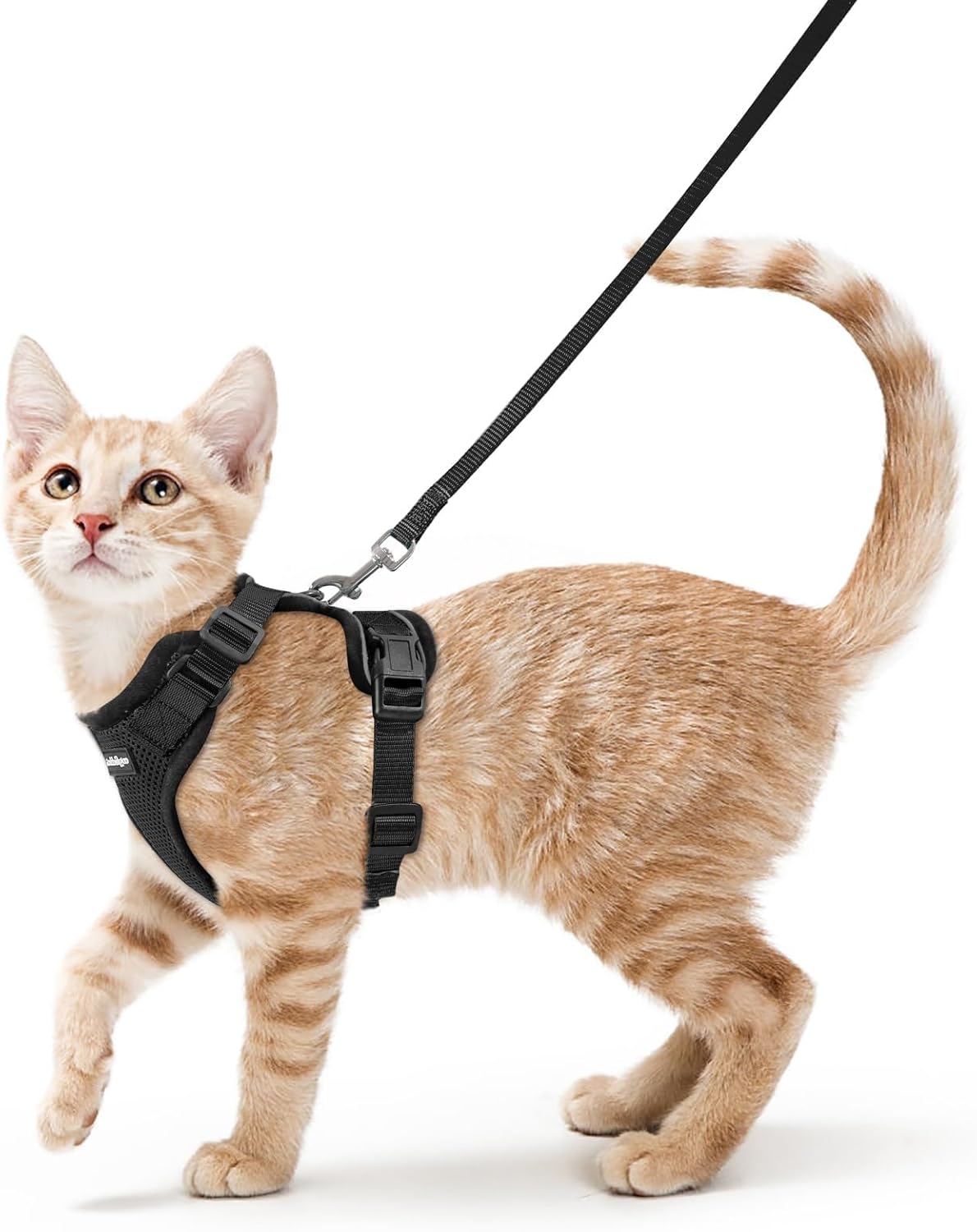
One caution while you are shopping: a harness is not a collar, and a collar is not a leash anchor. For cats, any collar should be a breakaway design that pops open under load. Never attach a leash to a collar, even briefly, because a startled cat can injure her neck in a single jerk.
Week one: the harness is just a weird rug
The goal of the first week is not walking. It is indifference. You want your cat to treat the harness the way she treats a rug on the floor, which means it needs to stop predicting anything unpleasant.
Start with the harness itself, unclipped, placed near the food bowl for a couple of days so it picks up good associations by proximity. Then begin micro-sessions: drape it over her back for three seconds, feed a high-value treat, remove it. Repeat at random times, never right after anything stressful. The moment of truth is the first full clip. Expect the famous floor-flop; almost every cat does it once. Do not laugh, do not film it for the group chat, and do not pull her upright. Just drop treats near her nose, let her stand when she chooses, and end the session after a minute or two while she is still calm.
Spread this over several days rather than forcing one long session. Sessions should end early and often. A cat who ends week one strolling around the living room in a vest has finished the hardest part of the entire program, and the yard trip three weeks later is almost a formality.
Multi-cat households need one extra pass. A second cat who stalks or ambushes the harnessed cat can undo a week of good sessions, because she cannot flee or fight properly while wearing gear. Either separate the cats during sessions or let the resident cat investigate the harness on the floor first; a shared sniff usually deflates the drama. And if the second cat is the confident one, do not be surprised if she demands a harness of her own within the month. Duplicate the program for her rather than sharing gear, because a borrowed harness smells like the wrong cat and fits like the wrong cat too.
Week two: add the leash, stay indoors
Clip the leash to the harness and let it trail for a minute under supervision, so she feels the tug and learns nothing terrible follows it. Then pick the leash up and follow her. That is the whole session. Indoors, your job is to be a loose leash reminder, not a director.
Here we differ from the dog-walking instinct most people arrive with. Dog leash training teaches a heel, a position, a direction. Cat leash training teaches a rhythm: you go where she goes, at the speed she sets, and your only real skill is keeping the leash slack and quiet. Practice following her between rooms, dropping a treat near your feet now and then so she checks in voluntarily. The check-in habit is what saves you outside, because a cat who re-anchors on you when startled is manageable, while a cat who only anchors on the environment is a kite.
Keep these sessions to five or ten minutes. Watch for the level of comfort that looks like ordinary behavior: grooming mid-session, a full stretch, tail up. Those are your green lights for stage three.
The door is a threshold, not a start line
The first outdoor trip is where plans collapse, so script it before you open anything. Pick a quiet time of day: early morning or a weekday afternoon when the street is empty, the neighbor's dog is inside, and the school run is over. Choose a confined space, ideally a fenced yard or a quiet patio. Skip parks entirely for the first several weeks.
Before the door opens, harness on, leash held short in your leash hand, treat pouch loaded. Then open the door and wait. Let her decide to cross the threshold. If she does, the rule is five minutes, no exceptions, even if everything is going beautifully. Ending while she wants more is the trick that makes her eager next time; waiting until she is overloaded teaches her that outside is where things go wrong. Follow her around the yard, let her sniff the same spot for four of those five minutes if she wants, and then walk back inside with her before she asks.
Apartment dwellers: your version is a hallway and a patch of grass by the entrance, at a deliberately boring hour. The destination matters far less than the pattern of short, calm, ended-too-soon trips. Lengthen by a few minutes per trip across a week or two, and let her tolerance, not a map, set the pace.
The leash in your other hand
A word about the leash itself, because it is the one piece of kit owners improvise with and regret. The right cat leash is a short, fixed-length line of one and a half to two meters, light enough that a cat does not feel like she is towing cargo. Retractable leashes are the wrong tool for this job, full stop. A cat on a retractable learns that pulling extends her world, which rewards the exact lunging behavior the program is trying to soften, and when something startles her the reel is too slow to matter. If the harness set you bought includes a matching leash, use that one; it is sized for the job already.
Grip matters more than gear, though. Hold the leash loosely in a relaxed hand with a thumb loop, never wrapped around fingers or a wrist, because a sudden lunge with a wrapped leash becomes a shoulder injury for you and a dangling owner for her. Keep the line slack in a shallow U shape; a taut line transmits your tension straight down her spine, and tension is contagious. The leash should be something she forgets exists, which only happens when it never speaks first.
Reading the signals: curiosity versus overload
Outdoor sessions go wrong when owners miss the difference between a cat gathering information and a cat quietly drowning in it. The signals are legible once you know the vocabulary:
- Curiosity: tail up or gently swaying, ears forward, slow deliberate sniffing, weight settled.
- Uncertainty: ears rotating sideways, tail low and stiff, freezing mid-step with muscles loaded.
- Overload: dilated pupils, tail lashing, crouched walk, flattened body, the pre-bolt stillness.
At uncertainty, stop and let her process; most cats self-resolve in ten or twenty seconds. At overload, do not scoop her up in front of the scary thing, because that teaches her that being grabbed follows every fright. Instead, back up a few steps toward the last spot where she was confident, keep the leash slack, and give her the choice to follow you. Retreat first, then go inside. The inside part matters: never end a session at peak fear, or the doorway itself becomes the trigger.
Escape prevention: plan for the one bad moment
Even a perfectly fitted vest can meet a determined cat and a loose shrub. Build the backup layers before you need them. A breakaway collar with identification stays on outdoors in addition to the harness, never instead of it. A tag that holds a tracker is the practical upgrade; the Dgerp Airtag Cat Collar Breakaway pairs a reflective breakaway band with a holder sized for a tracking tag, which covers both the visibility and the find-her-fast problems in one purchase. Microchipping, if you have not already, is the layer that survives every other failure.
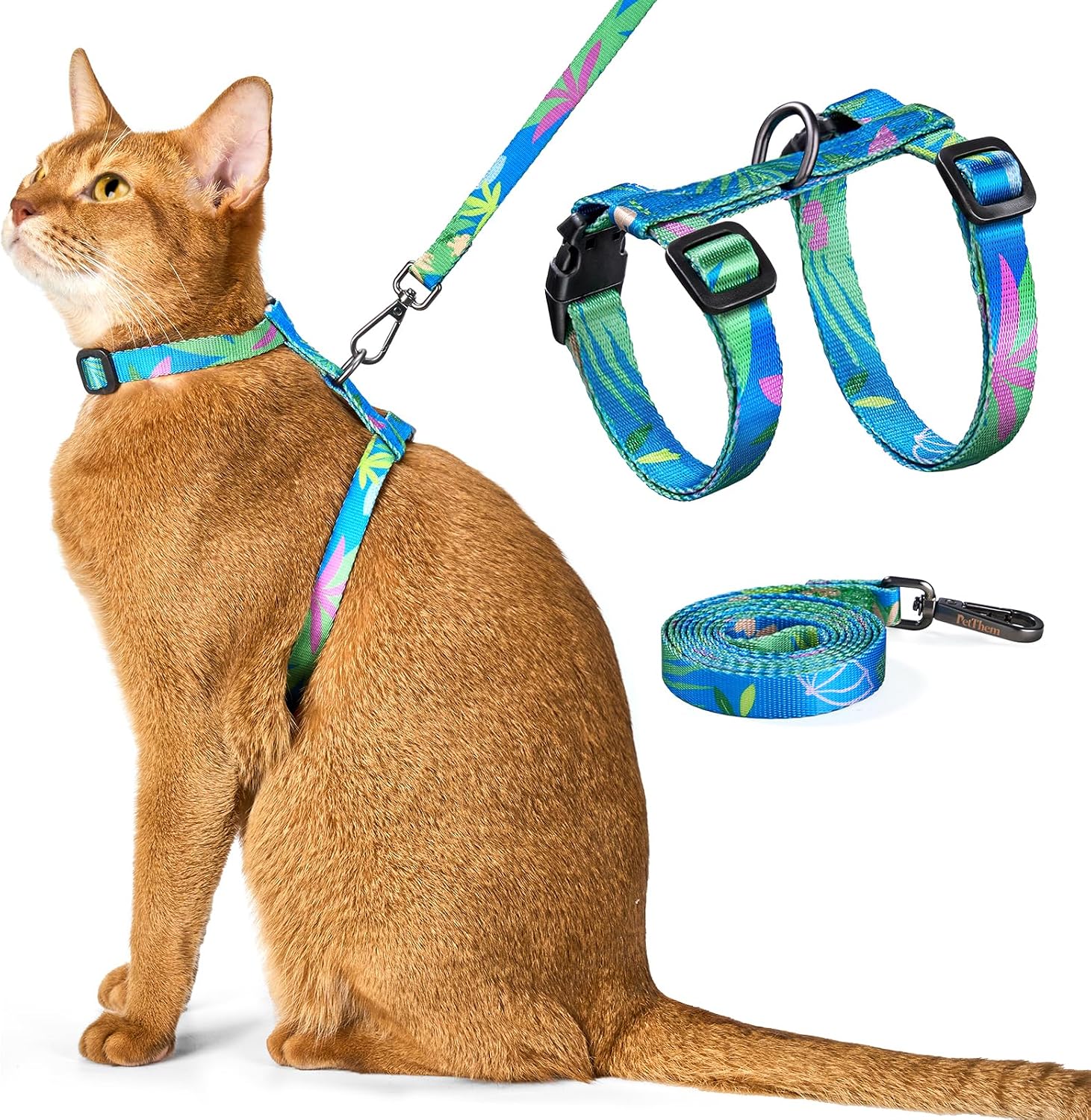
Re-run the two-finger test before every single outing. Straps settle, fur shifts, and a harness that was snug last Tuesday can have a finger-and-a-half of slack today. That slack is the exact amount a cat needs to reverse out of a vest. Thirty seconds of checking is cheaper than a missing-cat week.
Weather, season, and the parasite question
Outdoor time has seasonal fine print. In winter, most cats will tell you with their paws when the ground is too cold, but do not rely on that: short-haired and lean cats lose heat fast, and anything below freezing is a no-go regardless of enthusiasm. In summer, test pavement with the back of your hand held down for five seconds; if you cannot hold it, her pads cannot either. Winter also brings the silent hazard under every parked car. According to the ASPCA Animal Poison Control Center, ethylene glycol antifreeze is attractive to animals, sweet-tasting, and lethal in small amounts, so steer her away from puddles and drip stains entirely.
Fleas, ticks, and mosquitos do not care that your cat is on a leash rather than roaming free. According to the AVMA, year-round parasite prevention is the baseline recommendation for pets with any outdoor access, and a five-minute yard session counts. Talk to your vet about a product labeled safe for cats specifically, because several dog-targeted preventives contain permethrin, which is toxic to cats even in trace contact.
One more seasonal note: freshly fertilized or treated lawns need a waiting period listed on the product label before any pet walks on them. A neighbor's perfect grass this morning may have been sprayed yesterday evening.
When leash training is the wrong plan
Some cats should stay indoors, and the honest guide says so. A cat who hides for hours after a harness session is not stubborn; she is over threshold, and pushing forward builds a fear association that can take months to undo. A senior cat with stiff joints may outdoors-enthusiastically injure herself on terrain she can no longer navigate, so arthritis candidates need a vet exam before the program, not after a limp. And a cat with a heart condition or a severe anxiety history deserves a conversation with your vet before you add the stimulus load of the outdoors, however controlled.
For those cats, enrichment has cheaper doors: a window perch with a bird view, rotating puzzle feeders, a secure catio if the budget allows. The harness is one route to novelty, not the only one, and forcing it is how a training project becomes a behavior problem.
The checklist we hand owners
Before the first door opens, all six of these should be true:
- Girth measured and harness passes the two-finger test at every strap.
- Cat walks, stretches, and grooms normally while harnessed indoors.
- Indoor leash sessions done, with voluntary check-ins established.
- Quiet time and confined location chosen for trip one, five minutes planned.
- Breakaway ID collar on, tracker or tag attached, microchip current.
- Parasite prevention active and season hazards cleared for that day.
Then the only remaining rule is the one owners find hardest: end early. Every session should stop while your cat still wants more. Do that consistently and within a month you will have the rarest sight on the block, a cat sitting at the door in her vest, waiting for the leash you are already holding.
Related Reading
Want more on this topic? Check out our guides on best cat food premium nutrition for your feline friend, best cat gps trackers know where your cat goes, cat ear infections causes symptoms treatment guide.