A Guinea Pig Can Run Eight Miles a Night and Still Live in a Box
Wild cavies cover surprising ground foraging across grassland, and even a pampered house guinea pig keeps a strong drive to move, graze in short bursts, and patrol familiar routes. An enclosure, even one that meets modern minimum footprint standards, is a place to sleep, eat, and feel safe. It is not a gym. That gap between what a cage can provide and what a guinea pig's body expects is exactly why floor time exists, and it is the piece of daily care most owners quietly skip. The cage gets cleaned on schedule, the hay rack gets refilled, vitamin C gets dosed, and the pig still spends every hour of its life inside the same four walls.
We think floor time deserves the same seriousness as diet. Done well, it is a predictable daily routine that improves muscle tone, keeps nails and weight in check, and gives you the best observation window into your animal's health you will ever get. Done badly, it becomes a stressful weekly event that teaches your guinea pig to panic at the sound of the pen unfolding. This guide walks through the whole system: how much time to give, how to proof a room, pen versus free-roam, the first-session protocol, and the mistakes we see owners repeat every winter.
Why Daily Ground Time Is a Health Requirement, Not a Bonus
Guinea pigs are built for constant low-intensity movement. Their digestive system only functions correctly when food keeps moving through it, which is one reason a pig that stops moving and stops eating deteriorates so fast. Standing still for weeks has physical costs: muscle loss in the hindquarters, slower gut motility, weight creep from hay-plus-pellet diets with no expenditure, and more pressure hours on the plantar surfaces of the feet, which is a contributing factor in bumblefoot. There is also a behavioral cost. A pig that never leaves its cage has no environmental novelty to process, and boredom in rodents tends to express itself as bar chewing, bedding flinging, or lethargy.
According to the RSPCA, guinea pigs should have daily access to exercise space outside their main enclosure, in a safe, escape-proof area, in addition to living in a cage that is already generously sized. The exercise space matters because it lets the animal move at its own pace on a flat, open surface, which no cage layout really replicates. Humane organizations make the same point in slightly different words: the enclosure is the bedroom, and the animal needs a living room too.
One clarification before we go further, because the terminology trips people up: floor time is not the same as cage-free living. Free-roaming a guinea pig around an entire room full time is possible for experienced keepers with heavily modified rooms, but it carries real risks, from cords to gaps behind appliances, and it makes health monitoring harder because you stop seeing normal output patterns in one place. Our position is simpler: a properly sized cage plus one to two hours of supervised floor time every day covers the physiological and behavioral needs of nearly every pet guinea pig. That daily hour is where most of the health benefit lives.
How Much Time, and When to Schedule It
The working standard we recommend is at least one hour of floor time per day, every day, with more being better. Owners who can offer two hours in the evening usually see noticeably bolder, more active animals within a few weeks. Two scheduling details matter as much as duration.
First, consistency of time beats total minutes. Guinea pigs are creatures of routine with surprisingly accurate internal clocks, and a pig that gets floor time at 7 p.m. daily will start wheeking and waiting near the cage door around 6:45. Pick a slot you can hold seven days a week. The most common failure mode in floor time programs is not too little time on weekdays; it is skipping weekends entirely, which resets the animal's confidence every Monday.
Second, work with the crepuscular rhythm instead of against it. Guinea pigs are most naturally active at dawn and dusk. An early evening session after the household gets loud and active matches their energy peak, and midday sessions during the winter, when rooms are warm and bright, tend to produce a pig that sits frozen under the nearest hideout for fifty minutes. If your pig seems inert during floor time, check the timing before you check the pig.
Temperature deserves a mention here because it is November in most of the northern hemisphere, and floor time seasonality is real. The floor of a room is colder than the air at cage height, and a pig sitting on bare floorboards near an exterior wall in a draft can chill faster than you expect. Keep the room comfortably warm, keep the pen away from exterior doors and windows, and offer fleece or a hideout so the pig is never sitting directly on cold, hard flooring for the whole session.
Room Proofing: The Fifty-Minute Audit That Prevents Emergencies
Before the first session, walk the intended space on your knees. Literally. Get down to guinea pig eye level, about four inches off the floor, and you will notice an entirely different room: cable runs behind the desk, the gap under the dresser, the trailing surge protector, the corner where the rug curls up. Every one of those is at pig height and invisible from a standing position.
The proofing list we use, in priority order:
Cords and cables. A charging cable is a chew toy with a plug on one end. Route everything off the floor, use cord covers or split-loom tubing on anything unavoidable, and do not leave a power strip on the floor inside reach, even outside the pen walls. Guinea pigs have pushed panels apart and reached surprising distances.
Toxic plants. Anything leafy within reach gets checked. According to the ASPCA, a long list of common houseplants, including pothos, philodendron, dieffenbachia, and ivy, are toxic if chewed, and a floor-level plant is exactly at animal level. Either relocate plants for the session or skip free-roam in that room.
Escape routes and gaps. The gap behind the bookcase, the open doorway to a hallway that leads to stairs, the space under the kitchen units. Guinea pigs can flatten themselves through gaps that look absurdly small, and a pig behind the refrigerator is a genuine extraction emergency. Close doors, block gaps, and never run a session in a room you cannot fully close.
Other pets and other humans. Dogs and cats stay out of the room for floor time, full stop. Even a gentle dog watching through a pen wall is a persistent stressor, and prey animals do not get desensitized to predators by proximity, they just learn to be more anxious. Foot traffic matters too: schedule sessions when nobody is going to swing a door open into the pen.
Floor surface. Bare tile, hardwood, and laminate are slippery, and repeated sprinting on low-traction flooring strains hips and hocks and can aggravate the pressure sores behind bumblefoot. Lay down a rug, a fleece blanket, or interlocking foam mats across the play area. Traction is the single most underrated part of a good floor time setup, and it costs almost nothing.
Pen or Free-Roam: An Honest Comparison
Once the room is safe, you have a decision to make, and we will take a clear stance: most households should start with a dedicated floor pen, not free-roam, and graduate toward free-roam only if the room is genuinely secure.
The case for a pen is practical. A paneled pen defines the play zone, which lets you control the surface, keep hazards out, and clean up predictable output. It also means the session works even in a room you have not fully pig-proofed, because the barrier does part of the proofing for you. Modular wire-panel pens like the VISCOO 12-panel small animal playpen are the standard tool here: you configure the footprint to the space, the panels hook together without tools, and a two-by-four panel rectangle gives a pair of guinea pigs real running room.
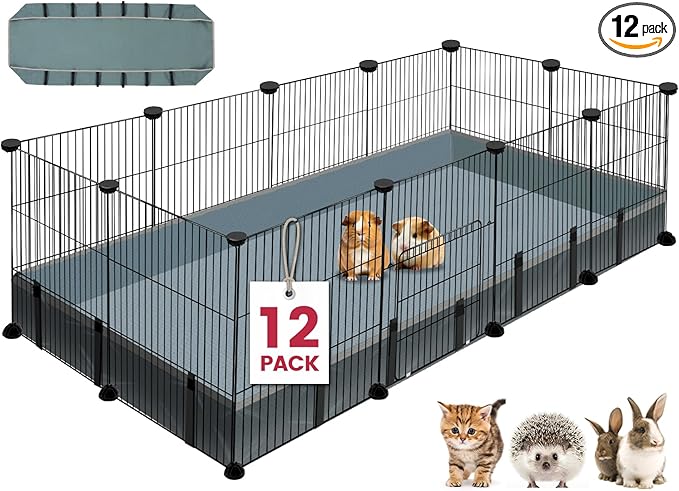
Set it up once and leave it up if you have the space; a pen that lives in the corner gets used daily, while a pen that gets assembled and disassembled tends to drift toward weekend-only duty.
Three pen details to get right. Panel spacing matters if you keep dwarf hamsters or very young guinea pigs, whose skulls and shoulders fit through gaps adults cannot; check the gap between the floor edge and the lowest panel, because that seam is where small animals escape. Height matters for rabbits, which jump cleanly from a standing start, so a rabbit pen needs panels well above sixteen inches or a covered top. And mesh pop-up exercise yards, the folding fabric kind, chew through quickly at pig mouth height and offer less structure; they are fine as a temporary travel option but we do not recommend them as the daily setup.
Free-roam, where the pig has a whole secured room, is the gold standard if you can do it safely. It produces the boldest, most confident animals and the most natural behavior, including full-speed laps you rarely see in a pen. But the requirements are heavier: every cord armored or removed, every gap blocked, doors kept closed, plants gone or elevated, and a family agreement that nobody opens that door during floor time. If your household cannot guarantee those conditions every single day, a pen is not a compromise, it is the correct choice.
What Goes Inside the Play Zone
An empty pen is a stage with no props, and a nervous guinea pig on an open stage just freezes. Structure the space deliberately.
One hideout minimum, positioned away from your sightline. Prey animals explore only after they have located cover. A hideout in the pen converts the whole area from threat to territory. A wooden hide works, and for a dedicated floor-time setup, something with multiple exits works better still: a three-way collapsible tunnel like the Rypet guinea pig tunnel hideout gives the animal entrances on three sides, so it never feels cornered, and it folds flat between sessions.
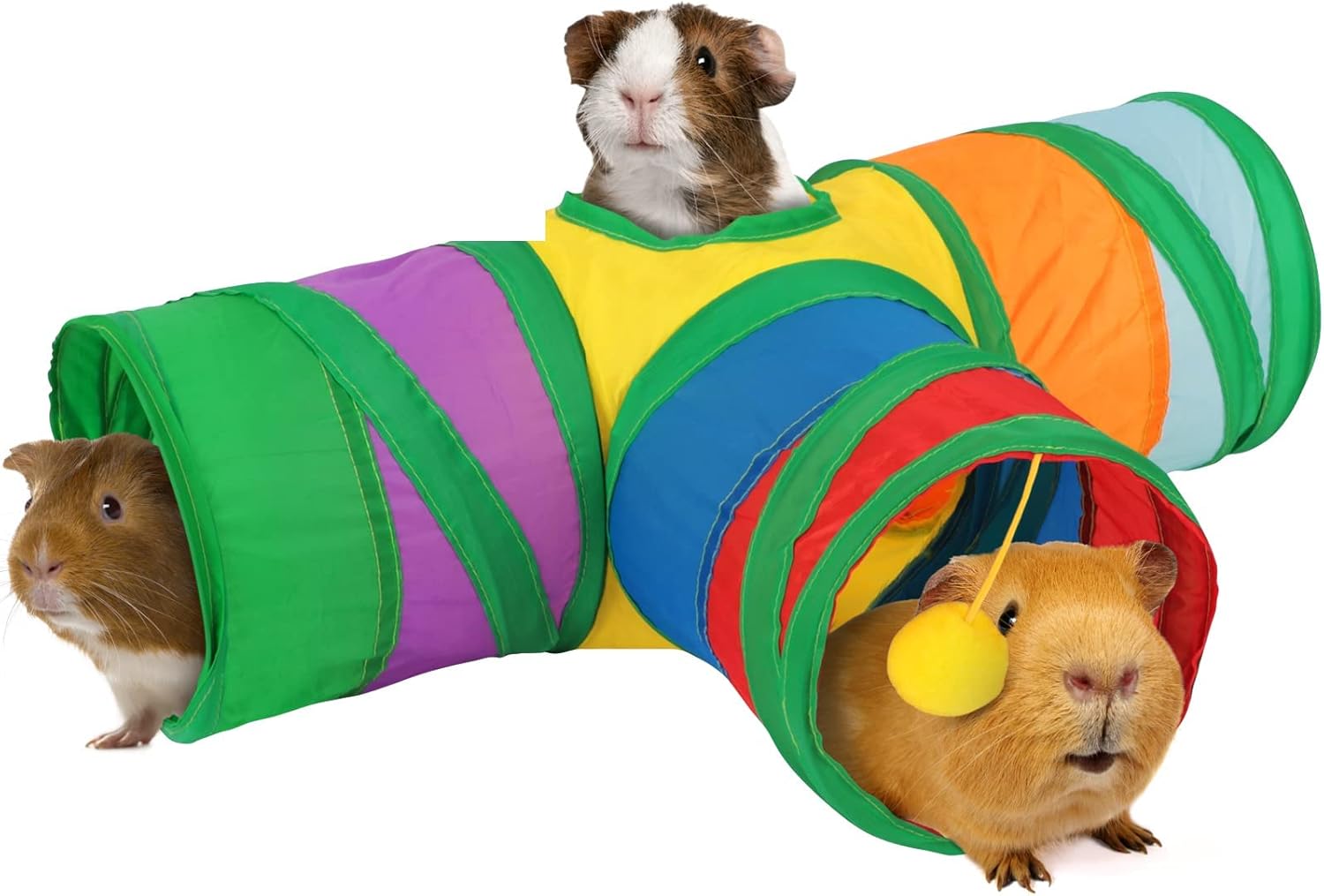
The rule of thumb we recommend: if the hideout has only one exit, a pig will enter it and refuse to come out; if it has two or three, the pig will use it as a base camp and keep moving.
Hay at one end, water ignored for short sessions. Scatter a small handful of hay and lay a short track of it along one side. Grazing while walking is the most natural floor-time behavior there is, and it keeps nervous pigs busy while they acclimate. Water is optional for a one-hour session; pigs hydrated at the cage do not dehydrate in an hour, and a water dish on fleece is mostly a mess generator.
One or two chew or play props, rotated weekly. Novelty is the point of floor time, so give the space a small, changing inventory. Rolled toys such as the woven grass chew balls made for rabbits and small animals give a pig something to nudge around the floor, and willow or apple-stick chews give it something to work on when it pauses. Rotate which props are in the pen each week so the space never becomes static. What you should not do is fill the pen with toys; two or three items plus hay is plenty, and clutter raises stress in a brand-new space.
Treats as a bridge, not a meal. A small, consistent treat used at the start and end of floor time builds a routine faster than anything else. Baked treat bites such as Oxbow Simple Rewards baked treats for guinea pigs and rabbits work well for this: one piece when the pig enters the pen, one piece when you are putting it back. The total treat budget for a session should stay trivial relative to daily hay and vegetable intake, because floor time is exercise, not a snacking opportunity.
The First Four Weeks: A Progressive Plan
If your guinea pig has never had floor time, or had a bad experience with it, do not start with a full hour in a new room. Prey animals need gradual exposure, and the schedule below is the one we recommend for a nervous or newly adopted pig.
Week 1: short, boring, same spot. Twenty to thirty minutes, in the pen, in the same room, at the same time every day. Sit on the floor a few feet away and read or look at your phone. Do not reach in, do not coax, do not film it. The message the pig needs to receive in week 1 is that this space appears every evening and nothing bad ever happens in it. Expect a lot of freezing and hiding in the tunnel; that is a normal acclimation script, not a failure.
Week 2: extend the clock. Move to forty-five to sixty minutes. Add the hay track and one chew prop. You can move slightly closer now. Most pigs start taking exploratory laps out of the hideout somewhere in this week, usually in the final ten minutes of the session when they have decided the coast is clear.
Week 3: introduce your hands properly. By now the pig should be taking food near you. This is when you begin gentle, correct handling practice inside the pen: let the pig step onto an open palm that holds a treat, and support the chest and hindquarters if you lift. Two rules we consider non-negotiable: never lift a guinea pig from above, because an overhead hand is an owl shape and triggers pure prey panic, and never chase a pig around the pen to catch it. Chasing teaches the pig that your hands are predators, and it undoes weeks of trust-building in one bad minute.
Week 4: full routine. Sixty to ninety minutes, props rotating weekly, and the pig should now wheek at the cage door when floor time is late. If your pig is still spending entire sessions motionless in the hideout at week 4, the problem is almost always environmental: the room is too loud, too cold, has a dog visible somewhere, or the session time is wrong for the animal's rhythm. Fix the environment before you conclude the pig is timid.
Reading the Body Language
Floor time is also the best diagnostic window you get all day, so learn the vocabulary.
Popcorning, the sudden vertical hop with a mid-air twist, is the single best welfare signal a guinea pig offers. A pig that popcorns during floor time is telling you the program is working. Do not mistake it for a spasm; it is the rodent equivalent of a joy sprint.
Freezing with the head low is caution, not distress. It is how prey animals batch-process novelty. A frozen pig that unfreezes within a minute or two and resumes exploring is fine. A pig that freezes and stays plastered flat for twenty minutes with wide eyes needs the environment dialed back, not encouragement.
Rumble strutting, the side-to-side hip sway with a low rumble, is social signaling, common in intact males and during bonding adjustments. If it escalates into mounting chases or teeth chattering between two pigs, separate the session into staggered turns and revisit bonding basics, because a floor-time injury between incompatible pigs is a real and avoidable vet visit.
Teeth chattering is a warning, aimed at you or another pig. Give space and remove the trigger. And if a pig that normally runs laps suddenly sits hunched and unmoving for a full session, weigh it, check its droppings, and watch its appetite at the next meal. A sudden activity drop is often the first visible line of a health problem, which is precisely why the daily session is worth keeping even when the pig is elderly and slow.
The End-of-Session Catch, Done Without Damage
The final two minutes of floor time are where most trust accidents happen, so script them. About five minutes before the session ends, place a small piece of the routine treat inside the hideout. Most pigs walk in on their own. Lift the hideout gently with the pig inside if the design allows a stable base, or scoop with two hands, one under the chest, one under the rump, held close to your body. What you are avoiding is the last-minute panic grab: the owner realizing they are late, chasing the pig into a corner, and shoving it overhead into the cage. One session handled like that can set a pig back weeks, and we have read enough owner accounts of exactly this pattern to treat it as the top priority fix in any floor time program.
A consistent sound helps. The same short whistle, or the rattle of the treat bag, given only at session end, becomes a reliable recall cue within a couple of weeks. Do not use the cue randomly during the session or it stops meaning anything.
Two Notes for Rabbit Owners
Everything above transfers to rabbits with three adjustments. Rabbits need more space, not less: a pen for a rabbit should offer several running strides in both directions, and many rabbit owners eventually convert a whole room. Rabbit-proofing is a heavier engineering job, because rabbits chew baseboards, carpets, and cords with real commitment, so baseboard guards and cord armor are mandatory rather than optional. And spaying or neutering matters more, since an intact rabbit's territorial marking and hormone-driven chewing make floor time considerably messier and less social. The happy signals differ too: a binky, the mid-air kick and twist, is the rabbit version of popcorning, and seeing one means the space is working.
The Mistakes We See Repeated Every Week
Weekend skipping. The routine collapses every Saturday and restarts every Monday, so the pig never fully relaxes. Five short weekdays plus two skipped days loses most of the confidence gains; twenty minutes on weekends protects the whole program.
Slippery floors. Sprinting on hardwood looks adorable and costs joints and hocks. Rugs or foam mats are the cheapest health intervention in this entire guide.
Chasing to catch. Covered above, but it bears repeating because it is the mistake with the longest trust shadow. Script the ending instead.
Using floor time as the only enrichment. A pig that gets one hour outside and then twenty-three hours in an unchanged cage is under-stimulated at home. Cage layout, hay variety, and foraging setups inside the enclosure still matter; floor time is one pillar, not the whole structure.
Introducing unfamiliars on the floor. Floor time is not the right venue to introduce two guinea pigs who have never met. Neutral territory matters for bonding, and a first meeting in a confined pen with no hideouts is a recipe for a fight. Do bonding deliberately, with supervision and an exit plan.
Cold-season complacency. In November, floor level is draft country. Check the session zone with the back of your hand at pig height; if you feel a draft, move the pen or shield that wall.
A Ten-Minute Weekly Floor Time Audit
Once the routine is running, keep it honest with a short weekly check:
Session log: did the pig get at least an hour every day this week, and roughly the same time slot? Pen and props: any bent panel seams, chewed mesh, or a hideout that needs rotating? Surface: rug or mats still lying flat, no curled edges to catch a toe? Room: any new cord, plant, or package left on the floor since last week? Weight trend: is the weekly weigh-in holding steady, and did droppings in the pen look normal in size and count? And finally, the fun metric: did you see at least one popcorn, binky, or full-speed lap this week? That last one is not a luxury; it is the clearest evidence that the program is doing its job. If the answer is no for two weeks running, tighten the environment before you blame the animal.
Start tonight if you have not started at all: pen down, tunnel in, twenty quiet minutes on the floor beside your pig, and the same time slot tomorrow. By the end of the month you will have an animal that greets the routine with noise instead of dread, and a much sharper picture of its health than any cage-side glance can give you.
Related Reading
Want more on this topic? Check out our guides on how to choose first small pet buying guide, best guinea pig bedding comfortable litter for your cavy, rabbit myths debunked common beliefs.