Aquarium Water Hardness: What GH and KH Do to Your Fish
Anyone who's watched a molly go listless in soft rainwater, or a discus sulk after a change in a limestone-built setup, has already bumped into water hardness. It rarely gets the attention ammonia and nitrite do, and that's a mistake. Hardness shapes how well water holds its pH, how fish regulate minerals inside their bodies, and whether a spawning attempt has any chance at all. Two numbers describe it. GH, or general hardness, counts the calcium and magnesium dissolved in the water. KH, or carbonate hardness, counts the carbonates and bicarbonates that stop pH from swinging. Read those two figures wrong and fish pay the price. Read them right and half the water questions that keep new keepers awake mostly disappear.
We treat hardness as the backbone of freshwater water chemistry, because almost every other parameter leans on it. pH drifts when KH is low. Fish get stressed when GH sits far outside the range they evolved in. The fix is rarely a bottle of magic liquid. It is understanding what you're measuring, and changing it on purpose instead of by accident.
GH and KH Are Two Different Numbers, Not One
New keepers often assume hardness is a single value. It isn't. GH measures divalent mineral ions, chiefly calcium and magnesium. KH measures alkalinity, the water's capacity to neutralize acid, which is driven mostly by carbonate and bicarbonate. A tank can have rock-hard water and still crash its pH overnight if KH is low, and a tank can have soft water that holds its pH perfectly because the KH is decent. The two often move together, but they are not the same thing, and confusing them sits at the root of a lot of bad advice.
Both are usually reported in degrees of hardness, written as dGH and dKH, or in parts per million. One degree equals roughly 17.9 parts per million of calcium carbonate. Test kits and online charts mix the two units freely, so convert before you compare anything. If your tap water reads 180 ppm, that's about 10 dGH, which lands in the moderately hard band, not the soft one.
How to Actually Read a Hardness Test
Drop-count kits are the standard tool because they're cheap and accurate enough for hobby work. The method is simple. Fill the test tube to the line, add one drop of the first reagent, cap it, invert it, and keep adding drop by drop until the color flips from one shade to another. Each drop equals one degree. Four drops to the change means 4 dGH. The same kit usually includes a second bottle for KH, and you repeat the count the same way.
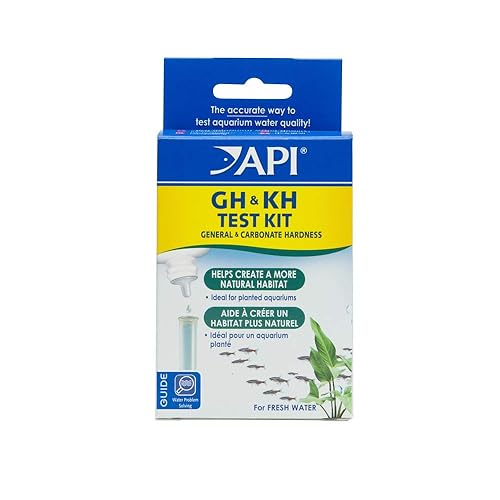
The API GH & KH Test Kit is the version most retailers stock, and it's the one we point owners toward when they ask what to buy first. It reads hardness in single-degree steps, which is plenty for a home tank. Pair it with a full-range pH and nitrogen kit so you're not testing hardness in isolation.
One habit matters more than the kit you choose. Test your source water before you ever fill a tank. Knowing your tap or well water is 12 dGH with a KH of 3 tells you instantly whether that soft-water species list you've been dreaming about is realistic, or whether you'll be fighting your own plumbing for years. Owners on municipal supplies should also recheck a few times a year, since utilities blend sources and hardness can shift without warning.
What KH Really Protects You From
KH is the buffer. Every living thing in the tank produces acid. Fish respiration adds carbon dioxide, which forms carbonic acid. The nitrogen cycle produces nitric acid as it converts ammonia to nitrate. Decaying plant matter and driftwood leach organic acids too. Carbonates in the water absorb all of that, holding pH steady. When KH runs out, the acid has nothing left to neutralize it, and pH can fall sharply and fast.
We consider a KH of 4 to 8 dKH the safe zone for a typical community aquarium. Below 4 dKH, the margin gets thin. In a planted tank running carbon dioxide injection, or a heavily stocked tank with driftwood, a KH of 2 can vanish in days and trigger a pH crash that drops readings below 6.0 overnight. That kind of swing is far more dangerous to fish than a stable pH that sits slightly outside their ideal range.
A pH crash doesn't just stress fish directly. It also stalls the nitrifying bacteria that process ammonia. Below roughly pH 6.0, those bacteria slow dramatically, ammonia and nitrite can climb, and you end up with two problems at once. This is why a sudden cluster of mystery deaths is often a hardness story wearing an ammonia mask.
Which Fish Want Soft Water and Which Want Hard
Species origin tells you most of what you need to know. Fish from the Amazon basin and other rain-fed tropical rivers evolved in very soft, slightly acidic water, usually 2 to 8 dGH. That group includes cardinal and neon tetras, most rasboras, discus, angelfish, most South American dwarf cichlids, and kuhli loaches. They can adapt to moderately hard water, but pushing them into 15 dGH with a pH above 8 asks for trouble.
Fish from limestone-rich lakes and mineral-heavy rivers sit at the opposite end. Livebearers like guppies, platies, and swordtails do best around 8 to 15 dGH. Mollies want it harder still, and they're the classic casualty of soft water, where they develop the shimmying, clamped-fin, wasting look that keepers describe as the molly disease. African cichlids from Lakes Malawi and Tanganyika need 10 to 18 dGH with a pH from 7.8 to 8.6, and goldfish thrive in moderately hard, well-buffered water.
Plenty of popular fish sit in the flexible middle. Bettas, corydoras, bristlenose plecos, and most barbs tolerate a wide GH range as long as it's stable. Captive-bred strains are generally more forgiving than wild-caught fish, because generations in farm water have softened the extremes. Forgiving is not the same as immune, though, and a fish that survives a mismatch isn't necessarily thriving in it.
Signs Your Fish Are in the Wrong Hardness
Hardness mismatches rarely kill a fish outright. They grind it down. A hard-water fish kept too soft may go off its food, fade in color, clamp its fins, and stop breeding. The molly shimmy is the textbook example, a rocking motion caused by a fish struggling to regulate its internal mineral balance. Soft-water fish kept too hard often show the opposite set of clues: rapid gill movement, flashing against decor, skittishness, and tetras that hang in a corner instead of schooling.
Reproduction is the most sensitive signal. Hardness affects how eggs absorb water and how sperm stay motile, so many species simply won't spawn outside their range, and eggs that are laid may fail to hatch. If a pair breeds happily but the eggs never develop, test GH before you blame genetics or diet.
None of these signs are unique to hardness. Fin clamping, appetite loss, and flashing also point to ammonia, nitrite, parasites, or low oxygen. That's why we always push owners to run a full panel instead of guessing. Test hardness, pH, ammonia, nitrite, and nitrate together, and you'll see which problem is real before you start adding treatments you don't need.
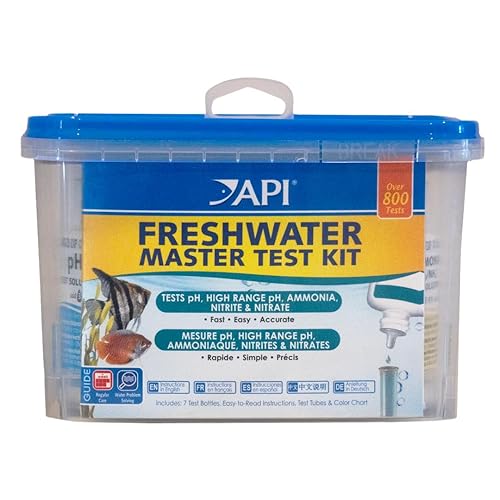
A full kit like the API Freshwater Master Test Kit covers pH, ammonia, nitrite, and nitrate, so it pairs naturally with a hardness kit. A quick total dissolved solids reading adds another layer of context, since TDS climbs and falls with the same minerals that drive hardness. The HM Digital TDS-3 TDS meter gives that number in about a second. TDS isn't GH, but a sudden jump after a change tells you something shifted in your source water.
How to Raise GH and KH Safely
Raising hardness is the easier direction, because you're adding minerals rather than removing them. Crushed coral, aragonite, and limestone dissolve slowly and lift both GH and KH, which makes them a good fit for livebearers and African cichlids. Put a mesh bag of crushed coral in the filter and let it work over weeks rather than dumping it loose in the tank.
Kits that use pure mineral salts let you target one number at a time. A GH booster raises calcium and magnesium without moving KH much, while sodium bicarbonate, plain baking soda, raises KH and pH without touching GH. Because these act fast, add a small amount, wait an hour, retest, and repeat. Dosing by the label and hoping for the best is how keepers overshoot and send fish into a mineral spike.
The pace rule applies to every adjustment. Fish tolerate a slow drift far better than a quick change. Aim to move GH or KH by no more than one or two degrees per day, and never chase a target in a single afternoon. If a fish already looks stressed, fix the stress first and adjust hardness second.
How to Lower GH and KH Safely
Lowering hardness means removing minerals, and that takes water that has fewer of them. Reverse osmosis and deionized water are the reliable route. They strip nearly everything out, so you blend them with tap water to hit a target. A 50/50 mix of RO and hard tap water often lands a tank in the soft-to-moderate range without any guesswork. Mix in a bucket, test the blend, then use it for changes.
Here's the mistake that trips up new keepers. A household water softener does not soften water for aquarium use. It swaps calcium and magnesium for sodium through an ion-exchange resin, so the fish get a sodium load instead of the minerals they need, and the water isn't actually lower in dissolved solids. Never fill a tank from a softened tap, and if your home has one, confirm whether a hard-water line exists for drinking or garden taps.
Natural methods lower KH gently. Peat, driftwood, and Indian almond leaves release tannic and humic acids that consume carbonates and nudge pH down. The catch is that they're fighting the buffer, so in hard, high-KH water the effect is small and short-lived. They're a nice supporting move in an already-soft tank, not a fix for 15 dGH tap water. Rainwater is free and soft, but it carries whatever the sky and your roof collected, so it needs testing before it goes anywhere near fish.
Why Stability Beats the Perfect Number
We'd rather see a tank sitting at a stable 8 dGH with a comfortable KH than one being yanked toward an ideal number every week. Constant small swings cause stress, and stress opens the door to disease. The goal of hardness management isn't to recreate a river in South America. It's to keep the tank inside a range your fish can handle, and keep it there.
Water changes are where stability breaks. If you keep soft-water fish and your tap runs hard, a large change with straight tap water can move GH and pH in one shot. Match the new water to the tank before it goes in. That means checking temperature, and checking hardness and pH, not just eyeballing the bucket.
A simple rule covers most cases. Change 20 to 30 percent weekly, match the parameters of the replacement water, and test the tank after the change. If the readings move more than you expected, the water you're adding is the difference you need to account for.
A Workflow You Can Repeat
Start by testing your source water and writing the numbers down. Test the tank next, then compare. Decide on a realistic target range based on the fish you actually keep, not the fish in a magazine photo. Adjust GH and KH slowly, a degree or two a day, and retest after each step. Once the tank is stable, test hardness weekly and after every large change. Change one variable at a time, so you always know what caused a shift.
For owners mixing RO water, keep a marked jug for the blend and stick to the same ratio until you've tested it. For owners on hard well water, know your numbers before you buy livestock, because it's far easier to choose fish that fit your water than to rebuild your water around the fish.
According to the U.S. Geological Survey, water hardness reflects the dissolved calcium and magnesium in a sample, usually reported in milligrams per liter as calcium carbonate, which is exactly the basis these hobby kits measure. And according to the American Veterinary Medical Association, poor water quality remains one of the most common preventable causes of disease in pet fish, which is why regular testing sits at the center of basic fish care.
If there's one takeaway we'd press hardest, it's this: learn your two hardness numbers before you stock the tank, then keep them steady. Fish live in the water you give them, and hardness is one of the few parts of that water you can measure and control with a ten-dollar kit. Test it, respect it, and stop fighting chemistry you can predict.
Related Reading
Want more on this topic? Check out our guides on best aquarium backgrounds stunning visual effects, fishless cycling new tank syndrome guide, aquarium gravel vs sand substrate comparison.