Automatic Cat Feeders 2026: A Research-Based Buying Guide for Smart Feeding on a Schedule
Automatic cat feeders have moved well beyond the simple timer-and-hopper dispensers of a decade ago. Modern units connect to your phone, dispense measured portions on a programmed schedule, record short voice messages that call your cat to the bowl, and in some cases include a camera so you can see your pet eating while you are away. For busy households, multi-cat homes with conflicting dietary needs, and cats on strict weight-loss plans, a feeder can be a genuinely useful tool for keeping mealtimes consistent. This guide explains the categories available, the specifications that actually matter, and the trade-offs you should weigh before buying, drawing on veterinary guidance, manufacturer specifications, and verified owner reports rather than hands-on product testing.
Why Consistent Feeding Schedules Matter for Cats
Cats are obligate carnivores with small stomachs and a natural grazing pattern, and veterinary resources consistently emphasize the value of routine in feline feeding. According to the Cornell Feline Health Center, feeding a complete and balanced diet on a predictable schedule supports healthy weight maintenance and makes it easier to notice early changes in appetite, which can be one of the first visible signs of illness. The Merck Veterinary Manual cat owner reference likewise notes that both overfeeding and prolonged gaps between meals create problems, from obesity to hunger-related vomiting in prone individuals.
An automatic feeder does not replace veterinary care or your own observation of your cat, but it removes human inconsistency from the equation. If your cat needs breakfast at 6 AM and you sleep in, or you work late twice a week, a programmed dispenser keeps the interval between meals steady. For cats on prescription diets or precise calorie targets, portion repeatability matters even more, and that is where feeder specifications deserve close attention before purchase.
The Four Main Categories of Automatic Feeder
Programmable dry-food dispensers
This is the largest category and the default choice for most households. A hopper holds several liters of dry kibble, a rotating auger or portion wheel drops a measured amount into the bowl at set times, and most models allow one to six meals per day with adjustable portion counts. Models such as the WOPET 6L and Roffie 7L fall here, offering 6 to 7 liters of capacity, voice-recording features, and dual power with battery backup. The trade-off is that these feeders only handle dry food, and some budget models have motors loud enough to startle nervous cats.
Smart feeders with cameras and app control
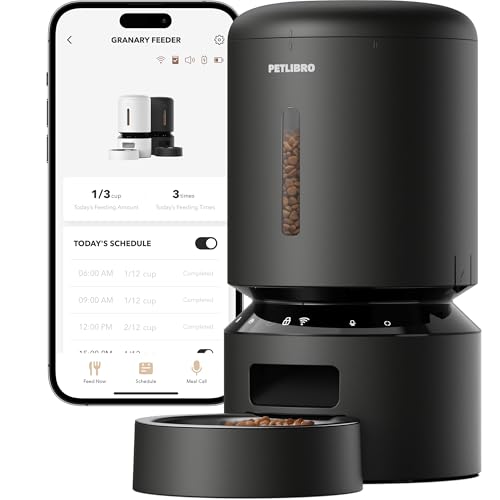
A step up adds WiFi connectivity, a 1080p camera with night vision, two-way audio, and a companion app with feeding history. The Petlibro camera feeder is the best-known example, combining a 5-liter hopper with remote monitoring. This category suits travelers and anxious owners who want visual confirmation that the cat is eating. The honest trade-offs are price, typically in the 130 to 170 dollar range, dependence on a working WiFi network, and a camera angle that covers the bowl area rather than the whole room. If your internet drops, most models still dispense on their stored schedule, but remote features stop working.
Wet-food feeders with ice packs
Wet food spoils quickly at room temperature, so the options are far narrower. The Cat Mate C500 is the category standard: five sealed compartments rotate under a lid on a 90-hour timer, with twin ice packs keeping open portions cool and dishwasher-safe bowls for cleaning. It suits cats who eat canned food, cats with dental issues who cannot manage kibble, and owners feeding medication mixed into wet food. The trade-offs are a hard limit of five meals, the need to freeze and rotate ice packs, no app connectivity, and portion sizes that run small for large-breed cats.
Microchip and RFID access feeders
The SureFeed style of feeder solves a different problem entirely: it does not dispense on a timer at all. Instead, a lid opens only when the correct microchip or collar tag is detected, keeping other pets out of a specific bowl. This is the practical answer for multi-cat homes where one animal steals food, needs a prescription diet, or is on a carefully measured weight-loss plan while housemates are not. Verified owner reports consistently describe it as effective at preventing food theft, with the trade-offs being a higher price, a requirement that every cat has a microchip or tag, small capacity, and the fact that it automates access rather than timing.
What to Look For: Specifications That Matter
Portion accuracy and increments
Portion systems vary widely. Some models dispense in fixed volume increments of roughly one-twentieth to one-tenth of a cup per portion, programmable from 1 to 39 portions per meal. Manufacturer specifications list the grams-per-portion figure, and that number is what you should compare against your cat's daily calorie target. The Merck Veterinary Manual reference material emphasizes measuring food by weight or precise volume rather than eyeballing, and a feeder that cannot hit your cat's needed portion size in whole increments will leave you over- or under-feeding slightly at every meal. Owner reports on budget models frequently mention inconsistent portion sizes caused by kibble shape and hopper level, so read recent reviews for the specific model and kibble size you plan to use.
Kibble size compatibility
This is the single most common source of buyer regret. Auger-based dispensers jam or dispense inaccurately when kibble is too large, too irregular, or flat-shaped. Check the maximum kibble size in the manufacturer specifications before buying, usually stated in millimeters or as a comparison to common kibble shapes. Freeze-dried and very large dental kibble rarely works well. If your cat eats an unusual kibble, look for feeders with infrared sensors or anti-jam designs, which the Roffie and several WOPET models include, and confirm in owner reviews that your kibble shape has been used successfully.
Power supply and backup
Look for dual power: a wall adapter plus battery backup. A power outage of even a few hours can mean missed meals, and cats should not go long stretches without food. Battery-only models trade reliability for placement flexibility. Smart models vary in whether their schedule survives WiFi outages; check that the timer is stored locally rather than depending entirely on the cloud, a detail worth confirming in the manual or in owner reports before relying on the feeder for an absence.
Capacity and freshness
Capacity ranges from about 2.6 liters up to 7 liters, roughly 2 to 7 pounds of kibble depending on density. Bigger is not automatically better: kibble slowly loses freshness and can oxidize in an open hopper over weeks. A 7-liter hopper suits multi-cat households and long absences; a 2.6 to 3 liter hopper suits a single cat and encourages fresher food through more frequent refills. Feeders with a sealed lid or desiccant pocket, such as the PETKIT Mini's fresh-lock system, slow staleness in humid climates.
Cleaning and materials
Whatever the food touches should come apart and wash easily. Removable, dishwasher-safe bowls and wide hopper openings save real time, and residual food oils go rancid and can put cats off their meals. Stainless steel or ceramic bowls resist scratching better than plastic, which matters for cats prone to feline acne on the chin. Check that the dispensing mechanism itself can be accessed for cleaning, since ground kibble dust accumulates in the auger housing of most models over months.
A Concrete Example: The Petlibro Camera Feeder
As a single illustrative example of the smart-feeder category, the Petlibro combines a 5-liter hopper, holding roughly 4 pounds of kibble, with a 1080p camera, night vision, two-way audio, and app-based scheduling with feeding history. Manufacturer specifications position it as an all-in-one solution for owners who want both dispensing and remote monitoring, and owner reviews commonly describe the dispensing mechanism as dependable and the unit as straightforward to clean.
The trade-offs are equally clear. It sits at the expensive end of the category, typically 130 to 170 dollars, it requires WiFi for its smart features, and the camera covers a fixed angle centered on the feeding area. It handles dry food only, like all auger dispensers. If your priority is simply reliable timed feeding rather than monitoring, a simpler programmable feeder at half the price may serve you better. If you travel often or want to confirm a shy cat is eating while you are at work, a camera-equipped model addresses that need directly. Note that PETLIBRO's Granary line spans camera and non-camera variants, so read the specific listing before assuming a unit records video; the buying boxes below point to one example in each price tier, with recent owner feedback worth reading before you commit.
Matching a Feeder to Your Household
Busy schedules and early mornings
For owners whose main need is punctual meals around a variable work schedule, a mid-range programmable dispenser is usually the right answer. The WOPET 6L offers 1 to 39 portions across up to four daily meals with a voice recording feature, and its reported portion accuracy is among the better values in its price band. Its weaknesses, per owner reports, are an occasionally buggy app and kibble-size limits, so verify your food fits before committing.
Multi-cat households
Shared bowls create two problems: the dominant cat overeats and the timid cat under-eats, and prescription diets leak between pets. For households where all cats eat the same food, a large-capacity model like the Roffie 7L with multiple daily meals works, though its bulk, plastic construction, and noise level draw criticism. For households with differing dietary needs, microchip access feeders are the honest solution, because no timer-based feeder can tell cats apart.
Weight management
Veterinary guidance, including weight-management material from the Cornell Feline Health Center, stresses measured portions and gradual calorie reduction under a veterinarian's supervision. A feeder with fine portion increments makes the measuring repeatable, but the math still has to come from your vet. Food quality matters as much as quantity; diets labeled complete and balanced under AAFCO pet food standards meet established nutrient profiles, and that labeling is worth checking regardless of how the food is dispensed.
Wet-food diets
If your cat eats canned food, your realistic choice is an ice-pack compartment feeder such as the Cat Mate C500, possibly paired with a dry-food dispenser for a mixed diet. Accept the limits: five meals maximum, ice packs that must be frozen between uses, and small portion compartments. There is currently no app-connected wet-food feeder with reliable portioning on the mainstream market, so be skeptical of marketing that implies otherwise.
Budget buyers
Basic programmable feeders in the 35 to 50 dollar range, such as the Amazon Basics 6L model, cover the core need: timed meals, decent capacity, dual power, and an LCD timer. Reviews consistently note loud motors and occasional portion inconsistency, which matter less for a single easygoing cat on maintenance food and more for a skittish cat or a strict diet. As a low-risk entry point to see whether your cat accepts a feeder at all, the budget tier has real value.
Safety Considerations
An automatic feeder is an appliance that your cat will paw, nudge, and occasionally attempt to open. Stability matters: a top-heavy hopper pulled over by a determined cat spills its entire contents, which for a food-motivated animal means an unmonitored all-you-can-eat event. Look for a wide base, and place the unit against a wall. Battery compartments should be secured and out of reach, since batteries pose a serious ingestion risk; the ASPCA Animal Poison Control resource is the right place to check if your cat ever chews or swallows part of a device, a battery, or anything else unfamiliar.
Cleaning frequency is also a safety issue, not just an aesthetic one. Rancid food residue and damp kibble dust can grow mold inside hoppers and auger tubes. Disassemble and wash food-contact parts weekly, dry them fully before refilling, and inspect the dispensing path monthly. If you use a smart feeder with a power cord, route the cord so it cannot be chewed or pulled, and consider a cord cover for cats with a chewing habit.
How Long You Can Rely on a Feeder Alone
This deserves plain honesty: a feeder extends safe absence time, it does not eliminate supervision. For dry food, most experienced sources suggest two to three days as a sensible maximum with a full hopper, verified power, and plenty of water. For wet food, the Cat Mate C500's ice packs keep compartments viable for roughly 24 hours, not the full 90-hour schedule the timer technically allows with dry compartments. For any absence beyond a weekend, arrange for a person to check on your cat, both for emergencies and because cats are social animals that notice absence. The original article's veterinary source note is worth repeating: annual wellness exams are recommended for adult cats, and semi-annual exams for cats eleven and older, since appetite changes tied to age-related conditions are caught earliest through regular veterinary attention.
Common Mistakes to Avoid
- Buying a hopper far larger than needed and letting kibble sit for weeks, going stale before it is eaten. Size capacity to a two-to-four-week refill cycle.
- Ignoring maximum kibble size specifications, then dealing with jams or inaccurate portions with large or flat kibble.
- Skipping battery backup, then losing the feeding schedule to a short power outage.
- Transitioning abruptly. Cats are neophobic about new objects near food. Most microchip feeders include a training mode for exactly this reason; with any feeder, place it near the regular bowl, dispense a meal manually, and give your cat several days to adjust before relying on it.
- Assuming the app portions match your cat's needs. Portion counts are arbitrary units; convert them to grams against the manufacturer's per-portion figure and your vet's calorie target.
- Using a feeder as a permanent substitute for interaction. Feeders automate scheduling, not companionship or play.
Feature Updates Worth Knowing in 2026
Feeder hardware has settled into a more predictable shape this year, which makes comparisons easier. Dual power is now standard rather than premium: nearly every midrange unit runs from a wall adapter with a battery backup bay, so a household power cut no longer dumps the whole schedule. Most app-connected models still pair only with 2.4 GHz Wi-Fi networks, and that remains the single most common setup failure people report, so check your router band before buying rather than after. Desiccant-sealed lids, which keep kibble dry in humid climates, have moved down to entry-level models as well. For multi-cat households with one cat on a prescription diet, microchip-activated feeders are worth the higher price; they read a collar tag or chip and only open for the right animal. None of these features changes the core advice above: capacity, portion accuracy, and cleanability still decide whether a feeder lasts.
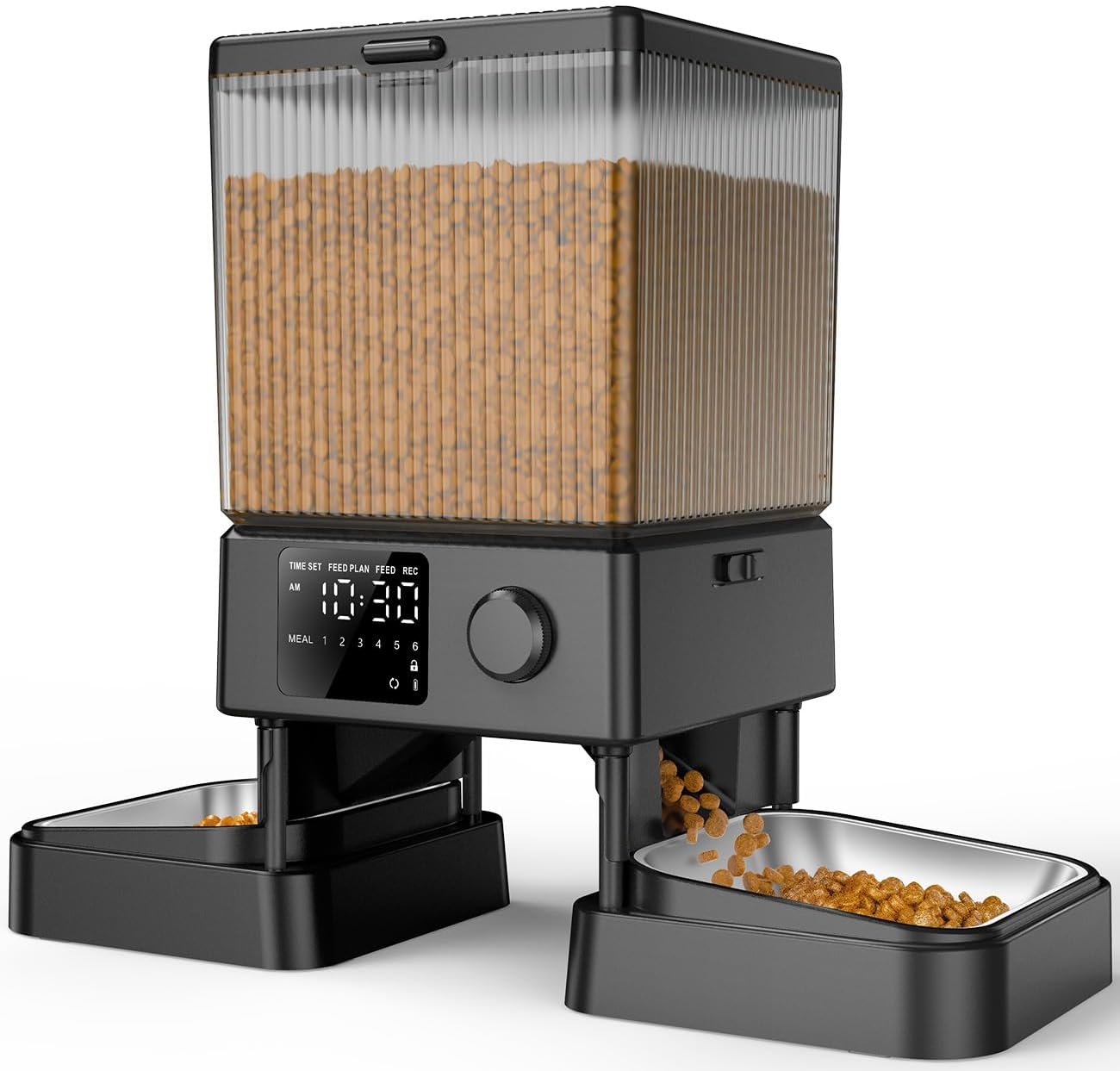
dual-tray feeder portioning two bowls on one schedule
Frequently Asked Questions
Can I leave my cat alone with an automatic feeder for a week?
Not responsibly. Dry-food feeders can cover two to three days at most before freshness, water, and litter concerns compound, and wet-food feeders are limited to about a day. Arrange a checker for anything longer.
Are automatic feeders safe for cats?
Yes, when the unit is stable, clean, and powered with backup. The main risks, tipping and spoiled-food residue, are both preventable with placement and a weekly cleaning routine.
Can one feeder serve multiple cats?
If they share the same food and eat peacefully, yes, and a large-capacity model helps. If diets differ or one cat bullies the other away from the bowl, microchip access feeders are the appropriate tool.
Do feeders help with weight loss?
They enforce whatever portions you program, which removes measuring error and begging-driven extras. The target itself should come from your veterinarian.
Do voice-recorded meal calls work?
Owner reports on models with a 10-second recording feature are largely positive; most cats learn to associate the recording with food within days, which helps cats who do not notice a quiet dispenser.
Where to Buy
As an Amazon Associate, PawCritic earns from qualifying purchases. This does not affect our reviews or recommendations.
The Bottom Line
The right automatic feeder depends on which problem you are solving. For punctual, consistent meals on a budget, a basic programmable dispenser does the job. For precise diet management, choose fine portion increments and verify kibble compatibility. For monitoring while away, a camera-equipped smart feeder like the Petlibro example linked above covers dispensing and observation in one unit. For wet food, ice-pack compartment feeders remain the only practical option, and for multi-cat households with conflicting diets, microchip access feeders are the honest answer. Whatever you choose, a feeder maintains consistency; it does not replace daily attention, observation, or regular veterinary care, and the cats who benefit most are the ones whose owners still watch how eagerly they come to the bowl.
Cold-Weather and Power-Outage Notes for Late 2026
Winter is when automatic feeders earn their keep and when they fail, sometimes in the same week. Storm-related outages are the obvious hazard. Before the season's first deep freeze, check what your model's battery backup actually powers: on many feeders, batteries keep the clock and schedule alive but cannot drive the auger motor, which means the unit will hold its settings yet skip meals entirely during an outage. Models that dispense on battery power are rarer and worth the premium if you live somewhere with unreliable winter electricity. Whatever you own, a charged power bank and a note about the manual dispense procedure belong next to the feeder.
Placement matters more in winter as well. Keep the hopper away from radiators and heating vents, since sustained warmth accelerates fat oxidation in kibble and can warp lid seals; our smart feeder roundup covers hopper materials and freshness features in more depth. Dry winter air also makes small kibble cling to chute walls with static, so a slightly larger kibble size or an occasional chute wipe-down keeps portions accurate.
If you are traveling over the holidays, run the feeder through a full week of its programmed schedule before you leave rather than trusting a single test meal. Confirm the low-food sensor actually reports, and still line up a human check-in — a feeder covers meals, not the water bowl, a jammed chute, or a cat that flips the unit off a shelf. For the days you are home, a puzzle feeder or slow bowl turns holiday downtime into useful enrichment, and a warm resting spot from our heating pad and warming bed guide keeps the rest of the routine comfortable when the house runs cold.
Related Reading
choosing a complete cat food, healthy cat treats and reward formats, and cat GPS trackers for indoor and outdoor cats.