The filter is the heart of any aquarium. It keeps fish alive between water changes, processes the toxic ammonia their waste produces, and maintains the biological balance that makes a tank thrive rather than crash. Yet it is also one of the most confusing purchases for new fishkeepers — there are dozens of filter types, hundreds of brands, and a lot of conflicting advice online.
Source: UF/IFAS Extension, University of Florida: The University of Florida IFAS Extension notes that a properly sized aquarium filter should process the entire tank volume at least three to five times per hour to maintain adequate biological filtration for a healthy nitrogen cycle.
Source: American Pet Products Association (APPA): The APPA 2023-2024 National Pet Owners Survey estimated that approximately 11.8 million U.S. households own freshwater or saltwater fish, making fish the third most popular companion animal in the United States.
This reference guide explains the three types of filtration every tank needs, what to look for when choosing a filter, and how to evaluate top options for 2026 — from beginner-friendly hang-on-back filters to powerful canister filters for planted tanks and larger setups. Every claim here is traceable to published guidance, manufacturer specifications, or verified owner reports, not hands-on testing.
What changed in 2026: canister filters got quieter and cheaper at the entry level, and many new models ship with self-priming pumps — the days of mouth-siphoning to start a filter are largely over. The other shift is toward oversized filtration: according to the UF/IFAS Extension at the University of Florida, a filter should turn the tank over at least three to five times per hour, and most tanks in trouble are under-filtered, not over-filtered. If you are just getting started, read the nitrogen cycle guide before buying anything. Here is the 2026 shortlist.
The Three Types of Filtration: Why All Three Matter
Every aquarium filter should provide three types of filtration. Understanding these will help you evaluate any filter you are considering:
- Mechanical filtration: Physical removal of particles — fish waste, uneaten food, plant debris. This is what keeps the water visually clear. Sponges, filter floss, and foam pads provide mechanical filtration.
- Biological filtration: The most critical type. Beneficial bacteria colonize filter media and convert toxic ammonia (from fish waste) into nitrite, then into relatively harmless nitrate. Without biological filtration, ammonia builds up and kills fish. Ceramic rings, bio-balls, and porous sponges provide surface area for these bacteria. According to the Merck Veterinary Manual, ammonia toxicity is the most common water-quality killer in home aquariums, which is why biological media should never be replaced all at once.
- Chemical filtration: Removal of dissolved compounds — tannins, medications, chloramines, and odors. Activated carbon is the most common chemical filtration media. It is optional in established tanks but useful for new setups or after medication treatments.
How to Size a Filter for Your Tank
the 5 aquarium filters for beginners and planted tanks in
The standard recommendation is to choose a filter rated for at least 4x your tank volume in gallons per hour (GPH) of flow. For a 20-gallon tank, you want a filter rated for at least 80-100 GPH. For heavily stocked tanks or tanks with messy fish (goldfish, cichlids), aim for 8-10x turnover. For planted tanks with CO2 injection, you may want lower flow to avoid gassing off CO2 — 3-5x turnover is often sufficient. Research on aquarium nitrogen dynamics consistently shows that under-filtered tanks spike ammonia faster than owners can detect with test kits — oversizing is cheap insurance.
Turnover rate is not the only number that matters. Media volume, flow adjustability, and the ability to customize filter media all affect long-term performance. A filter rated at 300 GPH with a tiny media basket may perform worse than a 200 GPH filter with a large media chamber, because the bacteria need surface area to colonize. When comparing filters, look at both the flow rate and the physical size of the media compartment. A larger media chamber means a larger bacterial colony, which means more stable water quality between maintenance sessions.
Another consideration is head height and flow loss. Manufacturer flow ratings are typically measured with no head pressure, meaning the pump is pushing water straight up with no resistance. In a real aquarium, the filter has to pull water up from the tank, push it through media, and return it. This reduces actual flow by 20-40% depending on the design. When sizing a filter, assume the real-world flow is lower than the box claims, and size up accordingly. For canister filters placed under a tank, head height can be significant, so a filter rated for 300 GPH might only deliver 200 GPH in practice.
The 4 Best Aquarium Filters in 2026
1. Aquaclear 70 Power Filter — Best Overall Hang-On-Back
Price: ~$59.99 | Flow Rate: 300 GPH | Tank Size: Up to 70 gallons | Type: Hang-on-back (HOB)
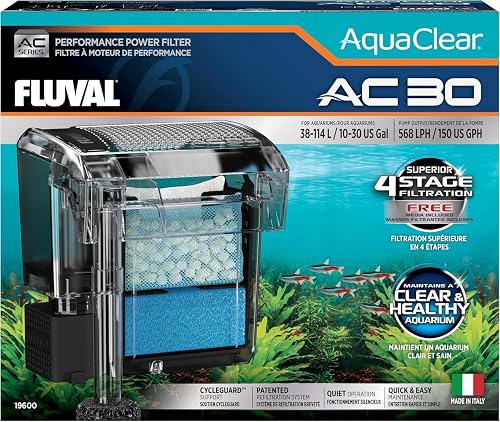
The AquaClear 70 has been the gold standard hang-on-back filter for decades, and it remains the top recommendation for most freshwater aquariums in 2026. What sets it apart from competitors is its large media basket — it holds significantly more biological media than comparable HOB filters, which means a more durable bacterial colony and better water quality. The flow rate is adjustable, which is valuable for planted tanks or tanks with fish that prefer calmer water.
The AquaClear uses a three-stage filtration system: foam sponge (mechanical), activated carbon (chemical), and BioMax ceramic rings (biological). All media is replaceable independently, so you never have to throw away your entire bacterial colony when changing filter media — a critical advantage over cartridge-based filters.
Pros: Large media capacity; adjustable flow; independent media replacement; excellent biological filtration; proven reliability over decades.
Cons: Can be noisy if water level drops; the impeller can rattle if debris gets inside; more expensive than basic HOB filters.
Best for: Community tanks, planted tanks, and anyone who wants a reliable, upgradeable HOB filter for tanks up to 70 gallons.
2. Fluval 307 Canister Filter — Best for Planted Tanks and Larger Setups
Price: ~$59.99 | Flow Rate: 303 GPH | Tank Size: Up to 70 gallons | Type: Canister
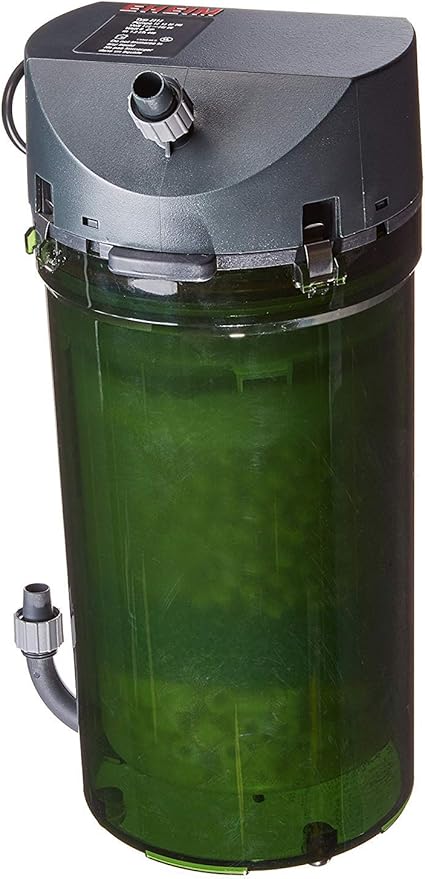
Canister filters are the preferred choice for planted tanks, larger aquariums, and serious fishkeepers. They sit below the tank (in the cabinet), are completely silent, and offer significantly more media capacity than any HOB filter. The Fluval 307 is the best mid-range canister filter available in 2026, featuring a redesigned impeller for quieter operation, a self-priming pump (no more mouth-siphoning to start), and a large media basket system that accommodates custom media configurations.
For planted tanks, the Fluval 307's adjustable output nozzle allows you to direct flow along the surface for gas exchange without disturbing the substrate — ideal for CO2-injected setups. The filter also runs completely silently, which is a significant quality-of-life improvement over HOB filters in living spaces.
Pros: Silent operation; large media capacity; self-priming; adjustable output; excellent for planted tanks; easy maintenance with quick-release valves.
Cons: Expensive; requires cabinet space below the tank; more complex setup than HOB filters; canister filters can crash if power is lost for extended periods (anaerobic bacteria).
Best for: Planted tanks, tanks 40+ gallons, and fishkeepers who want the best possible water quality and silent operation.
3. Seachem Tidal 55 — Best for Beginners
Price: ~$59.99 | Flow Rate: 200 GPH | Tank Size: Up to 55 gallons | Type: Hang-on-back (HOB)
Seachem's Tidal filter is the best beginner-friendly HOB filter on the market. Its standout feature is a surface skimmer that pulls water from the surface — removing the protein film that develops on most aquariums and improving gas exchange. It also includes a self-priming pump, a large media basket, and a unique pause button that stops the filter without losing prime — invaluable when feeding or doing maintenance.
The Tidal also includes a built-in water polishing pad and a basket large enough for custom media. For beginners who want a filter that just works without constant adjustment, the Tidal is the most forgiving and feature-rich option at this price point.
Pros: Surface skimmer included; self-priming; pause button; large media basket; easy to set up and maintain; excellent value.
Cons: The surface skimmer can be noisy if water level is low; flow rate is not adjustable on all models; not ideal for tanks over 55 gallons.
Best for: Beginners, community tanks up to 55 gallons, and anyone who wants a feature-rich HOB filter without the complexity of a canister.
4. Sponge Filter with Air Pump — Best for Breeding and Fry Tanks
Price: $15 (filter) + $20 (air pump) | Flow Rate: Variable | Tank Size: Up to 40 gallons | Type: Sponge filter
Sponge filters are the unsung heroes of the fishkeeping hobby. They are cheap, nearly indestructible, and provide excellent biological filtration through the porous sponge that beneficial bacteria colonize. Most importantly, they are completely safe for fry (baby fish) and shrimp — unlike HOB and canister filters, which can suck up small creatures. For breeding tanks, shrimp tanks, and hospital tanks, a sponge filter is often the best choice.
The Hikari Bacto-Surge and Aquaneat sponge filters are the most popular options. Pair with a reliable air pump (Tetra Whisper or Fluval Q series) for quiet, reliable operation.
Pros: Extremely affordable; safe for fry and shrimp; excellent biological filtration; nearly silent; easy to clean without losing bacterial colony.
Cons: No mechanical or chemical filtration; requires an air pump; not suitable as the sole filter for heavily stocked tanks; less aesthetically pleasing than other filter types.
Best for: Breeding tanks, shrimp tanks, hospital/quarantine tanks, and as a supplemental filter in any aquarium.
Filter Maintenance: The Most Overlooked Part of Fishkeeping
the 5 aquarium filters for beginners and planted tanks in
The most common mistake new fishkeepers make is cleaning their filter too thoroughly. Beneficial bacteria live in the filter media — if you rinse it under tap water (which contains chlorine), you will kill the bacteria and crash your tank's nitrogen cycle. Always rinse filter media in old tank water (the water you remove during a water change), never tap water. Clean only one section of media at a time, and never replace all media simultaneously.
Filter maintenance schedules vary by filter type and stocking level. HOB filters typically need media rinsing every two to four weeks. Canister filters can go longer between cleanings, often four to eight weeks, because they hold more media and have a larger bacterial colony. Sponge filters should be squeezed out in tank water when flow visibly slows, usually every two to four weeks. Over-cleaning is more dangerous than under-cleaning, because it removes the bacteria that keep fish alive.
When cleaning a canister filter, pay attention to the O-ring seal and impeller. A worn O-ring can cause leaks, and a dirty impeller can reduce flow or make noise. Most manufacturers recommend replacing O-rings annually and lubricating them with silicone grease. Impellers should be removed and rinsed during each cleaning. These small maintenance steps prevent the most common canister filter failures.
Common Mistakes When Choosing and Using Aquarium Filters
Under-sizing is the most frequent error. Many beginners buy a filter rated for their exact tank volume, only to find that it cannot keep up with a fully stocked tank. The rating on the box is usually based on a lightly stocked tank with no plants and minimal waste. Real-world stocking, feeding, and fish growth all increase the bioload. Buying a filter rated for at least 1.5 to 2 times your tank volume is a practical rule that prevents ammonia spikes.
Another common mistake is replacing filter cartridges on a fixed schedule. Cartridge-based filters often instruct users to replace the cartridge monthly, but this throws away the bacterial colony each time. If you use a cartridge filter, rinse the cartridge in tank water instead of replacing it, and only replace it when it is physically falling apart. Better yet, choose a filter with separate media compartments so you can replace mechanical media without touching biological media.
Ignoring flow patterns is another error. A filter that creates a strong current in one corner but leaves the rest of the tank stagnant will not filter effectively. Most fishkeepers benefit from a filter with adjustable flow and a spray bar or nozzle that distributes water across the tank. Dead spots allow waste to accumulate and can lead to algae problems. Observing water movement with a small piece of fish food or a bubble stream can reveal whether flow reaches all areas.
Finally, many owners forget that filters need a power source and a stable water level. HOB filters stop priming if the water level drops below the intake, and canister filters can lose prime after a power outage. Self-priming models reduce this risk, but no filter is immune to power failures. In areas with frequent outages, a battery backup air pump or a sponge filter driven by an air pump can provide emergency biological filtration.
Filter Media: What Goes Inside and Why
Filter media is the material inside the filter that actually does the work. Mechanical media, such as filter floss, foam pads, and sponges, traps particles. These should be rinsed regularly in tank water and replaced only when they lose structure. Biological media, such as ceramic rings, bio-balls, and porous rocks, provides surface area for bacteria. This media should almost never be replaced; it can last for years if rinsed gently. Chemical media, such as activated carbon, resin, or zeolite, removes dissolved compounds and should be replaced according to manufacturer instructions, usually every two to four weeks.
Layering media in the correct order matters. Water should flow through mechanical media first to remove particles, then through biological media to process ammonia and nitrite, and finally through chemical media if used. Placing biological media before mechanical media can clog it with debris and reduce its effectiveness. Most filter manufacturers design their media baskets with this order in mind, but custom setups benefit from deliberate layering.
Not every tank needs chemical filtration. Activated carbon is useful for removing medications, tannins, and odors, but it also removes trace elements that plants may need. In a heavily planted tank, continuous carbon use can slow plant growth. Many experienced fishkeepers use carbon only after medication treatments or when water has a yellow tint, and rely on mechanical and biological filtration the rest of the time.
Species-Specific Filtration Needs
Different fish have different filtration requirements. Goldfish are notorious waste producers and need filtration rated at 8-10x tank volume per hour, plus frequent water changes. Cichlids from Lake Malawi and Lake Tanganyika prefer high flow and high oxygenation, so a canister filter with a spray bar works well. Bettas prefer gentle flow and may struggle in a strong current, so a filter with adjustable flow or a sponge filter is a better choice. Discus and other soft-water fish benefit from stable biological filtration and may be sensitive to chemical media that alters water chemistry.
Shrimp tanks and fry tanks require special consideration because small animals can be sucked into filter intakes. Sponge filters are the safest option, but HOB and canister filters can be made safe with a pre-filter sponge over the intake. A pre-filter sponge also keeps debris out of the filter, reducing maintenance frequency. For reef tanks, filtration is more complex and typically involves live rock, protein skimmers, and sumps, which are beyond the scope of this guide but follow the same principles of mechanical, biological, and chemical filtration.
Planted tanks have unique filtration needs because plants consume ammonia and nitrate directly. A heavily planted tank may need less biological filtration than a bare tank with the same fish load, but it still needs mechanical filtration to keep water clear and flow to distribute nutrients. CO2-injected tanks should minimize surface agitation to avoid gassing off CO2, so a filter with adjustable flow or a spray bar directed downward is preferable.
Our Verdict
For most freshwater aquariums, the AquaClear 70 is the best all-around choice — it is reliable, upgradeable, and provides excellent biological filtration at a reasonable price. Beginners will find the Seachem Tidal 55 even more forgiving and feature-rich. For planted tanks and larger setups, the Fluval 307 canister filter is the clear winner. And for breeding or shrimp tanks, a simple sponge filter is often the best tool for the job.
Related reading: Aquarium Canister Filters for Large Tanks, Aquarium Sponge Filters, How to Cycle an Aquarium: The Complete Nitrogen Cycle Guide for Beginners, Aquarium Power Filters and Hang-on-Back Filtration, Aquarium RO/DI Filtration Systems, Reef Tank Starter Kits, Aquarium Canister Filters, Aquarium Filters, Fish Tanks for Beginners 2026: Easy Setup Aquariums, Common Aquarium Fish Diseases: Symptoms, Treatment, and How to Prevent Them, Aquarium Gravel vs Sand: Which Substrate Is Actually Better? and Aquarium Water Test Kits and Conditioners.
Affiliate Disclosure: PawCritic is reader-supported. We may earn a commission when you purchase through links on this page, at no extra cost to you. We only recommend products we genuinely believe in, and our editorial selections are never influenced by commission rates or affiliate partnerships.
Where to Buy: Our Top Picks
As an Amazon Associate, PawCritic earns from qualifying purchases. This does not affect our reviews or recommendations.