Why Cage Choice Matters for Conures
Conures are not beginner birds, despite their accessible price point and widespread availability. These small-to-medium parrots (ranging from the 60-gram green-cheeked conure to the 180-gram sun conure) possess the intelligence, energy, and destructive potential of parrots three times their size. A green-cheeked conure has the cognitive ability of a 3-year-old human child and the emotional complexity of a 5-year-old. A sun conure has a bite force of 300-400 PSI 鈥?enough to crack a Brazil nut shell. And virtually all conures are capable of learning to open simple cage latches, disassemble poorly-constructed toys within hours, and chew through thin-gauge wire in days if they're motivated.
The wrong cage for a conure is a recipe for problems: a cage that's too small leads to feather plucking (the number one behavioral problem in conures 鈥?approximately 15% of pet conures develop some form of feather-destructive behavior, and inadequate space is a primary contributing factor), aggression, and excessive screaming. A cage with bar spacing wider than 5/8 inch allows a conure to get its head stuck between the bars 鈥?a terrifying and potentially fatal situation. A cage with powder-coated finish rather than powder-coated and baked enamel can chip, exposing underlying metal that may contain zinc or lead 鈥?both toxic to parrots. A cage without a proper seed catcher or removable grate creates a daily mess that drives many owners to rehome their birds.
The minimum cage size for a single conure is 24 x 24 x 30 inches (length x width x height) 鈥?this is the absolute minimum for a bird that needs to spread its wings fully, climb, and play. The recommended size for a conure that spends 8+ hours per day in its cage is 30 x 30 x 36 inches or larger. Conures are active, acrobatic birds that need horizontal space for wing-stretching and vertical space for climbing 鈥?a tall, narrow cage is significantly worse than a shorter, wider cage because conures fly horizontally, not vertically. Bar spacing should be no more than 5/8 inch (1/2 inch is ideal for green-cheeked conures and the smaller conure species, 5/8 inch is acceptable for sun conures and jenday conures). Bar gauge should be at least 4mm (or 11-gauge) for small conures and 5mm (or 9-gauge) for larger conures 鈥?thinner bars can be bent or broken by a determined sun conure.
Beyond the cage itself, the accessories you choose 鈥?perches, food bowls, toys, cage liners, and cage covers 鈥?determine whether the cage is a functional home or a glorified prison. Natural wood perches of varying diameters (from 3/4 inch to 1.5 inches) are essential for foot health. Stainless steel food bowls are a necessity (ceramic can break, plastic harbors bacteria and is chewed apart). A rotation of 8-12 toys (3-4 in the cage at any time, rotated weekly) with different textures, materials, and challenges is the minimum for psychological enrichment. The cage should be positioned against a wall in a high-traffic area (conures are flock animals and need to be part of the household activity) but not directly in front of a window (overstimulation from outdoor activity can trigger hormonal aggression).
This guide covers the 8 best conure cages and essential accessories for 2026 鈥?from the budget-friendly starter cage for first-time conure owners to the premium lifetime cage that will last through 30 years of conure companions.
Top 8 Conure Cages for 2026
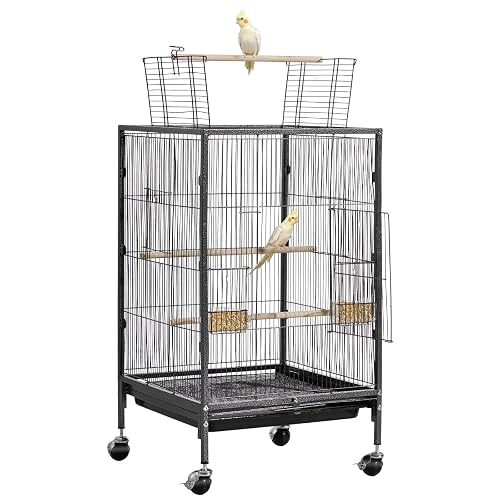
Best conure cages and accessories for 2026
1. HQ Aviary 30x36x72 Double Macaw Cage 鈥?Best Premium Lifetime Cage for Sun Conures & Large Conures
The HQ Aviary double macaw cage 鈥?configured as a single spacious cage with the divider removed 鈥?is widely regarded as the best "forever home" for a single sun conure, jenday conure, cherry-headed conure, or any of the larger Aratinga conure species. The full dimensions are 30 x 36 x 72 inches (6 feet tall!), providing an amount of space that's almost unheard of in the conure cage market. The bar spacing is 5/8 inch with 5mm gauge bars 鈥?appropriate for larger conures and virtually indestructible. The cage is constructed from powder-coated wrought iron with a baked enamel finish that's been tested for lead and zinc safety. The cage features a pull-out bottom grate, a deep metal seed catcher with a 4-inch lip, four locking feeder doors with stainless steel cups, two large front doors (15 x 20 inches each) that open fully for easy access, and four locking casters for mobility.
The 6-foot height allows for an incredible level of enrichment. The top third of the cage can be set up as a dedicated foraging zone with hanging toys, preening toys, and treat puzzles. The middle third has multiple natural wood perches at different diameters and angles, with a platform perch near a food bowl. The bottom third provides a lower play area with a boing (a rope coil) and a shredding station. A sun conure in a properly outfitted HQ Aviary cage will spend hours climbing from top to bottom, foraging for treats in the upper zone, resting on a perch in the middle, and shredding cardboard at the bottom 鈥?it's the closest thing to a full indoor aviary without building a dedicated bird room.
The HQ Aviary cage is heavy 鈥?about 80 pounds assembled 鈥?and the assembly takes 60-90 minutes with the included hex key tool (you'll need a cordless drill with a hex bit to make the process bearable). The cage is clearly built for commercial aviary or lifetime home use, with welds that are smooth and consistent, a powder coat that doesn't chip easily, and feeder doors that slide smoothly even after months of daily use. At $450-600, the HQ Aviary cage is more expensive than any other cage on this list, but it's the last cage you'll ever buy for your conure. A well-maintained HQ Aviary cage will last 20-30 years 鈥?long enough to outlive your conure and serve its successor. When you do the math: $500 梅 25 years = $20 per year for the best possible home for your parrot. That's the definition of value.
Pros:
- 30 x 36 x 72 inches 鈥?the most spacious conure cage available, true aviary-sized living space
- 5mm gauge bars with 5/8 inch spacing 鈥?virtually indestructible, safe for even the strongest conures
- Wrought iron construction with baked enamel 鈥?safe, durable, chip-resistant finish
- Four locking feeder doors with stainless steel cups 鈥?easy access, secure lock, no escape
- Two full-size front doors 鈥?15x20 inches each, access the entire cage interior for cleaning
- Deep seed catcher with 4-inch lip 鈥?excellent mess control, reduces daily sweeping
- Four locking casters 鈥?roll the cage for cleaning, lock in place for stability
- 20-30 year lifespan 鈥?the last cage you'll ever buy, lifetime cost per year is minimal
Cons:
- $450-600 鈥?significant upfront investment, more than many conures cost
- 80 lbs assembled 鈥?very heavy, difficult to move up stairs or through narrow doorways
- Assembly is time-consuming 鈥?60-90 minutes with a hex key, power drill recommended
- 6-foot height is too tall for some rooms 鈥?check ceiling height before purchasing
- Excessive for a single green-cheeked conure 鈥?a 30x30x36 cage would be sufficient
- Seed catcher corners can collect debris 鈥?needs thorough vacuuming monthly
Rating: 5/5 | Best For: Sun conures, jenday conures, cherry-headed conures, owners who want a single lifetime cage purchase
2. Prevue Pet Products 28x28x56 Empire Cage 鈥?Best Value Large Cage for Green-Cheeked Conures
The Prevue Empire Cage is the most popular conure cage on Amazon for good reason 鈥?it delivers 28 x 28 x 56 inches of living space at a price that's competitive with cages half its size. It features 3/8 inch bar spacing with 4mm gauge bars (safe for even the smallest conure species), a powder-coated non-toxic finish in a satin black or white color, a pull-out bottom grate with a removable metal seed catcher tray, a large front door (12 x 16 inches), two small feeder doors with included plastic cups (upgrade to stainless steel immediately), two wooden perches, two plastic perches, a seed catcher skirt, and four locking casters. The cage also includes a play top on top of the cage 鈥?a removable platform with a ladder that provides out-of-cage enrichment space when the bird is on top of the cage.
The Empire Cage's strength is its value: at $200-260, it provides a cage that's genuinely adequate for a single green-cheeked conure or a pair of conures that get along. The 28-inch width allows a green-cheeked conure to fully spread its wings (12-14 inch wingspan) with room to spare. The 56-inch height provides three distinct zones for perches, toys, and foraging. The 3/8 inch bar spacing is safe for even the smallest conure species (green-cheeked, maroon-bellied, black-capped). The included seed catcher does an excellent job of catching loose seed and debris 鈥?you'll still need to sweep around the cage, but the daily mess is reduced by about 70%.
The downsides are the included accessories. The plastic cups are not safe for long-term use 鈥?conures will chew the rims, and bacteria can hide in the scratches. Replace them with stainless steel cups immediately (budget $25-35 for a set of quality bowls). The wooden perches are all the same diameter (5/8 inch) 鈥?they provide no foot-exercise variety and should be supplemented with natural branch perches of varying diameters. The play top is functional but basic 鈥?you'll want to add additional toys and a foraging tray to make it engaging. Despite these accessory shortcomings, the cage itself is solid, well-constructed, and safe. It's the best value cage for green-cheeked conure owners who want adequate space without paying premium prices.
Pros:
- $200-260 鈥?excellent value for a 28x28x56 inch cage, beats competitors by $100-150
- 3/8 inch bar spacing 鈥?safe for all conure species, even the smallest
- 28-inch width 鈥?adequate for wing-spreading and horizontal movement
- Play top included 鈥?out-of-cage enrichment platform with ladder
- Seed catcher skirt included 鈥?reduces daily mess by ~70%
- Four locking casters 鈥?rolls easily on hardwood or carpet
- Pull-out bottom grate 鈥?easy cleaning, no need to reach inside
- Prevue replacement parts available 鈥?trays, grates, and cups sold separately
Cons:
- Plastic food cups included 鈥?must upgrade to stainless steel immediately ($25-35)
- Wooden perches are all the same diameter 鈥?no foot-exercise variety, must buy natural perches
- Powder-coated finish can chip if struck with a metal object 鈥?touch-up paint not included
- Feeder doors are small 鈥?removing large bowls through them is awkward
- Play top ladder is steep 鈥?some birds won't use it, need to train them
- No divider panel included 鈥?can't split into a quarantine cage
Rating: 4.5/5 | Best For: Green-cheeked conures, first-time conure owners, owners on a $200-350 total budget (including bowl upgrades)
3. A&E Vision Cage 26x26x42 鈥?Best Mid-Range Cage with Locking System
The A&E Vision Cage is the gold standard of mid-range conure cages 鈥?it's the cage that most experienced conure owners recommend to friends who have a realistic budget. The cage measures 26 x 26 x 42 inches with 5/8 inch bar spacing and 4mm gauge bars (appropriate for sun conures and larger Aratinga species, but check that green-cheeked conures can't squeeze through 鈥?most can't, but a very small female might). The standout feature is the Vision Slide-N-Lock door system 鈥?a double-locking mechanism that requires two distinct motions to open (slide the latch sideways, then lift). This is the most secure cage lock on the market 鈥?conures cannot open it, and it's one of the few cage locks that's genuinely child-proof and visitor-proof. The cage also features a 3-inch deep seed catcher with a rolled edge, a pull-out bottom grate with 1/2 inch spacing, two large feeder doors with stainless steel cups (included!), a full-width front door (20 x 10 inches) that opens downward to form a platform, and four locking casters.
The A&E Vision cage is the first cage in this price range that includes stainless steel food cups 鈥?a $25-35 value that many owners don't realize they need until after they've bought the cage and seen the plastic cups crack. The cups are 8-ounce capacity, which is appropriate for conures 鈥?large enough for a full day's food and water, but not so large that the conure bathes in the water bowl (a common problem with parrotlet-sized cups). The feeder doors are the push-button release type 鈥?a single press releases the door, and it swings outward for easy cup access. The Vision Slide-N-Lock on the main door is genuinely secure 鈥?you can test it by trying to open it with one hand while the conure watches (it can't be done).
At $280-370, the A&E Vision is $80-120 more than the Prevue Empire, but the stainless cups, superior door locks, and slightly better build quality justify the premium for owners who value security and convenience. This cage is a particularly good choice for households with children (the secure locks prevent accidental escapes) and for sun conure owners whose birds have figured out simpler latch mechanisms.
Pros:
- Vision Slide-N-Lock door system 鈥?the most secure cage lock available, impossible for conures to open
- Stainless steel food cups included 鈥?no immediate upgrade needed, saves $25-35
- 3-inch deep seed catcher with rolled edge 鈥?excellent mess control, easy to empty
- Full-width front door opens to a platform 鈥?useful for supervised out-of-cage time
- 5/8 inch bar spacing, 4mm gauge 鈥?appropriate for Aratinga conure species
- Push-button feeder doors 鈥?one-hand operation, cups slide in and out easily
- Four locking casters with 2-inch wheels 鈥?rolls smoothly on all flooring types
- Replacement parts available 鈥?A&E has excellent US-based customer service
Cons:
- $280-370 鈥?mid-range pricing, not a budget-friendly option
- 5/8 inch spacing may be borderline for small female green-cheeked conures 鈥?measure your bird's head first
- 42-inch height is adequate but not generous 鈥?a 50+ inch cage provides better enrichment zones
- Cage assembly is moderately difficult 鈥?the instructions are picture-only and can be confusing
- Seed catcher corners have gaps where debris accumulates 鈥?needs regular vacuuming
- No play top included 鈥?must purchase separately ($50-80) or use the front-opening door platform
Rating: 4.5/5 | Best For: Sun conures and Aratinga species, households with children, owners who value security features
4. Yaheetech 32x20x53 Hanging Conure Cage 鈥?Best Tall Flight Cage for Active Conures
The Yaheetech 32x20x53 inch hanging cage is an unusual but brilliant design for conures 鈥?it's a tall, narrow flight cage designed to be hung from the ceiling or a heavy-duty stand (included). The 32-inch width and 53-inch height provide generous horizontal and vertical space, while the 20-inch depth is sufficient for a single conure to fly short distances from perch to perch. The bar spacing is 5/8 inch with 4mm gauge bars. The cage includes four stainless steel feeder cups, four feeding doors, a pull-out bottom tray, a removable seed catcher skirt, a play top with a swing and ladder, and a heavy-duty rolling stand with locking casters.
The unique design feature is the hanging top 鈥?the cage is suspended from a steel frame that sits on the included stand, allowing the cage to swing slightly when the bird moves. This movement triggers the conure's natural balancing instincts, providing subtle but constant physical exercise that stationary cages don't offer. The slight swaying also mimics the movement of tree branches in the wind 鈥?it has a calming effect on many conures, reducing stress behaviors like screaming and feather plucking. The cage can also be hung from a ceiling hook (not included) for a truly suspended aviary effect 鈥?though this requires a ceiling joist rated for 50+ pounds.
The Yaheetech cage is an excellent choice for owners who want to maximize vertical space for a single conure in a small footprint. The 32-inch width fits in a corner that a 30x30 cage wouldn't. The 53-inch height provides plenty of room for multiple perches at different levels. The included stainless cups are a nice touch at this price point. At $180-230, the Yaheetech hanging cage provides the most vertical space per square foot of floor space of any cage on this list. It's a specialist cage 鈥?perfect for a sun conure in a small apartment, less ideal for a pair of conures that need more horizontal wing-stretching room.
Pros:
- 53-inch height in a 32x20 inch footprint 鈥?maximizes vertical space in small floor areas
- Hanging design with slight sway 鈥?natural movement, calming effect, physical exercise
- Four stainless steel feeder cups included 鈥?no need to upgrade from plastic
- Heavy-duty rolling stand with casters 鈥?move the entire cage easily
- Play top with swing and ladder 鈥?out-of-cage enrichment included
- $180-230 鈥?competitive pricing for a cage with stainless cups and play top
- Seed catcher skirt 鈥?good debris control, reduces daily sweeping
Cons:
- 20-inch depth is narrow 鈥?a conure's tail may touch the bars when turning on a perch
- Hanging design requires sturdy assembly 鈥?all bolts must be tight, weekly checks recommended
- Ceiling mount option requires ceiling joist reinforcement 鈥?not a simple hook install
- Not suitable for pairs of conures 鈥?too narrow for two birds to coexist comfortably
- Seed catcher skirt has gaps at corners 鈥?debris accumulates and requires cleaning with a handheld vacuum
- Swaying motion may cause motion sickness in some birds 鈥?rare but possible, monitor your bird for 2-3 days
Rating: 4/5 | Best For: Single conures in small apartments, space-maximization, owners who want unique cage design
5. Vision S01 Model 324 鈥?Best Easy-Clean Cage with Built-In Seed Catcher
The Vision S01 Model 324 is the most hygienic conure cage on the market 鈥?a thoughtfully designed German-engineered cage that eliminates the most annoying cleaning tasks through clever design. The cage measures 32 x 22 x 36 inches, with 3/4 inch bar spacing and 3.5mm gauge bars. The only size concern: 3/4 inch spacing is too wide for green-cheeked conures 鈥?this cage is suitable for sun conures and larger Aratinga species only. The impressive feature is the Vision Seed Catcher System: the entire bottom of the cage is a deep, removable plastic pan that doubles as the seed catcher. There's no separate grate, no pull-out tray, no wire bottom 鈥?just a smooth, easy-to-clean plastic pan that catches everything. The pan slides out from the front, carries to the sink, washes with soap and water in 30 seconds, and slides back in. No scraping, no vacuuming, no paper liner replacement.
Beyond the bottom pan, the S01 324 features Vision's signature side-feeder system: the food bowls sit outside the cage in recessed compartments with a removable clear plastic shield. The bird accesses the food through small openings in the cage wall, but cannot perch on top of the bowls, cannot knock them over, and cannot contaminate them with droppings. The bowls are held securely in place by a spring clip that requires a specific squeeze-and-lift motion 鈥?100% conure-proof. The cage comes with two stainless steel bowls (6-ounce capacity) and a water bottle with a stainless steel sipper tube. The cage also includes a pull-out play top with a perch and a ladder.
The Vision cage's cleaning advantages cannot be overstated. Every conure owner knows the frustration of a wire-bottom grate that accumulates dried droppings, or a seed catcher that leaves debris in the corners, or paper liners that need daily replacement. The Vision system eliminates all of this. The smooth plastic bottom pan wipes clean in 30 seconds. The side feeders mean no droppings in the food or water. The clear shield on the feeders catches loose seed before it falls to the floor. Owners consistently report spending 70% less time on daily cage cleaning with the Vision system compared to traditional cages. At $250-320, the Vision S01 324 costs more than basic cages, but the time saved on cleaning pays back the premium within 6-12 months.
Pros:
- Vision bottom pan system 鈥?easiest cleaning on the market, 30-second pan wash, no scraping
- Side-feeder design 鈥?food and water stay clean, no contamination from droppings
- Spring-clip feeder locks 鈥?100% conure-proof, no accidental bowl removal
- Stainless steel bowls included 鈥?safe, durable, easy to sanitize
- Clear waste shield on feeders 鈥?catches loose seed before it hits the floor
- German-engineered design 鈥?thoughtful details everywhere, from the smooth pan edges to the tool-free assembly
- 70% less cleaning time 鈥?the most time-efficient conure cage available
Cons:
- 3/4 inch bar spacing 鈥?too wide for green-cheeked conures and smaller species, Aratinga only
- 3.5mm gauge bars 鈥?adequate for sun conures but thinner than the 4-5mm of premium cages
- 36-inch height is adequate but not generous 鈥?less vertical space than the Empire or HQ cages
- Plastic bottom pan can be chewed by a determined conure 鈥?unlikely but possible, replaceable for $20-30
- Side feeder compartments limit bowl size 鈥?6-ounce bowls maximum, can't use large crocks
- Water bottle included but many conures don't take to them 鈥?buy a backup open bowl
Rating: 4/5 | Best For: Sun conures and Aratinga species, owners who hate cleaning cages, busy professionals, elderly owners with limited mobility
6. Prevue Pet Products 22x22x36 Corner Cage 鈥?Best Corner Cage for Space Optimization
The Prevue Corner Cage is designed for conure owners who need to fit a cage into a room corner where a rectangular cage wouldn't work. The cage is shaped as a 90-degree triangle with 22-inch sides and a 36-inch height 鈥?it tucks neatly into a corner, taking up virtually no floor space while providing an adequate 22-inch width on each side. The bar spacing is 3/8 inch with 4mm gauge bars 鈥?safe for all conure species. The cage includes a removable bottom grate, a pull-out seed catcher tray, a large front door (10 x 14 inches), two feeder doors with plastic cups (upgrade to stainless), two wooden perches, and a corner-play-top perch. The cage is available in black and white powder-coated finishes.
The Corner Cage's geometry is its defining feature 鈥?and its limitation. The 22-inch sides provide adequate diagonal space (about 31 inches across the hypotenuse), allowing a conure to spread its wings fully. The triangular shape also provides more usable perching space per square foot of floor space than a rectangular cage because perches can span the triangle's width. The cage looks significantly larger than its footprint suggests because the corner placement creates the illusion of open space around it. However, the actual interior volume is smaller than a comparable 24x24 rectangular cage 鈥?about 5,700 cubic inches vs. 8,600 cubic inches. This cage is adequate for a single green-cheeked conure that gets significant out-of-cage time (4+ hours daily), but it's too small for a conure that's caged for longer periods or for larger Aratinga species.
At $140-190, the Prevue Corner Cage is one of the most affordable conure-specific cages available. It's an excellent choice for a conure in a small apartment, dorm room, or bedroom where floor space is at a premium. The corner design also provides a psychological benefit 鈥?the cage feels more integrated into the room and less like a freestanding piece of equipment. Many owners report that their conures seem calmer in the corner cage because the back walls provide protection and the open front gives visibility without exposing the bird from all sides.
Pros:
- Corner design saves significant floor space 鈥?fits where rectangular cages won't
- $140-190 鈥?one of the most affordable conure cages available
- 3/8 inch bar spacing 鈥?safe for all conure species, including the smallest
- Corner placement provides visual security 鈥?birds feel protected from behind
- Larger diagonal width (31 inches) than the 22-inch sides suggest
- Pull-out seed catcher tray 鈥?quick cleaning access from the front
- Available in black or white finish 鈥?matches most room decor
Cons:
- 22-inch sides are the minimum acceptable width 鈥?too small for sun conures and large species
- 36-inch height is adequate but not generous 鈥?limits vertical enrichment zones
- Interior volume is significantly less than a comparable rectangular cage
- Plastic cups included 鈥?must upgrade to stainless steel immediately ($25-35)
- No play top or seed catcher skirt 鈥?need to buy separately or deal with debris on the floor
- Corner positioning can limit visibility 鈥?the bird sees a narrower field of view
Rating: 3.5/5 | Best For: Green-cheeked conures in small apartments, dorm rooms, space-constrained owners, single conures with ample out-of-cage time
7. King's Cages 30x30x48 Double Breeder 鈥?Best Extra-Wide Cage for Pairs of Conures
King's Cages is a Florida-based manufacturer of high-end aviary and breeder cages, and their 30x30x48 Double Breeder cage is the best option for owners with two conures housed together. The cage measures 30 x 30 x 48 inches 鈥?the 30-inch width is generous enough for a bonded pair to live comfortably, with enough horizontal space for both birds to spread their wings simultaneously without touching. The bar spacing is 5/8 inch with heavy-duty 5mm gauge bars (King's Cages is known for using thicker wire than other manufacturers). The cage includes two large front doors (each 14 x 18 inches), four feeder doors with stainless steel cups, a pull-out bottom tray with 1/2 inch grate spacing, a deep seed catcher skirt with reinforced corners, two wooden perches, two plastic perches, and a pair of locking casters.
King's Cages distinguishes itself through build quality. The wire is welded at every intersection, not just spot-welded 鈥?the cage is significantly stronger than comparably-priced cages from Prevue or Yaheetech. The powder coat is applied over a zinc primer (rust-proofing that prevents the metal cancer that eventually kills cheaper cages kept in humid environments). The welds are ground smooth 鈥?no sharp edges or burrs that could injure a bird's feet. The feeder doors use a heavy-duty spring latch that requires 5+ pounds of force to open 鈥?absolutely conure-proof. The seed catcher skirt is made from thicker steel than competitors and won't bend or warp in humidity. At $550-750, the King's Cages product is in a different price bracket than most conure cages 鈥?but it's built to commercial aviary standards and will outlast the birds living in it.
The Double Breeder is also available with an optional stand ($100-150 extra) that elevates the cage to eye level, which is highly recommended for conures 鈥?birds at eye level feel more part of the flock and are less likely to develop behavioral problems. The optional stand includes a storage shelf for bird supplies and a lower play area.
Pros:
- 30x30x48 inches 鈥?spacious enough for a bonded pair of conures or a single very active bird
- 5mm gauge bars with welded intersections 鈥?the strongest cage construction available
- Zinc primer under powder coat 鈥?rust-proof, lasts decades in any climate
- Smooth-ground welds 鈥?no sharp edges, completely safe for bird feet
- Four stainless steel cups included 鈥?premium bowls from day one
- Heavy-duty spring latch feeders 鈥?100% conure-proof locking
- Reinforced seed catcher skirt 鈥?won't bend or warp, lasts the life of the cage
- Florida-based manufacturer with US-based customer support
Cons:
- $550-750 鈥?very expensive, the most premium cage on this list
- Stand sold separately ($100-150) 鈥?adds to the already high cost
- Heavy 鈥?100+ lbs assembled, requires two people to move
- Assembly is complex 鈥?2+ hours with detailed instructions and multiple tools
- 30x30 footprint is large 鈥?requires significant floor space
- Overkill for a single conure 鈥?the HQ Aviary or A&E Vision provide adequate space at lower cost
Rating: 4.5/5 | Best For: Bonded pairs of conures, owners who want commercial-grade build quality, lifetime purchase
8. Yaheetech 28x20x50 Modular Flight Cage 鈥?Best Budget Tall Cage Under $150
The Yaheetech 28x20x50 Modular Flight Cage is the budget tall cage champion 鈥?a 50-inch tall cage with a 28-inch width at a price that's almost suspiciously low. The cage features 5/8 inch bar spacing with 3mm gauge bars (thinner than ideal but acceptable for light conure use), a pull-out bottom tray with a removable grate, two large front doors, two feeder doors with plastic cups, two wooden perches, a seed catcher skirt, and four casters. The cage is available in black or white.
The 28-inch width is genuinely adequate for a single conure. The 50-inch height provides three enrichment zones. The seed catcher works well for a cage at this price. The assembly takes about 45 minutes with the included hex key. At $120-150, this cage is $60-100 cheaper than the next cheapest option 鈥?and for conure owners on a tight budget, that difference can mean the difference between getting a proper cage and getting something inadequate. However, the compromises are real: the 3mm bars can be bent by a determined sun conure (reinforce them with zip ties at the corners), the plastic cups must be replaced immediately, the powder coating is thin and chips easily, and the welds are not ground smooth (check for sharp edges before assembling). This cage is acceptable for a green-cheeked conure that's supervised and has daily out-of-cage time. It's not suitable as a primary home for a larger conure species or for a bird that spends 12+ hours per day in its cage.
Pros:
- $120-150 鈥?the cheapest tall cage on the market, under half the price of most competitors
- 28x50 inches 鈥?adequate width and generous height for a single conure
- Seed catcher skirt included 鈥?better mess control than cages without one
- Two large front doors 鈥?good access for cleaning and bonding
- Four casters included 鈥?mobility without buying extras
- Available on Amazon with Prime shipping 鈥?fast, free delivery
Cons:
- 3mm gauge bars 鈥?thin, can be bent by a large conure, reinforce corners with zip ties
- Thin powder coating 鈥?chips easily, exposed metal may contain unsafe alloys
- Plastic cups included 鈥?must upgrade to stainless steel immediately ($25-35)
- Welds are unfinished 鈥?can have sharp edges, inspect thoroughly before assembly
- Not suitable for sun conures or larger Aratinga species 鈥?green-cheeked conures only
- Parts fit can be inconsistent 鈥?some units have misaligned door tracks or crooked trays
Rating: 3/5 | Best For: Budget-conscious green-cheeked conure owners, temporary or quarantine cages, owners who can supervise and supplement
Essential Conure Cage Accessories
Essential conure cage accessories for 2026
Natural Wood Perches
Dowel perches (the smooth, straight wooden perches that come with most cages) are the single worst thing for your conure's feet. A bird that perches exclusively on a uniform-diameter dowel develops pressure sores that progress to bumblefoot 鈥?a painful and difficult-to-treat infection of the foot pads. Natural wood perches of varying diameters (3/4 inch, 1 inch, 1.25 inches, 1.5 inches)exercise the bird's feet differently, promoting blood circulation and preventing pressure points. The best natural perches are made from manzanita (hard, long-lasting, attractive), dragonwood (textured, grippy, easy to clean), or java wood (soft enough for chewing but hard enough for perching). All natural perches must be from bird-safe wood 鈥?never use cedar, redwood, pressure-treated lumber, or wood from trees that have been sprayed with pesticides. We recommend purchasing a mixed pack of 4-6 natural wood perches in different diameters ($25-45 for a quality set).
Stainless Steel Food Bowls
Never use plastic food bowls for conures. Plastic harbors bacteria in scratches, is chewed apart by conures within weeks (ingesting plastic fragments that can cause crop impaction), and cannot be effectively sanitized. Stainless steel is non-porous, dishwasher-safe, chew-proof, and does not leach chemicals. You need at least three bowls: one for dry food (pellets and seed mix), one for fresh food (vegetables, fruit, sprouts 鈥?changed twice daily), and one for water (changed daily). Bowls should be at least 6-8 ounces for conures. The best options are locking bowls that attach to the cage bars (prevents tipping) or the Vision side-feeder system mentioned above. Budget $25-45 for a quality set of three stainless steel bowls with locking mounts.
Foraging Toys & Puzzle Feeders
Foraging is the single most important enrichment activity for conures. In the wild, conures spend 60-70% of their waking hours foraging for food. In captivity, that food appears in a bowl 鈥?and the bird has 6-8 hours of idle time that it fills with screaming, feather plucking, or destructive chewing. Foraging toys mimic the effort of finding food in the wild by requiring the bird to manipulate, shred, or solve a puzzle to access a treat. The best foraging toys for conures include: shreddable paper or palm leaf toys with treats hidden inside (like Planet Pleasures Foraging Wheels or Super Bird Creations Foraging Picks), acrylic puzzle boxes with compartments that slide open (requires the bird to figure out the sliding mechanism), silicone foraging mats with pockets and flaps (hide treats under layers of silicone flaps), and stainless steel skewers with treat chunks threaded on (the bird must slide pieces off the skewer). Rotate 3-4 foraging toys in the cage at all times and replace them weekly to maintain novelty. Budget $30-60 for a starter foraging toy collection.
Cage Liners & Substrates
The best cage liner for conures is unprinted newspaper or plain brown kraft paper. Avoid pine shavings (the phenols cause respiratory issues), cedar (toxic to parrots), corn cob bedding (promotes fungal growth when damp), and cat litter (causes respiratory distress and impaction if ingested). Paper liners should be changed daily 鈥?droppings harbor bacteria that can cause infections if the bird forages on the cage bottom. Use the cheapest unprinted newspaper you can find (available at office supply stores in bulk rolls for $15-25 for a year's supply). Avoid the pre-cut cage paper from pet stores 鈥?it's overpriced by 300-500%.
Cage Cover
A cage cover is essential for conures 鈥?they need 10-12 hours of uninterrupted, completely dark sleep per night to maintain hormonal balance and prevent behavioral issues. Without a cover, street lights, room lights, TV screens, and early morning sunlight disrupt the sleep cycle, leading to hormonal aggression, screaming, and feather plucking. The best cage covers are made from breathable cotton or polyester with a blackout lining 鈥?they block 99% of light while allowing air circulation. The cover should be slightly larger than the cage (a 1-2 inch overlap on each side prevents light gaps). A good quality cage cover costs $25-50 and should be washed monthly. DIY alternative: a black cotton bedsheet ($15-20) provides adequate darkness as long as the weave is tight enough to block light 鈥?avoid fleece or flannel (too hot, poor air circulation).
Comparison Table
| Cage Model | Dimensions | Bar Spacing | Bar Gauge | Includes Stand? | Stainless Cups? | Best For | Price |
|---|---|---|---|---|---|---|---|
| HQ Aviary Double Macaw | 30x36x72" | 5/8" | 5mm | Yes (casters) | Yes | Sun conures, lifetime cage | $450-600 |
| Prevue Empire | 28x28x56" | 3/8" | 4mm | Yes (casters) | No | Green-cheeked conures | $200-260 |
| A&E Vision 26x26x42 | 26x26x42" | 5/8" | 4mm | Yes (casters) | Yes | Sun conures, security | $280-370 |
| Yaheetech Hanging Cage | 32x20x53" | 5/8" | 4mm | Yes | Yes | Small apartments | $180-230 |
| Vision S01 Model 324 | 32x22x36" | 3/4" | 3.5mm | Yes (casters) | Yes | Easy cleaning | $250-320 |
| Prevue Corner Cage | 22x22x36" triangle | 3/8" | 4mm | Yes (casters) | No | Small spaces | $140-190 |
| King's Cages 30x30x48 | 30x30x48" | 5/8" | 5mm | Optional | Yes | Pairs of conures | $550-750 |
| Yaheetech Budget Flight | 28x20x50" | 5/8" | 3mm | Yes (casters) | No | Budget green-cheeked | $120-150 |
Conure Cage Setup Checklist
- Choose the right location: Place the cage against a wall in a room where the family spends time (living room, home office, kitchen 鈥?but not the kitchen itself due to Teflon fumes and hot surfaces). Avoid: directly in front of windows (overstimulation →hormonal aggression), drafty hallways, near air conditioning vents, and bedrooms (conures are loud). The cage should be at eye level 鈥?use a stand if needed.
- Set up perches correctly: Install natural wood perches of at least 3 different diameters. Place the highest perch 4-6 inches below the top of the cage (conures prefer to sleep at the highest point). Place a perch near each food bowl. Avoid placing perches directly over food bowls (droppings in food) or directly under the top grate (droppings from upper perches). Add a platform perch (a flat wooden or acrylic shelf) near a favorite sleeping spot 鈥?conures appreciate a flat surface to rest on.
- Arrange food and water bowls: Food bowls should be as far from perches as possible while remaining accessible 鈥?this forces the bird to move around the cage to eat. Water should be separate from food bowls (conures dip food in water, contaminating it rapidly). Place water on the opposite side of the cage from the food. Change water at least once daily 鈥?more often if the conure bathes in it (many do).
- Add toys strategically: Place foraging toys near the middle of the cage (the bird's natural activity zone). Place destructible/shredding toys near the bottom (conures often take destructible toys to the cage floor to work on them). Place foot toys and preening toys near perches (the bird plays with these while perching). Climbing toys should be near the top and sides. Rotate 25% of toys weekly 鈥?don't change everything at once (causes stress).
- Set up the cage cover: The cover should be slightly oversized and drape from the top of the cage. Leave a small 2-inch gap at the bottom for air circulation. Ensure the cover does not touch any toys or perches (a conure can pull the cover through the bars and shred it). Store the cover in a drawer during the day to prevent the bird from associating it with something to destroy.
FAQ
How much time should a conure spend outside its cage daily?
Absolute minimum: 2-3 hours of supervised out-of-cage time daily. Recommended: 4-6 hours. Conures are active, social parrots that need physical exercise (flying, climbing, playing) and social interaction (talking, training, cuddling) that cannot be provided inside a cage. A conure that gets less than 2 hours of out-of-cage time daily will develop behavioral problems: screaming (to get attention), feather plucking (from stress and boredom), and aggression (from frustration). If you cannot provide 4+ hours of out-of-cage time daily, reconsider whether a conure is the right pet for your lifestyle.
Can I use a cage cover for a conure that screams in the morning?
The morning scream is a conure's natural sunrise greeting 鈥?it's how they announce to their flock that the sun is up and it's time to find food. A cage cover will not stop this behavior permanently 鈥?the bird will scream when it hears the first signs of activity in the house (footsteps, running water, kitchen sounds), regardless of whether the cover is on. The solution is to establish a consistent sleep schedule: cover the cage at the same time every night (7-8 PM for most households), uncover at the same time every morning (7-8 AM), and simulate a gradual dawn 鈥?uncover the cage 30 minutes before you handle the bird, giving it time to wake up naturally.
My conure chews the cage bars constantly. Is this normal?
Bar-chewing is a sign of one of three things: boredom (not enough toys/enrichment), frustration (not enough out-of-cage time), or hormonal behavior (excess light exposure during sleep hours). Address all three: increase out-of-cage time to 4+ hours daily, add more destructible toys (pine, palm leaf, mahogany pods, sola wood), and ensure the cage is covered for 12 hours of completely dark sleep. If bar-chewing persists after addressing all three, the cage may simply be too small 鈥?upgrade to a larger cage. Bar-chewing can cause beak malocclusion (misalignment) over time, and it wears down the powder coating, potentially exposing toxic base metals.
Should I get one conure or a pair?
A single conure forms a stronger bond with its human owner 鈥?it sees you as its flock, relies on you for social interaction, and learns to talk and perform tricks more readily. A pair of conures bond with each other and are less interested in human interaction 鈥?they'll talk to each other in conure language rather than learning human words. Recommendation for first-time owners: start with a single conure for 6-12 months. If you then want a second conure, quarantine the new bird for 30 days and introduce them gradually. A bonded pair needs a much larger cage 鈥?minimum 30x30x48 inches (like the King's Cages Double Breeder above).
How do I choose between a green-cheeked conure and a sun conure?
These are the two most popular conure species, and the choice between them drives cage and equipment decisions. Green-cheeked conures (60-80 grams): quieter (their contact call is a soft chirp, not a scream), more adaptable to apartment living, less destructive, can live in cages with 5/8 inch bar spacing (most will fit through 3/4 inch bars, so 3/8 inch is safer). Sun conures (100-130 grams): significantly louder (their contact call is a piercing shriek that carries through walls), more destructive (stronger beak, more determined chewer), need larger cages, longer bar spacing (5/8 inch minimum), and heavier gauge bars. Sun conures are not suitable for apartment living 鈥?their vocalizations are in the 120+ decibel range, comparable to a jet engine at takeoff. Green-cheeked conures are suitable for apartments (their soft chirping is similar to a budgie in volume).
Conclusion
Our top conure cage picks for 2026
For sun conure and large Aratinga owners who want the best possible home for their bird, the HQ Aviary 30x36x72 Double Macaw Cage at $450-600 is the ultimate choice 鈥?the 6-foot height, heavy-duty 5mm bars, and spacious 30x36 inch footprint provide an interior volume that rivals small aviaries. It's the last cage you'll ever buy.
For green-cheeked conure owners who want the best value, the Prevue Pet Products 28x28x56 Empire Cage at $200-260 delivers 28-inch width and 56-inch height at a price that's competitive with cages half its size. Budget an additional $25-35 for stainless steel bowls and you have a complete, conure-appropriate home for under $300.
For owners who prioritize security and ease of cleaning, the A&E Vision Cage with Slide-N-Lock at $280-370 provides the most secure door system on the market, and the Vision S01 Model 324 at $250-320 provides a cleaning experience that no other cage can match 鈥?the removable bottom pan and side-feeder system reduce cleaning time by 70%.
And for bonded pairs of conures, the King's Cages 30x30x48 Double Breeder at $550-750 provides the space, strength, and build quality that two conures need to coexist happily. The welded intersections, 5mm gauge bars, and zinc primer undercoating ensure this cage will still be standing strong when your conures' grandchildren are making noise.
No matter which cage you choose, remember that the cage is only the foundation of your conure's happiness. The accessories 鈥?natural wood perches of varying diameters, stainless steel bowls, a rotation of foraging toys, a high-quality cage cover, and 4-6 hours of daily out-of-cage interaction 鈥?determine whether your conure merely survives or truly thrives. A $500 cage with $100 of quality accessories is a better home for your conure than a $700 cage with $20 of plastic cups and dowel perches. Invest in the accessories, and your conure will reward you with 20-30 years of affection, entertainment, and unbreakable companionship.
Related reading: Budgie & Parakeet Cages & Accessories, Bird Cages for Parakeets, Cockatiels & Small Parrots, Bird Cages, The 6 Best Bird Cages for Parrots and Parakeets in, Bird Cages & Aviaries for Parrots, Parrot Shower Perches & Bathing Accessories, Bird Window Perches & Aviary Accessories, Bird Cage Accessories & Essentials, Large Parrot Cages, Bird Foraging Toys & Puzzle Feeders, Canary Cages 2026: Fine Living for Your Songbird and Finch Cages 2026: Perfect Homes for Small Songbirds.
Affiliate Disclosure: PawCritic.com participates in the Amazon Services LLC Associates Program. We may earn commissions from qualifying purchases at no extra cost to you.
Where to Buy
As an Amazon Associate, PawCritic earns from qualifying purchases.
Affiliate Disclosure: PawCritic is reader-supported. When you buy through links on our site, we may earn an affiliate commission at no extra cost to you. Learn more.