Why a Large Parrot Cage Is the Most Important Investment You'll Make for Your Bird
There's a saying among veteran parrot keepers: "Buy the biggest cage you can afford 鈥?and then buy one size bigger." Large parrots 鈥?macaws, cockatoos, African Greys, Amazons, and Eclectus 鈥?are among the most intelligent, long-lived, and emotionally complex pets on Earth. A macaw can live 60-80 years, outliving its original owner. A cockatoo can form bonds as deep and complex as a human child. An African Grey has the cognitive abilities of a 5-year-old human and the emotional sensitivity to match. You don't put a being like that in a $150 wire box from a big-box pet store. You build them a home.
The cage is where your parrot will spend 8-12 hours per day (sleeping) plus whatever hours you're at work 鈥?for many companion parrots, that's 14-18 hours daily inside the cage. In the wild, a macaw flies 15-30 miles per day across rainforest canopies. Your captive macaw can't fly free, but it can 鈥?and must 鈥?climb, flap, hang, forage, and stretch inside its cage. A cage that's too small is not just uncomfortable 鈥?it's psychologically damaging. Under-stimulated, cramped parrots develop stereotypies: repetitive, purposeless behaviors like pacing, head-bobbing, feather-plucking, and self-mutilation. These behaviors, once established, are extraordinarily difficult to reverse. The most common root cause is insufficient cage space.
A proper large parrot cage is fundamentally different from the cages you see for budgies, cockatiels, or conures. The bar spacing must be 3/4 inch to 1-1/2 inches 鈥?just wide enough for the bird to climb comfortably, just narrow enough that the bird can't squeeze its head through and get stuck or injured. The bar gauge must be at least 4-5mm for medium-large parrots (Grey, Amazon) and 5-6mm for extra-large parrots (macaw, large cockatoo) 鈥?anything thinner will be bent, snapped, or chewed through by a determined beak. The cage construction must use stainless steel or powder-coated wrought iron 鈥?painted cages will be stripped by an African Grey in a matter of days, and the ingested paint chips can cause heavy metal poisoning. The welds must be rock-solid; a blue-and-gold macaw can exert over 500 PSI of bite pressure, enough to snap poor welds that would hold a smaller parrot indefinitely.
The minimum cage dimensions for large parrots are larger than most people realize. For a macaw or large cockatoo (Moluccan, Umbrella): minimum 48" wide x 36" deep x 60" tall (interior), with a preference for 60" x 48" x 72" whenever space permits. For an African Grey, Amazon, or Eclectus: minimum 36" wide x 24" deep x 48" tall, preferably 48" x 30" x 60". These dimensions allow the bird to fully extend both wings without touching the cage walls 鈥?a basic welfare requirement that far too many cages fail. When a parrot can't fully extend its wings, it can't perform the stretch-and-flap exercise behavior that maintains pectoral muscle mass and shoulder joint health. The result over years is muscle atrophy, joint stiffness, and a bird that can't fly even if given the opportunity.
This guide covers the 7 best large parrot cages for 2026, spanning budget-friendly entry-level options for African Greys and Amazons to premium stainless steel mansions for macaws that will outlive their owners. We'll cover what to look for in bar spacing, bar gauge, materials, door design, tray systems, casters, and assembly 鈥?because when you're dealing with a bird that can undo nuts and bolts with its tongue, every design detail matters.
What to Look For in a Large Parrot Cage: The Critical Factors
- Bar Spacing: This is the most critical spec 鈥?get it wrong and your bird is either stuck or escaped. For macaws and large cockatoos: 1" to 1-1/2" bar spacing. For African Greys, Amazons, and Eclectus: 3/4" to 1" spacing. For smaller large parrots (Senegals, caiques, small conures): 5/8" to 3/4" spacing. A bar gap that's too wide is a strangulation hazard 鈥?the bird gets its head through but can't pull it back, and the panic response can cause cervical injury or death. A bar gap that's too narrow makes climbing difficult and traps toes. Always verify the bar spacing spec from the manufacturer 鈥?don't rely on product photos or Amazon descriptions, which can be inaccurate
- Bar Gauge (Thickness): For macaws and large cockatoos: minimum 5mm bar gauge, preferably 6mm (solid stainless steel rods). For African Greys and Amazons: minimum 4mm. A macaw's beak can snap a 3mm wire in a single bite 鈥?and once one bar is broken, the bird has an escape route. Powder-coated bars are standard for mid-range cages; stainless steel bars are premium. Avoid cages with bars described as "wire" 鈥?these are typically too thin and will bend under the weight of a climbing large parrot. Test the bars by squeezing them between your thumb and forefinger 鈥?on a macaw-appropriate cage, you shouldn't be able to flex the bars at all
- Materials: Stainless steel is the gold standard 鈥?it's non-toxic (no coating to chip or ingest), rust-proof, easy to sanitize (can be pressure-washed), and essentially indestructible. Stainless cages cost 3-5x more than powder-coated but last 30+ years 鈥?over the lifespan of a macaw, the stainless cage is actually cheaper than buying 3-4 powder-coated cages. Powder-coated wrought iron is the standard for mid-range 鈥?the powder coat must be zinc-free and lead-free, specifically rated as "bird-safe" or "non-toxic." Substandard powder coating will chip under a large parrot's beak, and the exposed iron underneath will rust. Avoid: painted cages (the paint will be stripped and ingested), galvanized wire (zinc is toxic to parrots 鈥?causes heavy metal poisoning), and anything described as "coated wire" that doesn't specify the coating material
- Door Design: Large parrots figure out simple latch mechanisms 鈥?a cockatoo can open a slide-bolt latch with its beak and tongue in under 30 seconds. The cage door needs a secondary locking mechanism that a bird cannot physically reach from inside the cage: a padlock, a carabiner clip, or a two-step latch that requires a pulling motion (which parrots can do) plus a twisting motion (which they cannot). The main door should be large enough that you can comfortably reach every corner of the cage interior 鈥?a 24" x 36" door opening on a 48"-wide cage is standard. Multiple feeder doors (smaller doors at perch height for food and water dish access) reduce the number of times you need to open the main door, which reduces escape opportunities
- Tray and Grate System: The cage should have a removable bottom grate (where the bird stands) and a removable tray (below the grate, catching droppings and debris). The grate keeps the bird off the tray (preventing contact with droppings and spoiled food) and the tray slides out for daily cleaning. Look for a tray with a raised lip 鈥?it prevents debris from being kicked out when your parrot flaps its wings. The best trays are stainless steel or heavy-duty plastic with a smooth, non-porous surface that can be wiped clean. Metal grate bars should be spaced close enough (1/2" to 3/4") that the bird's foot can't slip through and trap a leg 鈥?grate entrapment is a common injury in cages with widely spaced grate bars
- Seed Guards / Skirt: Large parrots are champion mess-makers. A macaw can fling food debris 4-6 feet in every direction. A seed guard 鈥?a metal or acrylic skirt that extends outward from the cage's lower perimeter 鈥?catches falling debris before it hits the floor. The skirt should extend at least 3-4 inches from the cage walls on all sides, and it should be removable for cleaning. Metal skirts are more durable but add weight. Acrylic skirts are lighter and look cleaner but can crack if the bird drops a heavy toy on them. Some high-end cages (King's Cages, Avian Adventures) include built-in seed guards; for others, you'll need to buy a separate skirt or use a cage mat underneath
- Mobility and Casters: A 48" x 36" x 72" cage weighs 150-250 pounds empty 鈥?significantly more with perches, toys, and food dishes. You need to be able to move it for cleaning underneath and around it. Heavy-duty locking casters (4 wheels, all locking, rated for 500+ lbs) are non-negotiable. The casters should be 2-3 inches in diameter 鈥?small wheels catch on carpet and thresholds. Ball-bearing casters roll smoothly; plastic bushing casters bind and wear out. The cage stand should have a U-channel steel base (not thin tubular legs) designed to distribute the cage weight across the casters evenly. Never use a cage with removable casters that sit in sockets 鈥?an active macaw can rock the cage enough to pop a caster out of its socket
Top 7 Large Parrot Cages for 2026
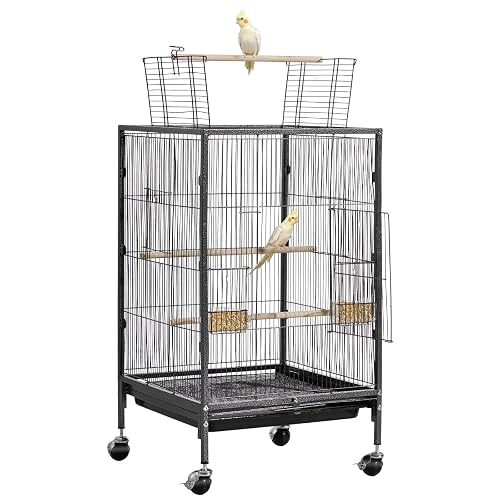
The best large parrot cages for 2026
The best large parrot cages for 2026
1. King's Cages 506 鈥?Best Overall Large Parrot Cage for Macaws and Cockatoos
King's Cages has been the benchmark for large parrot cages in North America for over 30 years, and the Model 506 鈥?also known as the Grand Macaw Mansion 鈥?is their flagship. The interior dimensions are 48" wide x 36" deep x 72" tall (exterior approximately 50" x 38" x 78" including the stand), providing 96 cubic feet of interior space for a macaw or large cockatoo to climb, flap, and explore. The cage is built from 5mm powder-coated wrought iron bars with 1" spacing 鈥?the sweet spot for macaw safety: wide enough for comfortable climbing, narrow enough that even an Umbrella cockatoo can't get its head through. The powder coating is a proprietary zinc-free, lead-free formula specifically tested for parrot safety. The cage arrives on a heavy-duty steel stand with four 3-inch locking casters that roll smoothly on hardwood, tile, and low-pile carpet.
The door system on the King's 506 is the best in the industry. The main door is 23" wide x 42" tall 鈥?large enough to step inside for cleaning 鈥?and uses a three-point locking system: a slide bolt, a twist-lock latch, and a carabiner clip hole for a padlock. A large macaw can manipulate a slide bolt with its tongue in under 60 seconds; it cannot operate a twist-lock or a carabiner. The three feeder doors (one front, two sides) are positioned at perch height and use the same secure latch design. The dome top opens flat to create a play-top area (great for the bird to perch on during supervised out-of-cage time), and the dome bars are reinforced with cross-bracing 鈥?unlike budget dome-top cages where the dome is structurally weak and bends if the bird hangs from it.
The tray system is equally well-designed. The bottom grate is 3/8" bar spacing (safe for large parrot feet) with a center support bar that prevents sagging under a 3-pound macaw's weight. The tray below is heavy-gauge stainless steel with a 1-inch raised lip 鈥?debris stays contained, and the smooth surface wipes clean in seconds. The seed guard is a 3-inch metal skirt that extends on all four sides, catching approximately 70% of flung food and feather debris. The cage includes two stainless steel feeder bowls (30 oz, heavy enough that a macaw can't flip them), two natural wood perches (manzanita, 1.5" diameter), and all assembly hardware. The cage requires two people to assemble 鈥?plan on 2-3 hours 鈥?and the instructions are clear photo-based diagrams. At $650-800, the King's 506 is a serious investment, but for a bird that will live 60+ years, it's the right cage.
Pros:
- 48" x 36" x 72" interior 鈥?96 cubic feet, full wing extension for even the largest macaws and cockatoos
- 5mm powder-coated wrought iron bars, 1" spacing 鈥?macaw-proof construction, safe bar gap
- Triple-locking door system 鈥?slide bolt + twist-lock + padlock point, escape-proof for even the smartest birds
- Stainless steel tray with raised lip 鈥?easy daily cleaning, debris containment
- Dome-top play area 鈥?additional supervised out-of-cage space, reinforced for climbing
- 3-inch locking casters on heavy-duty stand 鈥?smooth rolling on all surfaces
- 3 feeder doors with secure latches 鈥?reduces main door openings, less escape opportunity
- Includes stainless bowls, natural wood perches, and seed guard 鈥?ready to use out of the box
- 30+ year company track record 鈥?parts and replacement hardware available for every model
Cons:
- $650-800 鈥?premium priced, the most expensive powder-coated cage in this guide
- 250+ lbs assembled weight 鈥?requires two people to assemble and move
- Assembly is a 2-3 hour project 鈥?60+ bolts, needs a power drill with hex bit (manual allen wrench included but slow)
- Powder coating (not stainless steel) 鈥?will eventually chip after 10+ years of macaw abuse, requires touch-up
- Dome-top bars collect dust 鈥?harder to clean than flat-top cages
- Cage is too large to fit through standard 30" doorways assembled 鈥?will need to be partially disassembled to move rooms
Rating: 5/5 | Best For: Macaws, large cockatoos (Moluccan, Umbrella), multi-large-bird households, lifetime cage
2. A&E Cage Co. Extra Large Dome Top 鈥?Best Value Large Parrot Cage
A&E Cage Co. has been King's Cages' primary competitor for decades, and their Extra Large Dome Top (model 4032FL or 4824FL depending on retailer) delivers 80% of the King's 506 quality for roughly 60% of the price. The interior dimensions are 40" wide x 30" deep x 62" tall (the 4032FL) 鈥?slightly smaller than the King's 506 but still adequate for a single macaw or cockatoo that gets daily out-of-cage exercise. The bars are 4.5mm powder-coated wrought iron with 1" spacing 鈥?slightly thinner than King's (4.5mm vs 5mm), which matters for the largest macaws (Blue-and-Gold, Greenwing) but is adequate for African Greys, Amazons, and smaller cockatoos (Goffin's, Rose-breasted). The powder coating is bird-safe, zinc/lead-free, and well-applied with no visible drips or thin spots.
The A&E's stand-out feature is the play-top with a removable tray 鈥?the dome top has a perch and a sliding tray underneath that catches droppings during play-top time, preventing the bird from soiling the cage interior below. This is a genuinely useful feature for birds that spend supervised time on top of their cage. The main door is 20" x 36" with a two-point slide-bolt latch (adequate for Greys and Amazons, but we'd add a carabiner for macaws). The feeder doors are deep-set 鈥?6 inches from the cage exterior to the bowl holder 鈥?preventing the bird from reaching out and throwing bowls. The seed guard is a 2.5-inch acrylic skirt (not metal 鈥?lighter but less durable than King's metal skirt). At $400-500, the A&E Extra Large Dome Top is the best value large parrot cage on the market. If the King's 506 is out of budget, this is the next best thing.
Pros:
- 40" x 30" x 62" interior 鈥?adequate for single macaws and cockatoos with daily out-of-cage exercise
- Play-top with removable tray 鈥?convenient supervised out-of-cage time without soiling the interior
- $400-500 鈥?40% cheaper than the King's 506, excellent value for Greys and Amazons
- 4.5mm powder-coated bars with 1" spacing 鈥?adequate for most large parrots
- Deep-set feeder doors 鈥?prevents bowl-throwing, a common large parrot behavior
- Includes 2 stainless bowls, 2 wood perches, and acrylic seed guard
- Available at major retailers 鈥?Petco, Amazon, Chewy, easier to buy than King's (which is dealer-only)
Cons:
- 4.5mm bars 鈥?might not survive a determined Blue-and-Gold macaw over years, consider 5mm+ for largest species
- Slide-bolt latches (no twist-lock) 鈥?macaws can learn these, you'll need to add a carabiner or padlock
- Acrylic seed guard (not metal) 鈥?lighter duty, can crack if heavy toys fall on it
- Assembly hardware is lower quality 鈥?bolts are zinc-plated (not stainless), can rust in humid environments
- 40" width is borderline for a macaw 鈥?wing extension may touch bars, especially for Hyacinth macaws
- Caster quality is mediocre 鈥?small 2-inch wheels that bind on carpet, upgrade to aftermarket casters recommended
Rating: 4/5 | Best For: African Greys, Amazons, Eclectus, small cockatoos, budget macaw cage with daily out-of-cage time
3. Avian Adventures Stainless Steel Loro 鈥?Best Premium Stainless Steel Cage
The Avian Adventures Loro represents the absolute pinnacle of large parrot cage manufacturing 鈥?a cage built entirely from 304-grade stainless steel with 6mm solid bar construction, TIG-welded joints that are stronger than the bars themselves, and a price tag ($1,800-2,400) that reflects the materials and craftsmanship. This is a cage that will outlive your macaw 鈥?and likely you, too. The interior dimensions are 48" x 36" x 68", with 1-1/8" bar spacing. The entire structure 鈥?bars, tray, grate, seed guard, stand, and all hardware 鈥?is 304 stainless. There is no paint, no powder coating, no zinc, no plating 鈥?nothing that can chip, rust, corrode, or leach heavy metals. The tray is smooth (one-piece welded, no corners for bacteria to hide) and can be pressure-washed or steam-cleaned for veterinary-grade sanitation.
The Loro's design is distinctly European 鈥?clean lines, no dome top, no decorative scrollwork, just a rectilinear form that prioritizes function over ornament. The main door is a full 48" wide x 35" tall 鈥?half the front of the cage opens completely, allowing you to place large perches and toys without awkward angling. The door lock is a recessed two-stage mechanism that's completely inaccessible to the bird from inside the cage 鈥?parrots cannot touch it. The feeder doors use the same recessed design. The casters are medical-grade 3.5-inch stainless steel ball-bearing wheels with individual locks, rated for 800+ lbs. The tray slides out from a dedicated slot in the front, separate from the main door 鈥?you don't need to open the bird's cage to clean the tray. The Avian Adventures Loro is overkill for 99% of parrot keepers, but for breeders, rescue facilities, or the owner of a Hyacinth macaw (the most expensive pet bird on Earth), the investment is justified by longevity, sanitation, and absolute safety.
Pros:
- 100% 304 stainless steel construction 鈥?no coating to chip, ingest, or degrade, literally rust-proof forever
- 6mm solid bar construction, TIG-welded 鈥?joints are stronger than the bars, indestructible by any bird
- Recessed two-stage door lock 鈥?parrot can't touch it, escape-proof for the cleverest birds
- smooth one-piece stainless tray 鈥?veterinary-grade sanitation, pressure-washable, bacteria-resistant
- Separate tray access 鈥?clean the tray without opening the main bird door
- 48" x 36" x 68" interior 鈥?generous space for the largest macaws and cockatoos
- 3.5" medical-grade locking casters 鈥?magnificent rolling on all surfaces
- 30+ year expected lifespan 鈥?cheaper per-year than buying 3-4 powder-coated cages over a macaw's lifetime
Cons:
- $1,800-2,400 鈥?the most expensive cage in this guide by a factor of 3x, extreme initial investment
- 250+ lbs assembled, 300+ with accessories 鈥?extremely heavy, permanent placement recommended
- Assembly requires power tools and two people 鈥?3-4 hours, stainless hardware requires careful torque (don't cross-thread)
- No play-top or dome 鈥?rectilinear design, bird needs a separate play stand for out-of-cage recreation
- Industrial aesthetic 鈥?doesn't look like a "cage" in the traditional sense, more like veterinary equipment
- Lead time on orders 鈥?4-8 weeks, these are built to order, not warehouse-stocked
- Extreme overkill for African Greys or Amazons 鈥?these birds are not strong enough to damage a high-quality powder-coated cage
Rating: 5/5 | Best For: Hyacinth macaws, breeding facilities, rescue sanctuaries, owners seeking a lifetime cage, veterinary clinics
4. Prevue Pet Products Wrought Iron Macaw Cage 鈥?Best Entry-Level Macaw Cage Under $400
Prevue Pet Products occupies the budget entry point for large parrot cages, and their Wrought Iron Macaw Cage (model 3155 or 3155BLK) is the only cage in this guide that comes in under $400 while still providing the minimum acceptable dimensions for a single macaw. The interior measures 36" x 26" x 63" (note: width is 36", not 48" 鈥?this is the absolute minimum for a macaw). The bars are 4mm powder-coated wrought iron with 1" spacing 鈥?the bar gauge is the minimum acceptable for a Blue-and-Gold macaw; a Hyacinth or Greenwing would wear through these bars in months. The powder coating is bird-safe but thin 鈥?expect chipping within 3-5 years of daily macaw climbing and chewing. The door uses a simple slide-bolt latch 鈥?you must add a padlock for macaws.
The Prevue is the cage you buy when a large parrot unexpectedly joins your household 鈥?a rescue, a rehome, or an impulse purchase (we've all been there) 鈥?and you need a safe, adequate enclosure immediately while you save for a King's or Avian Adventures. It meets the minimum welfare requirements: the bird can turn around, spread its wings (barely 鈥?a large macaw's wingspan may touch the 36" width bars), climb, and access food and water. The tray and grate are standard painted metal (not stainless), the seed guard is a 2-inch plastic skirt, and the casters are 2-inch plastic wheels that work on hard surfaces but struggle on carpet. At $320-380, the Prevue is a temporary cage, not a lifetime home 鈥?but it keeps your bird safe while you budget for something permanent.
Pros:
- $320-380 鈥?the cheapest macaw-rated cage on the market with acceptable minimum dimensions
- 36" x 26" x 63" 鈥?meets minimum welfare requirements for a single large parrot
- 4mm powder-coated bars, 1" spacing 鈥?adequate for short-term use with most large parrots
- Lightweight (120 lbs) 鈥?can be assembled and moved by a single person
- Includes basic accessories 鈥?2 stainless bowls, 1 wood perch, plastic seed guard
- Available everywhere 鈥?Amazon, Petco, Chewy, Walmart, immediate shipping
- Simple slide-bolt door 鈥?easy for humans to operate (but easy for birds too, add a padlock)
Cons:
- 36" width 鈥?wing extension will likely touch bars for large macaws, borderline minimum
- 4mm bar gauge 鈥?minimum acceptable, Greenwings and Hyacinths will eventually damage bars
- Thin powder coating 鈥?expect chipping and rust within 3-5 years
- Slide-bolt latch only 鈥?not secure for macaws without a padlock added
- 2-inch plastic casters 鈥?bind on carpet, won't roll smoothly over thresholds
- Plastic seed guard and tray 鈥?less durable than metal, harder to sanitize
- Bottom grate bar spacing is wide 鈥?risk of foot entrapment for smaller large parrots (Greys, Senegals)
Rating: 3.5/5 | Best For: Temporary/emergency housing, rescue intake cages, budget save-up solution while planning a premium purchase
5. Yaheetech 69-Inch Wrought Iron Large Bird Cage 鈥?Best Budget Cage for African Greys and Amazons
Yaheetech has become the Amazon darling of budget bird cages, and their 69-inch Wrought Iron model is the best-selling large bird cage on the platform 鈥?over 15,000 reviews, 4.4 stars, and a price ($180-250) that seems too good to be true. Let's be clear about what this cage is and isn't. It is absolutely NOT a macaw cage 鈥?the 3.5mm bar gauge and 5/8" spacing are designed for medium parrots (African Greys, Amazons, Eclectus, cockatoos under 500g), and putting a macaw in this cage is both dangerous (bars will fail) and cruel (5/8" spacing is too narrow for macaw climbing comfort). For an African Grey or Amazon, however, this cage offers exceptional value: interior dimensions of 32" x 21" x 35" (top section), a 31-inch stand below (total height 69 inches), 3.5mm powder-coated bars with 5/8" spacing (the correct gap for a Grey or Amazon), a dome-top that opens into a play area, a slide-out tray, and 4 casters.
The Yaheetech's value proposition is compelling: for under $250, you get a functional, bird-safe enclosure for a medium-large parrot. The powder coating is bird-safe (zinc/lead-free per Amazon specification), the bar spacing is appropriate for Grey-sized feet and heads, and the included perches (dowel perches 鈥?not ideal, replace with natural wood) and bowls (plastic 鈥?replace with stainless) get you started. The cage is straightforward to assemble (one person, 60-90 minutes, allen wrench included). But manage your expectations: the bars are thin (a determined cockatoo will bend them), the latches are simple spring-loaded lift-tabs (an African Grey can open these within a week 鈥?add a twist-tie or clip), the plastic tray is flimsy and can crack if you bend it removing it for cleaning, and the casters are small plastic wheels that work on hard floors only. At this price point, the Yaheetech is a surprisingly good budget starter cage 鈥?but it's not a 10-year cage. Plan on replacing it within 4-6 years.
Pros:
- $180-250 鈥?the most affordable functional large bird cage on the market
- 32" x 21" x 35" (top) 鈥?adequate interior space for an African Grey, Amazon, or Eclectus
- 5/8" bar spacing 鈥?exactly right for medium-large parrot heads and feet
- Dome-top play area 鈥?bonus supervised out-of-cage perch space
- Easy assembly 鈥?one person, 60-90 minutes, clear instructions
- 15,000+ Amazon reviews 鈥?well-documented pros and cons, easy to research
- Includes basic perch and bowls 鈥?functional right out of the box
Cons:
- 3.5mm bar gauge 鈥?too thin for cockatoos or any bird that chews bars, insufficient for macaws
- Spring-loaded lift-tab latches 鈥?African Greys defeat these quickly, secure with zip ties or clips
- Plastic tray and bowls 鈥?cheap, less durable, harder to sanitize than stainless steel
- Included dowel perches 鈥?uniform diameter causes foot problems, replace with natural wood perches
- Small plastic casters 鈥?functional on hard floors only, don't roll on carpet
- 4-6 year expected lifespan 鈥?powder coat will chip, bars will bend, plan to replace within 5 years
- Not suitable for macaws or large cockatoos at all 鈥?do not put a macaw in this cage
Rating: 3.5/5 | Best For: Entry-level cage for African Greys and Amazons, budget starter cage, short-to-medium-term housing
6. Centurion Stainless Steel Double Macaw 鈥?Best Double-Wide Cage for Multi-Bird Households
When you have two large parrots that are bonded but need their own space 鈥?or one exceptionally active macaw that needs room to really move 鈥?the Centurion Stainless Steel Double Macaw ($1,500-1,900) is essentially two large cages joined into one. The total interior spans 72" wide x 36" deep x 72" tall, with a removable center divider that lets you use it as one enormous enclosure (144 cubic feet) or two side-by-side 36" enclosures. The construction is 5mm 304 stainless steel bars with 1-1/4" spacing, TIG-welded at every joint, with a powder-coated steel stand (the stand is powder-coated, not stainless, for cost savings). The double-wide footprint requires significant floor space 鈥?78" x 40" total including the seed guard 鈥?so measure carefully before ordering.
The Centurion's removable divider is what makes it special. With the divider in, you have two fully separated cages for birds that need their own space but benefit from adjacent social contact (many bonded pairs). With the divider out, you have the largest single parrot cage commercially available 鈥?a macaw can actually fly short distances inside this enclosure. Each half has its own main door, feeder doors, tray, and grate. The trays are heavy-gauge smooth stainless (one tray per side), and each side has its own seed guard. The casters are 3-inch ball-bearing stainless wheels rated for 1,000+ lbs combined. Assembly is substantial 鈥?two people, 4-5 hours, power drill required. This is a cage for dedicated parrot homes with dedicated parrot rooms.
Pros:
- 72" total width 鈥?largest commercially available single/double parrot cage
- Removable center divider 鈥?use as one super-enclosure or two side-by-side cages
- 5mm 304 stainless steel bars 鈥?construction quality for 30+ years of use
- TIG-welded joints 鈥?stronger than mechanically fastened cages of any material
- Dual independent tray and grate systems 鈥?clean one side without disturbing the other
- 3-inch ball-bearing stainless casters 鈥?industrial-grade mobility
- 144 cubic feet (divider out) 鈥?largest indoor flight space available in a commercial cage
Cons:
- $1,500-1,900 鈥?serious investment, second only to Avian Adventures in cost
- 78" x 40" footprint 鈥?requires a dedicated room or very large living space
- 360+ lbs assembled 鈥?permanent placement highly recommended, moving requires 3+ people
- 4-5 hour assembly 鈥?major project, requires power tools and patience
- Stainless bars but powder-coated stand 鈥?stand will eventually rust/chip, cage itself won't
- Lead time 6-10 weeks 鈥?custom build, not off-the-shelf
Rating: 4.5/5 | Best For: Multi-bird households, bonded pairs, single hyperactive macaws, avian sanctuaries
7. Prevue Hendryx Signature Series Playtop 鈥?Best Mid-Range Cage for African Greys
The Prevue Hendryx Signature Series Playtop (model SP42614) is the premium budget option for African Greys, Amazons, and similarly-sized parrots. It features a 32" x 23" x 65" interior (play-top model), 4mm powder-coated wrought iron bars with 3/4" spacing (the ideal gap for Grey-sized heads), and a thoughtfully designed play-top with two perches, two removable stainless bowls, and a sliding tray below. The bar spacing at 3/4" is notably narrower than the 1" spacing on macaw cages 鈥?this is exactly what you want for a Grey, as 1" spacing would allow a Grey's head to partially pass through. The powder coating is heavier and better-applied than the budget Prevue Macaw Cage 鈥?this is Prevue's "good" line, not their economy line. At $350-430, it's the sweet spot of quality and value for medium-large parrots.
The Signature Series distinguishes itself from budget cages with its hardware quality: stainless steel bolts (not zinc-plated), reinforced corner brackets, a two-stage latch system (slide bolt with a secondary friction catch), and ball-bearing casters that roll on carpet. The tray is a heavy-gauge plastic composite (not stainless but much better than budget plastic trays), and the grate is 3/8" bar spacing with a center support bar. The cage arrives in two boxes and assembles in about 2 hours with one person. For an African Grey or Amazon that's the primary household bird, the Prevue Signature Series is the best mid-range choice 鈥?significantly better than the $200 Yaheetech but not approaching the $800+ premium tier. It's a 10-12 year cage that your Grey will be comfortable in for its lifetime, as long as you're not dealing with an exceptional bar-chewer.
Pros:
- 32" x 23" x 65" 鈥?generous interior for African Greys and Amazons, full wing extension room
- 3/4" bar spacing 鈥?the correct gap for Grey-sized heads, safe and comfortable for climbing
- 4mm bar gauge, quality powder coat 鈥?better build than Prevue's economy line, 10+ year expected life
- Two-stage latch system 鈥?more secure than single slide bolts, adequate for Greys and Amazons
- Ball-bearing casters 鈥?roll smoothly on carpet, significant upgrade from plastic bushing casters
- Stainless hardware 鈥?bolts won't rust in humid environments, unlike zinc-plated budget hardware
- Play-top with sliding tray 鈥?convenient out-of-cage supervised time, droppings caught by tray
- $350-430 鈥?the best value in the $300-500 price range for medium-large parrots
Cons:
- Not for macaws or large cockatoos 鈥?3/4" bar spacing is too narrow, 4mm bars are too thin
- Plastic composite tray (not stainless) 鈥?adequate but not outstanding, will eventually scratch and stain
- Two-stage latches are good but not escape-proof 鈥?a determined Grey can still open these over time
- Play-top perches are dowel-style 鈥?replace with natural wood perches for foot health
- Grate bar spacing at 3/8" is borderline for Grey toes 鈥?small risk of toe entrapment for smaller-footed Greys
Rating: 4.5/5 | Best For: African Greys, Amazons, Eclectus, small cockatoos as a permanent mid-range cage
Comparison Table
| Product | Interior (W脳D脳H) | Bar Gauge | Bar Spacing | Material | Best For | Price |
|---|---|---|---|---|---|---|
| King's Cages 506 | 48" 脳 36" 脳 72" | 5mm | 1" | Powder-coated iron | Macaws, large cockatoos | $650-800 |
| A&E Extra Large Dome | 40" 脳 30" 脳 62" | 4.5mm | 1" | Powder-coated iron | Greys, Amazons, small cockatoos | $400-500 |
| Avian Adventures Loro | 48" 脳 36" 脳 68" | 6mm | 1-1/8" | 304 Stainless Steel | Hyacinth macaws, lifetime cage | $1,800-2,400 |
| Prevue Macaw (3155) | 36" 脳 26" 脳 63" | 4mm | 1" | Powder-coated iron | Budget macaw cage, temporary | $320-380 |
| Yaheetech 69" | 32" 脳 21" 脳 35" | 3.5mm | 5/8" | Powder-coated iron | Greys, Amazons, starter cage | $180-250 |
| Centurion Double Macaw | 72" 脳 36" 脳 72" | 5mm | 1-1/4" | 304 Stainless Steel | Multi-bird, bonded pairs | $1,500-1,900 |
| Prevue Signature Playtop | 32" 脳 23" 脳 65" | 4mm | 3/4" | Powder-coated iron | Greys, Amazons, mid-range | $350-430 |
Large Parrot Cage Setup Guide: Creating an Enriching Environment
How to properly set up and furnish a large parrot cage
How to properly set up and furnish a large parrot cage
- Perch Placement Strategy: Install at least 3-4 perches at different heights and orientations 鈥?never place perches directly above food and water bowls (droppings contamination). The highest perch should be at roughly 2/3 of the cage height 鈥?birds naturally seek the highest point, and placing perches all the way at the top causes them to hang from the ceiling bars, which is uncomfortable and can injure feet. Use natural wood perches of varying diameters (3/4" to 1-1/2" for large parrots) 鈥?the varying diameter exercises foot muscles and prevents pressure sores that develop from uniform dowel perches. Manzanita, dragonwood, and java wood are excellent. Include one rough-textured concrete or sand perch for natural nail and beak conditioning, but place it where the bird doesn't sleep (rough-textured perches cause foot irritation with prolonged contact)
- Toy Rotation System: Large parrots destroy toys rapidly 鈥?a macaw can demolish a $30 wooden toy in 2-3 days. Maintain a collection of 8-12 toys and rotate 3-4 into the cage per week, removing the previous set. This prevents toy boredom (a bored parrot is a feather-plucking parrot) and extends toy life. Include different toy types in each rotation: a foraging toy (treats hidden inside destructible material), a chew toy (soft wood blocks, palm leaf, cardboard), a puzzle toy (mechanical challenge with a food reward), and a foot toy (a small toy the bird can hold and manipulate). Never use toys with small parts that can be swallowed, bells with clappers that can be removed, or chain links that toes can catch in
- Food and Water Station: Use heavy stainless steel bowls (20-30 oz for large parrots) that can't be flipped 鈥?bowls should lock into holders on the cage bars, not sit loose on the floor. Position water bowls away from food bowls and perches to minimize contamination. Provide a separate bathing dish for birds that enjoy splashing (or use a cage-mountable shower perch for bathroom time). Never use water bottles with ball-bearing sippers for parrots 鈥?they can't get enough water volume from these and may dehydrate, and the ball mechanism can trap a beak. Change water twice daily 鈥?large parrots are champion soup-makers, dunking food in their water
- Substrate Management: Use cage liner paper or newspaper (black-and-white print only, no color ads 鈥?colored inks may contain toxic compounds) on the tray below the grate. Change paper daily 鈥?droppings accumulate fast with a large parrot. Avoid: corn cob bedding (grows mold and Aspergillus 鈥?fatal to parrots), walnut shell litter (dust causes respiratory issues), cedar or pine shavings (aromatic oils are toxic to avian respiratory systems), and cat litter (clumping or otherwise 鈥?ingestion risk). The safest option is plain, unprinted paper. For the floor area under and around the cage, a washable cage mat or vinyl floor protector saves your flooring from flung food and feather dander
- Lighting and Placement: Position the cage where the bird can see household activity (parrots are flock animals and need social contact) but not in direct line of kitchen fumes (Teflon/PTFE cookware off-gassing at high temperatures is deadly to birds 鈥?even in a different room, fumes travel through ventilation). Place the cage against at least one wall for security (birds feel exposed in open-center room positions). Provide a full-spectrum UVB/A bird lamp positioned 12-18 inches above the highest perch, on a timer for 10-12 hours of daylight. Avoid direct window placement 鈥?glass magnifies heat (can overheat the bird) and drafts cause respiratory stress
FAQ
Can I keep two macaws in one cage?
It depends entirely on the individual birds. Bonded pairs (birds that have lived together for years, mutually preen, and show no aggression) can share a cage if it's large enough 鈥?minimum 60" x 48" for two macaws. Unbonded birds of the same size in a cage together will almost certainly fight, and macaw fights are brutal 鈥?severed toes, broken beaks, and deaths occur regularly. Never "try it and see what happens" 鈥?introduce birds in neutral territory over weeks, watch for body language, and only co-house if they're clearly bonded. Even bonded pairs need their own food and water stations 鈥?competition over resources causes fights. A double-wide cage with a divider (like the Centurion) is safer than a single open cage for two birds.
Why is my parrot plucking its feathers? Is the cage too small?
Feather plucking has multiple potential causes, and inadequate cage space is a common one 鈥?but not the only one. A cage that's too small causes chronic stress, which can trigger plucking. But other causes include: malnutrition (vitamin A deficiency is a classic plucking trigger), hormonal imbalances (particularly in mature cockatoos), boredom and lack of foraging opportunities, insufficient sleep (parrots need 10-12 hours of darkness daily), skin parasites (mites), and underlying disease (liver, kidney, or respiratory). A larger cage is a good first step, but you need an avian veterinarian to run blood work and rule out medical causes. Behavioral plucking 鈥?once a bird has established the habit 鈥?is extremely difficult to reverse, and prevention (by providing adequate space and enrichment from day one) is vastly more effective than treatment.
Is a used cage safe? What should I check for?
Used cages can be excellent value 鈥?large parrot cages depreciate heavily on the secondhand market 鈥?but you must inspect for: (1) Rust 鈥?any rust on the bars, tray, or hardware, particularly in corners and weld points. Rust indicates that moisture has degraded the protective coating and the underlying iron is oxidizing. Rust patches are sharp (can cut feet and tongues) and the iron oxide can be toxic if consumed. Light surface rust on a tray is manageable; rust on the cage bars means the cage is at end of life. (2) Broken welds 鈥?inspect every bar junction. A single broken weld creates a flex point that the bird will find and exploit. Macaws can break additional welds once one has failed. (3) Chipped coating 鈥?powder coat chips near the bird's favorite perching spots (where they chew the bars). Chipped areas expose bare metal that will rust and that the bird can ingest. (4) Previous disease 鈥?thoroughly disinfect with a veterinary-grade cleaner (F10 SC or dilute bleach 1:10, thoroughly rinsed and fully dried for 24 hours before use). (5) Missing or damaged hardware 鈥?check that all casters lock, all feeder doors latch securely, and all bolts are present and tight.
Should I cover my parrot's cage at night?
Yes 鈥?for most large parrots, a cage cover provides the darkness and security needed for proper sleep. Parrots need 10-12 hours of uninterrupted darkness per night for hormone regulation, immune function, and behavioral health. A cage cover blocks ambient light (street lights, electronics, early sunrise) and reduces drafts. Use a breathable fabric (cotton, not polyester or nylon 鈥?birds can overheat under non-breathable covers). The cover should not touch the cage bars (brids may pull fabric through the bars and ingest threads). Never cover the cage during the day as a "punishment" for screaming 鈥?this creates negative associations with the cover and turns it into a stressor, not a comfort. Some parrots (particularly cockatoos) may be frightened by covers 鈥?if your bird shows distress (pacing, alarm calls) when covered, use a room-darkening solution instead (blackout curtains, moving the cage to a dark room at night).
Conclusion
Our large parrot cage recommendations for 2026
Our large parrot cage recommendations for 2026
For macaw and large cockatoo owners who want the best powder-coated cage money can buy 鈥?secure enough for a 500 PSI beak, spacious enough for full wing extension, and designed by a company with 30+ years of parrot cage expertise 鈥?the King's Cages Model 506 at $650-800 is the gold standard. The triple-locking door, 5mm bar gauge, stainless tray, and 96 cubic feet of interior space represent the highest expression of production parrot cage design.
For African Grey, Amazon, and Eclectus owners who want a permanent mid-range cage that balances quality and value, the Prevue Hendryx Signature Series Playtop at $350-430 offers the best combination of appropriate bar spacing (3/4"), adequate interior dimensions, quality hardware, and a functional play-top at a price that doesn't approach premium territory. It's a 10+ year cage for a Grey-sized parrot.
For owners of Hyacinth macaws, breeding facilities, or anyone building a true forever-home for the most demanding parrot on Earth, the Avian Adventures Stainless Steel Loro at $1,800-2,400 is an heirloom 鈥?a cage built entirely from 304 stainless steel with 6mm solid bar construction that will outlast the bird, the owner, and likely the next generation. It's an extreme investment that makes financial sense when you calculate the per-year cost over a macaw's 60+ year lifespan.
For rescue situations, unexpected rehomes, or budget-conscious new parrot owners, the A&E Extra Large Dome Top at $400-500 provides 80% of the King's 506 quality for 60% of the price 鈥?a genuinely good cage that will keep a macaw safe and comfortable for 8-12 years.
And for the owner of a new African Grey or Amazon who needs to get a functional cage immediately while saving for something better, the Yaheetech 69-Inch Wrought Iron Cage at $180-250 is the best of the budget options 鈥?appropriate bar spacing, adequate space, and bird-safe materials at a price that keeps the bird safely housed while you plan for the upgrade.
Your parrot's cage is not just a container. It's where your bird eats, sleeps, plays, and spends the majority of its hours for decades. Buy the biggest, strongest cage you can afford. Your parrot will thank you with a lifetime of companionship, play, and those moments when a creature that could bite through your finger chooses instead to gently preen your hair. That trust is earned 鈥?and it starts with a cage that respects what a large parrot is: intelligent, sensitive, powerful, and deserving of a home, not just an enclosure.
Related reading: Parrot Shower Perches & Bathing Accessories, Bird Cages for Parakeets, Cockatiels & Small Parrots, Parrot Playstands, Gym Trees & Activity Centers, Budgie & Parakeet Cages & Accessories, Bird Seed Mixes & Sprouting Seeds, Conure Cages & Accessories, Canary Cages 2026: Fine Living for Your Songbird, Finch Cages 2026: Perfect Homes for Small Songbirds, Cockatiel Cages 2026: Comfortable Spaces for Your Bird, Parrot Perches, Parrot Food and Bird Cages.
Affiliate Disclosure: PawCritic.com participates in the Amazon Services LLC Associates Program. We may earn commissions from qualifying purchases at no extra cost to you.
Where to Buy: Our Top Picks
As an Amazon Associate, PawCritic earns from qualifying purchases. This does not affect our reviews or recommendations.
Affiliate Disclosure: PawCritic is reader-supported. When you buy through links on our site, we may earn an affiliate commission at no extra cost to you. Learn more.